
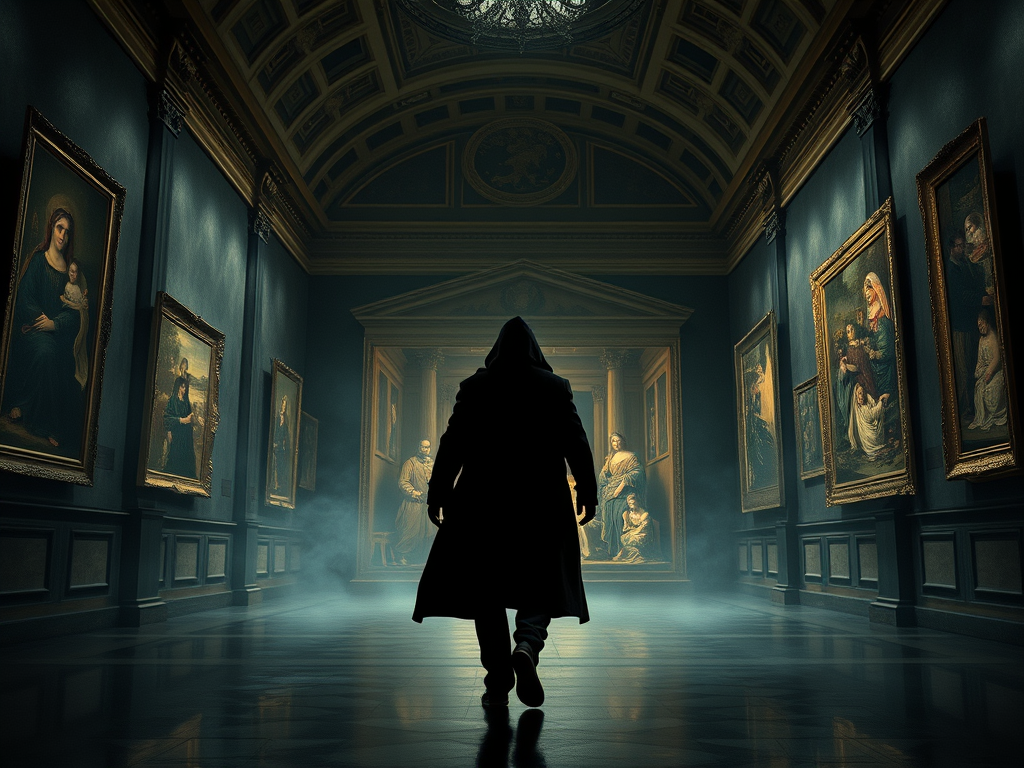
The world of fine art is one of beauty, culture, and immense value. But behind the serene facade of museums and galleries lies a shadow world of high-stakes crime. Art heists capture the public imagination like few other offenses; they are crimes of audacity, stealth, and mystery, often leaving behind bafflingly few clues. The stolen masterpieces vanish into the underworld, leaving empty frames and enduring questions. Despite decades of investigation by the world’s top law enforcement agencies, some of these audacious thefts remain completely unsolved, the priceless artworks lost and the culprits’ identities a secret. These are not just simple robberies; they are assaults on our shared cultural heritage. Join us as we delve into the murky depths of art crime to explore the top 10 unsolved art heists that continue to baffle investigators and intrigue the world.
10. The Daring Daylight Theft of the “Just Judges” Panel
The Ghent Altarpiece, a magnificent 15th-century polyptych by Hubert and Jan van Eyck housed in Saint Bavo Cathedral in Ghent, Belgium, is one of the most significant works in art history. It has also been one of the most frequently stolen, having been victimized multiple times over the centuries. But one of its panels, “The Just Judges,” vanished in a uniquely mysterious theft in April 1934 that remains unsolved. The panel was stolen overnight, with the thieves leaving a polite note in its place that read, “Taken from Germany by the Treaty of Versailles.”
This message kicked off a bizarre series of events involving a ransom demand of one million Belgian francs. The Bishop of Ghent entered into negotiations with the thief through a series of letters, and as a sign of good faith, the back of the stolen panel was returned. However, before the full ransom could be paid and the main painting recovered, the self-proclaimed thief, a stockbroker named Arsène Goedertier, suffered a fatal heart attack. On his deathbed, he dramatically declared that he was the only one who knew the location of the missing masterpiece and that the secret would go with him to his grave. Despite exhaustive searches based on clues left in his desk, the “Just Judges” panel has never been found. It has since been replaced by a meticulously painted replica, a constant reminder of the audacious crime and the secret that died in 1934.
9. The Disappearance of Caravaggio’s “Nativity” from a Sicilian Oratory
In October 1969, a masterpiece by the Italian Baroque painter Caravaggio, the “Nativity with St. Francis and St. Lawrence,” was crudely sliced from its frame in the Oratory of San Lorenzo in Palermo, Sicily. Painted in 1609, the work is considered one of Caravaggio’s most important and is valued at over $20 million. The theft was executed with brutal simplicity, leaving behind a gaping hole in the altarpiece and a mystery that has endured for over half a century. From the beginning, suspicion fell upon the Sicilian Mafia (Cosa Nostra), known for its involvement in art trafficking.
Over the years, the story of the painting’s fate has descended into a dark and conflicting legend. Numerous Mafia informants have offered tantalizing but often contradictory accounts. Some claimed the painting was frequently moved between farmhouses and hidden in barns, suffering significant damage from water and rodents. One particularly gruesome story, widely circulated but never confirmed, alleged that the priceless canvas was eaten by pigs. Another informant claimed it was displayed at important Mafia meetings as a symbol of power. Despite these fragments of information and periodic hopes of its recovery, the “Nativity” has never been seen again. Its absence represents a profound cultural loss, a masterpiece of light and shadow consumed by the darkness of organized crime.
8. The Concert: Vermeer’s Lost Masterpiece from the Gardner Museum
While the entire Isabella Stewart Gardner Museum heist is the stuff of legend (and holds our number one spot), the theft of Johannes Vermeer’s “The Concert” represents the single most valuable unrecovered painting in the world. Valued at over $250 million, this serene and intimate masterpiece was one of just 34 known paintings by the Dutch master, making its loss all the more devastating. The painting depicts a man and two women playing music in a sunlit room, a perfect example of Vermeer’s unparalleled skill with light, color, and quiet domesticity.
“The Concert” was stolen along with 12 other works in the infamous 1990 heist. The thieves, disguised as police officers, ripped the canvas from its frame, a brutal act that art historians still shudder to consider. Like the other stolen Gardner pieces, its whereabouts have been a complete mystery ever since. Theories have abounded: was it taken for a private collector, hidden by the IRA, or destroyed out of fear? The empty, ornate frame still hangs in its original spot in the Gardner Museum’s Dutch Room, a ghostly and powerful statement by the museum and a poignant memorial to the missing masterpiece. It serves as a daily, silent plea for the return of a work of art that is, by any measure, truly priceless.
7. The Brazen Heist at the Musée d’Art Moderne in Paris
In the early morning hours of May 20, 2010, a lone thief executed a remarkably simple yet devastatingly effective heist at the Musée d’Art Moderne in Paris. The culprit smashed a window, broke a padlock, and moved through the galleries completely undetected by the museum’s motion sensors, which had been malfunctioning for weeks. In a matter of minutes, he made off with five masterpieces of modern art, including Picasso’s “Le pigeon aux petits pois” and Matisse’s “La Pastorale.” The total value of the stolen works was estimated to be over €100 million.
The investigation eventually led to a suspect known as “Vjeran Tomic,” a notorious cat burglar dubbed “Spider-Man” for his ability to scale buildings. Tomic confessed to the theft but claimed he had only intended to steal a single painting by Fernand Léger. He said the alarm’s failure tempted him to take the other four iconic works as well. While Tomic and his accomplices who helped hide the paintings were eventually caught and sentenced, the story took a tragic turn. One of the accomplices claimed that in a moment of panic, he had thrown the five priceless paintings into a garbage container and that they were likely destroyed in an incinerator. Investigators have never been able to verify this claim, and many in the art world hold out hope that the story was a lie to protect a hidden buyer, and that the masterpieces may one day resurface.
6. The Vanishing Views of the Sea from the Van Gogh Museum
Vincent van Gogh’s paintings are among the most beloved and valuable in the world, making them a prime target for art thieves. In December 2002, two burglars used a simple ladder to climb onto the roof of the Van Gogh Museum in Amsterdam, smash a window, and descend into the main gallery. In a theft that took only a few minutes, they snatched two priceless early works: “View of the Sea at Scheveningen” (1882) and “Congregation Leaving the Reformed Church in Nuenen” (1884). Despite triggering the museum’s alarms, the thieves escaped down a rope before police could arrive.
The case remained cold for years. The thieves were eventually caught and convicted, but the paintings remained missing, believed to have vanished into the hands of organized crime. Then, in a stunning development 14 years later, in 2016, the artworks were discovered. Acting on a tip, Italian police raided a villa near Naples belonging to a notorious Camorra drug trafficking kingpin. There, wrapped in cotton sheets and hidden behind a wall in a bathroom, were the two missing Van Goghs, slightly damaged but largely intact. The recovery was a rare and celebrated victory in the fight against art crime, but the full story of the paintings’ 14-year journey through the European underworld remains a mystery.
5. The Bold Theft of the Munch Museum’s “The Scream”
Edvard Munch’s “The Scream” is one of the most iconic images in art history, a universal symbol of human anxiety. This fame has also made it a repeated target for thieves. In August 2004, two masked men armed with a handgun entered the Munch Museum in Oslo in broad daylight, in front of stunned tourists and staff. They simply walked up to the wall, tore the 1910 version of “The Scream” and another masterpiece, “Madonna,” from their wires, and walked out. The entire operation was shockingly brazen and over in less than a minute.
The theft sparked a massive international police investigation. For two years, the art world feared the fragile pastel-on-board paintings had been damaged or destroyed. Conspiracy theories flourished, suggesting the heist was carried out by a crime syndicate to distract police from other investigations. Fortunately, in 2006, Norwegian police announced they had recovered both paintings in a raid. While they had sustained some minor damage, including moisture stains and scratches, they were largely intact. The full details of the recovery and who the thieves were working for have been kept under wraps by authorities, leaving many aspects of this audacious daylight robbery a mystery. The convicted thieves have never revealed the mastermind behind the plot.
4. The Lost Duke of Wellington: Goya’s Stolen Portrait
In 1961, Francisco Goya’s “Portrait of the Duke of Wellington” made headlines when it was purchased by the British government to prevent it from being sold to an American collector. It was put on display at the National Gallery in London, a symbol of national heritage saved. Just 19 days later, it was stolen. The thief had apparently entered the museum through a bathroom window, evading the electronic security systems. The theft was a national embarrassment and sparked a massive manhunt.
What followed was a strange cat-and-mouse game. The thief began sending anonymous ransom notes, demanding not personal enrichment, but £140,000 to be donated to charity to pay for television licenses for the poor. The press had a field day with the “Robin Hood” art thief. For four years, the police were stumped. Then, in 1965, a 61-year-old unemployed bus driver named Kempton Bunton walked into a police station and confessed to the crime. He claimed he had simply walked out with the painting and returned it via a left-luggage office when he felt his charitable point had been made. He was tried but, in a surprising verdict, was acquitted of stealing the painting itself, as he argued he never intended to keep it. The full story of how an elderly man could so easily bypass security at a major museum remained somewhat fuzzy, a baffling and slightly comical chapter in the history of art heists.
3. The Curious Case of the Stolen Stradivarius
While not a painting, the “Davidoff-Morini” Stradivarius violin is a work of art so rare and valuable it commands prices in the millions. Crafted in 1727 by the legendary Antonio Stradivari, it was owned by the celebrated concert violinist Erica Morini. In October 1995, while the 91-year-old Morini lay dying in a New York hospital, the priceless instrument vanished from her locked Fifth Avenue apartment. There were no signs of forced entry, leading police to believe the thief was someone with access to the apartment and knowledge of the violin’s immense value.
The violin, valued at over $3.5 million at the time, has never been seen or heard from since. The FBI officially added it to its list of Top Ten Art Crimes, but the trail went cold almost immediately. A Stradivarius is nearly impossible to sell on the open market due to its fame and detailed documentation; each one is as unique and identifiable as a fingerprint. This has led to speculation that it was stolen to order for a wealthy, unscrupulous private collector who is content to simply possess it, never to be played or seen publicly again. The theft of the “Davidoff-Morini” Stradivarius remains one of the most frustrating and poignant mysteries in the art world, a silenced voice that may never be heard again.
2. The Great Cézanne Heist at Oxford’s Ashmolean Museum
On New Year’s Eve of 1999, as the world celebrated the dawn of a new millennium, thieves used the cover of the noisy festivities to carry out a meticulously planned heist. They cut a hole in the roof of the Ashmolean Museum in Oxford, England, dropped a smoke bomb to obscure security cameras, and descended by rope into the gallery below. Their target was a single, specific painting: Paul Cézanne’s “View of Auvers-sur-Oise.” Valued at around £3 million, the landscape is considered a pivotal work in the development of modern art.
The thieves ignored other valuable works in the gallery, indicating they were after this specific Cézanne. The professionalism and precision of the theft led investigators to believe it was a contract job, stolen to order for a specific buyer. Despite the painting’s fame and a worldwide alert issued through Interpol, it has never been recovered. The theft was a stark reminder that even with modern security, cultural treasures are vulnerable. The “View of Auvers-sur-Oise” remains on the FBI’s list of most-wanted stolen artworks, its whereabouts a complete mystery and its theft a perfectly executed crime that continues to baffle law enforcement.
1. The World’s Biggest Art Heist: The Isabella Stewart Gardner Museum
In the early hours of March 18, 1990, just after St. Patrick’s Day celebrations had wound down in Boston, two men dressed as police officers buzzed the security desk of the Isabella Stewart Gardner Museum. They claimed they were responding to a disturbance call. Against museum protocol, the young security guard let them in. In a matter of moments, the guards were overpowered, tied up, and left in the museum’s basement. The two thieves then had the entire museum to themselves for 81 minutes. They roamed the galleries and stole 13 priceless works of art, including three Rembrandts (including his only seascape, “The Storm on the Sea of Galilee”), a Vermeer (“The Concert”), a Manet, and five Degas sketches.
The total value of the stolen art is estimated to be over $500 million, making it the single largest private property theft in history. The thieves seemed to be strangely selective, leaving behind more valuable works and clumsily cutting the Rembrandt and Vermeer canvases from their frames. For over 30 years, the case has remained stubbornly unsolved. The FBI has pursued countless leads, focusing on Boston’s criminal underworld and suspected links to the IRA, but no arrests have ever been made and not a single piece has been recovered. The museum offers a $10 million reward for information leading to the art’s return, and the empty frames still hang in the galleries, a haunting memorial to the greatest art heist the world has ever seen.
Further Reading
For those captivated by the audacious world of art crime, here are several books that provide a deeper look into these fascinating and frustrating cases:
- “The Gardner Heist: The True Story of the World’s Largest Unsolved Art Theft” by Ulrich Boser
- “The Art of the Steal: Inside the Sotheby’s-Christie’s Auction House Scandal” by Christopher Mason
- “The Forger’s Spell: A True Story of Vermeer, Nazis, and the Greatest Art Hoax of the Twentieth Century” by Edward Dolnick
- “Priceless: How I Went Undercover to Rescue the World’s Stolen Treasures” by Robert K. Wittman and John Shiffman
- “The Rescue Artist: A True Story of Art, Thieves, and the Hunt for a Missing Masterpiece” by Edward Dolnick
Here at Zentara.blog, our mission is to take those tricky subjects and unlock them, making knowledge exciting and easy to grasp for everyone. But the adventure doesn’t stop on this page! We’re constantly exploring new frontiers and sharing discoveries across the digital universe. Want to dive deeper into more mind-bending Top 10s and keep expanding your world? Come join us on our other platforms – we’ve got unique experiences waiting for you on each one!
Get inspired by visual wonders and bite-sized facts: See the world through Zentara’s eyes on Pinterest!
Pin our fascinating facts and stunning visuals to your own boards. Explore Pins on Pinterest: https://uk.pinterest.com/zentarablog/
Discover quick insights and behind-the-scenes peeks: Hop over to Tumblr for snippets, quotes, and unique content you won’t find anywhere else. It’s a different flavour of discovery! Follow the Fun on Tumblr: https://www.tumblr.com/zentarablog
Ready for deep dives you can listen to or watch? We’re bringing our accessible approach to video and potentially audio! Subscribe to our YouTube channel and tune into future projects that make learning pop! Subscribe on YouTube: https://www.youtube.com/@ZentaraUK
Seeking even more knowledge in one place? We’ve compiled some of our most popular topic deep dives into fantastic ebooks! Find them on Amazon and keep the learning journey going anytime, anywhere. Find Our Ebooks on Amazon: https://www.amazon.co.uk/s?k=Zentara+UK&ref=nb_sb_noss
Connect with us and fellow knowledge seekers: Join the conversation on BlueSky! We’re sharing updates, thoughts, and maybe even asking you what wonders we should explore next. Chat with Us on BlueSky: https://bsky.app/profile/zentarablog.bsky.social
Perfect for learning on the move! We post multiple 10-minute podcasts per day on Spotify. Pop on your headphones and fill your day with fascinating facts while you’re out and about! Listen on Spotify: https://open.spotify.com/show/3dmHbKeDufRx95xPYIqKhJFollow us on Instagram for bytesize knowledge! We post multiple posts per day on our official Instagram account. https://www.instagram.com/zentarablog/ Every click helps us keep bringing honest, accessible knowledge to everyone. Thanks for exploring with us today – see you out there in the world of discovery!




Leave a Reply