
Table of Contents
For generations of children, seeing the backwards “R” in the Toys “R” Us logo was enough to trigger a dopamine rush. It wasn’t just a store; it was a pilgrimage site. It was the place where holiday wish lists were born, where you could race down aisles of bicycles, and where the sheer volume of action figures and dolls felt infinite. From the catchy jingle that promised eternal youth to the friendly face of Geoffrey the Giraffe, Toys “R” Us was a cultural monolith that defined the American childhood experience for decades.
However, the story of this retail giant is far more complex than just shelves stocked with Barbies and LEGOs. It is a saga of brilliant innovation, ghostly legends, corporate warfare, and a tragic financial collapse that had little to do with selling toys. Did you know the company started by selling cribs, not toys? Or that one of its most famous locations was legally declared “haunted” by psychics? The rise and fall—and recent zombie-like revival—of Toys “R” Us is a fascinating case study in business and nostalgia.
Whether you were a “Toys ‘R’ Us Kid” yourself or just remember the heartbreaking images of empty stores in 2018, these secrets reveal the history behind the world’s greatest toy store.
Here are 10 interesting facts you didn’t know about Toys “R” Us.
1. It Started as a Furniture Store Called “Children’s Bargain Town”
Before the toys, there were cribs. It is hard to imagine the colorful chaos of Toys “R” Us starting as a staid furniture showroom, but that is exactly how it began. In 1948, a 25-year-old World War II veteran named Charles Lazarus opened a store in Washington, D.C., called “Children’s Bargain Town.” Lazarus was anticipating the post-war Baby Boom and initially sold only baby furniture like cribs, strollers, and high chairs.
The pivot to toys was purely accidental. Customers buying cribs would ask if he sold toys to keep the babies occupied. Lazarus added a few rattles and stuffed animals to his inventory and noticed something crucial: parents only bought a crib once, but they came back for toys constantly as the child grew and broke things. Realizing the “repeat customer” potential was far higher in entertainment than in furniture, he slowly shifted his focus. By 1957, he opened his first dedicated toy supermarket and renamed it Toys “R” Us, with the backwards “R” designed to look like a child’s handwriting.
2. Geoffrey the Giraffe Was Originally Named “Dr. G. Raffe”
The mascot had a medical degree before he became a star. Geoffrey the Giraffe is one of the most recognizable corporate mascots in history, but he went through a significant identity crisis before finding his fame. In the 1950s, during the Children’s Bargain Town era, the mascot was a more realistic, somewhat academic-looking giraffe named “Dr. G. Raffe.”
The character was originally used in print advertisements to sell the store’s “prescriptions” for happy children—i.e., toys. When the brand officially became Toys “R” Us, the character was rebranded. He lost the medical title, became more anthropomorphic, and was eventually renamed Geoffrey. Over the decades, Geoffrey’s design evolved from a cartoon to a live-action suit, and even to an animatronic figure voiced by Jim Hanks (Tom Hanks’ younger brother). His family also expanded and contracted; at one point in the 80s and 90s, he had a wife named Gigi and two children, who were quietly retconned out of existence in later marketing campaigns to keep the focus on Geoffrey.
3. They Invented the “Category Killer” Business Model
The strategy that destroyed mom-and-pop shops. Long before Walmart or Home Depot dominated their respective markets, Toys “R” Us pioneered the concept of the “Category Killer.” In the 1950s and 60s, toys were primarily sold in small local shops or the seasonal departments of general stores. There was no such thing as a massive supermarket dedicated exclusively to one category of goods year-round.
Charles Lazarus changed retail history by building massive warehouses stocked with an overwhelming variety of a single type of product: toys. By buying in massive bulk directly from manufacturers, he could negotiate lower prices than any small store could match. He then sold these toys at steep discounts, driving the smaller competitors out of business. This “supermarket for toys” model was revolutionary and became the blueprint for future giants like Best Buy, Staples, and Barnes & Noble. Ideally, you could walk in and find every toy currently made, a promise that no other retailer could make at the time.
4. The “I Don’t Want to Grow Up” Jingle Was Written by a Thriller Novelist
A catchy tune with a surprising literary connection. If you grew up in the 80s or 90s, you can sing the Toys “R” Us jingle by heart. “I don’t want to grow up, I’m a Toys ‘R’ Us kid” is one of the most successful earworms in advertising history. The jingle was written in 1982 by Linda Kaplan Thaler and James Patterson. Yes, that James Patterson—the man who would go on to become the world’s best-selling author of thriller novels like Alex Cross and Women’s Murder Club.
At the time, Patterson was a junior copywriter at the J. Walter Thompson advertising agency. The jingle was designed to appeal to both children and parents, framing the refusal to grow up as a joyful celebration of play. It worked brilliantly, becoming the brand’s anthem for decades. The original commercials featured future stars like Jaleel White (Steve Urkel) and Jenny Lewis, cementing the song’s place in pop culture history alongside the “Big Mac” song and the Folgers theme.
5. The Times Square Flagship Had an Indoor Ferris Wheel
The ultimate tourist trap for kids. In 2001, Toys “R” Us opened a flagship store in New York City’s Times Square that was less a retail outlet and more a theme park. Spanning 110,000 square feet, it was the largest toy store in the world. Its centerpiece was a functioning 60-foot indoor Ferris wheel that rose through the center of the store’s multi-story atrium. Each car on the wheel was themed after a different toy brand, such as LEGO, Barbie, or Nickelodeon.
But the spectacle didn’t stop there. The store also housed a 20-foot tall animatronic T-Rex from Jurassic Park that would roar and move at shoppers, a life-sized Barbie dollhouse you could walk through, and a massive LEGO skyline of New York. It was a destination that attracted millions of tourists a year. Tragically, the store closed in 2015 due to rising rent costs—reportedly reaching $42 million a year—marking the beginning of the end for the brand’s dominance in the physical retail space.
6. The Sunnyvale Store Was Legally “Haunted”
Meet Johnny, the ghost of Aisle 4C. One of the strangest chapters in the company’s history involves the Toys “R” Us in Sunnyvale, California. For decades, employees and customers reported bizarre phenomena: toys flying off shelves, faucets turning on by themselves, and the feeling of being watched. The legend became so prominent that the TV show That’s Incredible! investigated the store in the 1980s, bringing in psychics and conducting séances.
The story goes that the store was built on the site of an old farm where a man named “Johnny” had bled to death after a woodchopping accident in the 1880s, having lost the love of his life to another man. Employees claimed Johnny was a playful spirit who would roam the aisles, specifically Aisle 4C. The legend was so widely accepted that it is one of the few times a major corporate chain has tacitly acknowledged a haunting, with managers often warning new hires about Johnny’s pranks. The location is now an REI, but locals still whisper that the ghost remains, perhaps confused by the sudden abundance of camping gear.
7. They Owned Their Biggest High-End Rival, FAO Schwarz
If you can’t beat them, buy them. FAO Schwarz was the antithesis of Toys “R” Us. While Toys “R” Us was a discount warehouse with concrete floors, FAO Schwarz was a luxury experience with doormen, high prices, and exclusive European toys. It was the store featured in the movie Big with the giant piano. However, as the retail landscape shifted, the high-end toy market struggled.
In 2009, Toys “R” Us acquired FAO Schwarz, effectively monopolizing the dedicated toy retail market in the United States. For several years, Toys “R” Us sold a line of “FAO Schwarz” branded toys in their standard stores, trying to bring a touch of prestige to their discount aisles. This merger was meant to save the luxury brand, but it ultimately failed to stop the bleeding. Toys “R” Us eventually closed the iconic FAO Schwarz Fifth Avenue store in 2015, ending an era of luxury toy retail in New York City until the brand was sold again and revived by a new owner years later.
8. The Company Was Destroyed by Wall Street, Not Just Amazon
The myth of the “Retail Apocalypse.” The common narrative is that Toys “R” Us died because everyone started buying toys on Amazon. While e-commerce certainly hurt, the true cause of death was financial engineering. In 2005, Toys “R” Us was taken private in a “leveraged buyout” by three firms: KKR, Bain Capital, and Vornado Realty Trust.
In a leveraged buyout, the purchasers use a massive amount of borrowed money to buy the company, and then transfer that debt onto the company’s own books. Almost overnight, Toys “R” Us went from having manageable liabilities to owing billions of dollars. For the next decade, the company had to spend roughly $400 million every year just to pay the interest on this debt. This was money that could have been used to update their stores, improve their website, or offer better prices. Instead, it went to Wall Street creditors. The company was actually still profitable on an operating basis when it filed for bankruptcy in 2017, but the debt load made it impossible to survive a bad holiday season.
9. They Had a Massive Private Label Empire
Imaginarium, Animal Alley, and the hidden profits. While kids came for the LEGOs and Hot Wheels, Toys “R” Us made a significant portion of its profit from its own “private label” brands. These were toys manufactured directly for the store, bypassing the major brands like Mattel or Hasbro. If you grew up in the 90s or 2000s, you likely owned toys from Imaginarium (educational wooden toys), Animal Alley (giant plush stuffed animals), Fast Lane (RC cars), or You & Me (dolls).
These brands allowed the company to control the quality and, more importantly, the profit margins. Imaginarium in particular was a beloved brand that the company acquired and expanded, becoming a staple for parents who wanted “smart” toys that didn’t require batteries. These exclusive lines were a key differentiator; you could buy a Barbie at Walmart, but you could only get that specific 4-foot-tall Animal Alley teddy bear at Toys “R” Us.
10. The Brand Is Making a “Zombie” Comeback Inside Macy’s
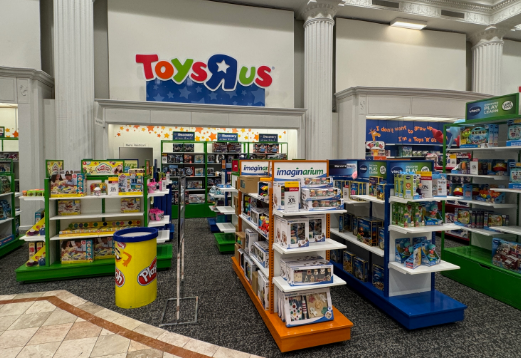
You can’t keep a good giraffe down. After closing all its US stores in 2018, it seemed Toys “R” Us was gone for good. However, the brand proved too valuable to die. A new entity called WHP Global acquired the rights to the brand and launched an ambitious revival strategy. Instead of opening massive, expensive warehouses again, they partnered with department store giant Macy’s.
As of 2022, Toys “R” Us “shops” have opened inside over 400 Macy’s locations across America. These aren’t just shelf sections; they are branded areas featuring Geoffrey, demo tables, and the classic colorful signage. It is a “store-within-a-store” concept designed to capture the nostalgia of the brand without the crushing overhead of maintaining 40,000-square-foot buildings. While it isn’t quite the same as the cavernous superstores of the past, it means that a new generation of kids can still technically be “Toys ‘R’ Us kids,” proving that the brand has more than one life.
Further Reading
- Toys “R” Us: The Rise and Fall of a Retail Giant by History of Gear (A concise business history).
- Retail Gangster: The Insane, Real-Life Story of Crazy Eddie by Gary Weiss (Provides context on the wild retail era of the 80s/90s).
- The United States of Nostalgia: The Retrospective Age by Grafton Tanner (Explores why we cling to brands like TRU).
- Failure to Adapt: How the Retail Apocalypse is Changing the Way We Shop by David S. Kidder.
Keep the Discovery Going!
Here at Zentara, our mission is to take tricky subjects and unlock them, making knowledge exciting and easy to grasp. But the adventure doesn’t stop at the bottom of this page. We are constantly creating new ways for you to learn, watch, and listen every single day.
Watch & Learn on YouTube
Visual learner? We publish 4 new videos every day, plus breaking news shorts to keep you smarter than the headlines. From deep dives to quick facts, our channel is your daily visual dose of wonder.
https://www.youtube.com/@ZentaraUK
Listen on the Go on Spotify
Prefer to learn while you move? Tune into the Zentara Podcast! We drop a new episode daily, perfect for your commute, workout, or coffee break. Pop on your headphones and fill your day with fascinating facts.
Every click, view, and listen helps us keep bringing honest knowledge to everyone. Thanks for exploring with us today—see you out there in the world of discovery!
Leave a Reply