
Table of Contents
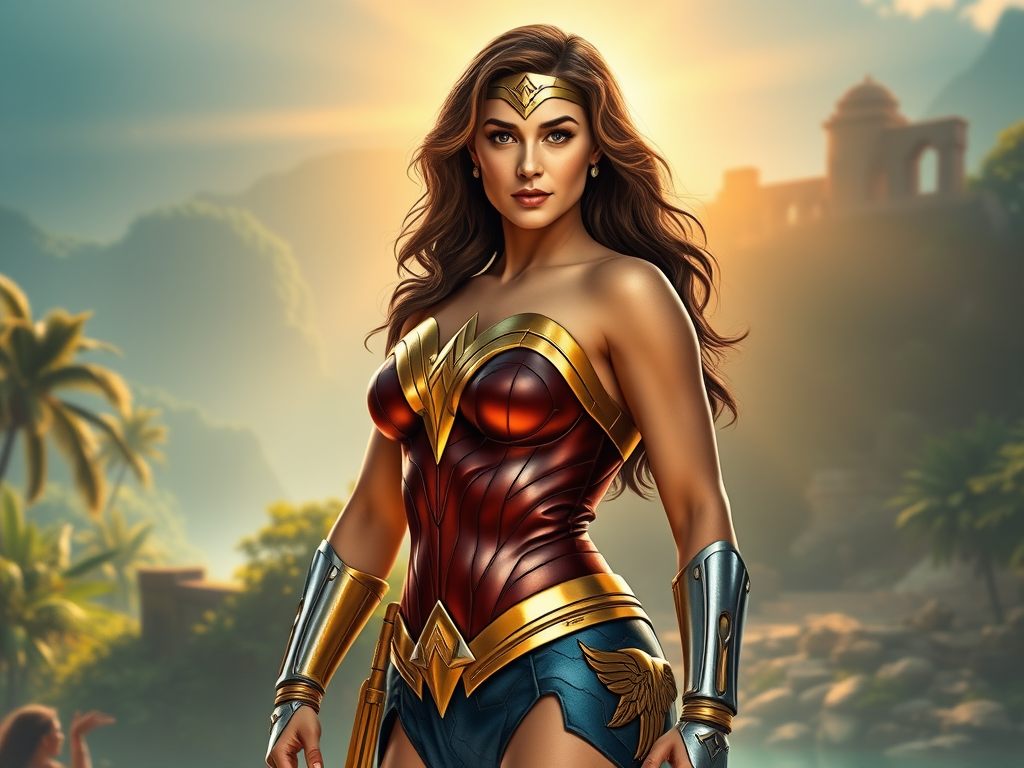
She is the Princess of Themyscira, the Daughter of Zeus, and the greatest warrior in the DC Universe. Alongside Superman and Batman, Wonder Woman forms the “Holy Trinity” of comic books—a pillar of strength, compassion, and divine power. Since her debut in All Star Comics #8 in 1941, Diana Prince has been more than just a superhero; she has been a feminist icon, a war-time propaganda figure, a mod fashionista, and a diplomat for peace in a world obsessed with conflict.
However, the history of Wonder Woman is far more eccentric and psychologically complex than her modern movie appearances might suggest. Unlike Batman, who was born from pulp noir, or Superman, who was born from sci-fi optimism, Wonder Woman was born from psychology and unconventional romance. Her comic book journey is paved with bondage imagery, radical feminist theory, strange weaknesses, and drastic retcons that have rewritten her origin more times than perhaps any other hero.
Prepare to traverse the mists of Paradise Island and uncover the secrets of the Amazons. Here are 10 facts about the comic book history of Wonder Woman that reveal the fascinating truth behind the Golden Lasso.
1. Created by the Inventor of the Lie Detector
The origin of Wonder Woman begins not with a comic book writer, but with a Harvard-educated psychologist named William Moulton Marston. Marston was a fascinating and controversial figure who is credited with inventing the systolic blood pressure test—a key component of the modern polygraph, or lie detector. He believed that women were morally superior to men and that society would only find peace when women ruled.
Marston didn’t create Diana alone. His inspiration came from the two women he lived with in a polyamorous relationship: his wife, Elizabeth Holloway Marston, and his former student, Olive Byrne. It was Elizabeth who suggested that his new superhero should be a woman, and it was Olive’s heavy silver bracelets that inspired Wonder Woman’s iconic bulletproof wristbands. This “polycule” lived together, raised children together, and kept their lifestyle a secret from the conservative 1940s public. Wonder Woman was the fictional vessel for Marston’s psychological theories about the power of female love and submission, making her arguably the most intellectually charged superhero creation of the Golden Age.
2. The Golden Age “Bracelets of Submission” Weakness
In modern comics and films, Wonder Woman is nearly invulnerable, often standing toe-to-toe with Doomsday or Darkseid. However, in her original Golden Age incarnation, she had a bizarre and very specific weakness known as Aphrodite’s Law. According to this rule, if an Amazon’s “Bracelets of Submission” were chained together by a man, she would lose all her super-strength and Amazonian powers.
This plot device was used constantly in the 1940s stories. Villains would frequently manage to weld or chain her wrists together, rendering her helpless until she could use her wits to escape. Marston included this not just to add dramatic tension, but to reinforce his psychological theory that submission to a loving authority was noble, but forced submission to tyranny (represented by the villains) was the ultimate evil. It was a metaphorical representation of the patriarchal chains that women had to break. While this weakness has long since been retconned out of continuity, it remains a fascinating look at the allegorical nature of early comic storytelling.
3. The Prevalence of Bondage Imagery
If you flip through a stack of 1940s Wonder Woman comics, you will notice a startling trend: Diana is tied up. A lot. She is bound with ropes, chains, lassos, and straps in almost every single issue. This wasn’t an accident, nor was it merely the result of villains trying to capture her. It was a deliberate choice by William Moulton Marston that has sparked debate for decades.
Marston believed that “loving submission” was the secret to a happy society. He felt that the imagery of a powerful woman being bound, and then breaking free, was empowering. However, he also admitted in private letters that the bondage themes had an erotic subtext, serving as a way to make the character appealing to male readers while slipping in feminist ideology. The sheer volume of bondage imagery eventually drew the ire of the Editorial Advisory Board at DC Comics, who were concerned about the sexual undertones. Today, this aspect of her history is studied by scholars as a unique intersection of kink, psychology, and early 20th-century feminism.
4. She Was the Secretary of the Justice Society
Despite being one of the most powerful heroes in the DC Universe, Wonder Woman faced significant sexism within the pages of the comic books themselves. When the Justice Society of America (the precursor to the Justice League) was formed in the 1940s, Wonder Woman was included as a member. However, while Hawkman, Dr. Fate, and the Green Lantern went off to fight Nazis and monsters, Wonder Woman was often left behind.
Her official title in the team was Secretary. In All Star Comics #13, the men actually tell her to stay at headquarters to type up the minutes of the meeting while they go on the mission. This was partly due to a confusing editorial rule: at the time, characters who had their own solo comic titles (like Flash, Green Lantern, and Wonder Woman) were only “honorary” members of the JSA to promote the lesser-known characters. However, while Flash and Green Lantern were eventually written out of the team meetings, Wonder Woman was kept around specifically to do the administrative work, a stark reflection of the gender roles of the era.
5. The Clay vs. Zeus Origin Controversy
For over 70 years, Wonder Woman’s origin was unique among superheroes: she had no father. The classic story, established in her debut and solidified by George Pérez in the 1980s, was that her mother, Queen Hippolyta, yearned for a child. Hippolyta sculpted a baby out of clay from the shores of Themyscira, and the Greek goddesses (specifically Aphrodite, Athena, and others) breathed life into the sculpture, gifting her with powers. She was literally “born of clay.”
This changed controversially in 2011 with DC’s “New 52” reboot. Writer Brian Azzarello retconned her origin to reveal that the “clay story” was a lie told to protect her. In reality, she was the biological daughter of Hippolyta and Zeus, the King of the Gods. This made her a demigod, akin to Hercules. While this added a layer of divine drama and integrated her more deeply into the Olympian pantheon wars, many purists hated the change. They felt it undermined the feminist significance of her creation—that she was a woman born solely of women, owing nothing to a patriarch. The “clay vs. biology” debate continues to be a point of contention in the fanbase.
6. The “Mod” Era and I Ching
The late 1960s were a strange time for comics, as publishers tried desperately to stay relevant with the changing youth culture. In 1968, Wonder Woman underwent her most radical transformation ever. In a storyline influenced by the spy craze (think James Bond and The Avengers TV show), Diana renounced her powers to stay on Earth when the Amazons retreated to another dimension.
Stripped of her costume and abilities, she opened a boutique in Greenwich Village and began wearing white jumpsuits and mod fashion. She learned martial arts from a blind mentor named I Ching and fought crime as a non-powered secret agent. This era, often called the “Diana Prince” era, was intended to make her a modern, independent woman. However, feminist icon Gloria Steinem, who grew up reading the original comics, was horrified. She argued that stripping Wonder Woman of her powers wasn’t feminist; it was disempowering. Steinem put the classic, costumed Wonder Woman on the cover of the first issue of Ms. magazine in 1972, lobbying DC to return Diana to her Amazonian glory—which they eventually did.
7. The Introduction of Nubia
Decades before the concept of a “multiverse” of heroes became mainstream, Wonder Woman’s lore introduced a powerful counterpart. In 1973, Wonder Woman #204 introduced Nubia, a Black Amazon warrior who claimed to be the “real” Wonder Woman. In a fascinating twist on the clay origin, it was revealed that Hippolyta had formed two babies from clay: one from light clay (Diana) and one from dark clay (Nubia).
Nubia was stolen by Mars (the God of War) and raised on a floating island, only to return and challenge Diana for the title. The two fought to a draw, eventually realizing they were sisters. Nubia is historically significant as DC’s first Black female superhero character. While she was underutilized for many years, often relegated to the background, modern comics have revitalized her character. As of recent storylines, Nubia has even served as the Queen of the Amazons and officially holds the title of Wonder Woman alongside Diana, finally receiving the recognition she deserves as an equal rather than a sidekick.
8. She Became the God of War
Wonder Woman is often described as the Ambassador of Peace, but her methods are far more pragmatic than Superman’s or Batman’s. She is a trained warrior willing to use lethal force if necessary. This duality reached its peak during the New 52 run when she did the unthinkable: she killed her mentor, Ares, the God of War.
But in the magical logic of Olympus, “you keep what you kill.” By slaying Ares, Diana physically absorbed the mantle, becoming the new God of War. This wasn’t just a title; it came with new powers, including telepathic control over soldiers and the ability to raise armies of the dead. It created a fascinating internal conflict for the character. How can the Ambassador of Peace also be the embodiment of War? This storyline explored the idea that war is a burden that must be managed by someone with compassion, rather than someone who revels in bloodshed.
9. She Was Worthy of Mjolnir
In the 1996 crossover event DC vs. Marvel, the two publishing giants pitted their heroes against one another. In one of the battles, Wonder Woman was paired against Marvel’s Storm (of the X-Men). Before the fight, Diana stumbled upon Thor’s hammer, Mjolnir, which had been lost in the chaos.
She picked it up, and to no one’s surprise, she was found worthy. The power of Thor flowed through her, granting her immense lightning abilities and increasing her already god-like strength. She could have easily obliterated Storm. However, in a moment that perfectly encapsulates her character, Diana looked at the hammer and decided it would be an unfair advantage. She dropped Mjolnir, choosing to fight Storm based on her own skills alone. Unfortunately, Storm then blasted her with lightning and won the fight (the outcome was voted on by fans), but the moment proved Diana’s integrity and worthiness famously transcend universe boundaries.
10. The Lasso of Truth Retcon
The Lasso of Truth is Wonder Woman’s most famous tool, a golden rope that forces anyone bound by it to tell the truth without deception. Most fans assume this has always been its function. However, in the original Marston comics, the lasso didn’t strictly compel truth; it compelled obedience.
In the Golden Age, anyone caught in the lasso was forced to obey Wonder Woman’s commands. While “tell me the truth” was a common command, she could also use it to order villains to stop fighting, forget information, or even change their clothes. It was a tool of absolute control, tying back to Marston’s psychological theories of dominance. It wasn’t until the Post-Crisis reboot in 1986, helmed by artist and writer George Pérez, that the lasso was explicitly defined as a magical artifact forged from the Girdle of Gaea that specifically burned away lies and revealed the soul’s truth. This shift turned the weapon from a device of control into a device of revelation, aligning perfectly with her role as a seeker of truth.
Further Reading
To better understand the Amazon Princess and her evolution through the decades, these graphical tomes are essential:
- “Wonder Woman: The Golden Age Omnibus Vol. 1” by William Moulton Marston and H.G. Peter – The original, bizarre, and fascinating stories from the 1940s that started it all.
- “Wonder Woman: Gods and Mortals” by George Pérez – The definitive 1987 reboot that established the modern, mythological take on the character and her supporting cast.
- “The Secret History of Wonder Woman” by Jill Lepore – A non-fiction book that dives deep into the life of creator William Moulton Marston, his polyamorous family, and the feminist origins of the character.
- “Wonder Woman: Blood” (New 52 Vol. 1) by Brian Azzarello and Cliff Chiang – A gritty, horror-tinged reimagining of the Greek pantheon that introduces the controversial Zeus origin.
- “Wonder Woman: Earth One” by Grant Morrison and Yanick Paquette – A modern graphic novel that revisits the themes of submission and female authority with a provocative, contemporary lens.
Here at Zentara.blog, our mission is to take those tricky subjects and unlock them, making knowledge exciting and easy to grasp for everyone. But the adventure doesn’t stop on this page! We’re constantly exploring new frontiers and sharing discoveries across the digital universe. Want to dive deeper into more mind-bending Top 10s and keep expanding your world? Come join us on our other platforms – we’ve got unique experiences waiting for you on each one!
Get inspired by visual wonders and bite-sized facts: See the world through Zentara’s eyes on Pinterest!
Pin our fascinating facts and stunning visuals to your own boards. Explore Pins on Pinterest: https://uk.pinterest.com/zentarablog/
Discover quick insights and behind-the-scenes peeks: Hop over to Tumblr for snippets, quotes, and unique content you won’t find anywhere else. It’s a different flavour of discovery! Follow the Fun on Tumblr: https://www.tumblr.com/zentarablog
Ready for deep dives you can listen to or watch? We’re bringing our accessible approach to video and potentially audio! Subscribe to our YouTube channel and tune into future projects that make learning pop! Subscribe on YouTube: https://www.youtube.com/@ZentaraUK
Seeking even more knowledge in one place? We’ve compiled some of our most popular topic deep dives into fantastic ebooks! Find them on Amazon and keep the learning journey going anytime, anywhere. Find Our Ebooks on Amazon: https://www.amazon.co.uk/s?k=Zentara+UK&ref=nb_sb_noss
Connect with us and fellow knowledge seekers: Join the conversation on BlueSky! We’re sharing updates, thoughts, and maybe even asking you what wonders we should explore next. Chat with Us on BlueSky: https://bsky.app/profile/zentarablog.bsky.social
Perfect for learning on the move! We post multiple 10-minute podcasts per day on Spotify. Pop on your headphones and fill your day with fascinating facts while you’re out and about! Listen on Spotify: https://open.spotify.com/show/3dmHbKeDufRx95xPYIqKhJFollow us on Instagram for bytesize knowledge! We post multiple posts per day on our official Instagram account. https://www.instagram.com/zentarablog/ Every click helps us keep bringing honest, accessible knowledge to everyone. Thanks for exploring with us today – see you out there in the world of discovery!




Leave a Reply