
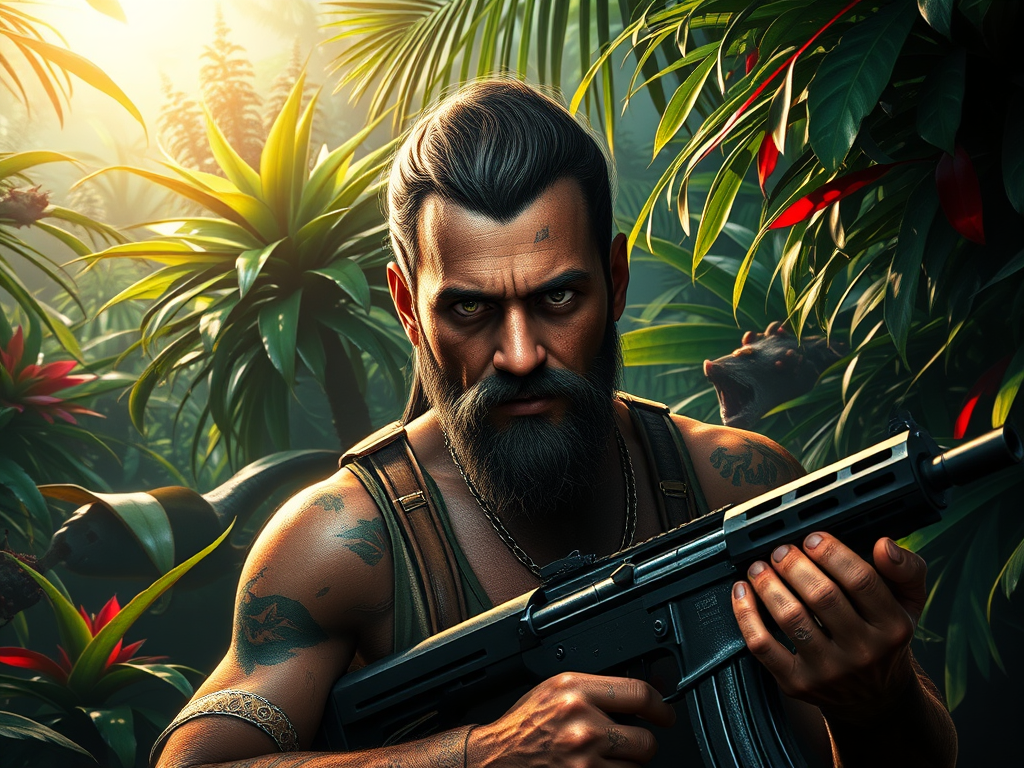
In the realm of open-world first-person shooters, few franchises have managed to balance chaos, beauty, and madness quite like Far Cry. For over two decades, Ubisoft’s flagship shooter has dropped players into the most hostile environments on Earth—from the sweltering savannas of Africa to the radioactive ruins of Montana—and told them to simply “survive.” It is a series defined by charismatic villains, emergent gameplay, and the terrifying realization that a badger is often more dangerous than a man with a machine gun.
But the history of Far Cry is as unpredictable as a wingsuit flight through a forest fire. The series has changed developers, shifted genres, and reinvented its own identity multiple times. It began as a tech demo for dinosaurs, survived a disastrous movie adaptation, and accidentally created one of the most iconic villains in gaming history thanks to a failed audition. Whether you are a veteran of the Rook Islands or a newcomer to Yara, the development secrets of this franchise reveal a fascinating story of risk-taking and happy accidents. Here are ten facts about the Far Cry franchise that will redefine your definition of insanity.
1. The Franchise Started as a Dinosaur Tech Demo Called “X-Isle”
Before Far Cry was a game about shooting mercenaries in paradise, it wasn’t a game at all. In 1999, a small German studio called Crytek created a technology demonstration for Nvidia to showcase the power of their new GeForce 3 graphics cards. Titled X-Isle: Dinosaur Island, the demo featured a lush, tropical environment teeming with prehistoric life.
The tech was mind-blowing for the time, rendering foliage and water distances that were previously thought impossible. Ubisoft saw the potential in the engine (CryEngine) and struck a deal with Crytek to turn the demo into a full game. The dinosaurs were swapped for mutants (Trigens), and the camera was given a gun. Thus, the original Far Cry (2004) was born. While the dinosaurs were cut from the first game, the franchise eventually returned to its prehistoric roots with Far Cry Primal in 2016, finally closing the circle on the original concept.
2. The Villain Vaas Montenegro Was Created by Accident
If you ask any gamer to name a Far Cry villain, they will say Vaas Montenegro. The mohawked pirate from Far Cry 3 is the face of the franchise. However, in the original script for the game, Vaas did not exist. The main villain was supposed to be a stoic, brutish character named “Bull,” physically imposing and largely silent.
When actor Michael Mando auditioned for the role of Bull, his physicality and emotional intensity were completely wrong for the character written on the page, but his performance was so electric that the developers couldn’t let him go. Ubisoft decided to scrap the character of Bull entirely and write a new villain specifically designed around Mando’s audition. They gave the character Mando’s likeness, his erratic energy, and his chilling monologue about the “definition of insanity.” If Mando hadn’t given that specific, unhinged audition, the franchise’s most iconic character would have never existed.
3. “Far Cry 2” is Secretly a Sequel to the First Game
For years, fans theorized that the antagonist of Far Cry 2, a nihilistic arms dealer known as “The Jackal,” was actually Jack Carver, the protagonist of the first Far Cry. The theory was based on their similar backgrounds (both former US Navy), physical resemblance, and the fact that the Jackal seems to know exactly how a mercenary thinks.
In 2021, nearly 13 years after the game’s release, the game’s creative director Clint Hocking finally confirmed the theory. He revealed that the Jackal is indeed Jack Carver. The narrative implication is tragic: after the events of the first game, the “hero” became disillusioned and traumatized, eventually morphing into the very villain he would have once fought. It turns the series into a dark character study about how violence cycles and corrupts, connecting the sci-fi roots of the first game to the gritty realism of the second.
4. The “Crab Rangoon” Ending of Far Cry 4
Far Cry 4 features a charismatic dictator named Pagan Min who rules the Himalayan region of Kyrat. The game typically involves a 20-hour campaign of joining a rebel group to overthrow him. However, players discovered that they could beat the game in roughly 15 minutes by doing absolutely nothing.
At the very beginning of the game, Pagan Min captures the protagonist, Ajay Ghale, and brings him to a dinner table. He asks Ajay to wait for him while he takes a phone call. Most players instinctively leave the room to escape, triggering the main game. But if you actually listen to the villain and simply sit at the table for about 13 minutes, Pagan Min returns. He thanks you for being polite, helps you accomplish your goal (scattering your mother’s ashes), and the credits roll. It is a brilliant subversive twist that suggests the bloody civil war that follows is entirely the player’s fault for being impatient.
5. Far Cry Primal Invented an Entirely New Language
When developing Far Cry Primal, which is set in 10,000 BC, the developers faced a unique problem: English didn’t exist yet. Having the cavemen characters speak modern English with a British accent (a common Hollywood trope) would have destroyed the immersion. Instead of using gibberish, Ubisoft partnered with historical linguists from the University of Kentucky.
They reconstructed a language based on Proto-Indo-European (PIE), the theoretical ancestor of modern languages like English, Spanish, and Hindi. They created three distinct dialects for the game’s tribes: the Wenja, the Udam, and the Izila. The actors had to learn this reconstructed language, adding a layer of authenticity that is rare in video games. The grunts and shouts you hear in the game are actually a scientifically educated guess at how our ancestors might have communicated.
6. The “Blood Dragon” Spinoff Started as an April Fool’s Joke
Far Cry 3: Blood Dragon is a neon-soaked, synth-wave love letter to 1980s action movies, featuring cyborgs and laser dinosaurs. It is wildly different from the serious tone of the main games. When Ubisoft first teased the concept, most of the gaming press and the public assumed it was an elaborate April Fool’s joke.
The marketing team leaned into this confusion, releasing over-the-top, low-budget style trailers that looked like VHS rips. But the game was real. It was a standalone expansion developed by a small, passionate team who wanted to reuse the Far Cry 3 assets to make something fun and ridiculous. It became a massive critical and commercial success, proving that the Far Cry formula worked just as well with comedy and lasers as it did with grit and realism.
7. Far Cry 2’s Weapon Jamming Was a Calculated Risk
Far Cry 2 is often cited as the most divisive entry in the series because of its extreme dedication to realism. One of its most controversial features was weapon degradation. As you used a gun, it would physically rust and get dirty over time. If you used a gun for too long without swapping it, it would jam in the middle of a firefight, forcing you to mash a button to clear the chamber. If it got too damaged, it would literally explode in your hands.
While many players found this frustrating, it was a deliberate design choice to force improvisation. The developers didn’t want players to find one “best gun” and keep it forever. They wanted to force players to scavenge dirty AK-47s off dead enemies and feel the panic of a malfunction. It created a sense of desperation and hostility that the polished, power-fantasy sequels largely abandoned.
8. The Series Had a Disastrous Movie Adaptation by Uwe Boll
Like many video game franchises in the mid-2000s, Far Cry fell victim to director Uwe Boll, who is infamous for making low-budget, critically paned adaptations of games. Released in 2008, the Far Cry movie starred Til Schweiger as Jack Carver.
The film was a critical and commercial failure. It abandoned almost all the plot points of the game, featured low-quality action sequences, and completely missed the tone of the source material. It holds a distinctively low rating on review aggregator sites. Most fans of the franchise pretend it doesn’t exist, but it remains a fascinating footnote in the history of video game movies, representing the era before adaptations like The Last of Us showed that games could be taken seriously on screen.
9. Far Cry 5 Used “Audio Conditioning” on the Player
Far Cry 5 deals with a doomsday cult that uses brainwashing techniques. One of the key plot points involves the song “Only You” by The Platters. In the game, the cult uses this song as a trigger to force the protagonist into a murderous trance.
The brilliance of the game design is that it effectively conditions the player as well. Throughout the game, whenever you hear the song, the screen blurs and you are forced into a high-stress time-trial combat sequence. By the end of the game, players reported feeling a genuine pavlovian spike of anxiety simply upon hearing the opening notes of the song, mirroring the conditioning of the character. It was a meta-narrative trick that blurred the line between the avatar and the person holding the controller.
10. The “Golden Path” Rebels in Far Cry 4 Are Arguably the Villains
Far Cry games often play with the idea that the “hero” might not be a good person, but Far Cry 4 takes this to a darker level. The player spends the game fighting for the “Golden Path” rebels against the tyrant Pagan Min. The rebels are led by two leaders, Amita and Sabal, and the player must choose who to support.
However, if you pay close attention to the endings, you realize that both rebel leaders are arguably worse than the dictator they are replacing. Amita wants to turn the country into a drug state using child soldiers to fund infrastructure, while Sabal wants to enforce a brutal religious fundamentalism that executes non-believers. The game subtly suggests that Pagan Min, despite being a psychopath, was the only one who was honest with you from the start. This moral ambiguity—where winning the war might actually doom the country—is a hallmark of the franchise’s storytelling.
Further Reading
- The Art of Far Cry 6 by Ubisoft
- Far Cry: Absolution by Urban Waite
- Blood, Sweat, and Pixels by Jason Schreier (Contains insights into Ubisoft’s development culture)
Keep the Discovery Going!
Here at Zentara, our mission is to take tricky subjects and unlock them, making knowledge exciting and easy to grasp. But the adventure doesn’t stop at the bottom of this page. We are constantly creating new ways for you to learn, watch, and listen every single day.
📺 Watch & Learn on YouTube
Visual learner? We publish 4 new videos every day, plus breaking news shorts to keep you smarter than the headlines. From deep dives to quick facts, our channel is your daily visual dose of wonder.
Click here to Subscribe to Zentara on YouTube
🎧 Listen on the Go on Spotify
Prefer to learn while you move? Tune into the Zentara Podcast! We drop a new episode daily, perfect for your commute, workout, or coffee break. Pop on your headphones and fill your day with fascinating facts.
Click here to Listen on Spotify
Every click, view, and listen helps us keep bringing honest knowledge to everyone. Thanks for exploring with us today—see you out there in the world of discovery!


Leave a Reply