
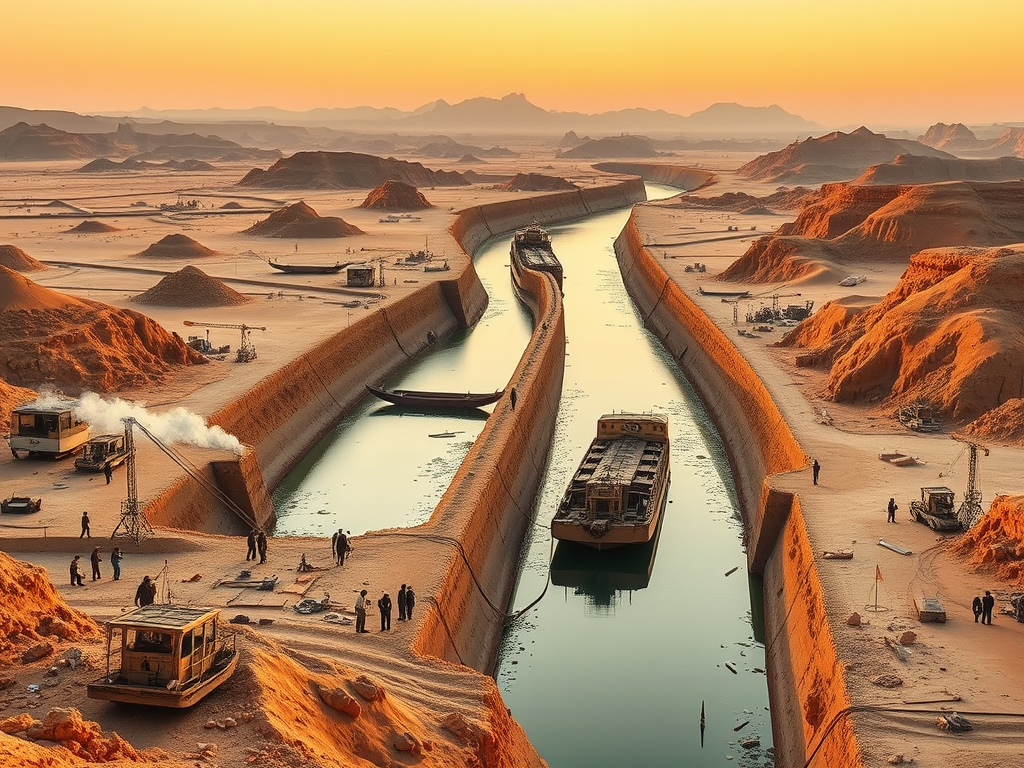
The Suez Canal is more than just a waterway; it is a monumental feat of engineering that fundamentally altered the geography of global trade. By slicing through the Isthmus of Suez to connect the Mediterranean Sea to the Red Sea, this project eliminated the need for ships to navigate the perilous journey around the southern tip of Africa. It effectively shrank the world, bringing the East and West closer together than ever before.
As of late 2025, the canal remains one of the most vital arteries of the global economy, handling approximately 12% of world trade. However, the Suez Canal history is marred by extreme physical challenges, political maneuvering, and a staggering human cost. From the initial vision of Ferdinand de Lesseps to the transition from manual labor to massive steam-powered dredges, the construction of the canal was a ten-year odyssey that pushed 19th-century technology to its absolute limit.
In this article, we will dive into the top ten facts about the building of this “Highway to India.” We will explore the maritime trade impact, the controversial use of corvée labor, and the engineering breakthroughs that made this impossible truth a reality.
1. The Vision of Ferdinand de Lesseps: A Diplomatic Gamble
While the idea of a canal had existed since the time of the Pharaohs, it was a French diplomat named Ferdinand de Lesseps who finally brought the project to life in the mid-19th century. De Lesseps was not an engineer, but he was a master of interpersonal communication and persuasion. He leveraged his close friendship with Sa’id Pasha, the Viceroy of Egypt, to secure the “Concession” to build the canal in 1854.
De Lesseps envisioned the canal as a neutral path for all nations, yet the project was almost exclusively funded by French and Egyptian interests. This created immense tension with Great Britain, who feared that a French-controlled canal would threaten their dominance over the route to India. The creation of the Suez Canal Company was a bold financial experiment, selling shares to the public in what was one of the first truly global infrastructure investments. De Lesseps’ tenacity proved that sometimes, the biggest obstacle to engineering isn’t the earth itself, but the politics of the people living on it.
2. The Initial Myth: The Level of the Two Seas
For decades before construction began, many scientists believed the project was impossible due to a “level error.” It was widely thought that the Red Sea was 33 feet higher than the Mediterranean. If this were true, a canal without locks would create a catastrophic wall of water rushing toward Europe. Even the great Napoleon Bonaparte’s engineers had reached this incorrect conclusion during his Egyptian campaign.
It wasn’t until a new survey was conducted in 1847 by the Société d’Études du Canal de Suez that the truth was revealed: the difference in sea levels was negligible. This was a critical science fact that changed everything. It meant the Suez could be a “sea-level canal,” requiring no locks to move ships from one elevation to another. This made the design much simpler but the excavation much deeper, as the entire 120-mile path had to be dug out to a depth that could accommodate massive ocean-going vessels.
3. The Human Cost: The Brutal Corvée Labor System
The most somber chapter of Suez Canal history is the use of the “corvée”—a system of forced labor. In the early years of construction (1859–1863), the Egyptian government provided tens of thousands of peasants (fellahin) every month to dig the canal by hand. These workers were often forced to work in extreme heat with nothing but pickaxes, shovels, and baskets to move millions of tons of desert sand.
Conditions were horrific. Workers faced constant threats from dehydration and disease, particularly cholera and dysentery. While the exact death toll is still debated by historians, it is estimated that thousands of laborers died during the construction. The international outcry against this unethical human experimentation in labor eventually forced the abolition of the corvée in 1864. This forced the Suez Canal Company to pivot toward a new solution: the Industrial Revolution.
4. A Technological Pivot: The Steam-Powered Revolution
When the forced labor supply was cut off, the project faced a total collapse. To save the canal, de Lesseps and his engineers turned to cutting-edge science and technology. They commissioned the construction of massive, specialized steam-powered dredges and excavators. These machines were the heavy hitters of the 19th century, capable of moving more earth in a day than thousands of men could move in a week.
These dredges used long conveyor belts (known as longloirs) to dump excavated silt far back from the canal’s banks, preventing it from sliding back in. This transition was a landmark in engineering history. It turned the Suez Canal into a proving ground for the same mechanical innovations that would later be used to build the Panama Canal. Without this mechanical intervention, the canal likely would have remained an unfinished trench in the sand.
5. Overcoming the Desert: The Fresh Water Canal
One of the biggest logistical nightmares of building in the middle of the Isthmus was the total lack of drinking water. The region was a parched wasteland. To keep the thousands of workers and steam engines functioning, the company had to build a second, smaller canal first: the Fresh Water Canal.
This smaller waterway diverted water from the Nile River across the desert to the construction sites. It was the lifeblood of the project. Before its completion, water had to be brought in on the backs of 3,000 camels every single day. This “canal within a canal” is a frequently overlooked Suez Canal fact, but without it, the main project would have been physically impossible. It transformed the desert into a habitable corridor, allowing for the birth of new cities like Port Said and Ismailia.
6. Slicing Through the Bitter Lakes
The canal’s path wasn’t just through sand; it also made use of natural depressions. The most significant of these were the Bitter Lakes. These were ancient, dry salt basins that sat below sea level. When the canal finally reached these basins, the engineers allowed the Mediterranean and Red Seas to flow in, creating massive inland lakes that ships could use as passing zones.
Filling the Bitter Lakes was a spectacular sight. As the seawater rushed into the parched basins, it dissolved ancient salt crusts that were several feet thick. Today, these lakes serve as essential “waiting rooms” for convoys of ships, allowing the canal to operate with a “one-way street” system that swaps directions throughout the day. This use of geology facts saved the engineers miles of arduous digging and provided a natural solution to a logistical problem.
7. The British Opposition and the Buyout
While France was building, Britain was brooding. The British government initially did everything in its power to stop the canal, fearing it would give the French too much influence over India. They even funded anti-canal propaganda and pressured the Ottoman Empire to halt the work. However, once the canal opened and proved its maritime trade impact, the British changed their tune.
In 1875, the Egyptian government faced a severe financial crisis. Seizing the opportunity, British Prime Minister Benjamin Disraeli bought Egypt’s entire share in the canal for £4 million—a move he famously described to Queen Victoria as “You have it, Madam!” This shift in power dynamics turned the canal into a joint Anglo-French venture, ensuring that the British Navy would guard the waterway for the next 80 years to protect their “Imperial Lifeline.”
8. The Statue of Liberty Connection
Few people realize that the Statue of Liberty was originally designed to stand at the entrance of the Suez Canal. The sculptor, Frédéric Auguste Bartholdi, proposed a giant statue of an Egyptian peasant woman holding a torch, titled “Egypt Bringing Light to Asia.” He pitched the idea to de Lesseps and the Egyptian Viceroy, but the project was rejected as being too expensive.
Undeterred, Bartholdi took his sketches, modified the woman to be Libertas (the Roman goddess of freedom), and pitched the idea to the United States for the centennial of the American Revolution. The rest is cultural history. While the canal got a lighthouse instead, the “impossible truth” remains that the world’s most famous symbol of freedom was born from the desert sands of the Suez project.
9. The Grand Opening: A Party for the Ages
The Suez Canal officially opened on November 17, 1869, with a celebration of unprecedented scale. Empress Eugénie of France led a procession of 50 ships through the canal on her imperial yacht, the L’Aigle. The event was attended by royalty, scientists, and writers from across the globe, signaling the start of a new era of intercultural exchange.
The Egyptian Khedive, Ismail Pasha, spared no expense. He commissioned an opera house in Cairo and even asked Giuseppe Verdi to write an opera (Aida) for the occasion (though it wasn’t finished in time). The opening of the canal was viewed as a victory of “Man over Nature.” It was a moment of supreme confidence in 19th-century progress, though the massive debt incurred for the party and the construction would eventually lead to the loss of Egyptian independence to the British.
10. Transforming the World’s Map: The Trade Legacy
The impact of the Suez Canal’s completion was instantaneous. Before 1869, a steamer traveling from London to Mumbai had to travel 12,000 miles. After the canal opened, that distance dropped to 7,200 miles—a reduction of 40%. This wasn’t just about speed; it was about economic exchange. It made fresh goods, mail, and travel between Europe and Asia affordable for the first time.
This maritime trade impact also led to the “Scramble for Africa,” as European powers sought to control the areas around the new trade route. Even today, the “Ever Given” grounding in 2021 proved how fragile this 150-year-old link remains. The construction of the Suez Canal didn’t just move sand; it shifted the gravity of the world’s wealth and power, a legacy that continues to define our modern globalized world.
Further Reading
To explore the fascinating world of engineering marvels and the history of the Middle East, these books provide deep and accessible insights:
- “The Path Between the Seas” (specifically the introductory sections on Suez) by David McCullough
- “Suez: De Lesseps and the Canal” by John Pudney
- “The Man Who Invented the Twentieth Century: Ferdinand de Lesseps” by various biographers
- “Breaking the Desert: The Building of the Suez Canal” by Zachary Karabell
Keep the Discovery Going!
Here at Zentara, our mission is to take tricky subjects and unlock them, making knowledge exciting and easy to grasp. But the adventure doesn’t stop at the bottom of this page. We are constantly creating new ways for you to learn, watch, and listen every single day.
📺 Watch & Learn on YouTube
Visual learner? We publish 4 new videos every day, plus breaking news shorts to keep you smarter than the headlines. From deep dives to quick facts, our channel is your daily visual dose of wonder.
Click here to Subscribe to Zentara on YouTube
🎧 Listen on the Go on Spotify
Prefer to learn while you move? Tune into the Zentara Podcast! We drop a new episode daily, perfect for your commute, workout, or coffee break. Pop on your headphones and fill your day with fascinating facts.
Click here to Listen on Spotify
Every click, view, and listen helps us keep bringing honest knowledge to everyone. Thanks for exploring with us today—see you out there in the world of discovery!




Leave a Reply