
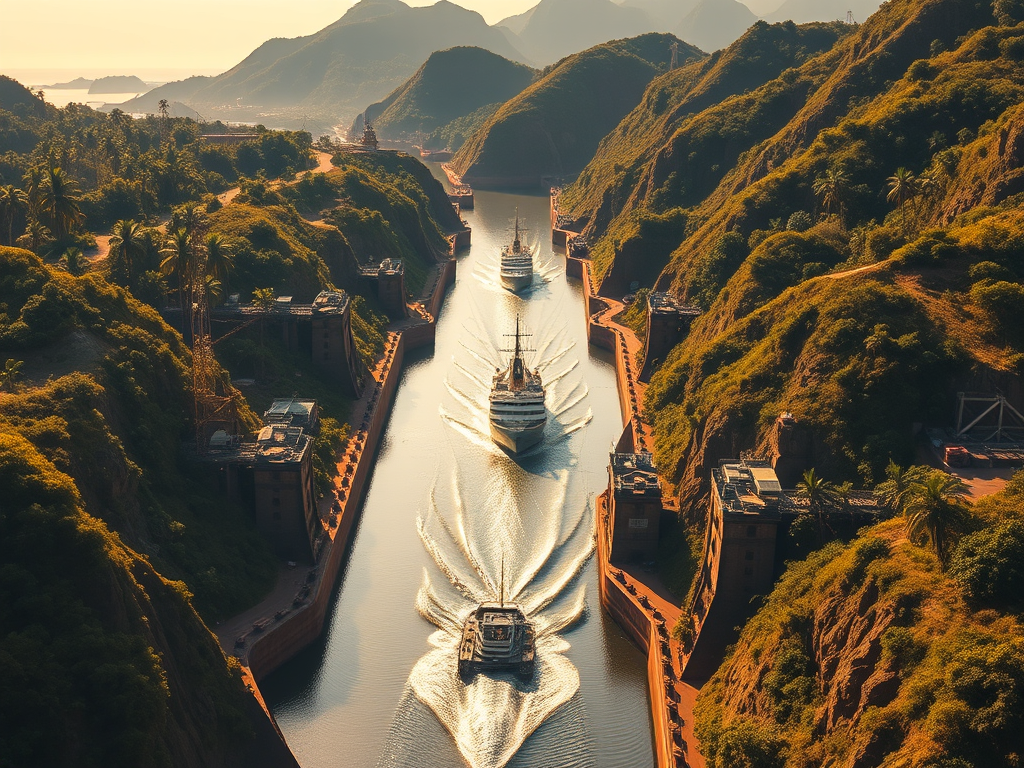
For centuries, the narrow Isthmus of Panama stood as a tantalizing, stubborn barrier—a thin strip of land separating the world’s two great oceans. The dream of carving a path through it was a fantasy shared by kings, explorers, and engineers for four hundred years. When it was finally achieved in 1914, the Panama Canal was more than just a waterway; it was a monumental act of human will, a feat of engineering that dwarfed the pyramids, and a geopolitical power play that redefined global trade and military strategy forever. The construction of this 50-mile marvel was not the result of a single decision, but the culmination of powerful forces—economic ambition, military necessity, national pride, and groundbreaking scientific discovery. To understand why this colossal project was undertaken, we must explore the compelling reasons that turned a centuries-old dream into a concrete and steel reality.
1. The Age-Old Dream of a Western Passage
The quest for a shortcut between the Atlantic and Pacific is nearly as old as the European discovery of the Americas itself. When explorer Vasco Núñez de Balboa first crossed the Isthmus of Panama on foot in 1513 and laid eyes on the vast Pacific Ocean, the strategic importance of this sliver of land became immediately apparent. Ships sailing from Europe to Asia had to undertake the perilous, months-long journey around the southern tip of South America, Cape Horn. As early as 1534, Charles V, the Holy Roman Emperor and King of Spain, ordered a survey of the isthmus to assess the feasibility of a canal, hoping to gain a commercial and military edge over Portugal.
While the 16th-century technology was nowhere near capable of the task, the dream never died. It became a recurring obsession for centuries. Think of it as a tantalizing geographical puzzle that every great power wanted to solve. The idea represented ultimate control over global maritime routes, a way to bend the planet’s geography to the will of man and empire. This long-standing, almost mythical ambition provided the foundational inspiration for all subsequent efforts, framing the canal not just as a practical project but as the fulfillment of a historic destiny.
2. The California Gold Rush and the Dawn of Demand
For centuries, the dream of a canal was largely a strategic fantasy. That changed dramatically in 1848 with the discovery of gold in California. The ensuing California Gold Rush created the first massive, practical demand for a faster and safer route connecting the eastern and western coasts of the United States. Thousands of prospectors, merchants, and settlers were desperate to reach California, and the existing options were terrible. The cross-country wagon trail was grueling and took months. The sea voyage around Cape Horn was a 13,000-mile, six-month ordeal plagued by storms and treacherous seas.
A third route emerged: a “Panama Shortcut.” Travellers would take a ship to the Atlantic side of Panama, trek through the dense, disease-ridden jungle by mule and canoe, and then board another ship on the Pacific side. It was faster but incredibly dangerous. The demand was so high that American financiers built the Panama Railway in 1855. It was an engineering marvel in its own right, but it was also a clear demonstration of the immense commercial potential of the isthmus. The Gold Rush transformed the canal from a colonial dream into a pressing American economic need, proving that people would pay almost any price to shave months off their journey.
3. The Suez Canal as a Technological and Economic Blueprint
In 1869, the world watched in awe as the Suez Canal opened in Egypt, linking the Mediterranean Sea to the Red Sea. The project, masterminded by French diplomat Ferdinand de Lesseps, was a resounding success. It slashed the sea route from Europe to Asia by thousands of miles and was a spectacular commercial triumph. The Suez Canal served as a powerful proof of concept; it demonstrated that modern engineering could conquer immense geographical barriers and that the economic rewards for doing so were almost limitless.
This success directly inspired France, now brimming with national pride and engineering confidence, to tackle the even greater challenge of Panama. De Lesseps, hailed as a national hero, was convinced he could replicate his success in Central America. The Suez Canal provided the blueprint, the confidence, and the star power to attract massive investment and political support for a Panama Canal project. It shifted the global mindset from “what if” to “how soon,” setting the stage for the first serious attempt to sever the Americas.
4. The Lessons from the Disastrous French Attempt
Riding the wave of his Suez success, Ferdinand de Lesseps launched the French effort to build a sea-level canal in Panama in 1881. The project was an unmitigated catastrophe. De Lesseps tragically underestimated the unique challenges of the Panamanian jungle. Unlike the flat, sandy desert of Suez, Panama was a mountainous region with torrential rainfall, impenetrable jungle, and, most devastatingly, rampant tropical diseases. Yellow fever and malaria, carried by mosquitoes, scythed through the workforce, killing an estimated 20,000 labourers. After nearly a decade of struggle and financial scandal, the French company went bankrupt in 1889.
While a colossal failure, the French attempt was a crucial prerequisite for the eventual American success. It served as a massive, expensive lesson in what not to do. Furthermore, the French left behind a significant amount of infrastructure, including excavations, buildings, abandoned machinery, and, most importantly, the property rights and concession from Colombia. The subsequent American effort was not started from scratch; it was, in many ways, a salvage and recovery operation that benefited immensely from the French tragedy.
5. The Drive of American Imperialism and “Manifest Destiny”
By the late 19th century, the United States was a rising global power, filled with an expansionist energy often described as “Manifest Destiny.” The idea that the nation was destined to expand its dominion and spread its values was a powerful ideological force. After the Spanish-American War in 1898, the U.S. acquired territories in the Caribbean (Puerto Rico) and the Pacific (the Philippines, Guam). Suddenly, the United States was a true two-ocean power with a burgeoning empire.
In this context, a canal through Central America, controlled by the United States, was seen as a natural and necessary component of this new global stature. It would be a powerful symbol of American technological prowess, commercial might, and political dominance in the Western Hemisphere. Building the canal was seen as America’s grand project, a way to physically and symbolically link its coasts and project its power outward. It was the ultimate expression of a nation coming of age and asserting its role as a major player on the world stage.
6. The Famous Journey of the USS Oregon
No single event highlighted the military need for the Panama Canal more dramatically than the journey of the battleship USS Oregon in 1898. At the outbreak of the Spanish-American War, the Oregon was stationed on the Pacific coast. It was urgently needed to join the Atlantic fleet to confront the Spanish navy in the Caribbean. The battleship was forced to embark on the epic 13,000-mile voyage around Cape Horn. For 66 agonizing days, the entire nation followed the ship’s progress through newspaper reports, acutely aware that a naval battle could be lost before this powerful asset even arrived.
The journey was a strategic nightmare. It was like watching your best firefighter stuck in traffic while your house is burning down. The USS Oregon arrived just in time to participate in the Battle of Santiago Bay, but the lesson was seared into the minds of American military planners and politicians. A nation with two coasts needed a two-ocean navy, and a two-ocean navy was ineffective without the ability to move its fleet rapidly between them. The Oregon’s frantic dash provided the visceral, undeniable argument that a canal was not just a commercial convenience but a vital component of national security.
7. The Unstoppable Will of Theodore Roosevelt
While the reasons for the canal were many, it took the singular focus and “big stick” diplomacy of one man to make it a reality: President Theodore Roosevelt. A fervent nationalist and believer in American power, Roosevelt saw the canal as the most important undertaking of his generation. He was impatient with diplomatic niceties and determined to see dirt fly. When negotiations with Colombia to secure the rights to the Canal Zone stalled, Roosevelt was not deterred.
Roosevelt famously and unapologetically declared, “I took the Isthmus.” He embodied the canal project, making it a centrepiece of his presidency and a symbol of his aggressive, can-do foreign policy. He even became the first sitting U.S. president to leave the country when he visited the construction site in 1906, posing for photos at the controls of a giant steam shovel. This iconic image perfectly captured his personal and national commitment to the project. Without Roosevelt’s relentless drive, the canal might have remained a dream for decades longer.
8. Engineering Panamanian Independence from Colombia
The final political obstacle to the canal was Colombia, which controlled the Isthmus of Panama. In 1903, the U.S. negotiated a treaty with Colombia, but the Colombian Senate, believing the terms were unfavourable, refused to ratify it. Infuriated, Theodore Roosevelt and American policymakers turned to a more direct solution. They discreetly supported a burgeoning independence movement among the Panamanian people, who had long chafed under Colombian rule and were desperate for the economic benefits the canal would bring.
On November 3, 1903, the revolution began. The U.S. Navy dispatched the warship USS Nashville to the Panamanian coast, physically preventing Colombian troops from landing to suppress the rebellion. It was a classic piece of geopolitical hardball. Panama declared its independence, which the U.S. recognized almost immediately. Within days, the U.S. signed the Hay-Bunau-Varilla Treaty with the new Panamanian government, granting the U.S. control of a ten-mile-wide Canal Zone in perpetuity. This maneuver, though controversial, swept away the final political barrier and gave the U.S. the total control it needed to begin construction.
9. The Lure of Unprecedented Economic and Trade Benefits
Ultimately, the most enduring reason for the canal was economic. The promise of the waterway was a revolution in global trade. For a ship travelling from New York to San Francisco, the canal would slash the voyage from over 13,000 miles to just over 5,000 miles, saving weeks of time and enormous sums in fuel and transport costs. This shortcut would dramatically boost trade between the U.S. coasts, making it cheaper to ship lumber from Oregon to New York and manufactured goods from the East Coast to the West.
But the impact was global. The canal would also create more efficient trade routes between Europe and Asia, and between the east and west coasts of South America. It was envisioned as a vital artery for the world’s economy, a funnel through which a huge percentage of global maritime traffic would flow. This immense commercial potential was the primary justification for the staggering $375 million investment (an astronomical sum at the time) and the driving force that ensured the canal, once built, would become an indispensable part of the global economic system.
10. The Scientific Victory Over Disease
The single greatest obstacle to building the canal was not rock or mud, but the mosquito. The French had been defeated not by engineering challenges, but by yellow fever and malaria. The Americans understood that they could not succeed unless they first won the war against these diseases. This led to one of the greatest public health campaigns in history, led by Dr. William C. Gorgas. Applying the recent discovery that mosquitoes were the carriers of these diseases, Gorgas implemented a massive sanitation program across the Canal Zone.
His teams drained swamps, fumigated homes, installed screens, and built a clean water supply. It was a meticulous, systematic war on the mosquito population. By 1906, yellow fever was completely eliminated from the Canal Zone, and malaria rates were drastically reduced. This medical victory was the true foundation of the engineering success that followed. It made it possible for a large workforce to stay alive and healthy enough to complete the Herculean task of construction. Without the conquest of disease, the canal would have claimed thousands more lives and likely would have failed, just as the French effort had.
Further Reading
To explore the epic story of the Panama Canal’s construction in greater detail, these books offer rich and compelling narratives:
- The Path Between the Seas: The Creation of the Panama Canal, 1870-1914 by David McCullough – The Pulitzer Prize-winning masterpiece, this is widely considered the definitive account of the canal’s creation, covering both the French and American efforts in vivid detail.
- Panama Fever: The Epic Story of the Building of the Panama Canal by Matthew Parker – This book focuses powerfully on the human story of the canal’s construction, particularly the brutal conditions and the war against disease that workers faced.
- The Canal Builders: Making America’s Empire at the Panama Canal by Julie Greene – An insightful look at the social history of the Canal Zone, exploring the lives of the diverse, multinational workforce that actually built the canal.
- A Man, a Plan, a Canal: Panama by Theodore Roosevelt – A short article written by Roosevelt himself for Outlook magazine, offering his direct and unapologetic perspective on the project and his role in its realization.
Here at Zentara.blog, our mission is to take those tricky subjects and unlock them, making knowledge exciting and easy to grasp for everyone. But the adventure doesn’t stop on this page! We’re constantly exploring new frontiers and sharing discoveries across the digital universe. Want to dive deeper into more mind-bending Top 10s and keep expanding your world? Come join us on our other platforms – we’ve got unique experiences waiting for you on each one!
Get inspired by visual wonders and bite-sized facts: See the world through Zentara’s eyes on Pinterest!
Pin our fascinating facts and stunning visuals to your own boards. Explore Pins on Pinterest: https://uk.pinterest.com/zentarablog/
Discover quick insights and behind-the-scenes peeks: Hop over to Tumblr for snippets, quotes, and unique content you won’t find anywhere else. It’s a different flavour of discovery! Follow the Fun on Tumblr: https://www.tumblr.com/zentarablog
Ready for deep dives you can listen to or watch? We’re bringing our accessible approach to video and potentially audio! Subscribe to our YouTube channel and tune into future projects that make learning pop! Subscribe on YouTube: https://www.youtube.com/@ZentaraUK
Seeking even more knowledge in one place? We’ve compiled some of our most popular topic deep dives into fantastic ebooks! Find them on Amazon and keep the learning journey going anytime, anywhere. Find Our Ebooks on Amazon: https://www.amazon.co.uk/s?k=Zentara+UK&ref=nb_sb_noss
Connect with us and fellow knowledge seekers: Join the conversation on BlueSky! We’re sharing updates, thoughts, and maybe even asking you what wonders we should explore next. Chat with Us on BlueSky: https://bsky.app/profile/zentarablog.bsky.social
Perfect for learning on the move! We post multiple 10-minute podcasts per day on Spotify. Pop on your headphones and fill your day with fascinating facts while you’re out and about! Listen on Spotify: https://open.spotify.com/show/3dmHbKeDufRx95xPYIqKhJFollow us on Instagram for bytesize knowledge! We post multiple posts per day on our official Instagram account. https://www.instagram.com/zentarablog/ Every click helps us keep bringing honest, accessible knowledge to everyone. Thanks for exploring with us today – see you out there in the world of discovery!




Leave a Reply