The Incredible Hulk is one of the most iconic figures in the Marvel Universe, a literal titan of industry—if that industry is smashing tanks and leaping over skyscrapers. Created by the legendary duo of Stan Lee and Jack Kirby, the character represents the ultimate personification of repressed emotion and raw, unchecked power. Since his debut, the Hulk has evolved from a simple “monster of the week” into a complex psychological study of trauma, identity, and the burden of god-like strength.
To understand the Hulk is to understand the tragedy of Dr. Bruce Banner. At his core, the story isn’t just about a green giant; it’s about a man trying to survive the storm living inside his own mind. For beginners and long-time enthusiasts alike, the lore of the Hulk is vast, spanning cosmic wars, subterranean kingdoms, and the deepest recesses of the human psyche. This guide dives into the essential elements that define the “Strongest One There Is,” exploring why this gamma-irradiated behemoth remains a cornerstone of modern mythology.
1. The Duality of Man: The Jekyll and Hyde Connection
The foundational DNA of the Incredible Hulk is rooted in classic literature, specifically Robert Louis Stevenson’s Strange Case of Dr. Jekyll and Mr. Hyde. Stan Lee explicitly sought to create a character that blended the sympathetic nature of Frankenstein’s monster with the dual-identity struggle of Jekyll and Hyde. Bruce Banner is a brilliant, mild-mannered physicist—the epitome of human intellect—while the Hulk is the manifestation of his repressed anger and childhood trauma.
This duality is what makes the Hulk more than just a superhero. He is a cautionary tale about the dangers of suppressing one’s true self. Unlike many heroes who choose their path, Banner is a victim of his own creation. The transformation is often depicted as a painful, bone-shattering process, emphasizing that the Hulk is an externalization of internal agony. This relationship has shifted over time; sometimes they are at war, sometimes they find a tentative peace, but they are always two sides of the same coin. This psychological depth is why the character resonates: we all have a “Hulk” inside us, a part of our personality we try to keep hidden from the world.
2. The Original Grey Hulk and the Printing Fluke
While everyone recognizes the Hulk as a vibrant shade of emerald, he wasn’t originally intended to be green. In his very first appearance, the Hulk was actually grey. Stan Lee chose grey because he wanted a color that didn’t suggest any specific ethnic or cultural group, leaning into the “ghoul” or “monster” aesthetic. However, the printing technology of the time struggled to maintain a consistent shade of grey. In some panels, he looked silvery; in others, he looked charcoal or even slightly blue.
To solve this technical headache, the decision was made to change his color to green starting with the second issue, as green was much easier for the four-color printing process to handle consistently. This “mistake” became one of the most fortunate accidents in comic history, creating a visually striking and instantly recognizable brand. Decades later, writers cleverly retrofitted this change into the lore by introducing the “Grey Hulk” (also known as Joe Fixit) as a separate personality within Banner’s mind, representing his craftier, more selfish, and street-smart side compared to the “Savage” Green Hulk.
3. Gamma Radiation: A Blessing and a Curse
The catalyst for the Hulk’s existence is the Gamma Bomb, a weapon of mass destruction designed by Bruce Banner himself. During a live-fire test, a teenager named Rick Jones wandered onto the testing site. In an act of pure heroism, Banner rushed out to save the boy, shoving him into a protective trench just as the bomb detonated. Banner was bathed in a lethal dose of gamma radiation—a force that, in the real world, would lead to certain death. In the Marvel Universe, however, it acted as a transformative mutagen.
Gamma radiation in Marvel lore is often portrayed as having a semi-mystical quality, acting as a bridge between science and something more primordial. For Banner, it didn’t just change his DNA; it unlocked the “Green Door,” a metaphysical gateway. This radiation allows the Hulk to draw energy from an external source, explaining how he can gain hundreds of pounds of muscle and bone mass in a matter of seconds. This scientific accident serves as a permanent tether between Banner’s brilliance and his destructive potential, making him a living embodiment of the atomic age’s greatest fears.
4. The Many Faces of the Behemoth
One of the most fascinating aspects of the Hulk is that he isn’t just one “person.” Bruce Banner suffers from Dissociative Identity Disorder (DID), exacerbated by the gamma radiation. Over the years, several distinct personas have emerged, each representing a different facet of Banner’s fractured psyche. The most famous is the “Savage Hulk,” the child-like, rage-filled version that wants to be left alone. Then there is “Joe Fixit,” the grey-skinned Vegas enforcer who is smaller but far more cunning and manipulative.
Other notable personas include “Professor Hulk,” a merger of Banner’s intellect and the Hulk’s power, and the “Maestro,” a villainous, hyper-intelligent version from a dystopian future. There is also the “Devil Hulk,” a protective but malevolent entity that acts as a dark father figure to Bruce. These shifts in personality mean that a Hulk story can change genres instantly—from a superhero romp to a noir detective story to a psychological horror. Understanding the Hulk requires recognizing that the “monster” is actually a crowded room of competing voices.
5. Infinite Strength Fueled by Unlimited Rage
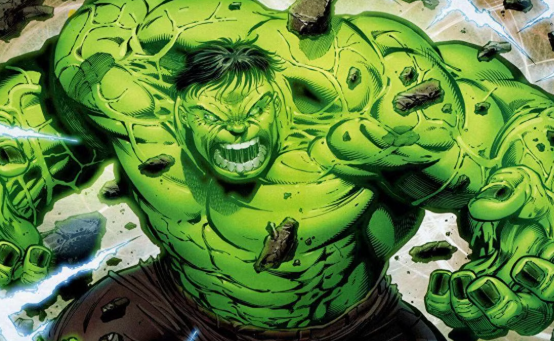
The Hulk’s power level is unique in the world of fiction because it has no theoretical upper limit. Most superheroes have a maximum weight they can lift or a top speed they can reach. The Hulk, however, operates on a scaling mechanic: “The madder Hulk gets, the stronger Hulk gets.” When the Hulk is calm or mildly annoyed, he is already capable of trade-off with gods. But as his adrenaline rises and his anger intensifies, his physical strength increases exponentially.
This makes the Hulk a terrifying opponent in a protracted battle. If you don’t defeat him quickly, he will eventually become strong enough to shatter the very ground you stand on. He has been shown holding together the tectonic plates of a planet, punching through time-barriers, and overcoming the gravity of a black hole. This infinite potential is a metaphorical reflection of human emotion; just as there is no limit to how much a person can feel, there is no limit to the physical force the Hulk can exert when pushed to the brink.
6. A Regenerative Healing Factor That Rivaling Wolverine
While most people focus on the Hulk’s offensive capabilities, his defensive powers are equally staggering. The Hulk possesses perhaps the most efficient healing factor in the Marvel Universe. He can regrow entire limbs, organs, and even his head in extreme circumstances. Unlike other characters with healing powers, the Hulk’s regeneration is powered by the same gamma-fueled rage that drives his strength. The more damage he takes, the angrier he becomes, which in turn accelerates his healing.
This durability extends to his skin, which is nearly invulnerable to conventional weaponry. High-caliber bullets bounce off him like pebbles, and he can withstand the heat of a nuclear explosion or the absolute zero of deep space. He is also immune to all known terrestrial diseases and most poisons. This immortality is part of Bruce Banner’s tragedy; he has often tried to end his own life, only for the “Other Guy” to spit the bullet out or heal the damage before it becomes fatal. The Hulk isn’t just a fighter; he is an indestructible force of nature.
7. The Complex World of Gamma Mutates
The Hulk does not exist in a vacuum. His origin led to the creation of an entire sub-species of characters known as “Gamma Mutates.” The most prominent is Jennifer Walters, Bruce’s cousin, who became She-Hulk after receiving an emergency blood transfusion from him. Unlike Bruce, Jennifer usually retains her personality and intelligence while transformed, representing a more “successful” integration of gamma power.
Conversely, the Hulk has a rogues’ gallery of gamma-powered villains who represent the dark side of this evolution. The Abomination (Emil Blonsky) is twice as strong as a “calm” Hulk but cannot transform back into human form. The Leader (Samuel Sterns) received gamma radiation that went to his brain instead of his muscles, giving him hyper-intelligence and making him the Hulk’s intellectual foil. These characters serve as mirrors to Banner, showing what happens when gamma radiation interacts with different personalities—from the noble hero to the megalomaniacal tyrant.
8. Navigating the Astral Plane and Mystical Awareness
A little-known fact about the Hulk is his sensitivity to the supernatural. Despite being a creature of science, the Hulk has the unique ability to see astral forms—spirits or souls that are invisible to the human eye. This was originally manifested as a defense mechanism against Dr. Strange, allowing the Hulk to interact with the Sorcerer Supreme even when Strange was in his non-physical state.
This ability stems from Banner’s deep-seated fear of his father’s ghost and his own internal “demons.” Because the Hulk’s mind is so fractured and his connection to the “Green Door” is so profound, he is naturally tuned into different frequencies of reality. He can sense when someone is watching him from another dimension and can sometimes even “punch” his way into mystical realms. This adds a layer of cosmic and magical significance to the character, elevating him from a simple “brick” powerhouse to a being with profound metaphysical importance.
9. The Heroic Sacrifice of the Gamma Bomb Test
The true measure of Bruce Banner’s character is found in the seconds before he became the Hulk. Banner was not a victim of a random accident; he was a victim of his own morality. When he saw Rick Jones out on the testing grounds, he knew the countdown could not be stopped in time. He chose to leave the safety of the bunker, knowing the risks, to save a complete stranger.
This act of selflessness defines the hero within the monster. Even though the Hulk is often hunted by the military and viewed as a menace, the foundation of his existence is a life-saving act. This theme persists throughout his history: the Hulk often protects the innocent, even if he does so with terrifying violence. Rick Jones would go on to become a lifelong ally to both Banner and the Hulk, serving as a constant reminder that the “monster” was born out of a desire to do good.
10. Worldbreaker Status: The Ultimate Planetary Threat
There are moments in comic history where the Hulk’s rage reaches such a fever pitch that he enters a state known as the “Worldbreaker.” This isn’t just a title; it is a literal description of his power level. In this state, the Hulk emits so much gamma energy that his mere footsteps cause massive earthquakes and his presence can crack the crust of a planet. This level of power was most notably seen after the Hulk suffered immense personal loss on the planet Sakaar, leading to his return to Earth for vengeance.
The Worldbreaker Hulk represents the terrifying reality of what happens when the “Strongest One There Is” stops holding back. Usually, a small part of Bruce Banner’s subconscious mind is always working to calculate the trajectory of the Hulk’s debris to ensure no innocents are killed. When that restraint is removed, the Hulk becomes a threat to the entire solar system. It serves as the ultimate “what if” scenario, showcasing the true, frightening scale of the power Bruce Banner carries within his soul.
Further Reading
- The Incredible Hulk: Planet Hulk by Greg Pak – A seminal story where the Hulk is exiled to a gladiator planet, showcasing his leadership and warrior spirit.
- The Immortal Hulk by Al Ewing – A modern masterpiece that leans into the body-horror and mythological roots of the character.
- Hulk: Future Imperfect by Peter David – A classic tale introducing the Maestro, a dark version of the Hulk from the future.
- Essential Hulk Vol. 1 by Stan Lee & Jack Kirby – The original stories that started it all, detailing the first transformations and the grey-to-green transition.
- 10 Things You Should Know About Carnage – Marvel Comics

- 10 Things You Should Know About The Green Arrow – DC Comics

- 10 Things You Should Know About Booster Gold – DC Comics

- 10 Things You Should Know About Hulk – Marvel Comics

- 10 Things You Should Know About CYBORG – DC Comics