
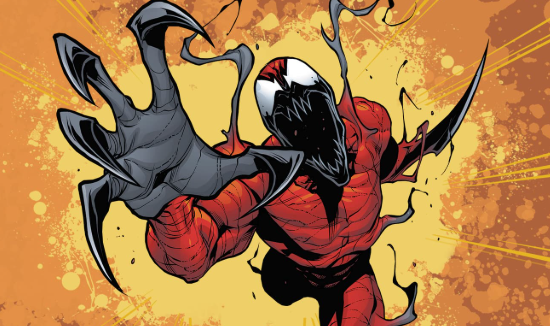
In the sprawling landscape of the Marvel Universe, where heroes strive for justice and villains often seek power or wealth, there exists a singular entity of pure, unadulterated chaos: Carnage. If Spider-Man represents responsibility and Venom represents vengeance, Carnage represents the terrifying absence of both. Emerging from the gritty comic book era of the early 1990s, the character of Carnage—a fusion of a bloodthirsty serial killer and an alien parasite—pushed the boundaries of what a “supervillain” could be.
To the uninitiated, Carnage might look like a red, leaner version of Venom. However, beneath that undulating crimson surface lies a level of depravity that makes even the most hardened Marvel anti-heroes shudder. He isn’t interested in world domination or intricate heists; he is interested in the artistic expression of slaughter. As one of the most popular and persistent threats in the Spider-Man mythos, Carnage serves as a dark reflection of the havoc that can be unleashed when a broken mind is granted god-like power. This guide dives deep into the anatomy, psychology, and history of the red symbiote to explain why he remains the ultimate nightmare of the Marvel Universe.
1. The Host: Cletus Kasady’s Lifetime of Malice
Before there was a symbiote, there was Cletus Kasady. Unlike Eddie Brock (Venom), who was a disgraced journalist with a skewed sense of morality, Cletus was a prolific and unrepentant serial killer long before he ever encountered alien biology. Born in a psychiatric hospital and raised in an environment of extreme abuse and neglect, Kasady’s psyche was shattered from the start. He viewed life as inherently meaningless and chaos as the only true constant in the universe.
When we discuss Carnage, we are discussing a “perfect union.” While most symbiotes struggle to dominate their hosts or find a balance, the Carnage symbiote found a soulmate in Kasady. His philosophy of “random violence” provided the alien entity with a clear, albeit horrific, purpose. This makes Carnage far more dangerous than Venom; there is no “man” to reason with inside the suit. There is only a unified consciousness dedicated to the spread of mayhem. This backstory is essential to understanding why Carnage can never truly be “rehabilitated”—the evil didn’t come from the stars; it was already waiting in a prison cell on Earth.
2. A Biological Accident: The Birth of a Nightmare
The origin of the Carnage symbiote is a classic example of “wrong place, wrong time.” While Eddie Brock was serving time in prison, the Venom symbiote arrived to break him out. During the escape, the symbiote unknowingly went into labor, asexually producing an offspring. In the symbiote world, the offspring is often stronger than the parent, but this specific “spawn” was left behind in the cell shared by Brock’s cellmate—Cletus Kasady.
The tiny, red parasite entered Kasady’s bloodstream through a small cut, bonding with him on a cellular level. This was a radical departure from the way Venom bonded with Brock. Because the symbiote entered Kasady’s vascular system, it didn’t just sit on top of his skin like a suit; it became part of his biological makeup. This unique bonding process is why Carnage is physically superior to Venom and why he is significantly harder to separate from his host. He isn’t just wearing the alien; he is the alien.
3. Why He’s Red: The Blood Bond
Visually, Carnage is instantly recognizable by his vibrant, vein-like red coloration and black accents. This isn’t just an aesthetic choice by comic book artists; it is a direct result of his origin. Because the symbiote bonded with Cletus Kasady via his bloodstream, the alien entity integrated Kasady’s own hemoglobin into its biomass. The red hue is a literal manifestation of the blood that fuels the host.
This blood-bond gives Carnage several advantages. Most notably, it makes the symbiote much more resilient to the traditional weaknesses of its species. While Venom is highly susceptible to sonic frequencies and fire, Carnage possesses a heightened resistance to these elements. Furthermore, the “liquid” nature of his suit is more chaotic and unstable than Venom’s. It often appears to be dripping or smoking, reflecting the boiling rage and unstable blood-chemistry of the man underneath. When you see the red, you aren’t just seeing a color; you are seeing the literal life-force of a killer weaponized.
4. Weaponized Anatomy: Beyond Webs and Punches
Spider-Man uses webs; Venom uses brute strength and tendrils. Carnage, however, uses his body as a mobile armory. Because of the symbiote’s unique “unstable” nature, Kasady can morph his limbs into a variety of solid, bladed weapons. He frequently turns his hands into axes, scythes, spears, and daggers. These aren’t just blunt objects; the symbiote can harden its mass to create edges sharper than any surgical steel.
What makes this power truly terrifying is Carnage’s ability to “launch” these weapons. He can fire spikes and blades from his body as projectiles, which then dissolve shortly after impact, leaving no evidence behind. He can also create “threads” of red biomass that act like webs but are far more lethal, often lined with microscopic barbs. This versatility allows Carnage to fight multiple opponents at once, attacking from every angle with a flurry of blades. He doesn’t just fight his enemies; he carves through them with the creativity of a master sculptor working in the medium of destruction.
5. The Power Scale: Why It Takes a Village
In his very first appearance, Carnage proved to be so powerful that Spider-Man was utterly incapable of defeating him alone. In the hierarchy of Marvel power levels, Carnage is significantly stronger than both Spider-Man and Venom combined. This forced one of the most famous “unholy alliances” in comic history, where Peter Parker had to seek help from his greatest enemy, Venom, just to stand a chance against the red menace.
The sheer physical might of Carnage is supplemented by his speed and his lack of a “moral governor.” While Spider-Man pulls his punches to avoid killing, and Venom follows a twisted “Protector” code, Carnage exerts 100% of his lethality in every strike. His reflexes are superior to Spider-Man’s, and his strength is sufficient to lift over 80 tons. This “overpowering” nature is why Carnage stories often involve massive team-ups of heroes; he is a “level boss” who requires a raid party to take down, often forcing heroes to make uncomfortable moral compromises to stop his rampage.
6. Maximum Carnage: The Cult of the Madman
Carnage is not just a solo act; he has a terrifying ability to inspire and lead other sociopaths. The most famous example of this is the “Maximum Carnage” event, where Kasady escaped from the Ravencroft Institute and “adopted” a family of misfits. This group included the sonic-screaming Shriek, the monstrous Spider-Doppelganger, the Demogoblin, and Carrion. Together, they turned New York City into a literal war zone, spreading a “psychotic virus” that caused ordinary citizens to riot.
This “family” dynamic highlights the psychological threat Carnage poses. He is a charismatic void—a leader who doesn’t want to rule, but wants everyone to join him in his madness. Shriek, in particular, became his “bride,” and their twisted romance added a layer of domestic horror to the character. Carnage’s ability to orchestrate large-scale chaos proves that he isn’t just a mindless beast; he is a master of psychological manipulation who understands how to tap into the darkest impulses of those around him.
7. The Ultimate Stealth: Immune to the Spider-Sense
One of Spider-Man’s greatest advantages is his “Spider-Sense,” a precognitive warning system that alerts him to danger. However, because the Venom symbiote was once bonded to Peter Parker, it (and its offspring) became invisible to this sense. This means that Carnage can sneak up on Spider-Man without triggering any warnings, nullifying Peter’s primary defensive tool.
Furthermore, Carnage has a superior ability to camoflauge himself compared to Venom. He can mimic any clothing with perfect detail, but he can also blend into his surroundings like a chameleon, becoming virtually invisible to the naked eye. He can also thin his biomass down to the point where he can slip through cracks in doors or travel through ventilation systems with ease. This combination of “invisibility” to the Spider-Sense and physical stealth makes him a ghost-like predator. You don’t hear Carnage coming until the blades have already found their mark.
8. Resistance to Separation: A Permanent Union
In the world of symbiotes, the “sonic blast” or “intense heat” is the standard way to force the alien to let go of the host. For Venom, this is a painful but effective “reset button.” For Carnage, it is much more complicated. Because the symbiote is integrated into Kasady’s blood, attempting to remove it is often a fatal procedure for the host. In many instances, even when the symbiote appears to be destroyed, a single drop of Kasady’s blood is enough to regenerate the entire entity.
This permanence makes Carnage a “perpetual threat.” You can’t just lock the symbiote in a jar and put Cletus in a cell; as long as he lives, the symbiote lives within him. This has led to some of the darkest stories in Marvel history, where heroes have to contemplate whether execution is the only way to truly stop the Carnage. The bond is so profound that the symbiote has even been shown to “mourn” Kasady or go to extreme lengths to resurrect him, proving that their connection is as much emotional as it is biological.
9. The Philosophy of Chaos
What truly separates Carnage from other villains is his motivation—or lack thereof. Most villains have a “Why.” Magneto wants mutant supremacy; Dr. Doom wants order under his rule; Green Goblin wants to destroy Spider-Man’s spirit. Carnage’s “Why” is simply that the world is a joke and death is the punchline. He views the laws of society as flimsy illusions that people use to hide from the reality of their own mortality.
This nihilism makes him impossible to bargain with. You cannot offer Carnage money, power, or land. He just wants to see the look in someone’s eyes when they realize that their life can be ended for no reason at all. This philosophical core makes him a terrifying mirror to the reader. He represents the “randomness” of tragedy. In a world of structured superhero stories, Carnage is the element of pure entropy that threatens to pull the entire narrative into a blood-soaked void.
10. The Cosmic Connection: The Knull Era
In more “evergreen” terms of lore, Carnage is more than just a street-level threat; he has a deep connection to the ancient history of the symbiote race. He is often portrayed as a “chosen” agent of Knull, the primordial god of the abyss who created the symbiotes. Through this connection, Carnage has occasionally ascended to “god-like” status, gaining the ability to control other symbiotes or even absorb their power to become a massive, multiversal threat.
This cosmic upgrade reframes Carnage from a “Spider-Man villain” into a “Universal threat.” He is the herald of the void, the “Red Slayer” who paves the way for the end of all things. Whether he is carving up thugs in a dark alley or leading an army of symbiote dragons through the vacuum of space, the essence of the character remains the same: he is the ultimate expression of the “End.” He is the blood on the tracks, the monster under the bed, and the reminder that in the Marvel Universe, chaos always has a face—and it’s wearing a wide, jagged grin.
Further Reading
- Marvel Comics: Maximum Carnage by Various – The quintessential 90s crossover that defines the character’s peak chaos.
- Carnage: Mind Bomb by Warren Ellis – A terrifying, psychological deep-dive into the mind of Cletus Kasady.
- Absolute Carnage by Donny Cates – A modern epic that connects Carnage to the wider history of the Marvel Universe and the symbiote god.
- The Amazing Spider-Man #361-363 by David Michelinie – The first appearance and original “unholy alliance” between Spider-Man and Venom.
- 10 Things You Should Know About Kang the Conqueror – Marvel Comics

- 10 Things You Should Know About The Sentry – Marvel Comics

- 10 Things You Should Know About Starlight From The Boys TV Show

- 10 Things You Should Know About Ghost Rider – Marvel Comics

- DC Comics: 10 Essential Things to Know About Shazam





One response to “10 Things You Should Know About Carnage – Marvel Comics”
[…] 10 Things You Should Know About VENOM – Marvel Comics 10 Things You Should Know About Carnage – Marvel Comics […]