
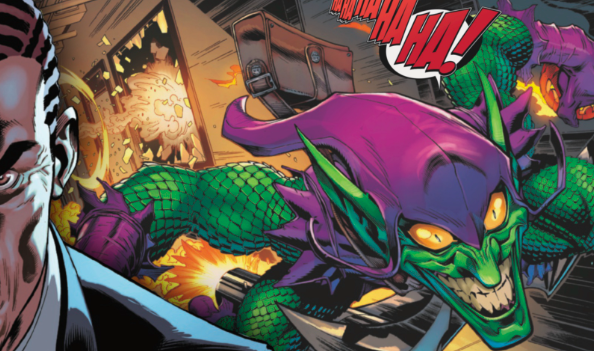
In the sprawling pantheon of comic book antagonists, few figures evoke the same visceral dread as the Green Goblin. While other villains might want to rob a bank or rule the world, the Goblin wants something far more intimate: he wants to shatter the soul of Peter Parker. He is the cackling shadow atop a high-tech glider, a monster birthed from corporate greed and chemical instability. To understand the Green Goblin is to understand the darkest corners of the Spider-Man mythos—a place where family ties are weaponized and heroism is met with unthinkable tragedy.
The rivalry between Spider-Man and the Green Goblin isn’t just a battle of brawn; it is a psychological war. It is a clash between a boy who believes that “with great power comes great responsibility” and a man who believes that power is a license to do whatever one desires. In this deep dive, we unmask the madness of Norman Osborn and explore why this emerald-clad menace remains the undisputed “greatest enemy” in the history of the wall-crawler.
1. The Corporate Shark: The Cold Heart of Norman Osborn
Before he ever donned a mask or threw a pumpkin bomb, Norman Osborn was a monster of a different variety: a ruthless industrialist. As the head of Oscorp, Norman embodied the “survival of the fittest” mentality. He was a man who prioritized profit over people and legacy over love. His cold, calculating nature made him a titan of industry, but it also left him emotionally hollow. This lack of empathy is the foundation of the Green Goblin. Unlike many villains who are victims of a “bad day,” Norman was already a predator in a three-piece suit.
The brilliance of his character lies in the duality of his power. By day, he is a respected pillar of the community and the father of Peter Parker’s best friend. By night, he is a cackling murderer. This creates a unique tension for Spider-Man; Peter cannot simply punch his way out of every problem when his enemy is also a man who holds the keys to the city’s economy and the heart of his best friend. Norman Osborn represents the corruption of the “American Dream,” showing what happens when ambition is untethered from morality.
2. The Formula for Madness: The Birth of a Super-Soldier
The Green Goblin was not a natural evolution; he was a chemical accident. Seeking to create a super-soldier serum to secure military contracts, Norman Osborn experimented with a volatile compound known as the “Goblin Formula.” During a laboratory mishap, the green liquid exploded in his face. The chemicals bathed his brain, drastically increasing his physical strength, intelligence, and healing capabilities. However, the price of this god-like power was his sanity. The formula fractured Norman’s mind, birthing the “Goblin” persona as a separate, more chaotic entity.
This transformation is a dark mirror to Peter Parker’s own origin. While the spider bite gave Peter power and a sense of duty, the Goblin Formula gave Norman power and a sense of entitlement. The physical enhancements are immense—the Goblin can trade blows with Spider-Man and survive injuries that would kill a normal man—but it is the mental boost that makes him truly dangerous. He became a tactical genius, capable of planning intricate traps that exploit Spider-Man’s every weakness. The formula didn’t just make him a monster; it made him a genius monster.
3. High-Tech Terror: The Engineering of the Glider
The image of the Green Goblin is inseparable from his iconic transport: the Goblin Glider. A masterpiece of aeronautic engineering, the glider is a bat-shaped wing capable of incredible speeds and pinpoint maneuverability. It is not just a vehicle; it is a weapon. Outfitted with heat-seeking missiles, machine guns, and even a “nitrogen exhaust” to blind pursuers, the glider allows the Goblin to dominate the New York City skyline. It turned a ground-based threat into an aerial predator.
The glider represents the technological side of the Goblin’s threat. It forces Spider-Man to fight in three dimensions, often high above the safety of the pavement. For Peter Parker, a hero who relies on sticking to surfaces, an enemy who can stay out of reach while raining fire from above is a constant tactical nightmare. The glider also symbolizes Norman’s vast resources; while Peter sews his own suits and mixes web fluid in a lab, the Goblin has the full R&D department of a multi-billion dollar corporation at his disposal, ensuring he is always one step ahead in the arms race.
4. The Pumpkin Bombs: A Whimsical Way to Die
The Green Goblin’s choice of weaponry is as eccentric as his personality. His most famous tools are the Pumpkin Bombs—incendiary grenades designed to look like jack-o’-lanterns. These “toys” are capable of melting through steel or releasing hallucinogenic gases. He also utilizes “Razor Bats,” sharp-edged boomerangs that track their targets, and “Ghost Bombs” that release a thick, suffocating smoke. The contrast between the festive appearance of these weapons and their lethal efficiency is a hallmark of the Goblin’s psychological warfare.
There is something deeply unsettling about a man laughing hysterically while throwing exploding holiday decorations. It reflects the Goblin’s view of the world as a dark joke. To him, the destruction of lives is a game, and the theatricality of his weapons is part of the fun. This whimsy makes him unpredictable; Spider-Man never knows if the next pumpkin will be a simple explosive, a sonic disruptor, or a gas designed to neutralize his Spider-Sense. By turning childhood imagery into tools of terror, the Goblin attacks the very concept of safety and innocence.
5. The Personal Vendetta: Knowing the Face Behind the Lens
What elevates the Green Goblin above all other Spider-Man villains is that he was the first to bridge the gap between Peter Parker’s two lives. Very early in their rivalry, Norman Osborn discovered that the “masked menace” was actually the nerdy kid from Queens. This knowledge transformed a simple hero-villain dynamic into a personal vendetta. Norman didn’t just want to kill Spider-Man; he wanted to destroy Peter Parker’s life, targeting his family, his friends, and his sanity.
This discovery changed the stakes of the series forever. It removed the safety net of the secret identity. When the Goblin knows who you are, no one is safe—not Aunt May, not Mary Jane, and not his own son, Harry. This creates a constant state of paranoia for Peter. Every time he sees Norman Osborn in a business suit, he has to wonder if the Goblin is lurking just beneath the surface, waiting for the perfect moment to strike at his heart. This intimacy makes the Goblin the most terrifying kind of enemy: the one you have to see at social gatherings.
6. The Night Gwen Stacy Died: The Bridge that Changed Everything
If there is one moment that defines the Green Goblin’s cruelty, it is the tragic death of Gwen Stacy. In a move that shocked the world of fiction, the Goblin kidnapped Peter’s first true love and took her to the top of a bridge. In the ensuing battle, Gwen fell, and despite Spider-Man’s attempt to catch her with a web-line, the whiplash of the sudden stop snapped her neck. This event shattered the “Silver Age” of comics, proving that being a hero had real, irreversible consequences.
The death of Gwen Stacy is the permanent scar on Peter Parker’s soul. It was the Goblin’s greatest “victory,” even though it eventually led to Norman’s own apparent death. By killing Gwen, the Goblin took away Peter’s hope for a normal, happy future. It was a calculated act of malice designed to prove that the “great responsibility” Peter carries is nothing but a burden of grief. Every interaction between the two characters since that night has been filtered through the lens of this tragedy, making their rivalry the most emotionally charged in the genre.
7. A Legacy of Madness: The Harry Osborn Problem
The tragedy of the Green Goblin is not limited to Norman; it extends to his son, Harry. Harry Osborn, Peter Parker’s best friend, eventually discovered the truth about his father and the man who “killed” him. Struggling with addiction and the weight of his father’s shadow, Harry took up the mantle of the Green Goblin himself. This forced Peter into the unthinkable position of having to fight his best friend, a man he viewed as a brother.
The “Legacy of the Goblin” is a recurring theme of corruption. It shows that Norman’s evil is like a virus, infecting those closest to him. Harry’s time as the Goblin was marked by a desperate need for his father’s approval and a fractured sense of reality. This family dynamic adds a layer of empathy to the story; Peter doesn’t just hate the Goblin, he pities the Osborns. He sees the potential for goodness in Harry, but the specter of Norman always manages to pull the family back into the darkness. It is a cycle of trauma that Peter is perpetually trying to break.
8. The Design of the Demon: Purple, Green, and Grinning
Visually, the Green Goblin is a masterpiece of character design. Created by the legendary Steve Ditko, the costume is a bizarre mix of a medieval jester and a folkloric goblin. The clashing colors of emerald green and royal purple are striking and unnatural, while the large, expressive eyes and the permanent, toothy grin create an “uncanny valley” effect. The mask is designed to look like a living creature, blurring the line between man and monster.
The design communicates the character’s personality instantly. He is loud, vibrant, and terrifyingly cheerful. The use of a satchel to carry his bombs adds a “trick-or-treat” element to his raids, reinforcing the idea of a twisted game. Unlike the sleek, modern designs of newer villains, the Goblin’s look is timelessly eerie. It suggests an ancient evil brought into the modern world of high-tech weaponry. When that green face emerges from the smoke of an explosion, the audience knows that chaos has arrived.
9. The Psychological Mirror: Power vs. Responsibility
The Green Goblin is the ultimate philosophical foil to Spider-Man. Peter Parker’s entire life is governed by the idea that his gifts are a debt he owes to society. Norman Osborn believes his gifts make him a god among insects. To Norman, responsibility is for the weak—a chain that holds back the truly great from achieving their potential. He views Peter as a waste of talent, someone who could be a king but chooses to be a servant.
This clash of ideologies is what makes their battles so compelling. The Goblin constantly tries to “break” Peter by forcing him into impossible moral dilemmas. He wants Peter to give in to his anger, to kill him, and to finally admit that the world is as cruel and chaotic as the Goblin believes it to be. Every time Peter refuses to sink to Norman’s level, he proves the Goblin wrong. This makes the Goblin’s hatred even more intense; he cannot stand the existence of a man who possesses great power but refuses to use it for selfish gain.
10. The Unending Resurrection: Why the Goblin Never Stays Dead
In the world of heroes and villains, death is often a revolving door, but for the Green Goblin, it is a part of his mythos. Norman Osborn has “died” numerous times—most notably by his own glider—only to return years later, often revealed to have been pulling the strings of Spider-Man’s life from the shadows. His ability to survive is not just a result of the Goblin Formula’s healing factor; it is a narrative necessity. The Goblin is the “final boss” of Peter Parker’s life.
His returns are always significant because they signify a return to the personal, psychological stakes of Peter’s youth. Whether he is taking over a criminal empire, manipulating the government, or simply stalking Peter’s family, Norman’s presence raises the tension to a fever pitch. He is the one villain Peter can never truly move past. As long as there is a Peter Parker, there will be a Green Goblin waiting in the wings to remind him that being a hero is a dangerous, heartbreaking, and never-ending job.
Further Reading
- The Death of Gwen Stacy (The Amazing Spider-Man #121-122) by Gerry Conway and Gil Kane
- Spider-Man: Blue by Jeph Loeb and Tim Sale
- The Osborn Journal by Glenn Greenberg
- Spider-Man: A Death in the Family by Howard Mackie and John Romita Jr.
- The Amazing Spider-Man: Revelations by J. Michael Straczynski
One response to “The Goblin’s Grin: 10 Dark Secrets Behind Spider-Man’s Deadliest Obsession”
[…] The Goblin’s Grin: 10 Dark Secrets Behind Spider-Man’s Deadliest Obsession […]