
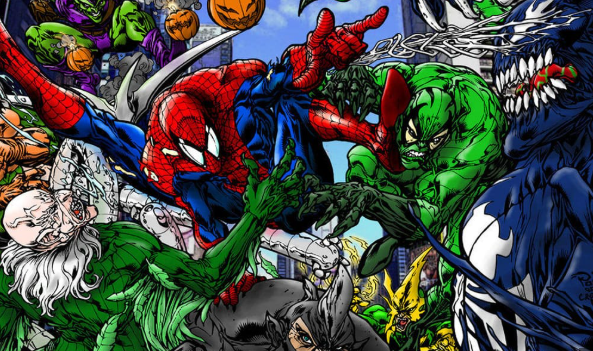
In the vast tapestry of the Marvel Universe, a hero is only as compelling as the obstacles they face. While many heroes battle cosmic entities or intergalactic tyrants, Spider-Man’s world is defined by a “Rogues’ Gallery” that is intensely personal, tragically human, and visually spectacular. These aren’t just monsters in masks; they are reflections of Peter Parker’s own life, scientific ambitions gone wrong, and the dark consequences of power without responsibility.
To understand Spider-Man is to understand the “Sinister” forces that constantly test his resolve. From the billionaire brilliance of the Green Goblin to the alien hunger of Venom, each antagonist serves a specific narrative purpose, challenging the wall-crawler physically, intellectually, and morally. This comprehensive guide explores the ten most significant villains in the Spider-Man mythos, detailing their origins, their motivations, and why they remain the gold standard for comic book villainy.
1. The Green Goblin: The Archenemy and the Osborn Legacy
If Spider-Man has a definitive arch-nemesis, it is the Green Goblin. Norman Osborn, a ruthless industrialist and the father of Peter’s best friend, Harry, became the Goblin after an experimental “Goblin Formula” granted him superhuman strength at the cost of his sanity. Riding a high-tech bat-glider and armed with a cache of pumpkin bombs, the Green Goblin represents the antithesis of everything Peter Parker stands for. While Peter uses his gifts to help others, Norman uses his to exert dominance and satisfy his megalomania.
The Green Goblin is unique because the conflict is deeply personal. Norman isn’t just a costumed criminal; he is a man who knows Peter’s secret identity and has used that knowledge to systematically dismantle Peter’s life. The tragedy of the Osborn family—with Harry often caught in the middle—adds a layer of Shakespearean drama to their battles. The Goblin is the shadow that looms over Peter’s happiest moments, a constant reminder that his life as a hero carries a heavy price for those he loves. He is the monster who proved that in Spider-Man’s world, the hero doesn’t always save everyone.
2. Doctor Octopus: The Dark Reflection of Scientific Ambition
Dr. Otto Octavius was once a brilliant nuclear physicist, a man Peter Parker might have grown up to be had his life taken a different path. After a laboratory accident fused four mechanical, telepathically controlled tentacles to his torso, Octavius turned to a life of crime as Doctor Octopus. With his bowl-cut hair and heavy spectacles, he initially seems unassuming, but his genius-level intellect and the sheer versatility of his mechanical arms make him one of Spider-Man’s most formidable physical and mental threats.
“Doc Ock” serves as a cautionary tale about the dangers of intellectual arrogance. He views himself as superior to the “ignorant masses,” including Spider-Man, whom he often dismisses as a mere nuisance. Their rivalry is a “battle of the brains” as much as it is a physical brawl. Interestingly, Octavius is also the founder of the Sinister Six, proving his capability as a master strategist. He doesn’t just want to defeat Spider-Man; he wants to prove his objective superiority. This obsession with legacy and brilliance makes him a complex figure who, at times, has even attempted to prove he could be a “superior” hero to Peter himself.
3. Venom: The Shadow Self and the Lethal Protector
Venom is perhaps the most visually striking and terrifying entity in the rogue’s gallery. The character is a dual being: a sentient alien symbiote that once bonded with Peter Parker, and Eddie Brock, a disgraced journalist who blames Spider-Man for his professional ruin. Together, they form a monstrous version of the wall-crawler, complete with web-swinging abilities and a physique that dwarfs the original hero. Venom is the “Shadow Self”—a dark, distorted mirror that possesses all of Spider-Man’s powers but none of his restraint.
What makes Venom so terrifying is that the symbiote knows Peter’s every thought and secret, and it can bypass his “Spider-Sense,” the early-warning system that usually keeps Peter safe. This negates Spider-Man’s greatest tactical advantage. Over time, the character has evolved from a vengeful stalker into a “Lethal Protector,” an anti-hero who protects those he deems innocent while remaining brutally violent toward those he considers guilty. This moral ambiguity and the symbiotic relationship between the host and the alien make Venom a fascinating study in shared trauma and redirected rage.
4. The Lizard: The Tragedy of a Good Man’s Mutation
Dr. Curt Connors is not a villain by choice, which makes his story one of the most heartbreaking in the series. A gifted surgeon who lost his arm in a war, Connors developed a serum based on reptilian DNA in hopes of regenerating his limb. While the serum worked, it had the horrific side effect of transforming him into a giant, mindless bipedal lizard. In this form, Connors’ brilliant mind is suppressed by a savage, predatory instinct that views all mammals as enemies.
The Lizard highlights the recurring theme of the “mad scientist” but adds a layer of familial tragedy. Peter Parker is often caught in a position where he cannot simply “defeat” the villain; he must save the man inside. Every battle with the Lizard is a race against time to administer a cure before Connors hurts his own wife and son or causes irreparable damage to the city. This dynamic forces Spider-Man to use his scientific skills in the heat of battle, emphasizing that his greatest victories are often those where he manages to bring a friend back from the brink of monstrosity.
5. Sandman: The Reluctant Criminal and the Power of Form
Flint Marko, the man who became the Sandman, represents the blue-collar criminal element of Spider-Man’s world. After being exposed to radioactive sand at a nuclear testing site, Marko gained the ability to transform his body into a granular substance at will. He can harden his limbs into massive hammers, turn into a localized sandstorm, or slip through the smallest of cracks. He is a master of molecular manipulation, making him nearly impossible to restrain through traditional means.
Unlike the Green Goblin or Doctor Octopus, Sandman is rarely motivated by world domination or personal vendettas. He is often portrayed as a man driven by simple greed or a desperate desire to provide for his family. This makes him one of Spider-Man’s more sympathetic foes. Peter often tries to appeal to Marko’s better nature, recognizing that he is a victim of circumstance rather than a truly evil person. The visual creativity of their battles—often involving water, heat, or vacuum cleaners—showcases the “problem-solving” aspect of Spider-Man’s heroism, as he must find creative ways to defeat an opponent who can literally slip through his fingers.
6. Electro: The High-Voltage Price of Being Overlooked
Max Dillon was a common electrical linesman who gained the power to generate and control vast amounts of electricity after a freak accident involving power lines and experimental chemicals. As Electro, he is a living capacitor, capable of firing lethal bolts of lightning, riding electrical currents, and even disrupting the bio-electricity in Spider-Man’s own body. Visually, he is often depicted with a striking lightning-bolt mask, symbolizing his explosive power and his equally volatile ego.
Electro represents the danger of a small man gaining immense power. Before his accident, Max Dillon felt ignored and disrespected by society. Once he became Electro, he used his abilities to command the attention he felt he was owed, usually through theft and destruction. He is often driven by an inferiority complex, which makes him prone to fits of rage when Spider-Man mocks him. His battles with the wall-crawler are high-stakes spectacles that often light up the New York City skyline, serving as a reminder that even the most “unseen” individuals can become world-shaking threats if they are pushed too far.
7. Mysterio: The Master of Illusions and the Death of Truth
Quentin Beck was a failed Hollywood special effects wizard and stuntman who realized his talents for deception could be used for a far more lucrative career in crime. As Mysterio, he wears a distinctive “fishbowl” helmet and utilizes a sophisticated array of holographic projectors, hallucinogenic gases, and robotic drones to create convincing illusions. He doesn’t just fight Spider-Man; he attacks his mind, making the hero doubt his senses and his very reality.
Mysterio is a villain of the information age. He understands that perception is reality. He can make Spider-Man believe he is a giant, that the city is melting, or that he has lost his powers. Because Mysterio has no actual superpowers, he relies entirely on his intellect and his mastery of theatricality. This makes him a unique challenge for Peter, whose Spider-Sense is often baffled by Mysterio’s multi-sensory deceptions. Their encounters are surreal, psychedelic journeys that highlight the importance of truth and the danger of being misled by a master manipulator who treats the entire world as his stage.
8. Kraven the Hunter: The Ultimate Predator and the Honor of the Kill
Sergei Kravinoff, known as Kraven the Hunter, is a world-class big-game hunter who views Spider-Man as the “ultimate prey.” Unlike many of Peter’s foes, Kraven doesn’t use high-tech gadgets or scientific mutations (though he does use mystical herbs to enhance his physical senses and strength). He relies on ancient hunting techniques, traps, and his own peak-human conditioning. Kraven is driven by a strict, albeit twisted, code of honor and an obsession with proving himself the greatest hunter in history.
Kraven’s most famous narrative involvements explore the psychological toll of the hunt. He doesn’t just want to kill Spider-Man; he wants to “best” him, to understand him, and eventually, to replace him. This creates a primal, almost mythic rivalry. Kraven views the urban jungle of New York through the lens of the African veldt, and he sees Spider-Man as a noble beast that must be conquered to validate Kraven’s own existence. His presence adds a grim, stoic tone to the rogue’s gallery, reminding Peter that there are those who hunt not for money or power, but for the dark satisfaction of the kill.
9. Kingpin: The Untouchable Crime Lord of the Concrete Jungle
Wilson Fisk, the Kingpin of Crime, is a villain who operates on a different scale than the others. While he possesses immense physical strength—his massive frame is composed almost entirely of muscle—his true power lies in his influence. He sits at the center of a web of corruption that extends into the police department, the judicial system, and the city’s highest offices. Kingpin is the “untouchable” villain, a man who can ruin Peter Parker’s life with a phone call or a signature.
The conflict between Spider-Man and Kingpin is a battle between street-level justice and systemic evil. Peter can punch a monster, but he can’t easily punch a “legitimate” businessman who has the city in his pocket. Fisk is cold, calculating, and utterly ruthless, often using Peter’s loved ones as leverage. He views Spider-Man as a chaotic variable that disrupts his orderly criminal empire. This rivalry forces Peter to deal with the complexities of the law and the frustrating reality that sometimes, the “bad guy” is protected by the very system the hero is trying to uphold.
10. The Vulture: The Scavenger’s Spite and the Theft of Youth
Adrian Toomes, the Vulture, was an elderly electronics engineer who was cheated out of his company by a younger partner. In a fit of vengeful genius, he perfected a flight harness that not only granted him the ability to soar like a bird but also enhanced his physical strength to superhuman levels. As the Vulture, he is a bitter, cynical scavenger who preys on the society he feels has discarded him. His avian suit, featuring sharp, metallic wings, makes him a deadly aerial combatant.
The Vulture provides a fascinating age-based foil for Spider-Man. Peter is the embodiment of youthful potential and altruism, while Toomes is the embodiment of aged resentment and greed. Toomes often views himself as a victim, justifying his crimes as “taking back” what the world owes him. His fights with Spider-Man are often breathtaking dogfights through the skyscrapers of New York. The Vulture’s presence in the rogues’ gallery serves as a reminder that bitterness can be just as corrosive as any radioactive chemical, turning a brilliant mind into a predatory force of nature.
Further Reading
- The Amazing Spider-Man: The Death of Gwen Stacy by Gerry Conway
- Spider-Man: Kraven’s Last Hunt by J.M. DeMatteis
- Spider-Man: Birth of Venom by Randy Schueller, Jim Shooter, and Todd McFarlane
- The Sinister Six (The Amazing Spider-Man Annual #1) by Stan Lee and Steve Ditko
- Spider-Man: Blue by Jeph Loeb and Tim Sale




2 responses to “Web of Terror: 10 Iconic Spider-Man Villains and Why They Are Unforgettable”
[…] Web of Terror: 10 Iconic Spider-Man Villains and Why They Are Unforgettable […]
[…] Web of Terror: 10 Iconic Spider-Man Villains and Why They Are Unforgettable […]