
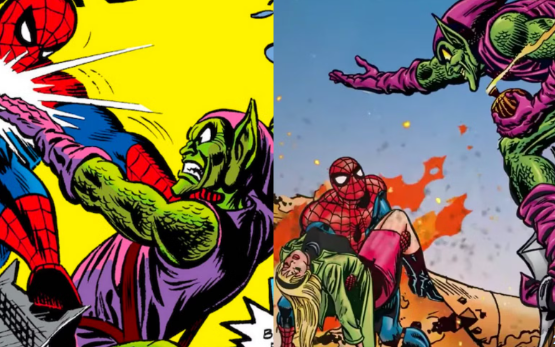
In the vast landscape of superhero rivalries, few match the sheer psychological brutality of the feud between Spider-Man and the Green Goblin. While other villains might seek to rob a bank or conquer the world, the Goblin’s mission is far more sinister: he wants to break Peter Parker. This is not just a clash of superpowers; it is a war between two different philosophies of power. One man believes power is a debt owed to the world, while the other believes it is a license to dominate the weak.
This rivalry has defined the web-slinger’s history for decades. It is a story of tragic coincidences, shared secrets, and the heavy price of wearing a mask. To understand why the Green Goblin is Spider-Man’s greatest enemy, one must look past the pumpkin bombs and the gliders to the two men underneath. This guide serves as the definitive introduction to the most personal, painful, and persistent conflict in the Marvel Universe.
1. The Genesis of a Grudge: An Unlikely First Encounter
The rivalry began not with a grand vendetta, but with a calculated business move. When the Green Goblin first appeared, he was a mystery even to the readers. Clad in emerald scales and riding a high-tech “broomstick” (which later evolved into the iconic bat-shaped glider), his initial goal was to organize the criminal underworld of New York City. To do this, he needed a trophy: the head of Spider-Man. He tricked the wall-crawler into a fake movie production in the desert, leading to a chaotic three-way battle that even involved the Incredible Hulk.
This early period established the Goblin as a tactical genius. He didn’t just want to punch Spider-Man; he wanted to outthink him. Unlike the street thugs Peter usually fought, the Goblin operated with a level of theatricality and resources that were unprecedented. He was the first villain to treat Spider-Man like a peer in a high-stakes game of chess. This foundational era set the tone for their future interactions, proving that the Green Goblin was not just another “villain of the week,” but a predator who had chosen Spider-Man as his primary prey.
2. The Unmasking: A Secret Shared in the Shadows
The most pivotal moment in the early history of the rivalry occurred when the Green Goblin managed to do the impossible: he discovered Spider-Man’s secret identity. By utilizing a gas that dulled Peter’s “spider-sense,” Norman Osborn was able to follow the hero home without being detected. In a move of staggering arrogance, he kidnapped Peter and revealed his own face, unmasking himself as the father of Peter’s best friend, Harry Osborn. This revelation changed the stakes of the conflict forever, transforming a superhero battle into a family tragedy.
Suddenly, the “masked menace” wasn’t just a monster in the sky; he was a man Peter saw at social gatherings and holiday dinners. This breach of the secret identity is what elevates the Goblin above foes like Doctor Octopus or Sandman. By knowing the face behind the mask, Norman gained the ability to strike at Peter’s heart, not just his health. The psychological weight of this secret became a permanent burden for Peter, as he realized that as long as Norman Osborn was alive, no one he loved would ever truly be safe.
3. The Bridge of No Return: The Death of Gwen Stacy
If there is a single event that defines this rivalry, it is the tragic night on the Brooklyn Bridge. In a fit of vengeful madness, the Green Goblin kidnapped Peter’s first true love, Gwen Stacy. During the ensuing battle, Gwen fell from the bridge. Despite Spider-Man’s desperate attempt to save her with a web-line, the whiplash of the sudden stop proved fatal. This moment didn’t just break Peter Parker; it broke the “Silver Age” of comic books, proving that being a hero could lead to irreversible, soul-crushing loss.
The death of Gwen Stacy is the permanent scar on the Spider-Man mythos. It was the moment the Green Goblin transitioned from a formidable foe to a source of pure, unadulterated trauma. The Goblin didn’t just kill Gwen to hurt Spider-Man; he did it to prove that Peter’s moral code was a weakness. Even though the battle ended with Norman seemingly impaled by his own glider, the damage was done. Every time Peter puts on the mask, the memory of that bridge and the sound of the snap serves as a haunting reminder of the cost of his responsibility.
4. The Goblin Formula: The Chemistry of Madness
The physical threat of the Green Goblin is powered by a volatile chemical compound known as the “Goblin Formula.” Developed by Norman Osborn to create a super-soldier, the serum granted him superhuman strength, reflexes, and a healing factor that rivals the world’s most powerful mutants. However, the serum came with a devastating side effect: it fractured his mind. The Green Goblin is not just a costume; it is a secondary, psychotic personality that lives within Norman, fueled by chemical instability and deep-seated arrogance.
This chemical origin provides a dark mirror to Peter Parker’s own transformation. While Peter’s spider-bite was a fluke of science that led to a sense of duty, Norman’s serum was a deliberate pursuit of power that led to a descent into narcissism. The formula enhances Norman’s already considerable intellect, making him a master of chemistry and engineering, but it also strips away his empathy. This “madness” makes the Goblin unpredictable; he is just as likely to plan a corporate takeover as he is to burn down an orphanage, making him a constant, volatile threat to the city.
5. High-Tech Terror: The Glider and the Pumpkin Bombs
While the formula provides the brawn, the technology provides the terror. The Green Goblin is synonymous with his “Goblin Glider,” a masterpiece of aeronautic engineering that allows him to dominate the skyline. The glider is more than just transportation; it is an extension of the Goblin’s body, armed with heat-seeking missiles, machine guns, and razor-sharp wings. It forces Spider-Man to fight in a three-dimensional arena, stripping away the hero’s advantage of staying grounded or sticking to walls.
Complementing the glider is the Goblin’s cache of specialized weaponry, most notably the “Pumpkin Bombs.” These incendiary grenades are designed to look like festive jack-o’-lanterns, but they are capable of melting through steel or releasing hallucinogenic gases. He also utilizes “Razor Bats”—sharp, bat-shaped boomerangs that can track targets. This choice of weaponry reflects the Goblin’s twisted sense of humor and his desire to turn symbols of fun into tools of death. For Peter Parker, hearing the cackle of the Goblin and the hum of the glider is a signal that a nightmare is descending from the sky.
6. The Generational Curse: The Tragedy of Harry Osborn
The rivalry between Spider-Man and the Green Goblin is not limited to one generation. The most tragic chapter involves Norman’s son, Harry Osborn. Struggling with the shadow of his father’s legacy and his own mental health, Harry eventually discovered the truth about both his father and his best friend, Peter. Driven by a mixture of grief and drug-fueled instability, Harry took up the mantle of the Green Goblin to avenge his father’s “death,” forcing Peter into the heartbreaking position of fighting his closest friend.
Harry’s time as the Goblin added a layer of emotional complexity to the feud. Peter didn’t want to defeat Harry; he wanted to save him. This era explored the “sins of the father” and how Norman’s toxic influence corrupted everything he touched. Harry’s eventual sacrifice—where he used his final moments to save Peter and Mary Jane—was a redemptive arc that highlighted the human cost of the Goblin legacy. It proved that the mask wasn’t just a tool for Norman’s ego; it was a curse that haunted the entire Osborn family line.
7. The Mastermind of the Shadows: The Return of Norman Osborn
For many years, the world believed Norman Osborn was dead, but the true depth of his villainy was revealed when it was discovered he had spent years in Europe, pulling the strings of Peter’s life from afar. This era, often associated with the “Clone Saga,” saw Norman return not just as a costumed criminal, but as a global mastermind. He revealed that he had orchestrated some of the most confusing and painful events in Peter’s life, including the return of his clones and the supposed death of his child.
This “return from the dead” cemented the Goblin as the ultimate “final boss” of the Spider-Man story. It showed that Norman was capable of playing a “long game” that spanned years and continents. He had moved beyond simple bank robberies to focus on the systematic destruction of Peter Parker’s legacy. By the time he officially stepped back onto the New York stage, he had transformed from a local menace into a high-level threat who could challenge the Avengers and take over the nation’s security, always with the primary goal of making Peter suffer.
8. Philosophical Antagonism: Power vs. Responsibility
At its core, the battle between Spider-Man and the Green Goblin is a philosophical debate fought with fists and bombs. Peter Parker lives by the creed that “with great power there must also come great responsibility.” He views his abilities as a debt to society. Norman Osborn, conversely, believes that power is its own justification. To Norman, those with power are “gods” who should rule over the “insects” of the common populace. He views Peter’s altruism not as a virtue, but as a pathetic waste of potential.
The Goblin is constantly trying to “prove” that Peter is just like him. He creates impossible moral dilemmas designed to force Peter into making selfish choices or taking a life. He wants Peter to give in to his rage and finally admit that the world is a chaotic, cruel place where only the strong survive. Every time Peter refuses to sink to the Goblin’s level—every time he chooses to save a life instead of taking one—he defeats the Goblin ideologically. This clash makes their rivalry deeply meaningful, as it tests the very core of Peter Parker’s character in every encounter.
9. Cinematic Clashes: The Evolution of a Screen Rivalry
The legendary feud has been adapted for the screen multiple times, each iteration bringing a new flavor to the conflict. The most iconic version featured a “father figure” dynamic, where Norman was a mentor to Peter before his descent into madness. This version emphasized the tragedy of the split personality, with Norman literally arguing with his own reflection in a mirror. The visual of the green armored suit and the chilling cackle set the standard for how general audiences view the character.
Later adaptations and multiversal crossovers have further explored the Goblin’s capacity for multiversal chaos. In these appearances, the Goblin is often portrayed as a “universal constant”—a threat so dangerous that he can cross the boundaries of reality just to find a version of Peter Parker to torment. These films have highlighted the Goblin’s role as the ultimate spoiler; he is the character who disrupts the status quo and forces the hero to face his darkest fears. Whether on the page or the screen, the sight of the Green Goblin ensures that the stakes are at their absolute highest.
10. The Legacy of the Hood: Hobgoblins and Successors
The impact of the Green Goblin is so vast that he has inspired a small army of successors and imitators. The most famous of these is the Hobgoblin, a mystery villain who utilized Norman’s abandoned equipment and improved upon the Goblin Formula to eliminate the madness. The mystery of the Hobgoblin’s identity haunted Peter for years, showing that even when Norman was gone, the “Goblin” archetype continued to plague New York City.
Other versions, like the “Goblin King” or various female “Goblin Queens,” have emerged over the decades, proving that the emerald identity is a mantle of terror that anyone with enough ambition and enough chemicals can pick up. However, none of these imitators have ever truly replaced the original. Norman Osborn remains the definitive Green Goblin because his hatred for Peter Parker is uniquely personal. The legacy of the Goblin is one of endless reinvention, but it always returns to the two men—the kid from Queens and the billionaire from Oscorp—locked in an eternal struggle for the soul of the city.
Further Reading
- The Amazing Spider-Man: The Death of Gwen Stacy by Gerry Conway and Gil Kane
- Spider-Man: Blue by Jeph Loeb and Tim Sale
- The Spectacular Spider-Man: The Child Within by J.M. DeMatteis and Sal Buscema
- Spider-Man: A Death in the Family by Howard Mackie and John Romita Jr.




One response to “The Emerald Grudge: Why Spider-Man vs. Green Goblin Is the Ultimate Battle of Wills”
[…] The Emerald Grudge: Why Spider-Man vs. Green Goblin Is the Ultimate Battle of Wills […]