
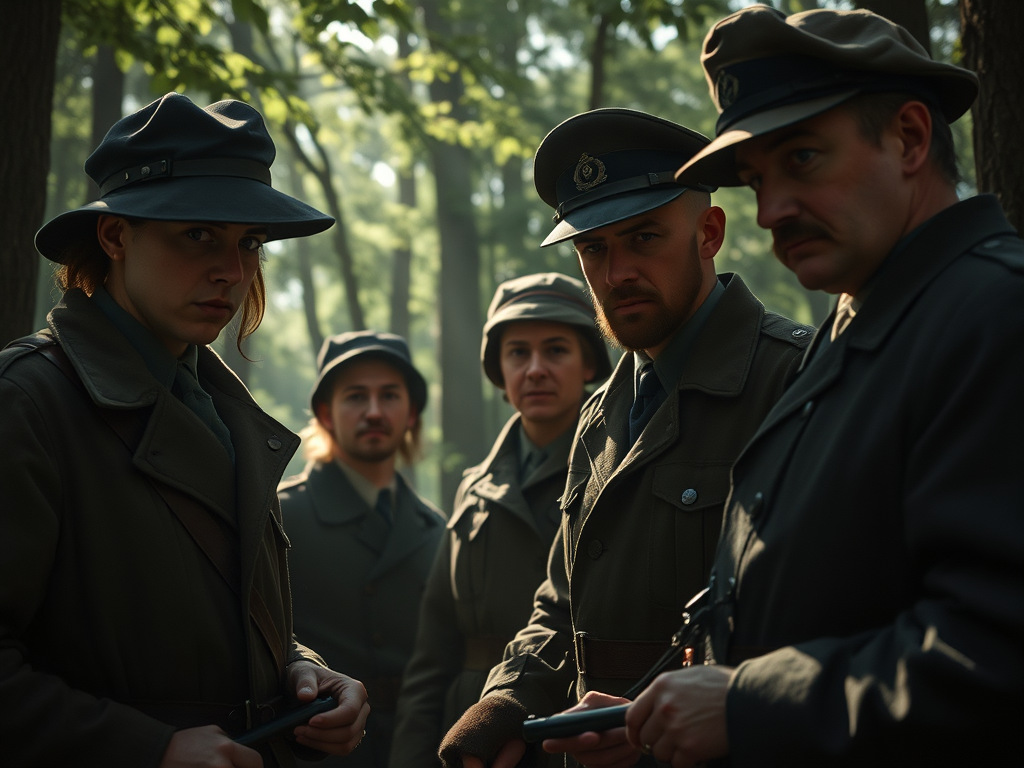
Imagine a time when the world was plunged into darkness, and brave heroes had to fight not on open battlefields, but in the shadows, using cunning and courage. That’s the story of “Churchill’s Secret Warriors,” a group of extraordinary men and women who risked everything to fight the Nazis in World War II. They weren’t regular soldiers marching in uniform; they were spies, saboteurs, and secret agents, handpicked by Prime Minister Winston Churchill himself to “set Europe ablaze!”
This incredible organization was called the Special Operations Executive, or SOE for short. Formed in 1940, when Britain faced the very real threat of a German invasion, the SOE was Churchill’s answer to fighting back when traditional armies couldn’t. Their mission was simple yet incredibly dangerous: go behind enemy lines in occupied Europe, disrupt the Nazi war machine, and support local resistance movements. Think of them as the ultimate underdog team, using their wits and bravery to outsmart a much larger and more powerful enemy.
The SOE agents came from all walks of life – teachers, writers, engineers, even poets. They were trained in secret country houses in skills like espionage, sabotage, and guerrilla warfare. Many paid the ultimate price for their bravery, but their actions played a vital role in weakening the Nazi grip on Europe and paving the way for the Allied victory. Their story is a thrilling tale of courage, ingenuity, and unwavering dedication to freedom. So, let’s uncover the top ten fascinating facts about these incredible secret warriors.
1. Born from Necessity: Churchill’s Call to “Set Europe Ablaze!”
In the dark days of 1940, after the evacuation from Dunkirk, Britain stood largely alone against the might of Nazi Germany. Winston Churchill, the determined Prime Minister, knew that a different kind of war was needed. He famously ordered the creation of the Special Operations Executive (SOE) with the clear and audacious directive to “set Europe ablaze!” This wasn’t about conventional warfare; it was about striking from within, creating chaos and resistance in German-occupied territories.
The SOE was a brand-new idea, combining elements of propaganda, sabotage, and guerrilla warfare under one secret umbrella. Before this, such operations were often seen as “ungentlemanly.” But desperate times called for desperate measures. Churchill understood that to fight a powerful enemy, Britain needed to use every tool at its disposal, even if it meant fighting dirty. The SOE was essentially a secret army, working silently to undermine the enemy, proving that even a small, determined force could make a huge difference in the face of overwhelming odds.
2. The Ministry of Ungentlemanly Warfare: A Secretive Nickname
The SOE quickly earned several nicknames, reflecting its unique and often unconventional methods. One of the most famous was the “Ministry of Ungentlemanly Warfare.” This playful yet accurate title highlighted the fact that the SOE’s work involved activities that were far from the traditional rules of war. They specialized in things like sabotage, assassinations, and psychological warfare – methods that military leaders at the time might have considered less “honorable” but were absolutely necessary to win.
Imagine a secret club where the members learn to pick locks, build bombs out of everyday items, and disappear without a trace. That’s the kind of training the SOE provided. Their agents were taught to blend in, gather intelligence, disrupt supply lines, and even encourage local populations to resist the occupation. This unofficial nickname, though humorous, perfectly captured the SOE’s daring spirit and their willingness to do whatever it took to undermine the enemy, even if it meant breaking all the “rules.”
3. From Ordinary People to Extraordinary Spies: Agent Recruitment
One of the most remarkable things about the SOE was who they recruited. They weren’t just looking for soldiers; they sought out ordinary men and women from all walks of life. Teachers, shopkeepers, engineers, linguists, artists – anyone with a particular skill, a calm demeanor, and an unwavering sense of patriotism could become an agent. Many had special knowledge of occupied countries, often because they had lived there before the war.
Imagine being chosen for a super-secret mission, not because you’re a muscle-bound hero, but because you’re good at puzzles, or speak another language perfectly, or can fix anything. The SOE valued intelligence, adaptability, and nerve above all else. They looked for people who could think on their feet, blend into any crowd, and withstand immense pressure. This diverse group of recruits meant the SOE had a wide range of talents to draw upon, making them incredibly effective in their varied missions.
4. The Grueling Training: Learning the Dark Arts of Espionage
Before an agent could be sent behind enemy lines, they had to undergo incredibly rigorous and secret training. These training schools were hidden in secluded country estates across Britain, disguised as ordinary civilian properties. Here, recruits learned everything from unarmed combat and silent killing to radio operation, codes, and demolition. It was like going to a very dangerous, very real-life spy school!
They learned how to parachute at night, how to forge documents, how to live off the land, and how to withstand interrogation. Imagine practicing blowing up bridges with real explosives, or learning to transmit secret messages using a tiny radio hidden in a suitcase. The training was designed to be tough, pushing agents to their limits, both physically and mentally, to prepare them for the immense dangers they would face. Only the very best, the most resourceful and resilient, passed these demanding courses.
5. Women in the Shadows: Courageous Female Agents
While many people think of spies as men, the SOE famously recruited and deployed a significant number of women as agents, particularly in France. These brave women often served as couriers, carrying vital messages and funds, or as wireless operators, sending and receiving secret radio communications – a role so dangerous they were known as “pianists” because of their work on the radio keys.
Imagine being a young woman, parachuting into enemy territory, knowing that if you were caught, you faced torture and death. Women like Noor Inayat Khan, a wireless operator who was eventually captured and executed, and Nancy Wake, known as “The White Mouse” for her ability to evade the Gestapo, showed incredible bravery and resilience. Their ability to blend in and often be less suspected by the enemy gave them a unique advantage, making their contributions absolutely vital to the SOE’s success.
6. Sabotage and Disruption: Hitting the Enemy Where It Hurt
The SOE’s primary mission was to disrupt the enemy’s war effort through sabotage. This meant blowing up railway lines, destroying factories, damaging infrastructure, and generally making life as difficult as possible for the occupying forces. Think of it as creating countless small problems that, when added together, became a massive headache for the Nazis.
Imagine agents sneaking into a heavily guarded factory at night to plant explosives that would halt production of tanks or aircraft. Or imagine them derailing trains carrying vital supplies to the front lines. These acts of sabotage were designed to slow down the German war machine, divert resources, and create a climate of fear and uncertainty. Every explosion, every broken piece of machinery, contributed to weakening the enemy’s ability to fight and helped to boost the morale of the occupied populations.
7. Supporting Resistance Movements: Fueling the Fight for Freedom
Beyond their own direct actions, a crucial part of the SOE’s role was to support, supply, and train local resistance movements in occupied countries. These resistance fighters, often ordinary citizens, were eager to fight back against the Nazis but needed help with weapons, explosives, and training.
Imagine a network of brave civilians, hiding in forests or operating from secret apartments, waiting for help to arrive from outside. SOE agents would parachute in, carrying money, arms, and communication equipment, then connect with these groups, teaching them how to organize, how to use explosives, and how to gather intelligence. This support was incredibly important, giving these local heroes the tools and knowledge they needed to conduct their own vital operations against the occupiers, showing them they were not alone.
8. The Wireless Operators: The Most Dangerous Job
Among all the dangerous roles in the SOE, being a wireless operator was arguably the most perilous. These agents were responsible for maintaining secret radio contact with London, sending vital intelligence and receiving orders. Their radios, often hidden in suitcases, were their lifelines, but also their greatest risk.
Imagine having to set up a bulky radio in a hidden attic, knowing that every time you transmit, the enemy’s direction-finding vans are trying to pinpoint your location. The average lifespan of a wireless operator in occupied France was just six weeks before they were caught. Yet, these courageous individuals continued their work, understanding that without their transmissions, the entire network would go blind. Their ability to send and receive coded messages was the nervous system of the SOE, connecting the agents in the field to their commanders back in Britain.
9. The Ultimate Sacrifice: The Price of Secrecy
The world of secret warfare was brutal, and many SOE agents paid the ultimate price for their bravery. If caught, they faced torture, imprisonment, and often execution. The secrecy surrounding their missions meant that if they disappeared, their families often wouldn’t know their fate until after the war, if ever.
Imagine knowing that every mission could be your last, and that if you were caught, there would be no rescue. Despite these terrifying risks, men and women volunteered for the SOE, driven by a deep sense of duty and a fierce desire to liberate Europe from Nazi tyranny. Their sacrifices were a testament to their extraordinary courage and commitment, and their stories serve as a powerful reminder of the hidden human cost of war.
10. Legacy of the Secret Warriors: Forging Modern Special Forces
The methods and techniques pioneered by Churchill’s Secret Warriors in the SOE had a lasting impact, laying the groundwork for many of the modern special forces units we see today. The idea of small, highly trained teams operating behind enemy lines, conducting sabotage, and working with local resistance groups, was revolutionary.
Think of elite military units that operate in the shadows today. Many of their tactics and much of their training can be traced back to the innovative approaches developed by the SOE. The “Ministry of Ungentlemanly Warfare” showed that a flexible, adaptive, and highly skilled force, even if small in number, could achieve significant strategic objectives. Their daring spirit and innovative methods continue to inspire and influence special operations around the world, proving that even in the darkest times, cleverness and bravery can overcome overwhelming odds.
Further Reading
- “Churchill’s Secret Warriors: The Explosive True Story of the Special Forces Desperadoes of WWII” by Damien Lewis
- “Nancy Wake: The White Mouse” by Russell Braddon
- “Code Name Lise: The True Story of the Woman Who Became WWII’s Most Highly Decorated Spy” by Larry Loftis
- “Spy Princess: The Life of Noor Inayat Khan” by Shrabani Basu
- “A Woman of No Importance: The Untold Story of the American Spy Who Helped Win World War II” by Sonia Purnell
Here at Zentara.blog, our mission is to take those tricky subjects and unlock them, making knowledge exciting and easy to grasp for everyone. But the adventure doesn’t stop on this page! We’re constantly exploring new frontiers and sharing discoveries across the digital universe.
Want to dive deeper into more mind-bending Top 10s and keep expanding your world? Come join us on our other platforms – we’ve got unique experiences waiting for you on each one!
- Get inspired by visual wonders and bite-sized facts: See the world through Zentara’s eyes on Pinterest! Pin our fascinating facts and stunning visuals to your own boards. Explore Pins on Pinterest: https://uk.pinterest.com/zentarablog/
- Discover quick insights and behind-the-scenes peeks: Hop over to Tumblr for snippets, quotes, and unique content you won’t find anywhere else. It’s a different flavour of discovery! Follow the Fun on Tumblr: https://www.tumblr.com/zentarablog
- Ready for deep dives you can listen to or watch? We’re bringing our accessible approach to video and potentially audio! Subscribe to our YouTube channel and tune into future projects that make learning pop! Subscribe on YouTube: https://www.youtube.com/@ZentaraUK
- Seeking even more knowledge in one place? We’ve compiled some of our most popular topic deep dives into fantastic ebooks! Find them on Amazon and keep the learning journey going anytime, anywhere. Find Our Ebooks on Amazon: https://www.amazon.co.uk/s?k=Zentara+UK&ref=nb_sb_noss
- Connect with us and fellow knowledge seekers: Join the conversation on BlueSky! We’re sharing updates, thoughts, and maybe even asking you what wonders we should explore next. Chat with Us on BlueSky: https://bsky.app/profile/zentarablog.bsky.social
- Perfect for learning on the move! We post multiple 10-minute podcasts per day on Spotify. Pop on your headphones and fill your day with fascinating facts while you’re out and about! Listen on Spotify: https://open.spotify.com/show/3dmHbKeDufRx95xPYIqKhJ
- Follow us on Instagram for bytesize knowledge! We post multiple posts per day on our official Instagram account.
https://www.instagram.com/zentarablog/
Every click helps us keep bringing honest, accessible knowledge to everyone. Thanks for exploring with us today – see you out there in the world of discovery!

Leave a Reply