
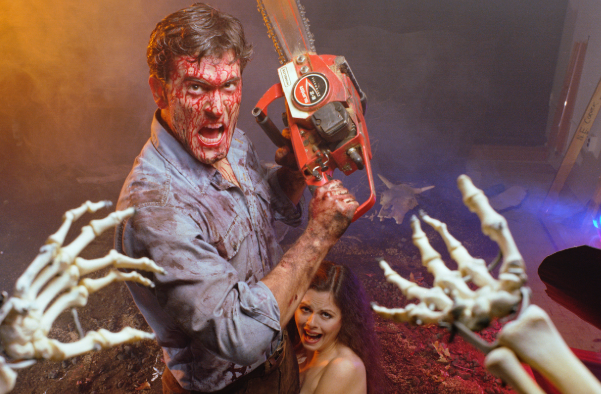
Before the high-octane action of modern blockbusters and the polished aesthetics of contemporary studio horror, there was a small, gritty, and relentlessly terrifying film that changed the landscape of cinema forever. The Evil Dead is the ultimate “lightning in a bottle” success story. It is a film born from the sheer willpower of three childhood friends—Sam Raimi, Bruce Campbell, and Rob Tapert—who ventured into the woods of Tennessee with a 16mm camera and a dream of scaring audiences senseless. What they produced was not just a movie, but a visceral, sensory assault that pushed the boundaries of what was possible on a micro-budget.
For the uninitiated, the premise is deceptively simple: five college students spend a weekend in an isolated cabin, only to discover a “Book of the Dead” and a tape recorder that, when played, releases an ancient, demonic force. This force, known as the “Deadites,” begins to possess the students one by one, leading to a night of gore, madness, and survival. However, the legacy of The Evil Dead goes far beyond its plot. It is a masterclass in DIY filmmaking, a testament to the power of creative ingenuity over financial resources. From its inventive camera work to its controversial reception across the globe, the film remains a cornerstone of the horror genre. To understand The Evil Dead is to understand the soul of independent horror: it is messy, loud, brave, and utterly unforgettable.
1. The Blueprint for the “Cabin in the Woods” Genre
While The Evil Dead was not the very first movie to feature a remote cabin, it is the film that perfected the “Cabin in the Woods” trope into a definitive horror blueprint. This setting provides the perfect “pressure cooker” environment for horror—isolation, limited resources, and the absence of outside help. The cabin functions as a character in its own right, transitioning from a peaceful, rustic retreat to a claustrophobic trap where every creaking floorboard and banging shutter signals impending doom.
The genius of this setting lies in its relatability. Almost everyone understands the primal fear of being alone in the wilderness after dark. By stripping away the safety nets of civilization, the film forces the characters to confront both external demons and their own internal panic. This narrative structure has been echoed in hundreds of films since, but rarely has it been executed with the same raw, unpolished energy. The isolation isn’t just a plot device; it’s a sensory experience, amplified by the film’s aggressive sound design and the constant, unseen presence of the “evil” lurking just beyond the tree line.
2. A Production Defined by Pure Physical Suffering
The stories from the set of The Evil Dead are legendary in the film industry, often sounding more like a survival ordeal than a professional movie shoot. The production took place in a real, dilapidated cabin in Morristown, Tennessee, during a freezing winter. With no running water and minimal heating, the cast and crew were frequently on the verge of hypothermia. Sam Raimi, known for his “sadistic” directorial style, believed that the characters’ exhaustion and terror would look more authentic if the actors were actually miserable.
The special effects only added to the discomfort. The primary ingredient for the film’s abundant “blood” was a mixture of corn syrup, food coloring, and dairy creamer. The chemical formula for this sticky concoction—often jokingly referred to by the crew—was roughly:
$$C_{12}H_{22}O_{11} (Sucrose) + Red Dye + Creamora$$
This mixture would dry into a hard, sugary shell under the hot lights, making it nearly impossible for the actors to move. Bruce Campbell famously had to be wrapped in blankets in the back of a truck after 24 hours of being soaked in this syrup, only for the syrup to freeze, effectively gluing him to the vehicle. This level of physical sacrifice created a gritty, tactile reality that modern digital effects simply cannot replicate.
3. The Invention of the “Shaky Cam” and DIY Cinematography
Sam Raimi and his cinematographer, Tim Philo, had to invent new ways to move the camera because they couldn’t afford expensive cranes or dollies. The most famous innovation was the “Shaky Cam” (or “Vas-O-Cam”). This involved mounting the camera to a long wooden plank and having two people run through the woods while holding either end. This technique created a frantic, low-to-the-ground, and predatory point-of-view that became the signature visual style for the “Evil” itself.
This DIY approach forced the filmmakers to be incredibly creative with their visual language. They used “ram-o-cams” (cameras driven through windows) and “stump-o-cams” (cameras mounted to rotating logs) to achieve disorienting, kinetic shots. These techniques weren’t just about saving money; they created a unique energy that made the film feel alive. The camera became an active participant in the horror, swooping and diving with a supernatural speed that suggested the presence of something non-human. This aesthetic would go on to influence a generation of filmmakers, proving that a creative vision is far more valuable than a high-end equipment rental.
4. The Evolution of Bruce Campbell as Ash Williams
In the original 1981 film, the character of Ash Williams is a far cry from the confident, “groovy” action hero he would eventually become in the sequels. Here, Ash is the sensitive, somewhat timid member of the group. He is the last person you would expect to survive a demonic onslaught. Bruce Campbell’s performance captures the slow, agonizing descent from a normal college student to a shell-shocked survivor pushed to the brink of insanity.
The physical demands placed on Campbell were immense. As the “Final Guy,” he is subjected to a relentless barrage of physical abuse, from being thrown through walls to battling his own possessed friends. Campbell’s background in physical comedy and slapstick—he was a huge fan of The Three Stooges—actually helped him sell the violence. He understood how to move his body to make a hit look more painful or a fall look more dramatic. This performance laid the foundation for one of the most iconic characters in horror history, proving that a hero is most compelling when they are vulnerable, flawed, and fighting for every single breath.
5. The Necronomicon and Forbidden Lore
The central MacGuffin of the film is the Naturan Demanto, later renamed the Necronomicon Ex-Mortis (the Book of the Dead). While the name is a nod to the works of H.P. Lovecraft, the book’s design in the film is entirely unique. Bound in human skin and inked in human blood, the prop was designed by special effects artist Tom Sullivan to look ancient and inherently “wrong.” The sketches inside the book—filled with demonic incantations and grotesque illustrations—hinted at a vast, dark history that extended far beyond the walls of the cabin.
The use of the book introduces the concept of “summoned” evil. Unlike a slasher who is a physical person, the evil in this film is an intangible force triggered by the violation of forbidden knowledge. When the characters play the tape recording of the Sumerian incantations, they are essentially unlocking a door that cannot be easily closed. This theme of “curiosity killing the cat” is a classic horror element, but The Evil Dead gives it a visceral punch. The book isn’t just an object; it’s a gateway to a chaotic dimension that defies the laws of physics and morality.
6. The Legend of the “Fake Shemps”
As the grueling production stretched on longer than expected, many of the original actors and crew members had to leave the set to return to their jobs or school. To finish the film, Raimi and Campbell had to get creative with “stand-ins.” They began using friends, family members, and even themselves to play the parts of characters who were either partially obscured, seen from behind, or covered in heavy demonic makeup. They dubbed these stand-ins “Fake Shemps,” a reference to Shemp Howard of The Three Stooges, whose role was filled by a body double after his death.
This “Fake Shemp” tradition became a staple of Sam Raimi’s production company, Renaissance Pictures. It highlights the scrappy, “all hands on deck” nature of the production. If a hand was needed to reach out from a cellar door, or a body was needed to fall through a floor, whoever was available at the time would put on the costume and do the stunt. This improvisational spirit is woven into the very fabric of the movie, giving it an unpredictable, lived-in quality. It serves as a reminder that filmmaking is a collaborative effort of endurance, where the final product is often the result of sheer persistence.
7. Saved by the King: The Stephen King Endorsement
Despite the passion behind it, The Evil Dead struggled to find a distributor initially. It was seen by many as too intense, too gory, and too “small” for a wide release. Its fortunes changed dramatically when it was screened at the Cannes Film Festival. In attendance was legendary horror author Stephen King. King was so blown away by the film’s relentless energy and originality that he wrote a glowing review for a magazine, calling it “the most ferociously original horror movie of the year.”
This endorsement from the master of modern horror was the turning point. It gave the film instant credibility and caught the attention of distributors who had previously passed on it. King’s quote was prominently featured on the movie’s posters and home video covers, acting as a “seal of approval” for horror fans worldwide. Without this high-profile support, The Evil Dead might have remained an obscure cult oddity. Instead, it became a global phenomenon, proving that even a micro-budget film can reach the heights of the industry if it has the right champions.
8. Banned and Brutal: The “Video Nasties” Era
When the film was released on home video in the United Kingdom, it became caught up in a moral panic known as the “Video Nasties” controversy. Due to its extreme gore and a particularly infamous scene involving a possessed tree, the film was labeled as “obscene” by the British Board of Film Classification. It was effectively banned, and copies were seized by police in raids on video rental shops. This legal battle lasted for years, with the film becoming a symbol of the fight against censorship.
Paradoxically, being banned was the best marketing the film could have asked for. The “forbidden” nature of the movie made it a must-see for a generation of rebels and horror enthusiasts. Underground bootleg tapes were traded like contraband, cementing the film’s status as a legendary cult classic. The controversy highlighted the film’s effectiveness; if it was powerful enough to scare the government, it was certainly worth watching. Eventually, as censorship laws evolved, the film was released uncut, but the aura of “danger” surrounding it remains a part of its historical identity.
9. The Genesis of “Splatstick”
While the first Evil Dead is played much more “straight” as a horror film than its sequels, it still contains the seeds of what fans call “Splatstick”—a combination of extreme gore (splatter) and over-the-top physical comedy (slapstick). There is an absurdity to the violence that borders on the surreal. When a character is stabbed, they don’t just bleed; they erupt in geysers of multi-colored fluids. The physics of the cabin become warped, with blood pouring from light fixtures and shadows taking on a life of their own.
This tonal blend is a direct reflection of Sam Raimi’s sensibilities. He understood that horror and comedy both rely on timing and “the reveal.” By pushing the gore to such an extreme that it becomes impossible, he allows the audience to release their tension through shocked laughter. This unique tone set The Evil Dead apart from the grim, depressing slashers of the era. It wasn’t just trying to make you feel bad; it was trying to take you on a wild, exhilarating roller coaster ride where the scares and the “gross-out” moments were part of the fun.
10. A Lasting Legacy Written in Blood
The impact of The Evil Dead on the film industry is impossible to overstate. It launched the career of Sam Raimi, who would go on to direct massive superhero blockbusters, and made Bruce Campbell a permanent icon of geek culture. But more importantly, it inspired thousands of aspiring filmmakers to pick up a camera and tell their own stories. It proved that you didn’t need a Hollywood studio to make a movie that resonated with a global audience; you just needed a few friends, a good idea, and the willingness to suffer for your art.
The film’s influence can be seen in everything from the “found footage” genre to the works of directors like Peter Jackson and Edgar Wright. It spawned a massive franchise including sequels, a reboot, a television series, video games, and even a stage musical. Yet, despite all the high-budget iterations that followed, the original 1981 film retains a special power. It is a raw, unrefined scream from the woods—a reminder that at its most basic level, horror is about the thrill of the unknown and the incredible things that can happen when a group of friends refuses to take “no” for an answer.
Further Reading
- If Chins Could Kill: Confessions of a B Movie Actor by Bruce Campbell
- The Evil Dead Companion by Bill Warren
- The Art of Horror Movies: An Illustrated History by Stephen Jones
- Make-Up, Monsters and Magic: The Art of Tom Sullivan by Tom Sullivan
- 10 The Exorcist III (1990) Movie Facts You Didn’t Know
- 10 Scream (1996) Movie Facts That Changed Horror
- 10 Hostel (2005) Movie Facts That Shocked Viewers
- 10 Hellraiser (1987) Movie Facts That Built Its Legacy
- 10 Candyman (1992) Movie Facts That Still Give Chills
- 10 Essential Facts About The Texas Chainsaw Massacre (1974)
- 10 Essential Facts That Explain the World of The Walking Dead TV Show
- From – Season 1 Full Recap and Spoilers Explained
- 10 Things You Should Know About The Thing (1982) – Movie Facts and Hidden Details
- 10 Fascinating Supernatural Facts You Probably Missed – TV Show Lore



