
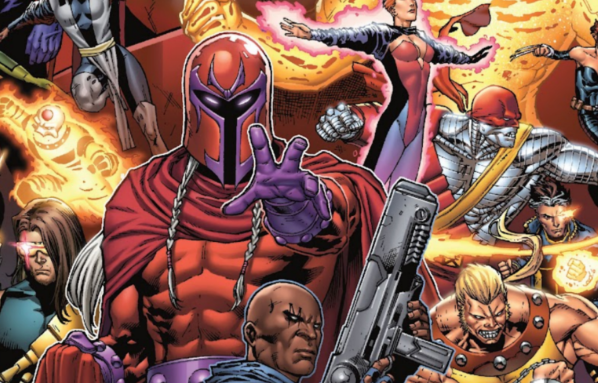
Imagine waking up to a world where the heroes you trust are gone, your greatest enemies are the only ones standing between humanity and extinction, and the very fabric of reality has been stitched back together by a madman. This isn’t just a “what if” scenario; it is the foundation of one of the most ambitious and beloved storylines in comic book history.
The Age of Apocalypse remains a gold standard for “Alternate Reality” storytelling. It didn’t just offer a glimpse into a dark future; it completely replaced Marvel’s entire X-Men line for months, demanding that readers forget everything they knew about their favorite mutants. It was a narrative gamble that paid off, creating a gritty, high-stakes landscape where survival of the fittest wasn’t just a theory—it was the law. Whether you are a seasoned collector or a newcomer curious about the multiverse, understanding this epic saga is essential for any true Marvel fan.
1. The Fatal Paradox: How a Son’s Love Erased the X-Men
The catalyst for this entire dystopian nightmare was a tragic case of good intentions gone horribly wrong. David Haller, the ultra-powerful mutant known as Legion and the son of Charles Xavier, traveled back in time with a singular, desperate goal: to kill Magneto before he could become a villain. Legion believed that by removing Xavier’s greatest rival, he would pave the way for his father’s dream of mutant-human peace to finally succeed.
However, the laws of time are rarely so cooperative. In a pivotal moment, Charles Xavier sacrificed his own life to save Magneto from Legion’s psychic blade. This selfless act created a devastating temporal paradox. Because Xavier died before he could ever form the X-Men, the entire timeline fractured and reformed into a reality where the mutant supremacist Apocalypse rose to power unchecked. This event serves as a haunting reminder that in the Marvel Universe, even the most heroic sacrifices can have catastrophic, unforeseen consequences, proving that the road to a living hell is often paved with the best intentions.
2. Magneto’s Redemption: The Unlikely Leader of the Resistance
In the world we know, Magneto is often the primary antagonist of the X-Men. But in the Age of Apocalypse, the death of his friend Charles Xavier served as a wake-up call that changed the trajectory of his life forever. Distraught by Xavier’s sacrifice, Magneto adopted his fallen friend’s dream of peaceful coexistence. He didn’t just become a hero; he became the founder and leader of the X-Men, leading a desperate underground resistance against Apocalypse’s regime.
This version of Magneto is a far cry from the ruthless revolutionary we usually see. He is a burdened father figure, a husband to Rogue, and a general who must make impossible choices to keep his species from descending into total depravity. Seeing Magneto wear Xavier’s mantle provides a fascinating psychological study of the character, illustrating that the line between hero and villain is often determined by the circumstances of one’s environment and the losses one endures. It is one of the most compelling “redemption arcs” in comic history, even if it took place in a world that shouldn’t exist.
3. The Darwinian Nightmare: Apocalypse’s “Survival of the Fittest”
When En Sabah Nur—the ancient mutant known as Apocalypse—conquered North America, he didn’t just want to rule; he wanted to prune the human race. His philosophy is a twisted interpretation of Darwinism, where only the strong have the right to exist. Under his reign, the “culling” of humans and “weak” mutants became a daily reality. He transformed the United States into a series of desolate labor camps and bio-experimental labs, turning a once-great nation into a monument to his ego.
Apocalypse’s rule is characterized by his “Four Horsemen,” a rotating cast of powerful mutants who enforce his will with absolute brutality. This setting allows for a deep dive into the horrors of authoritarianism, where the villain isn’t just a person to be punched, but a system to be dismantled. The Age of Apocalypse presents a world where the stakes aren’t just about saving the day, but about preventing the literal expiration of the human soul. It’s a bleak, oppressive atmosphere that makes the small victories of the X-Men feel all the more significant.
4. Familiar Faces, Terrifying New Roles: The Fall of the Summers Brothers
One of the most jarring elements for new readers is seeing iconic heroes reinvented as cold-blooded enforcers. Nowhere is this more evident than with Scott and Alex Summers, known to us as Cyclops and Havok. In this timeline, the brothers were raised in the pens of Mister Sinister, one of Apocalypse’s lead scientists. Rather than being the noble leaders of the X-Men, they serve as “Prelates,” high-ranking officers in the mutant hierarchy tasked with maintaining order in the slave camps.
While Scott Summers still possesses a flicker of morality—often secretly helping prisoners—his brother Alex is portrayed as a jealous, power-hungry fanatic. This sibling rivalry is dialed up to eleven, stripped of the heroic context that usually defines them. Seeing Cyclops with a scarred face and a cynical outlook or Havok as a genuine threat creates a sense of “uncanny” discomfort. It forces the audience to confront the idea that our heroes are often products of their upbringing, and without Xavier’s guidance, even the brightest stars can be dimmed by a dark environment.
5. The Birth of the Dark Beast: A Legacy of Mad Science
In the primary Marvel timeline, Hank McCoy (Beast) is the lovable, intellectual heart of the X-Men. However, the Age of Apocalypse introduced us to his dark reflection: a version of Beast who completely abandoned his humanity in favor of unethical genetic experimentation. This “Dark Beast” is a sadist who delights in “improving” mutants through painful and often lethal surgeries. He represents the ultimate corruption of intellect, showing what happens when genius is uncoupled from empathy.
Dark Beast didn’t just stay in this alternate timeline, either. He eventually found a way to escape into the main Marvel Universe, where he continued to cause chaos for years. His presence serves as a constant, living reminder of the horrors of the Apocalypse era. He is a fan-favorite villain precisely because he is so recognizable; he has the same voice and the same face as a beloved hero, but his eyes reflect a bottomless pit of cruelty. He is perhaps the greatest example of how this storyline managed to leave a permanent scar on the wider Marvel mythos.
6. Nate Grey: The Ultimate Weapon Born of Genetic Engineering
Because Scott Summers and Jean Grey were seen as the pinnacle of mutant potential, Mister Sinister used their DNA to bio-engineer a child in a lab. This child, Nate Grey (also known as X-Man), was designed to be the ultimate psychic weapon—a mutant powerful enough to destroy Apocalypse himself. Nate is essentially an “Omega-level” powerhouse, possessing telepathic and telekinetic abilities that dwarf almost anyone else in the series.
Nate Grey’s journey is one of the most “chosen one” narratives in the saga, yet it is subverted by the fact that he is a literal science project. He wanders the wasteland searching for purpose while being hunted by the very regime that created him. Unlike the Cable we know from the main timeline (who is also a son of Scott Summers), Nate lacks the techno-organic virus that keeps his powers in check, meaning his raw energy is constantly threatening to consume him. He represents the untapped, terrifying potential of the mutant race and serves as a beacon of hope for a world that has none.
7. A World Without the Avengers: Humanity’s Final Stand
In a world dominated by a mutant god, what happened to the rest of Earth’s Mightiest Heroes? One of the most haunting details of the Age of Apocalypse is the near-total absence of the Avengers. Without the stable environment provided by the X-Men and the traditional hero community, many of the world’s defenders were killed or never rose to power. Tony Stark and Clint Barton, for instance, are part of a desperate human resistance, but they lack the resources and superhuman backing to make a real dent in Apocalypse’s armor.
The Sentinels, typically the villains of X-Men stories, are actually repurposed as protectors of the human refugees in Europe. This role reversal is brilliant storytelling; it highlights just how desperate the situation has become when the “killing machines” of the past are the only things keeping the human race from extinction. It provides a global perspective on the conflict, showing that the “Mutant Problem” has become a “World Problem,” and that the extinction of humanity is not just a threat, but a scheduled event.
8. The High Stakes of the M’Kraan Crystal
How do you fix a reality that has been broken for twenty years? The answer lies in the M’Kraan Crystal, a cosmic artifact known as the “Nexus of All Realities.” The X-Men’s ultimate mission is to use a fragment of this crystal to send a traveler back in time to prevent Xavier’s death, effectively committing “chronological suicide.” By succeeding, they would ensure that their own world—and everyone they have ever known—would cease to exist.
This creates a profound moral dilemma. The characters are fighting to die so that a better world can live. It adds a layer of tragic heroism to every battle; when a character falls, they aren’t just fighting for their lives, but for the chance to be erased. The M’Kraan Crystal isn’t just a plot device; it’s a thematic symbol of the sacrifice required to fix a fundamental wrong. It elevates the story from a standard superhero brawl to a cosmic epic about the weight of existence and the value of a single life in the grand tapestry of time.
9. Morph and the Emotional Core of the Resistance
While many characters in this storyline are grim and gritty, the character of Morph provides much-needed levity and heart. A shapeshifter with a tragic past, Morph serves as the emotional glue for Magneto’s X-Men. In a world of grey morality and constant death, his humor and loyalty stand out as a reminder of why the world is worth saving in the first place.
Morph’s popularity skyrocketed during this era, largely because he was a character who had been killed off early in the popular X-Men animated series of the time. Seeing him reimagined as a key player in the comics felt like a “win” for fans. His ability to take on any form also allows for clever visual storytelling and moments of deceptive strategy. He represents the resilience of the spirit; even in the darkest timeline imaginable, there is still room for a joke, a friendship, and a reason to keep fighting.
10. The Legacy That Refused to Die
Though the Age of Apocalypse was intended to be a self-contained event that ended with the restoration of the main timeline, its impact was too massive to be contained. Several characters, including Dark Beast, Nate Grey, and the fan-favorite Sugar Man, successfully “crossed over” into the main Marvel Universe. This ensured that the consequences of this dark reality would continue to ripple through comic books for decades.
Furthermore, the storyline proved that fans were hungry for complex, long-form “Alternate Universe” narratives. It set the stage for later successes like House of M and the Ultimate Marvel line. The aesthetic of the era—the wild hair, the tattoos, and the “survivalist” gear—became iconic of the medium’s evolution. It remains a “must-read” because it wasn’t just a story about superheroes fighting villains; it was a story about identity, the power of choice, and the belief that even when the world is ending, it is never too late to do the right thing.
Further Reading
- X-Men: Age of Apocalypse Omnibus by Various Authors
- X-Men: Legionquest by Scott Lobdell and Mark Waid
- The Mutant Empire by Christopher Golden
- X-Men: The Complete Age of Apocalypse Epic (Multiple Volumes)
- 10 Things You Should Know About Kang the Conqueror – Marvel Comics
- 10 Things You Should Know About The Sentry – Marvel Comics
- 10 Things You Should Know About Ghost Rider – Marvel Comics
- From – Season 1 Full Recap and Spoilers Explained
- Stranger Things – Season 5 Full Recap and Spoilers Explained
- Stranger Things – Season 4 Full Recap and Spoilers Explained
- Stranger Things – Season 3 Full Recap and Spoilers Explained
- Stranger Things – Season 2 Full Recap and Spoilers Explained
- Stranger Things – Season 1 Full Recap and Spoilers Explained
- 10 Essential Things to Know About The Mole Man – Marvel Comics Lore



