
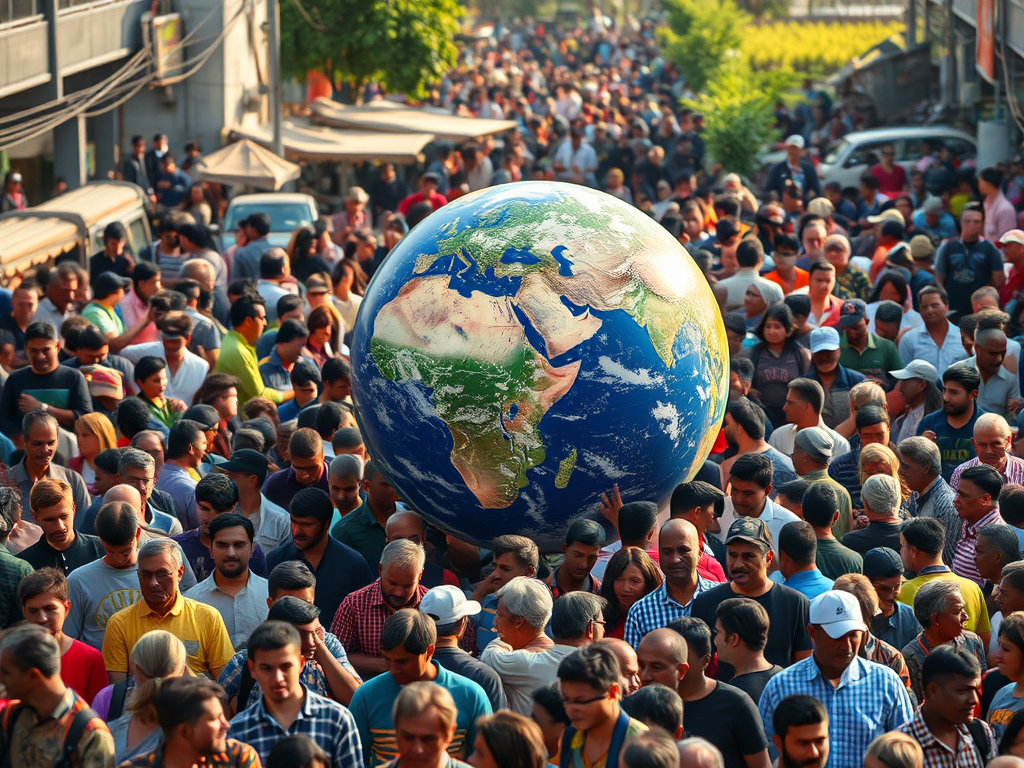
Have you ever stopped to think about how many people share our amazing planet Earth with you? It’s a number so big it’s hard to even imagine! Billions and billions of people, all living their lives, going to school, working, playing, and sleeping under the same sun and moon. The number of people on Earth hasn’t always been this large, and it’s changed in incredible ways throughout history.
Understanding the world population growth facts is like piecing together a giant puzzle about human history and our future. It involves looking at how many people are born, how long they live, and how these numbers change over time. It’s a topic that touches on everything from how we use resources to how cities grow and cultures interact.
Let’s dive into some fascinating facts about how our world population has grown over the centuries and what that growth looks like today. Get ready to explore some big numbers and interesting ideas!
Here are 10 interesting facts about the growth of the world population:
1. The World’s Population Today is GIGANTIC!
Let’s start with the biggest number: How many people are on Earth right now? As of early 2025, the world population is estimated to be well over 8 billion people! Imagine lining up 8 billion people – the line would stretch around the Earth many, many times! This huge number is constantly changing, with babies being born and people passing away every second.
Thinking about this number helps us grasp the sheer scale of humanity today. It means there are billions of different stories, dreams, and lives being lived all at once. This current figure is a key fact when we talk about world population growth facts and how much we’ve grown compared to the past.
2. For Most of History, There Weren’t Many People
It might seem like there have always been tons of people on Earth, but that’s not true. For tens of thousands of years, the human population grew incredibly slowly. Our early ancestors lived as hunter-gatherers, and life was tough. Food could be scarce, diseases were common, and people didn’t live as long as they do today.
Because of this, the population stayed relatively small for a very, very long time. It took all of human history up until relatively recently just to reach a significant number. This slow start is a crucial part of the history of world population – it makes the faster growth we see now even more surprising!
3. Agriculture Changed Everything
One of the biggest reasons the human population started to grow a bit faster was the invention of agriculture. When people learned how to farm and domesticate animals, they could settle in one place and produce more food than they could by just hunting and gathering. This meant more people could be supported in one area.
Having a more stable food supply led to communities growing into villages, towns, and eventually cities. While growth was still slow by today’s standards, the ability to produce food reliably was a game-changer for the human population and was one of the first major factors affecting population growth.
4. Reaching the First Billion Took Forever
Ready for a mind-blowing fact? It took all of human history – hundreds of thousands of years – for the world population to reach just 1 billion people! Experts estimate this milestone was reached around the early 1800s. Think about that: for almost all of our existence, there were fewer than a billion humans alive at any one time.
This really highlights how slow population growth was for the vast majority of human history compared to the rapid increase we’ve seen more recently. Knowing when did world population reach 1 billion gives us a starting point to understand just how quickly things have changed in the last couple of centuries.
5. The “Big Boom”: Faster and Faster Growth
After reaching 1 billion around 1800, the speed of population growth began to pick up dramatically. It only took about 130 years to add the second billion people (around 1930), then just 30 years for the third (around 1960), and even less time for the following billions!
This period of rapidly accelerating growth is often called the “population boom.” It meant that within a single lifetime, the number of people on Earth could double or even triple! Understanding how fast is world population growing today requires looking back at this period when the pace really picked up.
6. Medicine and Science Fueled the Speed-Up
So, why did population start growing so much faster after the 1800s? A major reason was incredible advancements in science, medicine, and technology. Things like discovering how to stop the spread of diseases, creating vaccines, inventing antibiotics, and improving sanitation (like clean water and sewers) meant that people started living much longer and fewer babies and children died.
Plus, improvements in farming technology meant we could grow even more food to feed the increasing number of people. It wasn’t just about more births; it was also about far fewer deaths, especially among young people, allowing more people to survive and have families of their own. These factors completely changed the pattern of world population growth facts.
7. Asia is Home to More Than Half the World
Looking at a map of how other countries celebrate birthdays is fun, but looking at a map of where people live is also fascinating! Today, the continent of Asia is home to more than half of the world’s population. This is mainly because of the two most populated countries on Earth: China and India, which each have over a billion people!
While populations are growing or shrinking at different rates in different countries, the sheer number of people already living in Asia means it holds the largest share of the global population. Understanding this helps us see how population isn’t spread evenly around the planet, leading to different levels of crowding in different places.
8. What is Population Density?
Speaking of crowding, have you heard the term population density meaning? It’s a way to measure how crowded a place is. It tells you how many people, on average, live in a specific area, like a square kilometer or a square mile.
A city like Tokyo or Mumbai has a very high population density because millions of people live in a relatively small area. A large desert or a remote forest region has a very low population density because there are few people spread out over a huge space. Looking at population density helps us understand the different living conditions and challenges faced by people in different parts of the world as the overall population grows.
9. The Growth Rate is Slowing Down
This might sound confusing since the total number of people is still increasing, but the rate at which the world population is growing is actually slowing down. Think of it like a car speeding up – it’s still going faster, but maybe not gaining speed as quickly as it was a few seconds ago.
Globally, families are having fewer children on average than they did in the past. This is due to many factors affecting population growth, including more access to education, healthcare, and family planning, especially for women, and people choosing to have smaller families in many parts of the world. So, while the number keeps climbing, the speed of the climb isn’t as fast as it was a few decades ago.
10. Looking Towards 9 or 10 Billion in the Future
What does the future hold for the world population? Experts who study populations (called demographers) use current trends to make predictions. The most common future world population predictions suggest that the population will continue to grow for several more decades, likely reaching somewhere around 9 or 10 billion people by the middle of this century.
After that, the rate of growth is expected to slow down even more, and the total number might even start to level off or slightly decrease towards the end of the century. These are just predictions, of course, and many things could affect them, but they give us an idea of the scale of human presence we might see on Earth in the coming years.
Conclusion
The growth of the world population is a story of incredible change, from slow beginnings to rapid acceleration, driven by human ingenuity and progress, particularly in areas like food production and medicine. We’ve seen how it took tens of thousands of years to reach 1 billion people, but only a little over 200 years to add another 7 billion! While the total number continues to rise, the rate of growth is slowing down, and the future might see the population stabilize. Understanding these world population growth facts helps us appreciate the dynamic history of humanity and think about the challenges and opportunities that come with sharing our planet with so many people.
Further Reading
If you found these facts interesting and want to learn more about people and populations, check out these books:
- The Atlas of People by Anita Ganeri
- Population Matters: Road Map to a Sustainable Future by Jacqueline Kasun (Note: This might be slightly advanced, but has good concepts)
- Why Are There So Many People? (Question and Answer Book) by Bolaji Balogun
- Refugees and Migrants (Disaster and Survival) by Clare Hibbert




Leave a Reply