
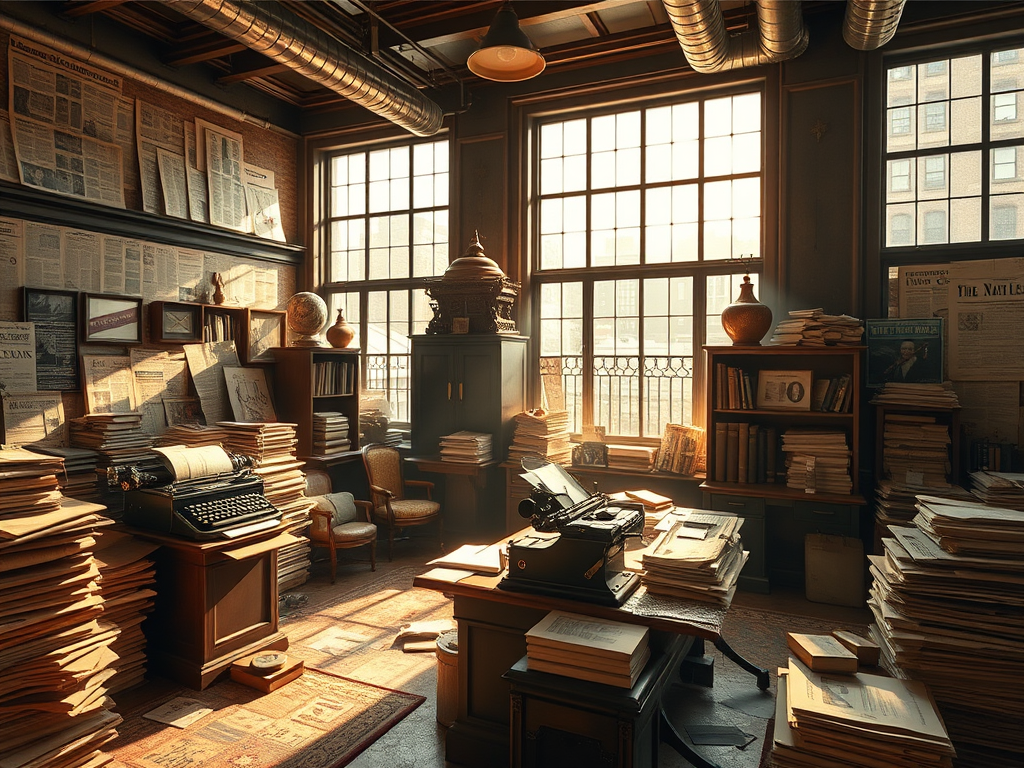
Have you ever seen a movie trailer with big, exciting words promising something amazing? Or maybe clicked on a headline online that seemed unbelievable? Well, long before the internet, newspapers were the main way people got their news, and one man became incredibly powerful by making his newspapers the most attention-grabbing of all. That man was William Randolph Hearst.
Born into a super-rich family in the 1860s, Hearst didn’t just want to inherit money; he wanted to make a splash and influence the world. He loved newspapers so much that he built an empire of them, changing the way news was reported forever. His life was full of big ideas, big buildings, and sometimes, big controversies!
Get ready to discover some fascinating facts about William Randolph Hearst, a man who used the power of the press to try and shape America.
1. Starting with a Struggling Newspaper: How William Randolph Hearst Began His Empire
William Randolph Hearst wasn’t exactly born into the newspaper business, but his family’s wealth gave him a unique start. His father, George Hearst, was a successful miner and later a U.S. Senator. In 1880, George acquired a newspaper in San Francisco called the Examiner. It wasn’t doing very well.
Young William was still in college at Harvard, but he was fascinated by newspapers, especially the exciting, attention-grabbing style of Joseph Pulitzer’s New York World. William begged his father to let him take over the Examiner. In 1887, his father finally agreed. So, at just 24 years old, William Randolph Hearst became the owner of a struggling newspaper. This was the very beginning of what would become a massive media empire. He wasn’t afraid to spend money to make the paper better and more interesting, setting the stage for his future in journalism. This is a key fact in understanding who was William Randolph Hearst and how he got his start.
2. The Birth of “Yellow Journalism”: Making News Exciting (and Sometimes Exaggerated!)
To make the San Francisco Examiner a success, Hearst needed to get people’s attention. He decided to make his newspaper lively, dramatic, and full of exciting stories. This style of reporting, which focused on sensationalism, scandal, and sometimes exaggerated or even made-up stories to sell more papers, became known as “yellow journalism.”
The name “yellow journalism” actually came from a popular cartoon character at the time called “The Yellow Kid,” who appeared in both Hearst’s and Pulitzer’s newspapers during their fierce competition. Hearst used big headlines, lots of illustrations, and stories that appealed to people’s emotions. He covered crime, disasters, and scandals with great detail, often bending the truth to make a story more dramatic. While it helped him sell a lot of newspapers and made him powerful, “yellow journalism” also raised questions about the ethics of reporting. It’s one of the most famous and debated William Randolph Hearst facts.
3. Taking on New York: Competing in the Big City
After making the Examiner a success in San Francisco, Hearst set his sights on an even bigger challenge: New York City. In 1895, he bought the New York Journal. New York had many newspapers, and the competition was fierce, especially with his former inspiration, Joseph Pulitzer, who owned the rival New York World.
Hearst and Pulitzer engaged in a heated “circulation war,” trying to sell more newspapers than the other. They slashed prices, hired the best writers and illustrators (often stealing them from each other), and used increasingly sensational tactics. This rivalry was a major event in the history of American journalism Hearst helped shape. They both used yellow journalism to the extreme, with screaming headlines and dramatic coverage of everything from everyday crime to international events. This period was wild and chaotic in the newspaper world, and it showed just how far Hearst was willing to go to be number one.
4. Accused of Starting a War: The Role of Hearst’s Newspapers
One of the most controversial aspects of William Randolph Hearst’s career is the claim that his yellow journalism helped push the United States into the Spanish-American War in 1898. His newspapers published dramatic and often exaggerated stories about the suffering of the Cuban people under Spanish rule and accused Spain of terrible atrocities.
When the American battleship USS Maine exploded in Havana Harbor, Hearst’s newspapers immediately blamed Spain with huge, emotional headlines, even though the real cause was unclear. Critics argued that Hearst and Pulitzer used their newspapers to whip up public anger and pressure the government to declare war. While it’s an exaggeration to say they caused the war single-handedly (there were many other factors), their sensational coverage certainly played a significant role in shaping public opinion and increasing support for intervention. This remains a powerful example of the influence of media and a key, often debated, fact about William Randolph Hearst.
5. Building a Media Empire: More Than Just Newspapers
William Randolph Hearst didn’t stop at just a few newspapers. He had a relentless drive to expand his influence. Over his lifetime, he acquired and started newspapers in cities all across the United States, building the largest newspaper chain in the country. At its peak, his Hearst Communications owned dozens of daily and Sunday newspapers.
But his empire wasn’t limited to just print. Hearst was also a pioneer in other forms of media. He moved into magazines, owning popular titles like Cosmopolitan and Good Housekeeping. He got involved in radio broadcasting and even movie production, creating newsreels and films. He also started King Features Syndicate, which distributed popular comic strips and articles to newspapers everywhere. This vast network of media outlets gave Hearst incredible power and reach, making him a true media mogul long before the term was commonly used. Understanding the scale of his William Randolph Hearst newspapers and other ventures is crucial to grasping his impact.
6. Trying His Hand at Politics: From Publisher to Politician?
With his immense wealth and control over so many newspapers that reached millions of readers, it might seem natural that William Randolph Hearst would want to enter politics himself. And he did! Hearst used his newspapers to support political causes and candidates he believed in, and he also ran for office several times.
He served two terms in the U.S. House of Representatives as a Congressman from New York in the early 1900s. He also made unsuccessful attempts to become the Mayor of New York City and the Governor of New York. Even though he had the power of his newspapers to promote his campaigns, he never reached the higher political offices he desired. His political ambitions and his use of his media empire to support them are important facts about William Randolph Hearst that show he wanted more than just media power; he wanted direct political influence.
7. Collecting Everything Imaginable: A Passion for Art and Artifacts
Beyond newspapers and politics, William Randolph Hearst had another huge passion: collecting. He amassed an absolutely enormous collection of art, antiques, and historical artifacts from around the world. He bought everything from ancient Roman sculptures and Egyptian artifacts to European tapestries, paintings, and even entire ceilings and fireplaces from old castles!
His collection was so vast that it filled warehouses on both the East and West Coasts of the United States. He had a keen eye for beautiful and historical objects, and he spent a fortune acquiring them. This passion for collecting wasn’t just a hobby; it was a major part of his life and would heavily influence the design of his most famous creation, Hearst Castle. The sheer scale and variety of his collection are amazing William Randolph Hearst facts that highlight his immense wealth and his desire to surround himself with history and beauty.
8. Building a “Castle” on a Hill: The Marvel of Hearst Castle
One of the most enduring parts of William Randolph Hearst’s legacy is the incredible estate he built on a hill overlooking the Pacific Ocean in California. He called it “La Cuesta Encantada,” which means “The Enchanted Hill” in Spanish, but it’s famously known today as Hearst Castle. Starting in 1919, Hearst worked with architect Julia Morgan for nearly 30 years to build this lavish and unique home.
Hearst Castle wasn’t just a house; it was a massive complex with a grand main building, guesthouses, pools, and gardens, filled with many of the art and artifacts he had collected. It was designed to look like a European castle and reflected Hearst’s love of history and grandeur. He entertained many famous guests there, including Hollywood stars, politicians, and artists. Building this architectural marvel was a lifelong project and is perhaps the most visually stunning of all the Hearst Castle facts tied to his life.
9. The Inspiration for Citizen Kane: Hollywood’s Take on a Tycoon
William Randolph Hearst’s life was so dramatic and influential that it became the inspiration for one of the most famous movies ever made: Citizen Kane (released in 1941). The film tells the story of a powerful and lonely newspaper magnate named Charles Foster Kane, whose life has many parallels to Hearst’s.
The movie explored themes of power, wealth, and the search for happiness, and many people saw the character of Kane as a thinly disguised version of Hearst. Hearst was reportedly very angry about the film and used his powerful newspapers to try and prevent it from being shown. The connection between Citizen Kane inspiration and William Randolph Hearst is a significant part of his cultural history, showing how his life captured the imagination of storytellers, even if the portrayal wasn’t always flattering.
10. A Complex Legacy: Power, Influence, and Changing Times
William Randolph Hearst lived a long life (1863-1951) and left behind a complex legacy. He was a visionary who understood the power of mass media and built an unprecedented empire. He was a master of grabbing attention and influencing public opinion, for better or worse. His use of yellow journalism changed the newspaper industry forever, leading to both more engaging reporting and concerns about accuracy and ethics.
He was also a man of grand tastes, a passionate collector, and the builder of a unique castle. Although his political ambitions weren’t fully realized, his influence on American life through his newspapers and other media was undeniable. The Randolph Hearst life story is a reminder of the impact individuals can have on shaping information and public discourse, and his legacy continues to be studied and debated today as the media landscape continues to change.
William Randolph Hearst was a larger-than-life figure who used his wealth and ambition to become a dominant force in American media. His story is a fascinating look at the power of newspapers, the evolution of journalism, and the life of a man who dreamed on a grand scale.
Further Reading
Here are a few books if you’d like to learn more about William Randolph Hearst and his world:
- Citizen Hearst: A Biography of William Randolph Hearst by W.A. Swanberg (Note: This is a detailed biography and might be best read with guidance or for older readers.)
- The Chief: The Life of William Randolph Hearst by David Nasaw (Another comprehensive biography for older readers.)
- Hearst Castle: An American Palace by Barbara J. Knox (This book focuses on the castle and is aimed at readers aged 7-12, offering a more accessible look at that part of his life).
- Yellow Journalism, Sensationalism, and Circulation Wars by Brett Griffin (Part of a series for young adults, this book explains the era and includes Hearst’s role).
Here at Zentara.blog, our mission is to take those tricky subjects and unlock them, making knowledge exciting and easy to grasp for everyone. But the adventure doesn’t stop on this page! We’re constantly exploring new frontiers and sharing discoveries across the digital universe.
Want to dive deeper into more mind-bending Top 10s and keep expanding your world? Come join us on our other platforms – we’ve got unique experiences waiting for you on each one!
- Get inspired by visual wonders and bite-sized facts: See the world through Zentara’s eyes on Pinterest! Pin our fascinating facts and stunning visuals to your own boards. Explore Pins on Pinterest: https://uk.pinterest.com/zentarablog/
- Discover quick insights and behind-the-scenes peeks: Hop over to Tumblr for snippets, quotes, and unique content you won’t find anywhere else. It’s a different flavour of discovery! Follow the Fun on Tumblr: https://www.tumblr.com/zentarablog
- Ready for deep dives you can listen to or watch? We’re bringing our accessible approach to video and potentially audio! Subscribe to our YouTube channel and tune into future projects that make learning pop! Subscribe on YouTube: https://www.youtube.com/@ZentaraUK
- Seeking even more knowledge in one place? We’ve compiled some of our most popular topic deep dives into fantastic ebooks! Find them on Amazon and keep the learning journey going anytime, anywhere. Find Our Ebooks on Amazon: https://www.amazon.co.uk/s?k=zentara+uk&crid=2273NA7RAJ1EU&sprefix=zentara+uk%2Caps%2C90&ref=nb_sb_noss
- Connect with us and fellow knowledge seekers: Join the conversation on BlueSky! We’re sharing updates, thoughts, and maybe even asking you what wonders we should explore next. Chat with Us on BlueSky: https://bsky.app/profile/zentarablog.bsky.social
- Perfect for learning on the move! We post multiple 10-minute podcasts per day on Spotify. Pop on your headphones and fill your day with fascinating facts while you’re out and about! Listen on Spotify: https://open.spotify.com/show/3dmHbKeDufRx95xPYIqKhJ
Every click helps us keep bringing honest, accessible knowledge to everyone. Thanks for exploring with us today – see you out there in the world of discovery!




Leave a Reply