
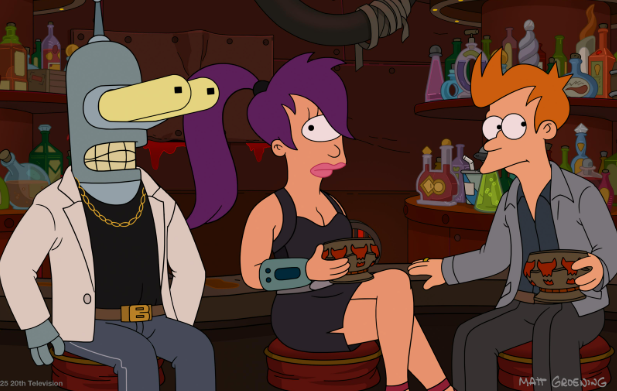
10 Mind-Blowing Futurama Secrets Only Superfans Know: The Ultimate Guide to New New York
When it first hit the airwaves, Futurama was often overshadowed by its older sibling, The Simpsons. However, beneath the surface of its delivery-boy-out-of-time premise lay a show of unparalleled intellectual depth, emotional resonance, and a commitment to continuity that changed the face of adult animation. Created by Matt Groening and developed alongside David X. Cohen, this series is a love letter to science fiction, mathematics, and the absurdity of the human (and robot) condition.
While many sitcoms rely on topical humor that fades within a few years, Futurama built a timeless universe. Its jokes are layered like an onion—or perhaps like the multi-dimensional space-time continuum—offering something new for the casual viewer and the dedicated scholar alike. Whether you are a newcomer just discovering the Planet Express crew or a veteran fan who can recite the “Robot Hell” song by heart, these ten facts reveal why the show remains the gold standard for speculative comedy.
1. The Ingenious Complexity of the Alien Language
In many science fiction properties, alien languages are merely gibberish or simple visual flavor. Futurama, however, treated its background details with the rigor of a linguistics department. The creators developed an entirely functional substituted cipher known as “Alienese.” Initially, this was a simple one-to-one character replacement for the English alphabet. The writers placed these symbols on background signs, advertisements, and graffiti throughout New New York, assuming it would take fans weeks or months to decode them.
To their shock, the dedicated audience cracked the first code within hours of the pilot episode airing. Refusing to be outsmarted, the production team developed “Alien Language 2,” which utilized a modular addition formula where each letter’s value depended on the value of the previous letters. This turned background gags into complex mathematical puzzles. This level of dedication illustrates the show’s core philosophy: never underestimate the intelligence of the viewer. The languages aren’t just set dressing; they are a living part of a world that rewards those who pay close attention to every frame.
2. A Real-Life Mathematical Theorem Born in an Episode
Perhaps the most prestigious feather in the show’s cap is the “Futurama Theorem.” In an episode involving a mind-switching machine, several characters swap bodies, only to realize that the machine cannot switch the same two bodies twice. To resolve the plot and return everyone to their original forms, a mathematical proof was needed to show that any number of mind-swapped individuals can be restored using only two additional people who have not yet participated in the swap.
Unlike most shows that would use “technobabble” to hand-wave the solution, writer Ken Keeler—who holds a PhD in applied mathematics—actually wrote and proved a new mathematical theorem specifically for the script. This isn’t just a clever bit of writing; it is a legitimate contribution to the field of group theory. It marks the first and likely only time in television history that a brand-new mathematical proof was created solely to facilitate the plot of a cartoon. It serves as a testament to the show’s “high-brow meets low-brow” aesthetic, where a fart joke can exist comfortably alongside a complex algebraic equation.
3. The Incredible Foresight of Nibbler’s Shadow
Long-term storytelling is a staple of modern television, but Futurama was practicing it long before it became the industry standard. In the very first episode, “Space Pilot 3000,” Fry is accidentally (or so it seems) frozen in a cryogenic tube. If you look closely at the shadows under the desk during the moment Fry falls backward, you can see a strange, three-eyed silhouette. This was not an animation error or a later digital addition; it was planned from the beginning.
It wasn’t until several seasons later that the show revealed the silhouette belonged to Lord Nibbler, an ancient and powerful alien who intentionally pushed Fry into the tube to save the universe a thousand years in the future. This level of narrative commitment is almost unheard of in episodic animation. The writers planted seeds that wouldn’t sprout for years, trusting that the show would live long enough to see the payoff. It transforms the entire series from a collection of random adventures into a cohesive, epic saga where every small detail has a purpose in the grander tapestry of time.
4. Bender’s Over-the-Top Engineering and Elemental Composition
Bender Bending Rodriguez is the breakout star of the series, a foul-mouthed, cigar-smoking robot who claims to be the “best” at everything. One of the show’s longest-running gags involves Bender’s physical makeup. Throughout the series, Bender claims to be 40% of various materials depending on the situation. Over the course of the show, he has claimed to be 40% zinc, 40% titanium, 40% dolomite, 40% luck, 40% chromium, and even 40% scrap metal.
If you add up all of Bender’s claims, he is technically several hundred percent “something.” This isn’t a continuity error; it’s a deliberate character trait that highlights his pathological need to boast and his total lack of self-awareness. Furthermore, his internal circuitry is often revealed to be powered by antiquated technology, such as a 6502 microprocessor—the same chip found in the Apple II and the original Nintendo Entertainment System. This blend of futuristic capabilities and obsolete internals makes Bender a perfect metaphor for the show’s retro-futuristic charm.
5. The Surprising Inspiration for Zapp Brannigan
Zapp Brannigan, the “25-star General” of the Democratic Order of Planets (D.O.O.P.), is a brilliant satire of the classic sci-fi hero. His character is a deliberate deconstruction of Captain James T. Kirk from Star Trek, reimagined as an incompetent, narcissistic, and deeply insecure buffoon. The creators envisioned Zapp as a man who is incredibly confident despite having zero reasons to be.
The role was originally written specifically for the legendary Phil Hartman. The character’s bombastic delivery and “velour-coated” ego were designed to harmonize with Hartman’s unique comedic timing. Following Hartman’s tragic passing before production began, the role was taken over by Billy West. West chose to play the character as an homage to Hartman’s style, while also drawing inspiration from big-voiced radio announcers of the 1950s. This creates a character who sounds like a hero from a Golden Age radio serial but acts like a total disaster, providing a sharp critique of the “macho” tropes often found in early space operas.
6. A Love Letter to Classic Sci-Fi Soundscapes
The auditory world of Futurama is just as meticulously crafted as its visuals. Rather than creating entirely new digital sounds for the futuristic technology, the production team went back to the roots of the genre. Many of the sound effects used for sliding doors, laser blasts, and computer interfaces are pulled directly from classic 1960s and 70s science fiction properties, most notably The Jetsons and Star Trek.
The sound of the Planet Express ship’s engine, for instance, has a distinct retro rumble that evokes the “World of Tomorrow” envisioned at mid-century World’s Fairs. This choice grounds the show in a specific aesthetic known as “Raygun Gothic.” It bridges the gap between the sleek, sterile future often depicted in modern media and the clunky, tactile future of our collective imagination. By using these familiar sounds, the show creates an instant sense of nostalgia for a future that never actually happened, making New New York feel lived-in and strangely familiar.
7. The Emotional Depth and Real-Life Parallel of “Jurassic Bark”
While the show is primarily a comedy, it is perhaps most famous for its ability to deliver devastating emotional blows. The episode “Jurassic Bark,” which explores the fate of Fry’s dog, Seymour, after Fry was frozen, is widely considered one of the saddest moments in television history. The story of a loyal pet waiting years for a master who never returns is based on the real-life story of Hachikō, an Akita dog in Japan who waited at a train station for his deceased owner for nine years.
The writers used this episode to ground Fry’s character. Despite his lack of intelligence and ambition, Fry’s capacity for love and his lingering connection to the past make him a deeply sympathetic protagonist. The episode’s ending, set to the song “I Will Wait for You,” serves as a reminder that Futurama isn’t just about robots and aliens; it’s about the universal experiences of loss, loyalty, and the passage of time. It proved that animation could tackle heavy themes with a grace and sincerity that many live-action dramas fail to achieve.
8. Hidden Details in the Show’s Iconic Opening Credits
The opening sequence of Futurama is a masterclass in world-building. Every time the Planet Express ship flies through the city, the screen is filled with references, but two specific elements change in almost every episode. First is the “subtitle” or caption that appears under the show’s title. These range from “Presented in Double Vision (where applicable)” to “Bender’s Humor Not Found,” setting the tone for the episode’s self-aware comedy.
The second changing element is the short cartoon playing on the giant billboard that the ship crashes into at the end of the sequence. These are almost always clips from classic black-and-white cartoons, such as Looney Tunes, Betty Boop, or early Disney shorts. This serves as a thematic bridge between the history of animation and its future. By crashing into the past to start every episode, the show acknowledges its roots while literally breaking through them to create something new. It’s a subtle nod to the evolution of the medium and the show’s place within it.
9. Professor Farnsworth and the Real Inventor of Television
The senile yet brilliant Professor Hubert J. Farnsworth is the catalyst for most of the show’s adventures. His name is not a random collection of syllables; it is a direct tribute to Philo Farnsworth, the American inventor who was a pioneer in the development of the electronic television. This connection highlights the show’s deep respect for the history of science and technology.
The character himself serves as a satire of the “mad scientist” archetype. Unlike the benevolent mentors found in many stories, the Professor is often dangerously indifferent to the safety of his crew and the ethics of his inventions (such as the “Doomstat” or the “Smell-O-Scope”). However, his occasional moments of genuine scientific brilliance remind the audience that he is a genius at heart. By naming him after the father of television, the creators created a meta-link between the medium the audience is consuming and the fictional world within it, suggesting that the “World of Tomorrow” is built on the shoulders of the innovators of today.
10. The Evolution of Leela and Her Mythological Roots
Turanga Leela, the one-eyed captain of the Planet Express ship, is the moral center and physical powerhouse of the show. Her name is derived from the Turangalîla-Symphonie by Olivier Messiaen, a massive orchestral work that explores themes of love, joy, and time. This high-art reference reflects Leela’s complexity as a character who struggles with her identity and her place in the universe.
For the first few seasons, Leela believes she is an alien from a distant planet, a classic sci-fi trope. However, the show eventually reveals she is a mutant from the sewers of Earth, abandoned by her parents so she could have a better life on the surface. This twist subverts the “chosen one from the stars” narrative and replaces it with a grounded, poignant story about social class and belonging. Her single eye, while a nod to the Cyclopes of Greek mythology, is treated not as a monster’s trait but as a unique physical characteristic that she navigates with grace. Leela’s journey from a lonely orphan to a confident leader is the emotional spine of the series, proving that even in a galaxy of trillions, the most important journey is the one where you find yourself.
Further Reading
- The Art of Futurama by Matt Groening
- The Science of Futurama by Various Authors (Check for compilations of scientific essays regarding the show)
- The Simpsons and Their Mathematical Secrets by Simon Singh (Contains significant chapters on Futurama‘s math)
- The Futurama Chronicles by Cohen & Groening (Production history and concept art)
- 10 Things You Should Know About Foghorn Leghorn – Looney Tunes
- 10 Futurama TV SHOW Facts That Still Hold Up
- 10 Things You Should Know About Speedy Gonzales – Looney Tunes
- 10 Things You Should Know About Yosemite Sam – Looney Tunes
- 10 Things You Should Know About The Looney Tunes
- 10 Things You Should Know About Road Runner – Looney Tunes
- 10 Things You Should Know About Wile E. Coyote – Looney Tunes
- 10 Things You Should Know About Tweety Pie – Looney Tunes
- 10 Things You Should Know About Sylvester The Cat – Looney Tunes
- 10 Things You Should Know About Porky Pig – Looney Tunes



