
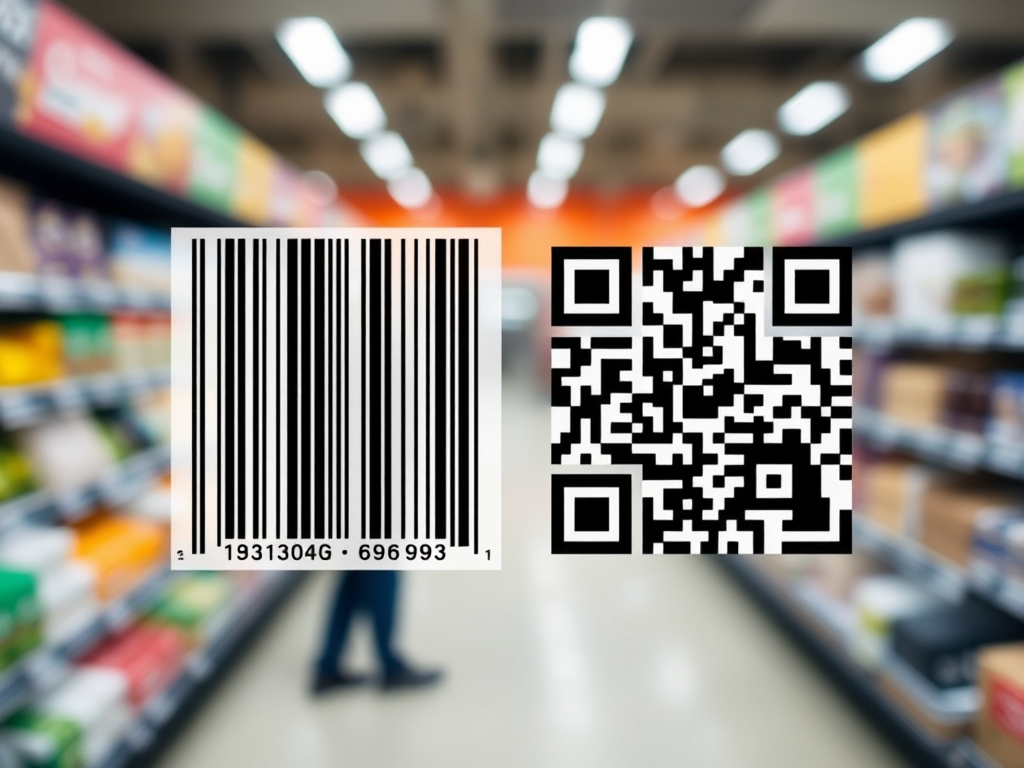
Have you ever picked up a packet of sweets, a new video game, or a library book and noticed those black and white stripes or the square-shaped puzzle pattern printed on it? These aren’t just random designs! They are barcodes and QR codes, tiny little windows into a world of information. They help shops know how much things cost, libraries keep track of books, and even let you visit websites by just pointing your phone camera.
It’s easy to think they’ve always been around, but like most amazing inventions, they have a cool history filled with smart people trying to solve problems. They didn’t just appear overnight! From the first ideas sketched on sand to the digital links we use every day, the journey of these codes is a fascinating story of innovation. So, buckle up as we travel back in time to discover the top 10 interesting facts about the history and evolution of barcodes and QR codes!
1. The Dream of Automatic Identification: Before the Stripes
Long before the familiar black and white lines of a barcode appeared on products, people were dreaming of ways for machines to automatically identify objects. Imagine a busy shop or a massive warehouse – keeping track of everything was a huge job that took lots of time and often led to mistakes. Think about early libraries where every book had to be checked in and out by hand, or grocery stores where clerks had to remember or look up every single price. This wasn’t efficient, especially as the world got busier and more goods were being produced and sold.
Inventors and engineers in the early to mid-20th century started thinking: could there be a way for a device, not a human, to quickly and accurately read information about an item? They imagined systems using patterns, lights, or even magnetic strips. While these early ideas weren’t exactly barcodes as we know them today, they planted the seed for the concept of automatic identification – a way to give objects a unique, machine-readable fingerprint. This fundamental idea was the necessary first step towards inventing codes that could be scanned, paving the way for future innovations like the UPC code and eventually, QR codes. This early thinking was crucial in understanding how to even approach the problem of quick, accurate item tracking, which is a key part of the history of barcodes and QR codes.
2. The First Barcode Patent: Inspired by Morse Code
Okay, so who actually came up with the idea for the barcode itself? The credit goes to two clever inventors named Norman Joseph Woodland and Bernard Silver. Back in 1948, they were students at Drexel Institute of Technology (now Drexel University) in Philadelphia. A local grocery store owner had asked the university to research a way to automatically read product information at checkout. Silver heard this and told Woodland about it.
Woodland, who had previously worked on the Manhattan Project, started thinking about patterns that could store information. He remembered learning Morse Code (dots and dashes used to send messages). He thought, what if you could make the dots and dashes into thick and thin lines? He even famously drew the first concept for a linear barcode in the sand on a beach in Miami, using his fingers to represent the lines. Their first patent, filed in 1949 and granted in 1952, described a system of concentric circles (like a target) made of thick and thin lines. This “bull’s-eye” design was an early form of a barcode, although it wasn’t the linear one we see most often today. This groundbreaking invention was the true origin of the barcode concept.
3. Developing the Universal Product Code (UPC): Standardizing the Stripes
While Woodland and Silver had the initial idea and patent, their circular design wasn’t easy to scan reliably with the technology available in the 1960s and early 70s. The retail industry really needed a standardized way to identify products across different stores and manufacturers. Imagine if every shop used a different system – it would be chaos!
So, in the late 1960s, a committee was formed by U.S. grocery industry leaders to find a universal solution. Several companies submitted their ideas for a scannable code. IBM, where Woodland had started working, developed a linear barcode design based on his earlier work, but modified to be more practical for printing and scanning. This design, primarily championed by IBM engineer George J. Laurer, was eventually chosen as the standard for the grocery industry in 1973. They called it the Universal Product Code, or UPC. This was a critical step in the history of barcodes, moving from a concept to a practical, industry-wide standard that could be printed on almost every product. Understanding the development of the UPC code is key to seeing how barcodes became so widespread.
4. The First Scan: Chewing Gum Makes History
Okay, we have the idea and the standard code (the UPC), but when did it actually get used in a real shop? The first ever retail transaction using a UPC barcode happened on June 26, 1974. The location was a Marsh Supermarket in Troy, Ohio.
What was the historic item that was scanned? It was a pack of Wrigley’s Juicy Fruit chewing gum! The pack is now famously on display at the Smithsonian National Museum of American History. Sharon Buchanan, a checkout clerk, made the first scan using a scanner installed at her register. This moment was a turning point. It proved that the technology worked in a real-world setting and could speed up the checkout process significantly, while also improving accuracy compared to manually typing in prices. This single pack of gum marked the beginning of a revolution in retail and logistics, showing how barcodes could transform shopping.
5. How Barcode Scanners “Read” the Lines: Light and Reflection
So, how does a scanner actually read those black and white lines? It’s quite clever! Barcode scanners work by using light. Most modern scanners use a red light (like a laser or LED) to illuminate the barcode. The light bounces off the surface of the barcode and is read by a sensor in the scanner.
Here’s the trick: the white spaces on the barcode reflect the light very well, while the black bars absorb the light. The scanner measures the amount of light that is reflected back. As the scanner moves across the barcode (or as you pass the barcode under a static scanner), it reads the sequence of reflected light (from white spaces) and lack of reflection (from black bars). These varying patterns of light and dark are translated into an electrical signal. This signal is then decoded by the scanner’s computer into the numbers and data represented by the barcode. This simple yet effective mechanism explains how barcodes work and why the contrast between the bars and spaces is so important for scanning technology.
6. Global Takeover: Barcodes Spread Everywhere
After the successful test in Ohio and improvements in scanning technology, the adoption of barcodes began to spread, first across the grocery industry in the United States, and then to other retail sectors and eventually across the globe. Why? Because they offered huge advantages.
For stores, barcodes meant faster checkout lines, fewer pricing errors, and much easier inventory management. Instead of counting everything by hand, they could scan items as they were sold and know exactly what they had in stock. For manufacturers, it meant they could track products more easily through the supply chain. The UPC system was adapted and expanded internationally, becoming standards like the European Article Number (EAN), which is very similar to the UPC but includes an extra digit. This global adoption made barcodes a fundamental part of modern commerce and logistics. The origin of the UPC code and its subsequent international spread truly transformed how goods are tracked and sold worldwide, solidifying the place of barcodes in history.
7. The Birth of the QR Code: Solving a Manufacturing Problem
While linear barcodes were becoming commonplace, a new challenge arose in Japan’s automotive industry in the 1990s. Car manufacturing involves tracking thousands of different parts. Standard linear barcodes could only hold a limited amount of information, usually just a product number. To get more details, like batch numbers or manufacturing dates, workers had to scan multiple barcodes or look up information separately. This was time-consuming and inefficient on a fast-moving production line.
Denso Wave, a subsidiary of the Japanese company Denso (which makes car parts), was tasked with creating a new type of code that could hold much more information than a traditional barcode and be scanned quickly from any direction. In 1994, Masahiro Hara and his team at Denso Wave developed the Quick Response code, or QR code. They were specifically designed to allow for high-speed scanning and to store more complex data, directly addressing the needs of manufacturers looking for better ways to track inventory and parts. This invention marked a significant evolution from the linear barcode.
8. Why QR Codes Are “Quick Response”: More Data, Faster Scan
The “QR” in QR code stands for “Quick Response.” This name highlights the two main goals the Denso Wave team had when creating them: to be able to read the code quickly and to contain a lot of information. How did they achieve this?
Unlike linear barcodes which store data in a single line of varying width bars, QR codes store data in a two-dimensional grid of black and white squares. This 2D structure allows them to hold significantly more information in the same amount of space. A standard UPC barcode typically holds about 12 digits, while a QR code can hold thousands of characters, including numbers, letters, and even Japanese Kanji characters. The distinctive three large squares in the corners of a QR code are “finder patterns.” These patterns allow scanners (like your smartphone camera) to quickly identify the code and determine its orientation, meaning you can scan it from almost any angle. This ability to store more data and be scanned faster explains why QR codes were invented – to handle complex tracking needs more efficiently.
9. How QR Codes Work: Patterns, Puzzles, and Data
Just like barcodes use light reflection, QR codes are also read by sensors that detect patterns of light and dark. However, because they are two-dimensional, the reading process is a bit more complex. When a scanner (like a smartphone camera app) looks at a QR code, it first identifies the three large finder patterns in the corners. These patterns tell the scanner where the code is and how it’s oriented.
Once the scanner knows the code’s position, it looks at the grid of smaller black and white squares within the code. Each square represents a bit of data (either a 0 or a 1). The pattern of these squares encodes the information. There are also smaller alignment patterns and timing patterns within the code that help the scanner read it accurately even if it’s slightly distorted or damaged. The scanner decodes this pattern of squares back into the original data, whether it’s a website address, a block of text, or contact information. Understanding how QR codes are used involves recognizing this efficient data storage and quick scanning capability.
10. Modern Uses and the Future: Beyond the Shop Floor
Today, both barcodes and QR codes are everywhere, far beyond their original uses in grocery stores and car factories. Barcodes are still fundamental for retail, inventory, and shipping, but their technology has improved, with scanners becoming smaller, faster, and more integrated.
QR codes have exploded in popularity, especially with the rise of smartphones. Because our phones have cameras and powerful processors, they can easily scan and decode QR codes. This has led to countless new applications: linking to websites, sharing Wi-Fi passwords, making payments, viewing menus in restaurants, getting information on museum exhibits, and even checking in for flights. They are cheap and easy to generate and print, making them accessible for businesses and individuals alike. The future likely holds even more creative uses for both types of codes, potentially integrating with augmented reality or providing even richer, dynamic information as scanning technology continues to evolve. This evolution of scanning technology is a continuous process building on the history of barcodes and QR codes.
The next time you see a barcode or a QR code, you’ll know they are more than just simple patterns. They are the result of decades of innovation, problem-solving, and the desire to make tracking and accessing information faster and easier. From a beach in Miami to your smartphone screen, their journey is a fascinating part of the story of how technology has changed our world.
Further Reading
- The Barcode Book: Reading, Printing, and Specification of Barcode Types by Roger C. Palmer
- Code of the Street: Barcodes, QR Codes, and the Future of Retail (Note: find an accessible version or summary for this age group if the full book is too technical, or choose an alternative beginner book on technology history)
- How Things Work: Encyclopedia of Steam, Engines, Robots, and More (Look for sections on automatic identification or data entry)
- Barcode: The Scanner That Changed the World by Paul Stockman (A more historical perspective, check availability and accessibility)




Leave a Reply