
Have you ever felt the ground shake? It can be a startling and powerful experience. Earthquakes are one of nature’s most dramatic events, reminders that our planet’s surface is not as solid and unchanging as it might seem. But what exactly causes the ground to tremble, and how do scientists figure out where and how strong an earthquake was?
The science of earthquakes explained simply involves understanding what’s happening deep beneath our feet. It’s a bit like detective work, piecing together clues from Earth’s structure and the energy it releases. While we can’t predict exactly when an earthquake will happen, scientists have learned a lot about why earthquakes happen easy to understand reasons, and they have developed clever tools to measure them.
Get ready to explore the powerful forces that shape our planet and discover the fascinating ways we study them. We’ll break down the complex process of earthquakes into 10 simple points, looking at both why they happen and how we measure their impact.
1. Earth’s Layered Structure: More Than Just Dirt and Rock
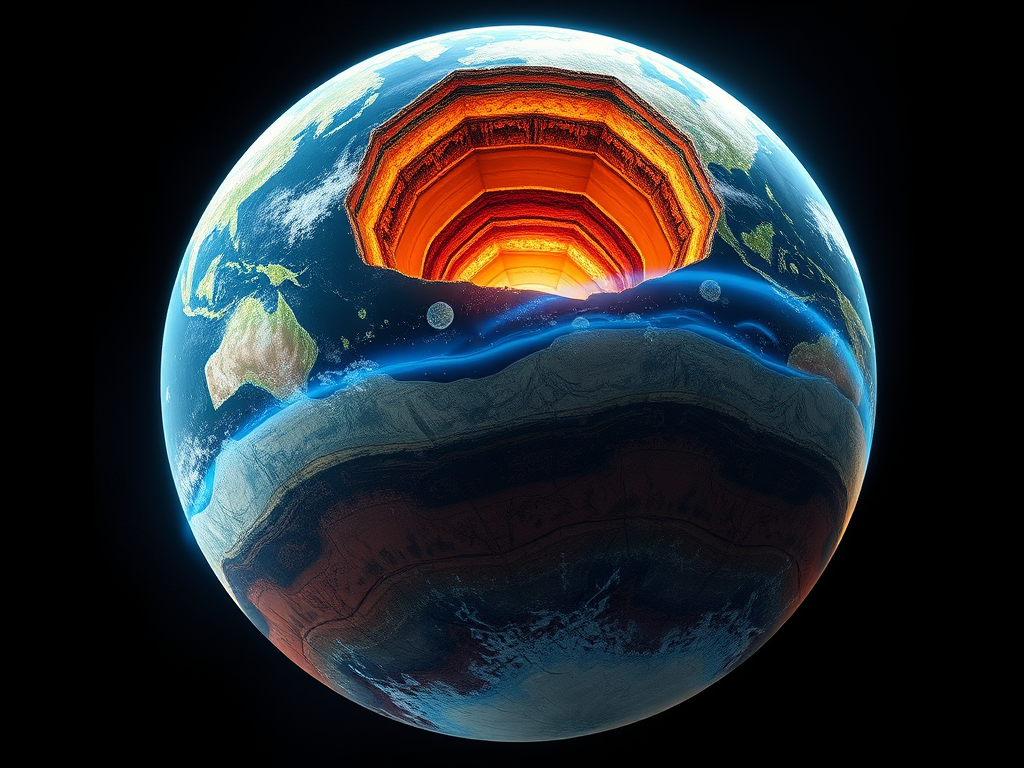
To understand earthquakes, you need to know a little bit about what Earth is made of, deep down. Imagine cutting the Earth in half like an apple. You’d see different layers! On the outside is the thin skin we live on, called the crust. Below the crust is a thick layer of hot, mostly solid rock called the mantle. And at the very center is the super hot core, made of metal.
Earthquakes happen in the outer layers – the crust and the very top part of the mantle. Think of the crust as the hard shell of a boiled egg. It’s solid, but it’s cracked into many pieces. The action happening between these pieces is the main reason we have earthquakes. The different materials and temperatures in these layers are what drive the processes that lead to shaking on the surface.
2. Tectonic Plates: Earth’s Giant, Moving Puzzle
That cracked outer shell of Earth isn’t just broken randomly. It’s divided into enormous slabs of rock called tectonic plates. These plates fit together like a giant, slightly messy jigsaw puzzle covering the entire planet. Some plates carry continents, others carry oceans, and some carry both!
These plates aren’t sitting still. They’re constantly, but very slowly, moving around on top of the warmer, softer rock of the upper mantle. Think of them floating on a very thick, slow-moving liquid, or perhaps like icebergs drifting in the ocean. The movement of these tectonic plates explained for kids using analogies helps visualize how our continents are always on the go, even though we don’t feel it day-to-day. Most earthquakes happen because of how these giant plates interact with each other as they move.
3. Plate Boundaries: Where the Action Happens
The edges of these tectonic plates, where they meet, are called plate boundaries. These boundaries are where most of Earth’s dramatic geological events, like volcanoes and earthquakes, occur. Plates can interact in different ways:
- They can pull away from each other (divergent boundaries).
- They can push towards each other and collide (convergent boundaries).
- They can slide past each other horizontally (transform boundaries).
Each type of boundary can cause earthquakes, but the biggest and most frequent ones often happen where plates are colliding or sliding past each other. The type of interaction at these boundaries dictates the kind of stress and movement that builds up, ultimately leading to ground shaking.
4. Fault Lines: The Scars of Movement
Within and between tectonic plates are cracks in the Earth’s crust called faults, or fault lines. These are essentially fractures where blocks of rock on either side have moved relative to each other in the past.
Think of a fault line as a giant crack in a wall. If you push on the wall, the stress will build up along that crack. Similarly, as tectonic plates move, the rock along fault lines gets stressed. While the plate boundary is the broad area where plates meet, fault lines simple definition explains them as the specific breaks within that zone where movement happens. Earthquakes occur when there is a sudden slip or movement along one of these fault lines.
5. Stress and Strain: Building Up Pressure
Tectonic plates don’t just glide smoothly past each other. Their edges are rough and can get stuck. As the plates keep trying to move, enormous forces build up along the fault lines where they’re locked. This built-up force is called stress, and the way the rock bends or deforms under this stress is called strain.
Imagine pushing two rough blocks of wood together. They might catch and not move at first, but if you keep pushing, the pressure increases. The same thing happens with tectonic plates. The longer the plates are stuck, and the more they try to move, the more stress and strain build up in the rocks along the fault line. This stored energy is like stretching a giant rubber band – it’s waiting to be released.
6. The Earthquake Happens: Sudden Release!
Eventually, the stress built up along the locked fault line becomes greater than the strength of the rocks holding it together. When this happens, the rocks suddenly break and slip past each other. This sudden movement is what causes an earthquake! The point deep underground where the rock first breaks is called the focus (or hypocenter) of the earthquake.
The energy that was stored up like a stretched rubber band is suddenly released in the form of waves that travel through the Earth. This explains why earthquakes happen easy: it’s the sudden snapping and sliding of rocks along a fault line under immense pressure. The spot on the Earth’s surface directly above the focus is called the epicenter, and this is often where the shaking is strongest.
7. Seismic Waves: Earth’s Tremors
When the rock slips during an earthquake, it sends out vibrations that travel through the Earth. These vibrations are called seismic waves. Think of them like ripples spreading out on a pond after you drop a stone. There are different types of seismic waves, and they travel at different speeds:
- P-waves (Primary waves): These are the fastest waves. They push and pull the rock in the same direction the wave is moving, like a Slinky being pushed. They can travel through solids and liquids.
- S-waves (Secondary waves): These are slower than P-waves. They shake the rock back and forth, perpendicular to the direction the wave is moving, like shaking a rope. They can only travel through solids.
- Surface waves: These are the slowest but often the most destructive waves. They travel along the Earth’s surface and cause the ground to move up and down and side to side.
Understanding seismic waves explained simply helps scientists locate earthquakes and understand the damage they might cause. P-waves arrive first, then S-waves, and finally the surface waves, which cause most of the felt shaking.
8. Seismographs: Feeling the Earth’s Pulse
How do scientists detect and record these seismic waves? They use instruments called seismographs. A seismograph is essentially a device that can feel and record ground shaking.
A simple way to think about how seismographs work simple explanation is to imagine a weight hanging from a spring. The weight has inertia, meaning it wants to stay still. The rest of the seismograph is firmly attached to the ground. When the ground shakes during an earthquake, the seismograph moves with it, but the hanging weight tends to stay in place. A pen attached to the weight records this relative movement onto a rotating drum or digitally. The wiggly line recorded is called a seismogram. By using seismographs in different locations, scientists can capture the arrival times and strength of the seismic waves.
9. Measuring Magnitude: How Big Was the Shake?
Scientists use special scales to measure the size or strength of an earthquake. You might have heard of the Richter scale. While the Richter scale was historically important and is still sometimes mentioned, scientists now more commonly use the Moment Magnitude Scale (Mw) for larger earthquakes because it’s more accurate.
These scales measure the magnitude of the earthquake, which is related to the amount of energy released at the source. The scales are logarithmic, which means that each whole number increase represents a much larger earthquake. For example, a magnitude 6 earthquake releases about 32 times more energy than a magnitude 5 earthquake, and about 1000 times more energy than a magnitude 4! Understanding the Richter scale explained easy (and the Moment Magnitude scale) helps us compare the power of different earthquakes.
10. Locating the Epicenter: Finding Where It All Started
Once seismic waves are recorded by seismographs at different stations, scientists can use that information to figure out where the earthquake happened – specifically, the location of the epicenter on the Earth’s surface.
Since P-waves travel faster than S-waves, the time difference between when the P-wave and the S-wave arrive at a seismograph station tells scientists how far away that station is from the epicenter. By getting this distance information from at least three different seismograph stations, they can draw circles on a map, with the radius of each circle being the calculated distance. The point where the three circles intersect is the earthquake epicenter explained simply. This triangulation method allows seismologists to pinpoint the location of the earthquake.
The science of earthquakes is a constant process of monitoring, measurement, and learning. By studying how and why the ground shakes, scientists help us understand the risks in different areas and develop strategies to make buildings and communities safer. While we can’t stop earthquakes from happening, understanding them empowers us to live more safely on our dynamic planet. Remember to always know your earthquake safety tips for kids if you live in an earthquake-prone area!
Further Reading
Here are a few books that can help you explore the science of earthquakes further:
- Earthquakes by Seymour Simon
- National Geographic Little Kids First Big Book of Rocks, Minerals, and Shells (Includes basics of Earth’s structure and movement) by Karen De Seve
- The Magic School Bus Inside the Earth by Joanna Cole




Leave a Reply