
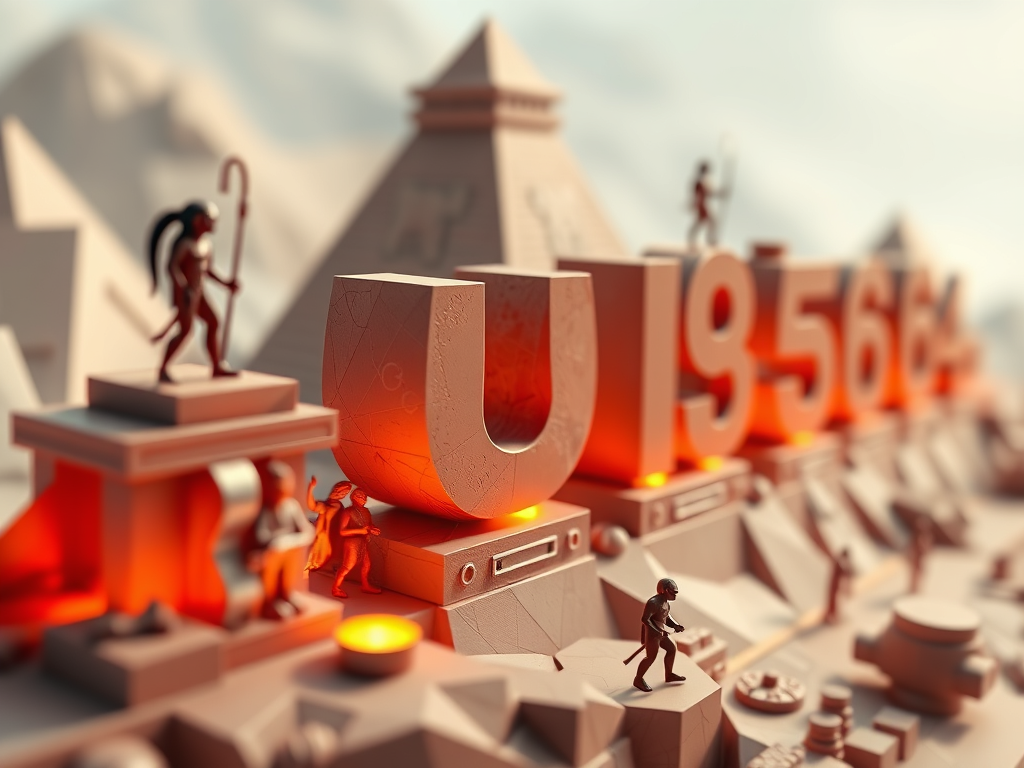
Can you imagine a day without numbers? No telling time, no counting your birthday money, no scores in video games, no recipes for yummy cakes! Numbers are everywhere, and they’re super important. But have you ever wondered where they came from? The history of numbers isn’t about a single person waking up one day and inventing “1, 2, 3.” Instead, it’s a fascinating adventure story that spans thousands of years and involves clever people from all over the world! Understanding the origin of numbers for students shows us how counting changed the world for kids and for everyone, transforming simple societies into the complex civilizations we know. Let’s explore 10 amazing steps in this journey, from simple scratches on a bone to the powerful numbers we use today, and see why are numbers important in civilization.
1. Before Numbers: The Dawn of Counting with Tally Marks
Long before fancy number symbols, people still needed to count. Imagine ancient hunters wanting to know how many bison they saw, or early farmers needing to track their sheep. Different ways people counted in history started very simply. One of the earliest methods was using tally marks – scratching lines on bones, wood, or cave walls. Archaeologists have found ancient bones, like the Ishango Bone from Africa (around 20,000 years old!), with groups of notches carved into them. Each notch might have represented one thing – one animal, one day, or one person. This was a basic but brilliant start! It was like saying, “I have this many,” by showing a collection of marks. This shows that the need to quantify, to answer “how many?”, is a very old human instinct, paving the way for ancient number systems explained simply.
2. Body Parts to the Rescue: Fingers, Toes, and Early Grouping
Our own bodies were probably the first calculators! People naturally used their fingers (and sometimes toes!) to count. This is likely why so many number systems around the world are based on 5, 10 (our ten fingers), or 20 (fingers and toes). Think about it: it’s easy to hold up three fingers to show “three.” This method also led to grouping. Instead of just endless tally marks, people started to group them. Maybe five tally marks were grouped together, then a new group started. This idea of grouping was a big step towards creating more organized ancient number systems explained simply. Using body parts was one of the very early different ways people counted in history, and it directly influenced how counting changed the world for kids by leading to base systems.
3. Ancient Egypt: Pictures for Numbers (Hieroglyphs)
The ancient Egyptians, famous for their pyramids and pharaohs, had one of the earliest known written number systems, dating back over 5,000 years. They used cool pictures called hieroglyphs to represent numbers. A single stroke was 1, a heel bone symbol was 10, a coil of rope was 100, a lotus flower was 1,000, a bent finger was 10,000, a tadpole or frog was 100,000, and a god with raised arms represented 1 million! To write a number like 234, they would just draw two coils of rope (200), three heel bones (30), and four strokes (4). It was additive, meaning you just added up the values of the symbols. While clever, imagine writing 999 – you’d need 27 symbols! This highlights the challenges that led to the evolution in the history of numbers.
4. Mesopotamia’s Clever System: Base 60 and Place Value Hints
Around the same time as the Egyptians, the people in Mesopotamia (modern-day Iraq), like the Sumerians and Babylonians, developed their own number system. They were super smart and used a base-60 system. We still see traces of their base-60 system today in how we measure time (60 seconds in a minute, 60 minutes in an hour) and angles (360 degrees in a circle). They used wedge-shaped marks called cuneiform, pressing a stylus into wet clay tablets. What was really clever was that they started to understand the idea of place value – that a symbol’s value could change depending on its position, a bit like how the ‘1’ in ’10’ means something different from the ‘1’ in ‘100’. This was a huge leap forward in the origin of numbers for students and a critical step towards more efficient counting.
5. Roman Numerals: Letters for Counting
You’ve probably seen Roman numerals on clocks, in book chapters, or for things like the Super Bowl! The Romans used letters from their alphabet to represent numbers: I (1), V (5), X (10), L (50), C (100), D (500), and M (1000). Like the Egyptian system, it was largely additive (VI is 5+1=6). However, they also introduced a subtractive idea – putting a smaller value before a larger one meant subtraction (IV is 5-1=4, and IX is 10-1=9). This made some numbers shorter to write. Roman numerals were used in Europe for centuries! But, try multiplying XXIV by XVII – it’s really tricky! Their system wasn’t great for complex math, which shows why are numbers important in civilization for progress; we needed something more efficient.
6. The Brilliant Mayans: Using Zero as a Placeholder
Far away in Central America, the Mayan civilization independently developed a very advanced number system around 2,000 years ago. They used a base-20 system (perhaps counting fingers and toes) and had symbols for numbers 0 through 19, using dots (for 1s) and bars (for 5s). Most incredibly, the Mayans were one of the first civilizations to develop and use the concept of zero as a placeholder. They had a special shell-like symbol for zero. This was revolutionary! Zero as a placeholder is crucial for a positional number system to work properly, clearly distinguishing numbers like 26 from 206. Their understanding of zero was a monumental achievement in the history of numbers.
7. India’s Game-Changing Invention: The Birth of Our Modern Numbers (and Zero!)
This is where our familiar numbers 0, 1, 2, 3, 4, 5, 6, 7, 8, 9 come into the story! The Hindu-Arabic numeral system, which we use today, was developed in India starting over 1,500 years ago. Indian mathematicians made two groundbreaking contributions: they developed a system with just ten symbols (0-9) and, crucially, they fully developed the concept of zero not just as a placeholder, but as a number in its own right. The Indian mathematician Brahmagupta, around 628 AD, established rules for using zero in calculations. This system also firmly used place value, meaning the position of a digit determines its value (the ‘5’ in 5, 50, and 500 means different things). This was incredibly powerful and efficient, truly showing how counting changed the world for kids and everyone. The invention of zero and its importance for children to learn cannot be overstated.
8. Spreading the Knowledge: Numbers Travel West
So how did these amazing Indian numbers reach the rest of the world? Arab scholars and merchants played a vital role. They learned the Indian system, recognized its brilliance, and adopted it. Famous Arab mathematicians like Al-Khwarizmi (from whose name we get “algorithm”) wrote books around the 9th century that explained and promoted this system. These books and ideas then traveled further west into Europe through trade and scholarly exchange, especially through places like Spain and Italy. Because Europeans learned these numerals from Arab writings, they became known as “Hindu-Arabic numerals” or often just “Arabic numerals.” This journey shows how knowledge sharing is crucial for progress.
9. Europe Catches On: The Power of 0 to 9
When Hindu-Arabic numerals first arrived in Europe around the 10th-12th centuries, they weren’t instantly popular. Many people were used to Roman numerals. However, merchants and mathematicians like Leonardo Fibonacci (famous for the Fibonacci sequence) recognized how much easier calculations like addition, subtraction, multiplication, and division were with the new system, especially with the amazing number zero! Gradually, over several centuries, the efficiency and power of the Hindu-Arabic system won out. The invention of the printing press in the 15th century helped to standardize and spread these numerals even faster. This adoption was key to the scientific revolution and the growth of commerce, demonstrating the profound impact of numbers.
10. Numbers Today and Tomorrow: The Foundation of Everything!
Today, the Hindu-Arabic numeral system is used all over the world. It’s the language of science, technology, engineering, finance, and so much more. Think about computers – they operate using a binary number system (just 0s and 1s), which is a direct descendant of the idea of place value and the concept of zero. From tally marks to modern numbers for kids to learn about, this journey has given us an incredibly powerful tool. Numbers allow us to build skyscrapers, send rockets to space, understand the universe, create amazing art and music, and run our daily lives. The history of numbers shows how a simple need – to count – led to one of humanity’s most impactful inventions, fundamentally shaping our world and continuing to drive innovation.
The story of numbers is a testament to human ingenuity and our endless quest to understand and organize the world around us. It’s a journey that started with simple scratches and has led to the complex digital world we live in today!
Further Reading
If you’re fascinated by the history of numbers and want to count on learning more, check out these books (as of May 21, 2025):
- The History of Counting by Denise Schmandt-Besserat (While academic, she has written in ways that are accessible, and her work is foundational. Look for simplified explanations of her theories on tokens leading to writing and numbers.) A more kid-friendly alternative might be to search for books that cite her work in a simplified manner.
- You Can Count on Monsters: The First 100 Numbers and Their Characters by Richard Evan Schwartz (A creative and visual way to engage with numbers, though not strictly history, it builds number sense.)
- The Man Who Counted: A Collection of Mathematical Adventures by Malba Tahan (A fictional story that weaves mathematical concepts and problems into an adventure, offering a fun way to see numbers in action.)
- Math Attack! (Horrible Histories) by Kjartan Poskitt (The Horrible Histories series is great at making historical topics, including aspects of math history, fun and engaging for this age group.)
- The Story of Numbers (Or, How We Learned to Count) – Look for titles like this by various authors aimed at children, such as books by Usborne or DK, which often cover topics like “history of mathematics” or “ancient civilizations” and include sections on numbers. Example: DKfindout! Science or History books often cover such topics.



Leave a Reply to Top Ten Mathematical Concepts That Explain Everyday Mysteries – Zentara.blog: Knowledge Made Accessible | Science, History, Tech & MoreCancel reply