
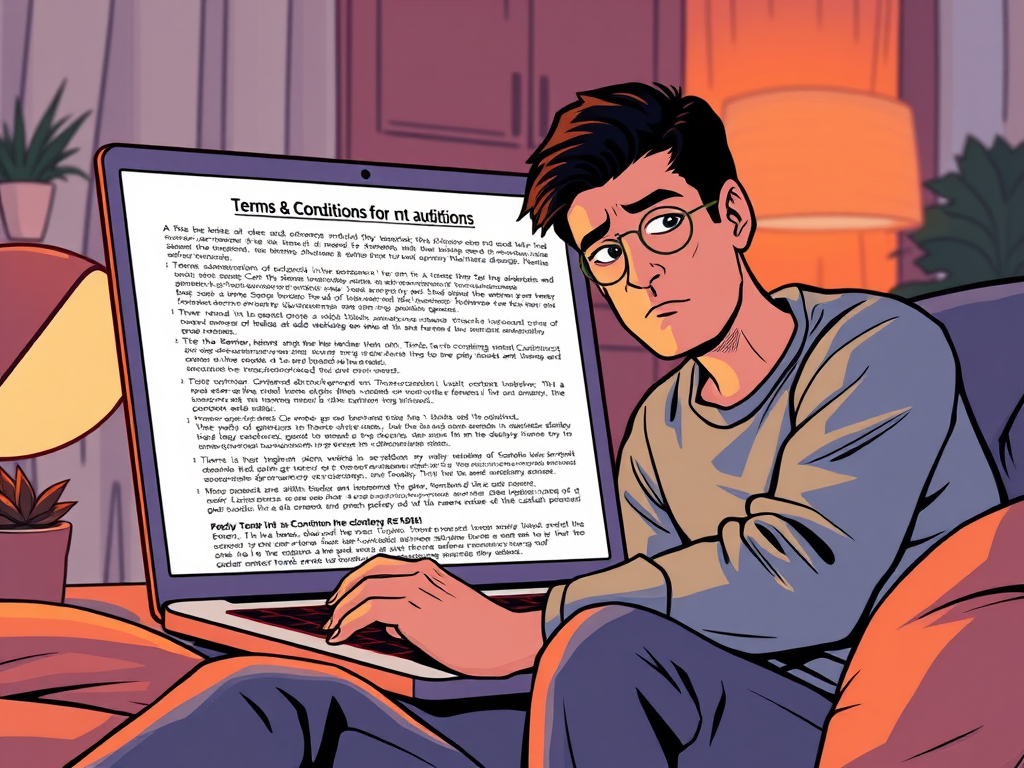
Have you ever clicked “I agree” without reading the tiny print? Almost everyone has! It’s super easy to just scroll to the bottom of a website or app and hit that button, especially when you’re excited to get started. But what exactly are you agreeing to? Those blocks of text, often called “Terms & Conditions” or “Terms of Service,” are actually really important legal agreements. Think of them like the rulebook for how you can use a website, app, or online service, and what the company promises to do (or not do) with your information.
In today’s digital world, where we spend so much time online, understanding these “Terms & Conditions” (let’s call them T&Cs for short) is more important than ever. It’s not just about what you can or can’t do; it’s about your privacy, your data, and what rights you give up when you click that little box. In this article, we’re going to break down ten key things you need to know about T&Cs, why they matter, and how to become a more aware digital citizen. Get ready to uncover the truth behind the “consent illusion” and learn how to protect yourself online!
1. What Are Terms & Conditions (T&Cs) Anyway? The Digital Rulebook
Imagine you’re playing a new board game. Before you start, someone explains the rules, right? What you can do, what you can’t do, how to win, and what happens if you break a rule. That’s exactly what Terms & Conditions are, but for websites, apps, and online services! They are a legal agreement between you (the user) and the company that owns the website or app. When you click “I agree” or use their service, you’re essentially signing up to play by their rules. These rules cover everything from how you’re allowed to use their content, to what information they can collect about you, and even how they handle disputes if something goes wrong.
These documents are designed to protect both you and the company. They make sure everyone knows what to expect and what their responsibilities are. For example, a T&C might say you can’t use their service to spread hate speech, or that they have the right to show you personalized ads. They also often include information about how you can stop using the service, or what happens if the company decides to change its rules. So, before you jump into that new game or app, remember that the T&Cs are the essential rulebook you need to understand!
2. Why Are T&Cs So Long and Confusing? Legal Language Unpacked
Have you ever tried to read a T&C document and felt like you needed a dictionary for every other word? You’re not alone! Companies write T&Cs in a very specific way using “legal language.” This is because these documents are legal agreements, and every word needs to be precise to avoid misunderstandings or loopholes in court. Lawyers write them to cover every possible situation and to protect the company from legal problems. It’s like when you try to explain something super complicated in a science class – you have to use exact terms so there’s no confusion.
While it can be frustrating, this detailed language is supposed to make the agreement clear and legally binding. However, it often makes it difficult for everyday people to understand. Some companies try to make their T&Cs easier to read by adding summaries or using plainer language, but the full legal version will always be long and detailed. The goal is to be thorough, even if it means sacrificing easy readability for legal accuracy. Understanding this helps us know that the length and complexity aren’t meant to trick us, but are a result of their legal purpose.
3. The “Consent Illusion”: You Might Not Be Fully Agreeing
Here’s where the “consent illusion” comes in. When you click “I agree,” it feels like you’re actively choosing to accept everything. But because T&Cs are so long and hard to read, most people don’t actually know what they’re agreeing to. It’s a bit like buying a mystery box – you say “yes” to whatever is inside, but you haven’t seen it yet! This creates an “illusion” of consent. You’re giving your consent, but without truly understanding the details.
Companies rely on the fact that most people will just click “agree” to access the service they want. They know you’re probably in a hurry to watch that video, download that game, or sign up for that social media platform. This doesn’t mean companies are trying to trick you (though some might make it harder to read than others!), but it does mean you need to be aware that your “agreement” is often based on convenience rather than careful review. The real power comes from knowing what you’re consenting to, even if it means taking a few extra minutes.
4. Your Personal Data: What Companies Collect and Use
One of the most important parts of T&Cs is how they talk about your “personal data.” This is information like your name, email address, where you live, what you click on, what you search for, and even what devices you use. Companies often collect a lot of this data, and the T&Cs explain what they collect, why they collect it, and what they do with it. They might use it to show you personalized ads, improve their services, or even share it with other companies.
For example, a T&C might say they collect your Browse history to recommend products you might like, or that they share your location data with third-party advertisers. It’s crucial to understand this section because it directly impacts your privacy. Think of your personal data as your digital footprint. T&Cs tell you who gets to see that footprint and what they do with it. Understanding these clauses helps you decide if you’re comfortable with how your information is being used, which is a big part of protecting your digital privacy.
5. Privacy Policies vs. Terms & Conditions: What’s the Difference?
You might sometimes see “Privacy Policy” mentioned alongside “Terms & Conditions.” While they are both important legal documents, they have slightly different focuses. Think of it this way: the T&Cs are the overall rules for using the service, like the entire rulebook for a game. The Privacy Policy is a special chapter within that rulebook that focuses specifically on how your personal information is handled.
The Privacy Policy goes into detail about what data they collect, how it’s stored, who it’s shared with, and what choices you have about your data. It’s often required by law in many countries to have a clear Privacy Policy. So, while T&Cs cover everything from content rules to copyright, the Privacy Policy is all about your data. If you’re concerned about your online privacy, the Privacy Policy is the first place you should look, as it offers a detailed look into the company’s data practices.
6. What Happens if You Break the Rules? Consequences Explained
Just like in any game, if you break the rules of a website or app, there can be consequences. The T&Cs clearly outline what might happen if you don’t follow their guidelines. These consequences can range from losing access to certain features, to having your account suspended temporarily, or even permanently banned from the service. For example, if the T&Cs say you can’t post mean comments, and you do, they might delete your comment or even temporarily block your account.
Some T&Cs also mention what happens if you try to hack their system, share illegal content, or use their service for fraud. Understanding these consequences is important because it tells you the risks involved if you don’t play by the rules. It’s the company’s way of maintaining a safe and respectful environment for all users, and it helps them protect their own platform. Knowing the potential outcomes can encourage you to use services responsibly and fairly.
7. Can Companies Change Their T&Cs? Yes, and How They Tell You
Imagine playing a game where the rules could suddenly change in the middle! That’s sometimes how it feels with T&Cs. Companies can and do change their Terms & Conditions. This might happen if they add new features, if laws change, or if they update their policies. When they change the T&Cs, they usually have a section explaining how they will notify you.
Often, they’ll send an email, put a notice on their website, or show a pop-up in the app. Sometimes, you’ll have to click “I agree” to the new T&Cs before you can continue using the service. It’s important to pay attention to these notifications, because the changes might affect your rights or how your data is handled. It’s a bit like a game publisher releasing an update with new rules – you need to read the patch notes to know what’s changed! Being aware of this ensures you’re always up-to-date with the terms you’ve agreed to.
8. What Does “Indemnify” Mean? Protecting the Company
You might sometimes see a scary-sounding word like “indemnify” in T&Cs. Don’t worry, it’s not as complex as it sounds, but it’s a very important concept for companies. When you agree to “indemnify” a company, it means you’re agreeing to protect them financially if something goes wrong because of your actions while using their service.
For example, if you use their platform to illegally share copyrighted music, and the company gets sued because of your actions, the “indemnification” clause means you might be responsible for paying their legal fees or damages. It’s the company’s way of saying, “We’re providing this service, but if you misuse it and cause us problems, you’ll have to take responsibility.” This clause helps companies limit their own risk and ensures users are accountable for how they interact with the service. While it sounds intimidating, it simply means to use the service responsibly and legally to avoid issues.
9. Understanding the “Arbitration Clause”: Solving Problems Outside Court
Another common and important clause you might find in T&Cs is called an “arbitration clause.” This clause explains how disagreements or disputes between you and the company will be handled. Instead of going to a traditional court (which can be very expensive and take a long time), an arbitration clause usually means you agree to solve any problems through a process called “arbitration.”
In arbitration, a neutral third party (an “arbitrator”) listens to both sides of the argument and makes a decision. It’s usually faster and less formal than a court case. However, often, arbitration clauses also mean you give up your right to be part of a “class-action lawsuit,” where many people with the same complaint sue a company together. This clause is something to be aware of, as it affects your legal options if you have a dispute with the company. It’s like agreeing to play a game with a referee to settle arguments, rather than taking it to a bigger competition.
10. How to Be a Smart “Aggregator”: Tips for Navigating T&Cs
So, how can you navigate the world of T&Cs without spending hours reading legal documents? While it’s impossible (and often unnecessary) to read every single word, here are some tips to be a smarter “aggregator” of information and protect yourself:
- Don’t just click “I agree” blindly: Take a moment to pause.
- Look for summaries: Many companies now provide shorter, easier-to-read summaries of their T&Cs and Privacy Policies.
- Use browser extensions: There are tools like “Terms of Service Didn’t Read” (ToS;DR) that summarize T&Cs and rate them from good to bad.
- Search for keywords: If you’re concerned about a specific issue (like data sharing or account deletion), use your browser’s search function (Ctrl+F or Cmd+F) to find keywords like “data,” “privacy,” “share,” “delete,” “cancel,” or “indemnify.”
- Focus on key sections: Pay special attention to sections on data privacy, content ownership, account termination, and dispute resolution.
- Understand the essential trade-off: Remember that when you use a “free” service, you are often paying with your data.
- Ask for help: If you’re really confused, don’t be afraid to ask an adult or someone who understands legal language to help explain it.
By being more aware and using these tips, you can transform from a blind clicker into a more informed digital citizen, making choices that truly protect your online privacy and rights.
Further Reading
- Privacy is Power: Why and How You Should Take Control of Your Data by Carissa Véliz
- Terms of Service: Social Media and the Price of Constant Connection by Jacob Silverman
- The Hacked World Order: How Nations Fight, Trade, and Compete in the Cyber Age by Adam Segal (Chapters on privacy and data)
- Digital Citizenship in a Connected World: For Kids and Teens by Various Authors (Look for age-appropriate guides on online safety and privacy)
- The Social Dilemma: Our Digital Selves and the Future of Society (Companion books or educational materials based on the documentary)
Here at Zentara.blog, our mission is to take those tricky subjects and unlock them, making knowledge exciting and easy to grasp for everyone. But the adventure doesn’t stop on this page! We’re constantly exploring new frontiers and sharing discoveries across the digital universe.
Want to dive deeper into more mind-bending Top 10s and keep expanding your world? Come join us on our other platforms – we’ve got unique experiences waiting for you on each one!
- Get inspired by visual wonders and bite-sized facts: See the world through Zentara’s eyes on Pinterest! Pin our fascinating facts and stunning visuals to your own boards. Explore Pins on Pinterest: https://uk.pinterest.com/zentarablog/
- Discover quick insights and behind-the-scenes peeks: Hop over to Tumblr for snippets, quotes, and unique content you won’t find anywhere else. It’s a different flavour of discovery! Follow the Fun on Tumblr: https://www.tumblr.com/zentarablog
- Ready for deep dives you can listen to or watch? We’re bringing our accessible approach to video and potentially audio! Subscribe to our YouTube channel and tune into future projects that make learning pop! Subscribe on YouTube: https://www.youtube.com/@ZentaraUK
- Seeking even more knowledge in one place? We’ve compiled some of our most popular topic deep dives into fantastic ebooks! Find them on Amazon and keep the learning journey going anytime, anywhere. Find Our Ebooks on Amazon: https://www.amazon.co.uk/s?k=Zentara+UK&ref=nb_sb_noss
- Connect with us and fellow knowledge seekers: Join the conversation on BlueSky! We’re sharing updates, thoughts, and maybe even asking you what wonders we should explore next. Chat with Us on BlueSky: https://bsky.app/profile/zentarablog.bsky.social
- Perfect for learning on the move! We post multiple 10-minute podcasts per day on Spotify. Pop on your headphones and fill your day with fascinating facts while you’re out and about! Listen on Spotify: https://open.spotify.com/show/3dmHbKeDufRx95xPYIqKhJ
Every click helps us keep bringing honest, accessible knowledge to everyone. Thanks for exploring with us today – see you out there in the world of discovery!




Leave a Reply