
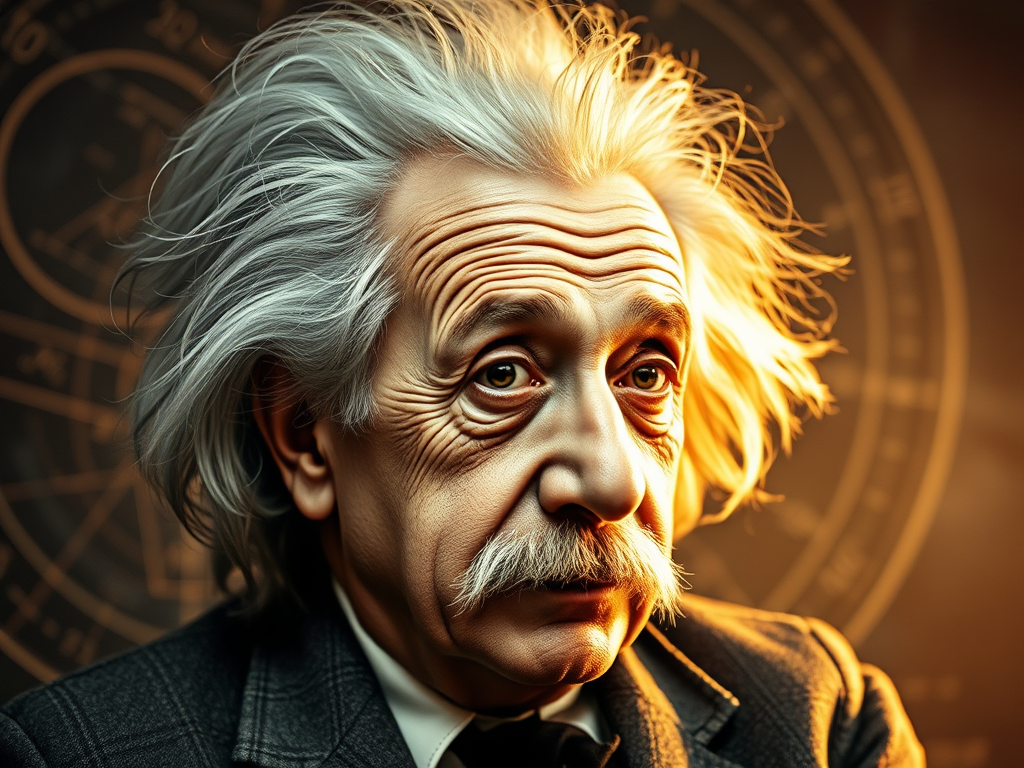
Albert Einstein (1879–1955) stands as one of the most iconic figures in the history of science, a theoretical physicist whose groundbreaking work fundamentally altered our understanding of space, time, gravity, and the universe itself. More than just a brilliant scientist, Einstein became a cultural icon, synonymous with genius, and a powerful voice for peace and justice in a tumultuous century. His wild, unkempt hair and thoughtful gaze became instantly recognizable, embodying the image of the solitary, deep thinker.
Born in Ulm, Germany, Einstein’s early life offered few hints of the revolutionary mind he would become. He was a curious, quiet child who reportedly developed a late fluency in speech. His formal education in Germany was often challenging for him, as he found the rigid, authoritarian Prussian schooling system stifling to his creativity and independent thought. This early experience fostered a lifelong skepticism of unquestioning authority and a deep appreciation for intellectual freedom.
Despite initial struggles to secure an academic position after graduating from the Swiss Federal Polytechnic School in Zürich, Einstein’s “miracle year” of 1905, while working as a patent clerk in Bern, Switzerland, saw him publish four revolutionary papers. These papers, submitted to the Annalen der Physik (Annals of Physics), laid the groundwork for modern physics, introducing concepts that would forever change scientific thought. His work on the photoelectric effect, Brownian motion, and especially his theories of special and general relativity, not only corrected and expanded upon Isaac Newton’s laws but also opened entirely new avenues of scientific inquiry.
Einstein’s impact extended far beyond the confines of theoretical physics. He was a committed pacifist, a staunch advocate for civil rights, and a vocal proponent of world government. His deep humanitarian convictions were shaped by his experiences as a Jewish refugee fleeing Nazi Germany, leading him to speak out against injustice and lend his support to various social causes. He spent his later years at the Institute for Advanced Study in Princeton, New Jersey, continuing his quest for a unified field theory, even as his fame grew exponentially around the world. His legacy is not only in the equations he formulated but also in the profound curiosity, independent spirit, and humanitarian values he championed throughout his remarkable life.
1. The Theory of Special Relativity: Redefining Space and Time
In 1905, while working as a patent clerk, Albert Einstein published his “On the Electrodynamics of Moving Bodies,” which introduced the world to the Special Theory of Relativity. This theory challenged the long-held Newtonian view of absolute space and time, proposing instead that space and time are not separate and fixed entities, but are intertwined into a single four-dimensional fabric called “spacetime.” The theory is built on two fundamental postulates: first, that the laws of physics are the same for all non-accelerating observers (inertial frames of reference), and second, that the speed of light in a vacuum is the same for all observers, regardless of the motion of the light source.
Imagine two people, one standing still and one on a fast-moving train. Newton’s physics would say they experience time and space identically. Einstein’s special relativity revealed that their experience of time and space would actually differ. Time appears to slow down for the person on the moving train relative to the stationary observer (time dilation), and objects moving at high speeds appear to contract in the direction of motion (length contraction). While these effects are negligible at everyday speeds, they become significant as objects approach the speed of light. Special relativity revolutionized our understanding of the universe, demonstrating that reality is relative to the observer’s motion and laying the groundwork for many technological advancements, including GPS systems.
2. E=mc²: The Equivalence of Mass and Energy
Perhaps the most famous equation in history, E=mc², is a direct consequence of Albert Einstein’s Special Theory of Relativity, also published in 1905. This elegant formula expresses the profound concept of mass-energy equivalence, stating that energy (E) and mass (m) are interchangeable and fundamentally the same thing, differing only in form. The ‘c’ represents the speed of light, squared, a colossal number which indicates that even a tiny amount of mass contains an immense amount of energy.
To understand this, imagine that mass is a highly concentrated form of energy, and energy is a dispersed form of mass. This equation revealed the immense energy locked within matter, a concept that was later dramatically demonstrated by nuclear fission and fusion, leading to both nuclear power and atomic weapons. But beyond these applications, E=mc² transformed physics by showing that mass is not conserved independently of energy, but rather mass and energy together are conserved. It provided a deep insight into the fundamental nature of the universe, linking two seemingly distinct physical properties in a beautifully simple, yet incredibly powerful, relationship.
3. The Photoelectric Effect: Pioneering Quantum Theory
While his theories of relativity brought him widespread fame, Albert Einstein was awarded the Nobel Prize in Physics in 1921 not for relativity, but for his explanation of the photoelectric effect. This phenomenon, observed years earlier, described how certain materials emit electrons when light shines on them. Classical physics, which viewed light purely as a wave, struggled to explain why the frequency (color) of light, rather than its intensity, determined whether electrons were emitted and their kinetic energy.
In 1905, Einstein proposed a revolutionary idea: light is not just a wave, but also consists of discrete packets of energy called “quanta” (later named photons). He suggested that an electron is emitted only if it absorbs a single photon with sufficient energy, which depends on the light’s frequency. If the photon’s energy is too low, no electrons are emitted, regardless of how bright the light is. This “particle-like” nature of light was a radical departure from established views and was a pivotal step in the development of quantum mechanics, a field that describes the behavior of matter and energy at the atomic and subatomic levels. Einstein’s work on the photoelectric effect helped establish the dual nature of light – both wave and particle – profoundly influencing the understanding of light and matter interaction, and laying the groundwork for technologies like solar panels and digital cameras.
4. The Theory of General Relativity: Revolutionizing Gravity
Ten years after his Special Theory, in 1915, Albert Einstein unveiled his General Theory of Relativity, a monumental achievement that completely reimagined our understanding of gravity. Isaac Newton had described gravity as a force pulling objects together, but he didn’t explain how this force worked across vast distances. Einstein’s general relativity proposed a radically different concept: gravity is not a force, but a manifestation of the curvature of spacetime caused by the presence of mass and energy.
Imagine spacetime as a stretched rubber sheet. If you place a heavy bowling ball on it, it creates a dip. A smaller marble rolling nearby wouldn’t be “pulled” by the bowling ball’s force; instead, it would roll into the dip created by the bowling ball’s mass. Similarly, massive objects like planets and stars warp the fabric of spacetime around them, and what we perceive as gravity is simply objects following the curves in this distorted spacetime. This theory not only accurately predicted phenomena like the bending of starlight around massive objects (confirmed during a solar eclipse in 1919) but also laid the theoretical foundation for black holes, gravitational waves, and the expansion of the universe, becoming the cornerstone of modern cosmology.
5. Explaining Brownian Motion: Proving the Existence of Atoms
In another of his 1905 “miracle year” papers, Albert Einstein provided a theoretical explanation for Brownian motion, a phenomenon observed by botanist Robert Brown in 1827. Brown had noted that pollen grains suspended in water moved in a continuous, seemingly random jiggling motion. At the time, the existence of atoms and molecules was still debated by some scientists. Einstein’s paper offered a mathematical model that proved this erratic movement was caused by the invisible, random collisions of water molecules with the larger pollen grains.
His detailed calculations showed that the observed motion of the pollen grains could only be explained if the water was composed of tiny, constantly moving particles (molecules). This provided compelling experimental evidence for the existence of atoms and molecules, which were previously largely theoretical constructs. By linking macroscopic observations to the microscopic world, Einstein’s work on Brownian motion solidified the atomic theory of matter and provided a quantitative method for determining the size of atoms, marking a significant step in the development of statistical mechanics and solidifying the particulate nature of matter.
6. Quantum Mechanics and the Wave-Particle Duality: A Complex Relationship
While Albert Einstein’s work on the photoelectric effect was foundational to quantum mechanics, his later relationship with the field became complex. He famously stated, “God does not play dice with the universe,” expressing his discomfort with the probabilistic nature of quantum mechanics, which suggested that subatomic particles don’t have definite properties until measured. He believed in a more deterministic universe governed by underlying principles, rather than inherent randomness.
Despite his philosophical objections, Einstein significantly contributed to the development of quantum theory. His concept of wave-particle duality, where light (and later, matter) exhibits both wave-like and particle-like properties, was a cornerstone. He was also instrumental in predicting Bose-Einstein condensate (a state of matter where particles behave as a single quantum entity at extremely low temperatures), stemming from a collaboration with Satyendra Nath Bose. While he spent much of his later career attempting to unify gravity with other fundamental forces (a “unified field theory”), a goal he never fully achieved, his quantum insights remain essential to our understanding of the subatomic world, underpinning everything from lasers to semiconductors.
7. Humanitarian and Pacifist Activism: A Voice for Peace
Albert Einstein was not only a scientific giant but also a passionate advocate for humanitarian and pacifist causes, using his immense fame as a platform for social change. Witnessing the devastation of two World Wars and the rise of Nazism in his native Germany, he became a staunch opponent of militarism and nationalism. He famously renounced his German citizenship in 1896 (and later again in 1933) due to his pacifist beliefs and opposition to the German state.
During World War I, he was one of the few German intellectuals to sign a manifesto against the war. Later, as a Jewish refugee, he became deeply concerned about the persecution of Jews in Europe and advocated for the creation of a Jewish homeland. While he initially supported the Allied efforts to develop an atomic bomb (fearing Nazi Germany would develop one first, and famously co-signed a letter to President Roosevelt warning of this), he became a vocal proponent of nuclear disarmament after the war, warning of the dangers of nuclear proliferation. His humanitarian convictions also extended to civil rights, where he spoke out against racial discrimination in the United States, forming friendships with figures like Paul Robeson and advocating for racial equality.
8. Philosopher of Science and Thinker: Beyond the Equations
Beyond his scientific equations, Albert Einstein was a profound philosopher of science and a deep thinker who pondered the nature of reality, knowledge, and the human condition. His famous quotes, such as “Imagination is more important than knowledge” or “The important thing is not to stop questioning. Curiosity has its own reason for existence,” reflect his approach to discovery. He believed that true understanding came not just from accumulating facts, but from imaginative leaps and a relentless curiosity about the universe’s underlying principles.
Einstein emphasized the role of intuition and aesthetics in scientific discovery, often stating that he trusted his intuition more than pure logic in the initial stages of formulating theories. He also held a nuanced view on religion, often expressing a deep awe for the order and beauty of the universe, which he sometimes referred to as “God” or “the Old One,” but he rejected traditional organized religion and anthropomorphic deities. His philosophical reflections, often expressed in essays and letters, continue to inspire critical thinking and a holistic approach to understanding the world, demonstrating that science and philosophy are not mutually exclusive but intertwined pursuits of truth.
9. Influence on Technology and Everyday Life: Unseen Impacts
While Albert Einstein’s theories might seem abstract, they have had a profound and often unseen influence on technology and everyday life. The most striking example is the Global Positioning System (GPS). The precise timekeeping required for GPS satellites to accurately pinpoint locations on Earth must account for the effects of both special and general relativity. Because satellites orbit at high speeds (special relativity) and experience weaker gravity than on Earth (general relativity), their clocks run at slightly different rates. Without Einstein’s equations to correct for these relativistic effects, GPS systems would quickly drift by kilometers each day, rendering them useless.
Beyond GPS, his work on the photoelectric effect underpins many modern technologies, including solar panels, digital cameras, automatic door sensors, and even light meters. Lasers, which are ubiquitous in everything from barcode scanners to fiber optics and medical surgery, are based on his theory of stimulated emission. Even the understanding of financial market fluctuations has drawn parallels to Einstein’s work on Brownian motion. His theoretical breakthroughs, initially seeming far removed from practical application, have become indispensable to the technological fabric of the 21st century.
10. Legacy of Curiosity and Intellectual Freedom: Inspiring Generations
Albert Einstein’s most enduring legacy is perhaps his embodiment of curiosity and intellectual freedom. He championed independent thought and was famously critical of rigid educational systems that stifled originality. His life’s work demonstrated the power of questioning established norms, pursuing radical ideas, and maintaining a childlike sense of wonder about the universe. He continuously sought to understand the “why” behind phenomena, rather than merely describing them.
Einstein’s image, that of a benevolent genius with a rebellious spirit, continues to inspire countless individuals to pursue careers in science, challenge conventional wisdom, and embrace the thrill of discovery. He left behind not just a collection of revolutionary theories but a powerful message about the importance of critical thinking, creativity, and the relentless pursuit of knowledge for its own sake. His intellectual honesty, humility in the face of the unknown, and unwavering belief in the comprehensibility of the universe ensure that his influence will continue to shape scientific inquiry and inspire future generations of thinkers and innovators.
Further Reading
- “Einstein: His Life and Universe” by Walter Isaacson
- “Subtle is the Lord: The Science and the Life of Albert Einstein” by Abraham Pais
- “Relativity: The Special and the General Theory” by Albert Einstein
- “Einstein’s Dreams” by Alan Lightman
- “The World As I See It” by Albert Einstein
Here at Zentara.blog, our mission is to take those tricky subjects and unlock them, making knowledge exciting and easy to grasp for everyone. But the adventure doesn’t stop on this page! We’re constantly exploring new frontiers and sharing discoveries across the digital universe. Want to dive deeper into more mind-bending Top 10s and keep expanding your world? Come join us on our other platforms – we’ve got unique experiences waiting for you on each one!
Get inspired by visual wonders and bite-sized facts: See the world through Zentara’s eyes on Pinterest!
Pin our fascinating facts and stunning visuals to your own boards. Explore Pins on Pinterest: https://uk.pinterest.com/zentarablog/
Discover quick insights and behind-the-scenes peeks: Hop over to Tumblr for snippets, quotes, and unique content you won’t find anywhere else. It’s a different flavour of discovery! Follow the Fun on Tumblr: https://www.tumblr.com/zentarablog
Ready for deep dives you can listen to or watch? We’re bringing our accessible approach to video and potentially audio! Subscribe to our YouTube channel and tune into future projects that make learning pop! Subscribe on YouTube: https://www.youtube.com/@ZentaraUK
Seeking even more knowledge in one place? We’ve compiled some of our most popular topic deep dives into fantastic ebooks! Find them on Amazon and keep the learning journey going anytime, anywhere. Find Our Ebooks on Amazon: https://www.amazon.co.uk/s?k=Zentara+UK&ref=nb_sb_noss
Connect with us and fellow knowledge seekers: Join the conversation on BlueSky! We’re sharing updates, thoughts, and maybe even asking you what wonders we should explore next. Chat with Us on BlueSky: https://bsky.app/profile/zentarablog.bsky.social
Perfect for learning on the move! We post multiple 10-minute podcasts per day on Spotify. Pop on your headphones and fill your day with fascinating facts while you’re out and about! Listen on Spotify: https://open.spotify.com/show/3dmHbKeDufRx95xPYIqKhJ
Follow us on Instagram for bytesize knowledge! We post multiple posts per day on our official Instagram account. https://www.instagram.com/zentarablog/ Every click helps us keep bringing honest, accessible knowledge to everyone. Thanks for exploring with us today – see you out there in the world of discovery!




Leave a Reply