
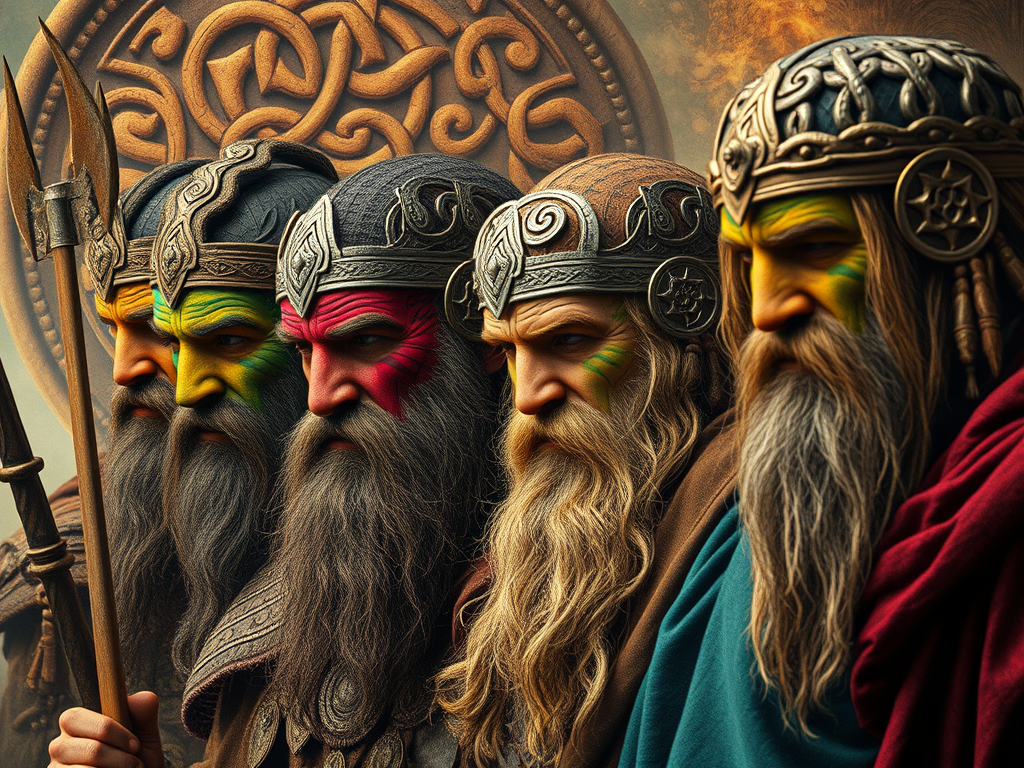
When we hear the word “Celt,” it often conjures images of ferocious, woad-painted warriors, mystical Druids, and intricate, swirling knotwork. The ancient Celts were indeed all of these things, but they were also much more. For over a millennium, they were the dominant culture in Iron Age Europe, a diverse collection of tribes bound by shared language, art, and beliefs, who spread from the heart of the Alps to the misty shores of the Atlantic islands. They were not a single, unified empire like Rome, but a vibrant tapestry of peoples who left an indelible mark on the continent.
The story of the Celts is one of paradoxes. They were feared by the Romans for their battle-fury, yet they produced some of the most sophisticated and beautiful abstract art of the ancient world. They built impressive hillforts and mastered metalworking, yet they left behind no written histories of their own, preferring the power of the spoken word. Understanding who the Celts were requires us to piece together a puzzle from the accounts of their enemies, the findings of archaeology, and the enduring legacy of their language and culture. Here are ten facts that illuminate the world of Europe’s enigmatic ancient warriors and artists.
1. They Were Not One Nation, But Many Tribes
One of the most crucial facts to understand about the ancient Celts is that they were never a single, unified empire or kingdom. The term “Celt” (from the Greek Keltoi) is a broad label used by ancient writers to describe a vast collection of diverse tribes who shared a similar culture and language group. From the Gauls in modern-day France, to the Celtiberians in Spain, the Gaels in Ireland, and the Britons in Great Britain, these groups were often as likely to fight each other as they were to unite against a common foe. Their society was tribal and hierarchical, led by chieftains or kings who gained their position through prowess in battle and the ability to bestow wealth upon their followers. This lack of centralisation was both a strength, making them resilient and adaptable, and a weakness, which the more unified and organized Roman army would eventually exploit with devastating effect.
2. Their Culture Evolved in Two Major Phases
Archaeologists trace the development of Celtic culture through two distinct Iron Age phases, named after key archaeological sites. The earlier phase is the Hallstatt culture (c. 800-450 BCE), which originated in the Alps of modern-day Austria. The Hallstatt Celts grew wealthy from mining and trading salt, and their art was characterized by geometric patterns and influences from the Mediterranean world. Around 450 BCE, a new, more dynamic phase emerged, known as the La Tène culture. Named after a site in Switzerland, the La Tène phase is considered the golden age of Celtic art. This style is what we typically associate with the Celts today: complex, curvilinear designs featuring spirals, trumpets, and stylized animal and human forms. This artistic explosion coincided with a period of major Celtic expansion, as La Tène warriors and migrants spread across Europe, sacking Rome in 390 BCE and pushing as far as modern-day Turkey.
3. Druids Were More Than Just Priests
At the heart of Celtic society were the Druids, a highly respected and powerful intellectual class. Roman writers like Julius Caesar described them with a mixture of awe and suspicion. The Druids were not just priests; they were the judges, the lore-keepers, the philosophers, and the scientists of Celtic society. They presided over religious ceremonies, which often took place in sacred natural groves (nemetons), and made sacrifices. As judges, they arbitrated disputes between individuals and tribes, and their power was such that they could excommunicate those who defied their rulings—a punishment that effectively made someone an outcast. Crucially, they were the guardians of the Celts’ immense body of oral tradition, including laws, history, and genealogies. Becoming a Druid required a long and arduous training period, said to last up to twenty years, during which vast amounts of knowledge had to be memorized, as it was forbidden to write down their sacred teachings.
4. Their Art Was Abstract and Full of Motion
While the art of the Greeks and Romans was largely representational, aiming to capture the world as it appeared, Celtic art was profoundly different. It was an art of abstraction, ambiguity, and constant, swirling motion. La Tène artists excelled in intricate metalwork, decorating shields, helmets, torcs (neck rings), and scabbards with mesmerizing, flowing patterns. They deliberately played with perception; what looks like a stylized bird from one angle might transform into a human face when viewed differently. This was not simply decoration; it was a sophisticated visual language, likely imbued with deep religious and magical significance. Masterpieces like the Battersea Shield or the Desborough Mirror, covered in complex asymmetrical swirls, were not just functional items but powerful symbols of status and belief, designed to dazzle, confuse, and perhaps even spiritually protect the owner.
5. They Were Feared Warriors Who Fought with “Gallic Terror”
The Celtic warriors of the La Tène period were renowned throughout the ancient world for their ferocity and bravery in battle. Roman and Greek writers described the furor Celticus or “Gallic terror”—the wild, terrifying charge of Celtic warriors, who would often fight naked or with their hair limed into stiff spikes, screaming battle cries to intimidate their enemies. They were masters of iron weaponry, producing high-quality swords, spears, and chainmail. Chariots were a key feature of their warfare, particularly in Britain, used to sow chaos and transport elite warriors into the fray. The practice of head-hunting was also common; the Celts believed the head housed the soul, and taking the head of a formidable enemy was a way to capture their spirit and power. This warrior ethos was central to their culture, with social status being intrinsically linked to martial prowess and bravery.
6. Celtic Women Could Hold Significant Power
While Celtic society was patriarchal, evidence suggests that women could wield more power and enjoy greater freedoms than their counterparts in the Roman and Greek worlds. Under the Brehon Laws of early Ireland, women could inherit property, choose their own husbands, and had legal protection within marriage. They were not simply confined to the domestic sphere. There are numerous accounts in both myth and history of powerful female leaders, poets, and warriors. The most famous historical example is Boudica, queen of the Iceni tribe in Britain. In 60/61 CE, she led a massive and bloody rebellion against the occupying Roman forces, destroying several major Roman settlements before she was ultimately defeated. Boudica’s rebellion serves as a powerful testament to the fact that women could, under certain circumstances, rise to positions of supreme political and military leadership within Celtic society.
7. They Relied on an Oral, Not Written, Tradition
One of the most fascinating aspects of Celtic culture is that, despite having knowledge of writing systems like Greek and Latin (which they used for simple inscriptions and records), they deliberately chose not to write down their sacred lore, history, or literature. This was a culture of the spoken word. The responsibility for memorizing and transmitting this vast body of knowledge fell to the Druids and the Bards (a class of esteemed poets and storytellers). This oral tradition was not seen as a weakness but as a way of keeping knowledge alive, sacred, and dynamic. It also enhanced the power and prestige of the intellectual classes who held this knowledge in their memory. Unfortunately, this means that most of what we know about the Celts comes from the biased accounts of their enemies, the Romans, or from later Christian monks in Ireland who wrote down the ancient myths centuries after the pagan era had passed.
8. Their Religion Was Tied to the Natural World
Celtic religion was polytheistic, with a vast pantheon of gods and goddesses who were often tied to specific places, tribes, or aspects of the natural world. They did not build temples in the Greco-Roman style, preferring to worship in natural sanctuaries called nemetons, such as sacred groves of trees, springs, or lakes. Water, in particular, was seen as a gateway to the Otherworld, and a huge number of valuable offerings—swords, shields, cauldrons, and jewellery—have been recovered by archaeologists from rivers and bogs across Europe, thrown into the water as gifts to the gods. The Celts also held a strong belief in an afterlife. Roman observers noted that they seemed to have little fear of death, believing that the soul was immortal and would be reborn into another body or pass to a vibrant Otherworld, a belief that likely contributed to their famous bravery in battle.
9. They Were Eventually Conquered and Assimilated by Rome
For centuries, the Celts were a major power in Europe, but the rise of the highly organized and disciplined Roman Republic marked the beginning of their decline on the continent. The most famous conflict was the Gallic Wars (58-50 BCE), documented by Julius Caesar. Caesar’s campaign was a brutal war of conquest that resulted in the subjugation of Gaul (modern France) and the deaths of a reported one million Celtic people. The Romans were skilled at exploiting the divisions between rival Gallic tribes, turning them against one another. Following conquest, a process of Romanization began. The Romans built cities, roads, and aqueducts, and the Celtic elites gradually adopted Roman language, customs, and styles of dress. While Celtic culture was largely extinguished on the continent, it survived and flourished on the islands of Britain and Ireland, which lay beyond the full reach of the Roman Empire.
10. Their Languages and Culture Survive Today
Though their ancient territories were overrun, the Celtic legacy is far from dead. The most direct and living connection to the ancient Celts is through the Celtic languages, which still survive on the western fringes of Europe. These languages belong to two branches: the Goidelic (or Gaelic) branch, which includes Irish, Scottish Gaelic, and Manx; and the Brythonic (or British) branch, which includes Welsh, Cornish, and Breton. These regions, often referred to as the “Celtic Nations,” are where the art, music, folklore, and traditions that evolved from ancient Celtic culture have been most resilient. While the modern identity of these nations is complex and has evolved significantly over 2,000 years, they represent a living link to the vibrant, warrior-artist culture that once dominated the European continent.
Further Reading
- “The Celts: A Very Short Introduction” by Barry Cunliffe
- “The World of the Celts” by Simon James
- “The Druids” by Peter Berresford Ellis
- “The Gallic War” by Julius Caesar (A firsthand, though heavily biased, Roman account of the Celts)
- “Blood and Mistletoe: The History of the Druids in Britain” by Ronald Hutton
Here at Zentara.blog, our mission is to take those tricky subjects and unlock them, making knowledge exciting and easy to grasp for everyone. But the adventure doesn’t stop on this page! We’re constantly exploring new frontiers and sharing discoveries across the digital universe. Want to dive deeper into more mind-bending Top 10s and keep expanding your world? Come join us on our other platforms – we’ve got unique experiences waiting for you on each one!
Get inspired by visual wonders and bite-sized facts: See the world through Zentara’s eyes on Pinterest!
Pin our fascinating facts and stunning visuals to your own boards. Explore Pins on Pinterest: https://uk.pinterest.com/zentarablog/
Discover quick insights and behind-the-scenes peeks: Hop over to Tumblr for snippets, quotes, and unique content you won’t find anywhere else. It’s a different flavour of discovery! Follow the Fun on Tumblr: https://www.tumblr.com/zentarablog
Ready for deep dives you can listen to or watch? We’re bringing our accessible approach to video and potentially audio! Subscribe to our YouTube channel and tune into future projects that make learning pop! Subscribe on YouTube: https://www.youtube.com/@ZentaraUK
Seeking even more knowledge in one place? We’ve compiled some of our most popular topic deep dives into fantastic ebooks! Find them on Amazon and keep the learning journey going anytime, anywhere. Find Our Ebooks on Amazon: https://www.amazon.co.uk/s?k=Zentara+UK&ref=nb_sb_noss
Connect with us and fellow knowledge seekers: Join the conversation on BlueSky! We’re sharing updates, thoughts, and maybe even asking you what wonders we should explore next. Chat with Us on BlueSky: https://bsky.app/profile/zentarablog.bsky.social
Perfect for learning on the move! We post multiple 10-minute podcasts per day on Spotify. Pop on your headphones and fill your day with fascinating facts while you’re out and about! Listen on Spotify: https://open.spotify.com/show/3dmHbKeDufRx95xPYIqKhJFollow us on Instagram for bytesize knowledge! We post multiple posts per day on our official Instagram account. https://www.instagram.com/zentarablog/ Every click helps us keep bringing honest, accessible knowledge to everyone. Thanks for exploring with us today – see you out there in the world of discovery!




Leave a Reply