
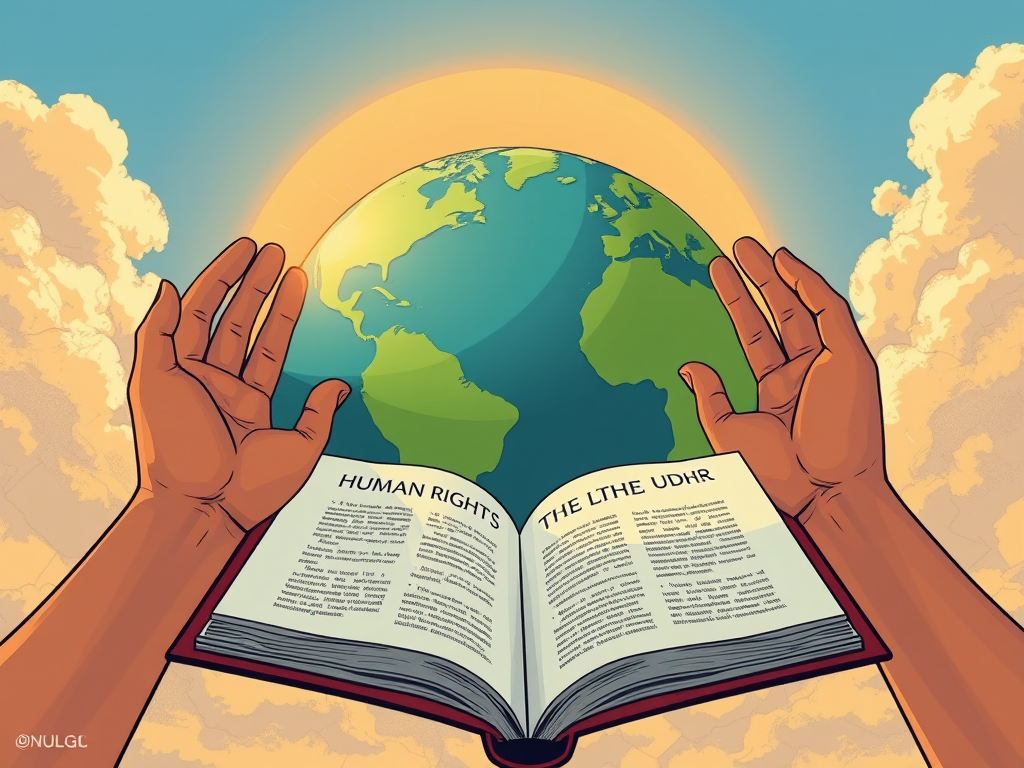
In the aftermath of the Second World War, a world scarred by unimaginable brutality came together to make a promise. This promise was that never again would humanity allow such atrocities to occur, that every single person, regardless of who they are or where they are from, possesses certain fundamental rights and freedoms. This promise was written down in 1948 in a groundbreaking document: The Universal Declaration of Human Rights (UDHR). While it contains 30 articles, its core message can feel vast and complex. Think of the UDHR not as a legal contract, but as a moral compass for humanity, a common standard of achievement for all peoples and all nations. It’s a powerful idea that you are born worthy and free. To truly grasp its significance, let’s break down 10 of these core freedoms into simple, understandable ideas that resonate in our daily lives.
1. The Right to Life, Liberty, and Security: Your Fundamental Safety Net
Imagine your life is a house. The most basic foundation you need is the certainty that no one can arbitrarily knock it down. This is the essence of Article 3 of the UDHR. The right to life means no one, including the government, can unjustly take your life. The right to liberty means you cannot be locked away or detained without a fair and just reason. It’s the freedom to walk down the street, choose your own path, and live without the constant fear of being snatched away. Finally, the right to security of person is about feeling safe in your own skin, protected from violence or harm. These three pillars—life, liberty, and security—are intertwined and form the ultimate safety net. They are the bedrock upon which all other human rights are built. Without them, the concepts of justice, equality, and dignity crumble. It’s the universal guarantee that your existence is valued and protected, the starting point for a meaningful life.
2. Freedom from Slavery and Torture: Owning Your Own Body and Mind
This is one of the most absolute declarations in the UDHR, found in Articles 4 and 5. The freedom from slavery means that no one can own you. Your body, your time, and your labour belong to you and you alone. It’s a direct rejection of historical evils and a stand against modern forms of exploitation like human trafficking and forced labour. Think of it as having the ultimate deed to yourself. Equally powerful is the freedom from torture. This right insists that no one should be subjected to cruel, inhuman, or degrading treatment or punishment. Your mind and body are sanctuaries that cannot be violated to extract information, punish you, or simply to terrorize you. It’s a profound statement about human dignity. It means that even if a person is accused of the worst crimes, their basic humanity must be respected. This right is non-negotiable; it draws a clear line in the sand that no government or individual is ever allowed to cross.
3. The Right to a Fair Trial: Your Shield Against Injustice
Imagine being accused of breaking a rule in a game, but the person accusing you is also the referee and can make up the rules as they go. It wouldn’t be fair, would it? Article 10 of the UDHR is designed to prevent this exact scenario in real life. The right to a fair trial is your shield against the misuse of power. It guarantees that if you are charged with a crime, you have the right to a public hearing by an independent and impartial tribunal. This means the court must be neutral, not biased against you from the start. Key elements include being considered innocent until proven guilty, having the right to a lawyer to defend you, and knowing the charges against you. It ensures that justice is not arbitrary but is based on evidence and established law. This right is a cornerstone of democracy, preventing governments from simply imprisoning their critics or anyone they dislike. It ensures the process of justice is transparent and accountable, protecting everyone from wrongful conviction.
4. Freedom of Thought, Conscience, and Religion: The Right to Your Inner World
Your mind is your own private universe. Article 18 protects this inner world, guaranteeing your freedom of thought, conscience, and religion. Freedom of thought means you have the right to hold any belief or opinion you choose, without fear of punishment. It’s the right to be a skeptic, a dreamer, an artist, or a critic. Conscience is your inner moral compass, and this right protects your ability to act according to your deepest ethical beliefs. The freedom of religion aspect is perhaps the most well-known; it gives you the right to have a religion or belief, to change it, and to practice it, either alone or with others, in public or in private. You can worship, teach, and observe your faith freely. Crucially, this also includes the right not to believe. It’s a fundamental freedom that recognizes that true human dignity comes from the ability to explore the biggest questions of life for oneself, without coercion from the state or anyone else.
5. Freedom of Expression and Opinion: Your Voice Matters
Have you ever been told to keep your opinion to yourself? Article 19 of the UDHR declares that you don’t have to. This is the right to freedom of opinion and expression. It’s more than just the right to speak; it’s the right to “seek, receive and impart information and ideas through any media and regardless of frontiers.” Think of it as the right to have a voice and the right to hear the voices of others. This freedom is the lifeblood of any open society. It allows journalists to hold the powerful accountable, citizens to debate important issues, and artists to challenge our perspectives. Of course, this right isn’t absolute; it doesn’t protect hate speech or incitement to violence. However, its core principle is that a free exchange of ideas, even unpopular ones, is essential for progress and truth. It protects your right to write a blog, post on social media, read a controversial book, or peacefully protest an issue you care about, ensuring that dialogue can flourish over silence.
6. The Right to Privacy: Protecting Your Personal Space
Imagine if your diary, your private conversations, and your home were open for anyone to inspect at any time. You’d feel exposed and unable to be yourself. Article 12 protects you from this kind of intrusion. It states that no one shall be subjected to “arbitrary interference with his privacy, family, home or correspondence, nor to attacks upon his honour and reputation.” This is your right to a personal bubble. It means your personal life is your own business. Your mail and digital messages shouldn’t be read without just cause. Your home shouldn’t be entered without permission. And your reputation shouldn’t be unfairly attacked. In our modern digital age, this right has become more critical than ever. It covers everything from government surveillance to how corporations handle your personal data. The right to privacy allows us the space to be authentic, to build relationships, and to live without the chilling effect of constant observation. It’s the right to draw a curtain and have a part of your life that is just for you.
7. The Right to Seek Asylum: A Lifeline in Times of Danger
If your home were on fire, you would flee to a safe place. The right to seek asylum, outlined in Article 14, is the international equivalent of this basic human instinct. It establishes that “everyone has the right to seek and to enjoy in other countries asylum from persecution.” This is a crucial lifeline for people whose fundamental rights are being violated in their home country. If someone faces torture, unjust imprisonment, or death because of their race, religion, nationality, or political opinion, they have the right to flee to another country and ask for protection. It’s important to note this is the right to seek asylum; it doesn’t guarantee it will be granted, as each country has its own process for determining refugee status. However, the principle is a powerful expression of shared humanity. It recognizes that borders should not be barriers to safety and that the international community has a moral responsibility to help those fleeing for their lives.
8. The Right to Education: Unlocking Human Potential
Education is not a luxury; it’s a tool for transformation. Article 26 champions the right to education, stating that it should be free, at least in the elementary and fundamental stages. Think of education as a key that unlocks countless doors. It unlocks personal potential, allowing individuals to improve their lives and broaden their horizons. It unlocks economic opportunity, providing the skills needed for better jobs. And it unlocks society’s potential, fostering tolerance, understanding, and respect for human rights itself. The UDHR specifies that education should be directed to the “full development of the human personality” and promote “understanding, tolerance and friendship among all nations, racial or religious groups.” It’s a visionary goal that sees education as more than just memorizing facts; it’s about creating well-rounded, compassionate, and engaged global citizens. This right empowers individuals and is one of the most effective ways to break cycles of poverty and build a more peaceful and just world.
9. The Right to Work and Join Unions: Dignity in Labour
Work is a central part of many people’s lives, and Article 23 ensures that this aspect of life is governed by principles of dignity and fairness. It declares that everyone has the right to work, to choose their employment freely, and to work in “just and favourable conditions.” This means protection against unemployment and the right to equal pay for equal work, preventing discrimination in the workplace. It’s about more than just having a job; it’s about having a job that provides a living wage, allowing you and your family to live with dignity. An essential part of this is the right to form and join trade unions. A trade union is like a megaphone for workers; it allows them to band together to negotiate for better pay, safer conditions, and fair treatment. This collective bargaining power helps to balance the relationship between employers and employees, ensuring that individual workers are not left powerless. This right promotes economic justice and recognizes the fundamental contribution that workers make to society.
10. The Right to Freely Participate in Cultural Life: The Joy of Being Human
Life is more than just survival; it’s also about joy, creativity, and community. Article 27 protects this vital aspect of our existence. It gives everyone the right to “freely participate in the cultural life of the community, to enjoy the arts and to share in scientific advancement and its benefits.” This is the right to be fully human. It’s the right to listen to music, read poetry, visit museums, and celebrate traditions that connect you to your heritage and community. It’s also about being a creator, not just a consumer. You have the right to write, paint, sing, and express your own culture. Furthermore, it protects the benefits of progress, stating that we should all share in scientific advancements. Think of life-saving vaccines or technologies that improve our quality of life; this right argues they should be accessible to all, not just a privileged few. It’s a beautiful right that celebrates the richness and diversity of human expression and innovation, ensuring we can all partake in the things that make life meaningful.
Further Reading
For those who wish to explore the history, impact, and meaning of the Universal Declaration of Human Rights in greater detail, these books provide accessible and profound insights:
- A World Made New: Eleanor Roosevelt and the Universal Declaration of Human Rights by Mary Ann Glendon
- Human Rights: A Very Short Introduction by Andrew Clapham
- On Human Rights: The Oxford Amnesty Lectures edited by Stephen Shute and Susan Hurley
- The Universal Declaration of Human Rights: A Commentary by Asbjørn Eide et al.
- Can a Woman Be a President?: The Case for Universal Human Rights by Sima Samar
Here at Zentara.blog, our mission is to take those tricky subjects and unlock them, making knowledge exciting and easy to grasp for everyone. But the adventure doesn’t stop on this page! We’re constantly exploring new frontiers and sharing discoveries across the digital universe. Want to dive deeper into more mind-bending Top 10s and keep expanding your world? Come join us on our other platforms – we’ve got unique experiences waiting for you on each one!
Get inspired by visual wonders and bite-sized facts: See the world through Zentara’s eyes on Pinterest!
Pin our fascinating facts and stunning visuals to your own boards. Explore Pins on Pinterest: https://uk.pinterest.com/zentarablog/
Discover quick insights and behind-the-scenes peeks: Hop over to Tumblr for snippets, quotes, and unique content you won’t find anywhere else. It’s a different flavour of discovery! Follow the Fun on Tumblr: https://www.tumblr.com/zentarablog
Ready for deep dives you can listen to or watch? We’re bringing our accessible approach to video and potentially audio! Subscribe to our YouTube channel and tune into future projects that make learning pop! Subscribe on YouTube: https://www.youtube.com/@ZentaraUK
Seeking even more knowledge in one place? We’ve compiled some of our most popular topic deep dives into fantastic ebooks! Find them on Amazon and keep the learning journey going anytime, anywhere. Find Our Ebooks on Amazon: https://www.amazon.co.uk/s?k=Zentara+UK&ref=nb_sb_noss
Connect with us and fellow knowledge seekers: Join the conversation on BlueSky! We’re sharing updates, thoughts, and maybe even asking you what wonders we should explore next. Chat with Us on BlueSky: https://bsky.app/profile/zentarablog.bsky.social
Perfect for learning on the move! We post multiple 10-minute podcasts per day on Spotify. Pop on your headphones and fill your day with fascinating facts while you’re out and about! Listen on Spotify: https://open.spotify.com/show/3dmHbKeDufRx95xPYIqKhJFollow us on Instagram for bytesize knowledge! We post multiple posts per day on our official Instagram account. https://www.instagram.com/zentarablog/ Every click helps us keep bringing honest, accessible knowledge to everyone. Thanks for exploring with us today – see you out there in the world of discovery!


Leave a Reply