
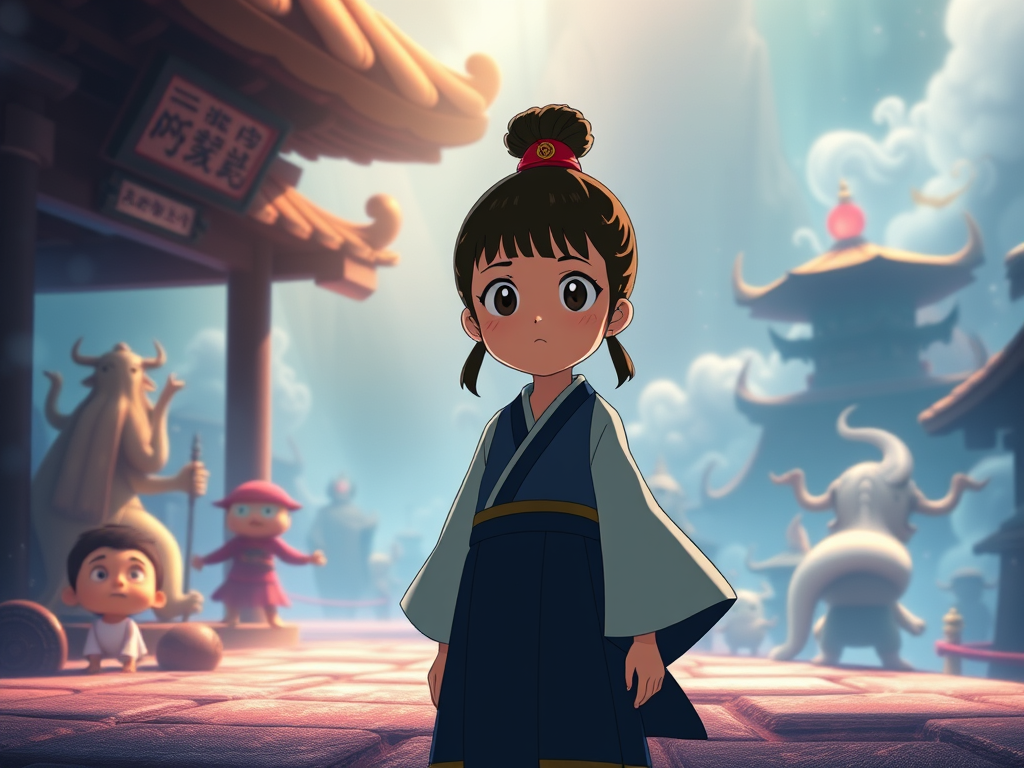
Released in 2001, Hayao Miyazaki’s Spirited Away is more than just an animated film; it’s a global cultural landmark. This enchanting, complex, and sometimes terrifying masterpiece was the first, and to this day only, hand-drawn, non-English language film to win the Academy Award for Best Animated Feature. It tells the story of Chihiro, a sullen 10-year-old girl who, while moving to a new town with her parents, stumbles into a world of ancient gods, strange spirits, and magical bathhouses. To save her parents, who have been turned into pigs, she must work, find her courage, and remember her own name.
The film’s universal appeal lies in its breathtaking visuals, its deep connection to Japanese folklore, and its profound exploration of universal themes like identity, greed, and environmentalism. But the magic we see on screen is only half the story. The creation of Spirited Away was a journey as unique and unpredictable as Chihiro’s own. From a production process that started without a script to inspirations drawn from real-life frustrations, these behind-the-scenes facts reveal the incredible artistry and deep personal meaning poured into every frame by the master animators at Studio Ghibli.
1. The Film Was Created Without a Script
In the world of Western filmmaking, starting a multi-million dollar production without a finished script is unthinkable. For Hayao Miyazaki, it’s the only way to work. In a fascinating departure from industry norms, Spirited Away had no screenplay when production began. Instead, Miyazaki develops his stories through the process of drawing storyboards. He often says he doesn’t know how the story will end when he starts; he discovers the narrative alongside his characters.
This organic, intuitive approach is central to the Studio Ghibli production process. It allows the film to grow and evolve, taking unexpected turns that a rigid script might prevent. Miyazaki compared this method to being a river finding its own path; the story has a direction, but its exact course is discovered along the way. For Spirited Away, this meant that characters like Haku and No-Face could develop in complexity as Miyazaki got to know them through his drawings. It’s a high-wire act that requires immense trust in the creative process, but it’s also what gives the film its dreamlike, immersive quality—the sense that the audience is discovering this strange, magical world right alongside Chihiro.
2. Chihiro Was Inspired by a Real, Moody 10-Year-Old Girl
The inspiration for Spirited Away came from a very personal place for Hayao Miyazaki. He wanted to create a film specifically for 10-year-old girls, an audience he felt was often served shallow, romanticised stories. The direct inspiration for the heroine, Chihiro, was the daughter of one of his friends, a television producer. Every year, Miyazaki would visit the family at their mountain cabin, and he observed that his friend’s daughter seemed listless and bored, glued to her portable game console.
He felt a need to create a heroine that girls like her could look up to—not a character born with magical powers or a special destiny, but an ordinary, sulky girl who finds her own strength through perseverance and hard work. He wanted to tell a story where the protagonist triumphs by learning to adapt, be polite, and value her connections to others. Chihiro’s transformation from a whiny, apathetic child into a capable and courageous young woman is the heart of the film’s message. Miyazaki’s goal was to tell his friend’s daughter, and girls everywhere, “Don’t worry, you’ll be able to handle it.” This relatable, human starting point is a key part of the film’s profound Spirited Away meaning.
3. The Stink Spirit Scene Was Based on Miyazaki’s Own Experience
One of the film’s most memorable and triumphant sequences involves Chihiro helping a grotesque “Stink Spirit” who comes to the bathhouse. As she bathes him, she discovers a thorn-like object in his side. With the help of the entire staff, she pulls out an incredible amount of human pollution—including a bicycle, fishing lines, and heaps of trash—revealing him to be the beautiful, powerful spirit of a polluted river.
This powerful environmental message was drawn directly from Miyazaki’s own life. He once participated in cleaning a local river, and during the clean-up, the community managed to pull out a bicycle that was buried in the sludge. The experience of seeing the river restored after removing the man-made filth stuck with him. He channelled this memory directly into the film, creating a powerful metaphor for humanity’s impact on the natural world. It’s a perfect example of how Miyazaki weaves important Spirited Away themes into the fantasy narrative, grounding the magical world in real-world concerns and giving the story a tangible, urgent relevance.
4. The Enigmatic No-Face Represents Modern Loneliness
No-Face, or Kaonashi, is one of cinema’s most iconic and mysterious creatures. He is often mistaken for a villain, but his true nature is far more complex and tragic. As his Japanese name “Kaonashi” (faceless) implies, he has no identity of his own. The best way to understand No-Face in Spirited Away is as a symbol of loneliness and the desperate search for connection in a consumerist society.
He is a floating, empty vessel who mirrors the personalities and desires of those he encounters. When he sees the staff’s greed for gold, he learns that he can “buy” attention and affection by magically producing it. His monstrous rampage isn’t born of malice, but of the pain and emptiness he feels when his offerings fail to give him a genuine connection. He literally consumes others to try and absorb their voices and personalities, but it only leaves him more bloated and miserable. It is only through Chihiro’s simple, unconditional acceptance—expecting nothing from him—that he is able to calm down and find peace. His journey to Zeniba’s cottage, where he learns the value of quiet, productive work, represents him finally finding a place where he can exist without having to consume.
5. Chihiro’s Name Is the Key to Her Entire Journey
One of the central rules of the spirit world is that the tyrannical witch Yubaba controls her workers by stealing their names. When Chihiro signs her contract, Yubaba takes her name, Chihiro Ogino (荻野 千尋), and renames her Sen (千). This act is far more than a simple plot device; it’s a profound metaphor for the loss of identity.
The meaning of Spirited Away is deeply embedded in this detail. The name “Chihiro” (千尋) translates to “a thousand fathoms” or “a thousand searches,” implying great depth and complexity. By contrast, “Sen” (千) simply means “one thousand.” Yubaba doesn’t just give her a new name; she strips her of her depth, her past, and her sense of self, reducing her to a mere number, a worker. Chihiro’s struggle throughout the film is not just to survive, but to remember her real name and hold onto who she is. Haku, who has forgotten his own name, warns her of this danger. Her final test, where she must identify her parents from a group of pigs, is a test of her spirit and core identity, which she passes not through magic, but through the insight she has gained.
6. The Food Is Temptation, and It Was Drawn with Intense Detail
The food in Spirited Away is legendary. From the mysterious, steaming dishes that turn Chihiro’s parents into pigs to the simple onigiri (rice balls) that make her cry, every meal is depicted with mouth-watering detail. This focus on food is deliberate and symbolic. In the opening scene, the feast represents the temptation and greed of the consumerist world of the 1980s Japanese bubble economy, which Miyazaki was critiquing. Her parents’ gluttony and lack of respect immediately mark them as outsiders who must be punished.
Conversely, the simple food Chihiro eats, like Haku’s rice balls or Lin’s steamed bun, represents true sustenance, kindness, and connection to the spirit world. The painstaking detail of the Spirited Away animation for these scenes was paramount. Animators studied how food jiggles, how steam rises, and how characters’ mouths should move to convey texture and weight. Miyazaki himself would often personally redraw key food scenes to ensure they looked perfectly soft, succulent, and delicious. This intense focus makes the food a character in itself, driving the narrative and representing the film’s core moral themes.
7. The Film Is a Hybrid of Hand-Drawn and Digital Animation
Studio Ghibli is celebrated for its commitment to traditional, hand-drawn animation, but Spirited Away marked a pivotal moment in the studio’s technological evolution. While it retains the unmistakable charm of hand-drawn art, it was the first Ghibli film to fully embrace digital tools. The Studio Ghibli production process for the film was a masterful blend of old and new techniques.
Every character was still meticulously drawn by hand on paper by animators, preserving the organic, fluid movement that is a hallmark of the studio’s style. However, instead of painting these drawings onto transparent cels, the drawings were scanned into computers. This allowed for a digital painting process, giving the artists an infinite colour palette and the ability to create subtle gradients and textures that were difficult with traditional paint. This digital workflow also enabled more complex camera movements, like the sweeping shots through the town and the bathhouse, and the seamless integration of computer-generated elements. This hybrid approach allowed Ghibli to enhance its visual storytelling without sacrificing the hand-crafted soul of its animation.
8. The “No Cuts” Policy Was Enforced with a Samurai Sword
For years, many of Studio Ghibli’s films were distributed in the West by companies that would heavily edit them, cutting scenes and changing dialogue to supposedly make them more palatable for American audiences. Hayao Miyazaki was deeply unhappy with this practice. When Miramax, then owned by Harvey Weinstein, acquired the rights to distribute Princess Mononoke, they considered making significant cuts.
In response, a Ghibli producer sent a now-legendary package to Weinstein’s office. It contained an authentic samurai sword, and attached to the blade was a simple, chilling message: “No cuts.” The message was received loud and clear. For the English-language release of Spirited Away, Ghibli partnered with Pixar’s John Lasseter, a close friend and admirer of Miyazaki. Lasseter championed the “no cuts” policy, ensuring that the film was dubbed and released with its artistic integrity completely intact. This fierce protection of the original vision is a major reason why the film resonated so powerfully with international audiences and critics, allowing them to experience Miyazaki’s masterpiece exactly as he intended.
9. The Spirit World’s Architecture Is Inspired by Real Places
While the world of Spirited Away is a fantastical creation, its beautiful and detailed architecture is heavily inspired by real locations. Miyazaki and his team drew from a variety of sources to create the film’s “lived-in” aesthetic. A primary inspiration was the Edo-Tokyo Open Air Architectural Museum, a park in Tokyo where historical Japanese buildings have been preserved. Miyazaki visited the museum frequently during production, drawing inspiration from the old-fashioned storefronts, bathhouses, and homes to give his spirit world a nostalgic, Meiji-era feel.
The magnificent bathhouse run by Yubaba is visually linked to several real onsen (hot springs), most notably Dōgo Onsen in Matsuyama, one of Japan’s oldest and most famous bathhouses. Furthermore, the charmingly chaotic and beautiful Taiwanese town of Jiufen is widely cited as a major visual influence. With its narrow, winding alleyways, steep staircases, and glowing red lanterns, the resemblance to the film’s mysterious town centre is unmistakable. These real-world touchstones ground the fantastical setting, giving it a sense of history and place that makes it all the more believable.
10. The Ending’s Ambiguity Is a Deliberate Thematic Choice
After passing Yubaba’s final test, Chihiro and her restored parents walk back through the tunnel to their car, which is now covered in dust and leaves. As she looks back, her memory of the spirit world seems distant and dreamlike. The film ends without explicitly confirming whether she remembers the details of her adventure. This ambiguity is entirely intentional and central to the film’s message.
The point is not whether she has photographic recall of Haku, Kamaji, and Lin. The point is that the experience has fundamentally changed her. The Spirited Away themes of growth and resilience culminate in this final scene. She is no longer the fearful, pessimistic child from the beginning of the film. She has gained confidence, courage, and an appreciation for the world around her. The spirit world was real because its effect on her was real. She doesn’t need to cling to the memory because she now carries its lessons within her. It’s a subtle and mature ending that trusts the audience to understand that the true evidence of a journey is not in souvenirs or photos, but in the person you become because of it.
Further Reading
To immerse yourself further in the enchanting world of Studio Ghibli and the mind of its master director, these books offer invaluable insights.
- The Art of Spirited Away by Hayao Miyazaki – A beautiful, oversized art book filled with concept sketches, character designs, storyboards, and detailed background paintings that reveal the visual development of the film.
- Starting Point: 1979-1996 by Hayao Miyazaki – A collection of essays, interviews, and memoirs from Miyazaki himself, providing a fascinating look into his philosophies on animation, storytelling, and life before he created Spirited Away.
- Sharing a House with the Never-Ending Man: 15 Years at Studio Ghibli by Steve Alpert – An entertaining and insightful memoir from a former Ghibli executive that offers a rare Westerner’s perspective on the studio’s unique business and creative culture.
Here at Zentara.blog, our mission is to take those tricky subjects and unlock them, making knowledge exciting and easy to grasp for everyone. But the adventure doesn’t stop on this page! We’re constantly exploring new frontiers and sharing discoveries across the digital universe. Want to dive deeper into more mind-bending Top 10s and keep expanding your world? Come join us on our other platforms – we’ve got unique experiences waiting for you on each one!
Get inspired by visual wonders and bite-sized facts: See the world through Zentara’s eyes on Pinterest!
Pin our fascinating facts and stunning visuals to your own boards. Explore Pins on Pinterest: https://uk.pinterest.com/zentarablog/
Discover quick insights and behind-the-scenes peeks: Hop over to Tumblr for snippets, quotes, and unique content you won’t find anywhere else. It’s a different flavour of discovery! Follow the Fun on Tumblr: https://www.tumblr.com/zentarablog
Ready for deep dives you can listen to or watch? We’re bringing our accessible approach to video and potentially audio! Subscribe to our YouTube channel and tune into future projects that make learning pop! Subscribe on YouTube: https://www.youtube.com/@ZentaraUK
Seeking even more knowledge in one place? We’ve compiled some of our most popular topic deep dives into fantastic ebooks! Find them on Amazon and keep the learning journey going anytime, anywhere. Find Our Ebooks on Amazon: https://www.amazon.co.uk/s?k=Zentara+UK&ref=nb_sb_noss
Connect with us and fellow knowledge seekers: Join the conversation on BlueSky! We’re sharing updates, thoughts, and maybe even asking you what wonders we should explore next. Chat with Us on BlueSky: https://bsky.app/profile/zentarablog.bsky.social
Perfect for learning on the move! We post multiple 10-minute podcasts per day on Spotify. Pop on your headphones and fill your day with fascinating facts while you’re out and about! Listen on Spotify: https://open.spotify.com/show/3dmHbKeDufRx95xPYIqKhJFollow us on Instagram for bytesize knowledge! We post multiple posts per day on our official Instagram account. https://www.instagram.com/zentarablog/ Every click helps us keep bringing honest, accessible knowledge to everyone. Thanks for exploring with us today – see you out there in the world of discovery!
Leave a Reply