
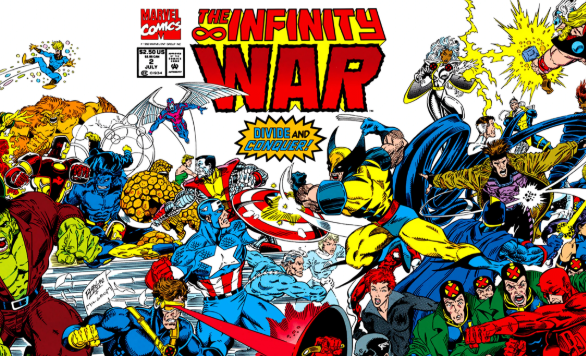
Long before the silver screen brought the Mad Titan into the global spotlight, the comic book world was rocked by a cosmic event of unparalleled scale. If the previous chapter, Infinity Gauntlet, was a story of ultimate power and its corruptive nature, its successor—the original Infinity War—is a descent into the fractured psyche of a god. It is a tale of mirrors, shadows, and the terrifying realization that our greatest enemy is often the darkness we try to cast out of ourselves.
In the early nineties, Marvel Comics mastered the “event” format, and this story stands as a pillar of that era. It isn’t just a sequel; it’s a thematic inversion. While the first story was a linear struggle against a single omnipotent foe, this saga is a chaotic, multi-dimensional chess match involving evil doppelgängers, reluctant alliances, and the return of a villain who represents the literal “bad side” of a cosmic savior. For those looking to dive deep into the lore that shaped the modern Marvel Multiverse, here is everything you need to know about this iconic struggle.
1. The Direct Aftermath of the Gauntlet
To understand this conflict, one must look at the vacuum left behind after the defeat of Thanos. When Adam Warlock successfully claimed the Infinity Gauntlet, he became the supreme being of the universe. However, Warlock realized that to be a perfectly fair and logical god, he had to purge himself of “human” inconsistencies. In an act of cosmic hubris, he used the Gauntlet to expel both his good and evil sides, believing that only pure neutrality would allow him to govern the cosmos effectively.
This decision backfired spectacularly. By casting out his extremes, Warlock unknowingly gave birth to two independent entities: the Goddess (his “good” side) and the Magus (his “evil” side). While Warlock remained “logical,” he was now hollow. The story begins when the Magus, a creature of pure, calculating malice, begins a campaign to reclaim the power of the Infinity Gems and reshape reality in his own twisted image. This setup transforms a typical superhero brawl into a deep dive into the philosophy of the self, suggesting that our flaws are just as necessary as our virtues.
2. The Return of the Magus
The central antagonist of this saga is the Magus, a character with a long and complex history in Marvel lore. Traditionally portrayed as a future, corrupted version of Adam Warlock, the Magus in this specific event is a literal manifestation of Warlock’s discarded darkness. He is cold, brilliant, and utterly ruthless. Unlike Thanos, who sought power to impress a lady (Death), the Magus seeks power because he believes it is his birthright as the “superior” half of Warlock.
The Magus operates from a dimension of shadows, slowly weaving a web that entangles the entire Marvel Universe. He is a master manipulator who stays three steps ahead of the heroes for most of the story. His presence forces the characters—and the reader—to confront the idea of “dark counterparts.” He doesn’t just want to kill the heroes; he wants to replace them. His return signaled a shift in Marvel’s cosmic storytelling, moving away from simple conquerors toward villains who represent deep-seated psychological fears.
3. The Terror of the Evil Doppelgängers
The most visually striking and memorable element of this storyline is the army of “evil twins.” The Magus creates a legion of doppelgängers—monstrous, distorted versions of Earth’s heroes. These aren’t just clones; they are nightmare versions of characters like Captain America, Iron Man, and the Fantastic Four, often sporting extra limbs, jagged teeth, and specialized powers designed to counter the originals.
[Table: Notable Doppelgänger Transformations]
| Original Hero | Doppelgänger Feature | Narrative Impact |
| Spider-Man | Six arms, razor webbing, monstrous face | Became a long-term recurring villain (“Spider-Man Doppelgänger”). |
| Iron Man | Bio-mechanical, parasitic armor | Represented the danger of technology without a soul. |
| Wolverine | Metallic, jagged claws and feral appearance | Forced Logan to confront his animalistic nature. |
These doppelgängers serve a dual purpose. On the surface, they provide the necessary “cannon fodder” for the massive action sequences that fans love. On a deeper level, they represent the Magus’s philosophy: that everything “good” in the universe has a dark, parasitic shadow waiting to take over.
4. Thanos: The Reluctant Protagonist
In one of the greatest “heel-turns” in comic history, Thanos of Titan—the man who had recently tried to wipe out half of all life—becomes one of the story’s primary protagonists. After his defeat in the previous saga, Thanos retired to a quiet life of farming, having gained a modicum of wisdom and humility. However, when he detects the rise of the Magus, he realizes that the threat is so great that he must intervene.
Thanos acts as a cynical, high-IQ strategist throughout the event. He aligns himself with Adam Warlock, despite their bloody history. Watching Thanos navigate a room full of heroes who rightfully hate him provides some of the best dialogue and tension in the series. He isn’t “good” now; he is simply practical. He knows that if the Magus wins, there will be nothing left for Thanos to eventually rule or observe. This nuanced portrayal of Thanos helped solidify him as one of the most complex characters in the Marvel stable, moving him beyond the trope of the “one-dimensional villain.”
5. The Formation of the Infinity Watch
Recognizing that no one person should hold the power of a god, Adam Warlock distributed the Infinity Gems among a group he called the “Infinity Watch.” Each member was tasked with guarding a specific gem, ensuring they could never be used in unison again. This group became the frontline defense against the Magus’s machinations.
- Adam Warlock (Soul Gem): The leader and moral center.
- Gamora (Time Gem): The deadliest woman in the galaxy.
- Drax the Destroyer (Power Gem): The muscle, albeit with limited intelligence at the time.
- Pip the Troll (Space Gem): The hedonistic navigator.
- Moondragon (Mind Gem): The powerful telepath with a superiority complex.
- Thanos (Reality Gem): The secret sixth member, kept in the shadows.
The dynamics of this team are fascinatingly dysfunctional. They aren’t the Avengers; they are a collection of outcasts and former villains who are bound together by a cosmic burden. Their struggle to work together while guarding the most powerful objects in existence adds a layer of “heist movie” tension to the grand space opera.
6. The Living Tribunal’s Interference
In the Marvel Universe, there is a hierarchy of power, and at the top (usually) sits the Living Tribunal—the multi-faced judge of the multiverse. Early in the story, the Living Tribunal makes a landmark ruling: the Infinity Gems will no longer function in unison. This was a direct response to the chaos caused by the “Gauntlet” incident.
This ruling is a critical plot point. The Magus’s entire plan hinges on obtaining a collection of five “containment units” (cosmic cubes from different realities) because he cannot use the Gems as a collective whole. However, the ruling also hampers the heroes. They have the ultimate weapons, but they are essentially “deactivated” when brought together. The quest to convince the Living Tribunal to reverse this decision—to allow the Gems to work again just long enough to stop the Magus—creates a ticking-clock scenario that heightens the stakes for the entire universe.
7. The Ultimate Nullifier Gamble
As the heroes realize the Magus is gaining ground, they turn to one of the most feared weapons in comic history: the Ultimate Nullifier. Traditionally associated with Galactus, the Nullifier has the power to erase anything from existence—but at the cost of the user’s own life if their focus wavers. The hero Quasar is chosen to wield it, leading to one of the most intense subplots in the series.
The use of the Nullifier represents the “nuclear option.” It shows the desperation of Earth’s heroes and cosmic entities alike. Quasar’s journey to the heart of the conflict, weapon in hand, serves as a masterclass in tension. It explores the weight of responsibility and the terrifying reality of what it means to hold the power of total annihilation. The failure or success of this gamble is a turning point that leads directly into the mind-bending climax.
8. Galactic Entities as Pawns
The Magus doesn’t just target street-level heroes; he manipulates the fundamental forces of the universe. Beings like Galactus, the Silver Surfer, and even the personification of Eternity find themselves caught in the Magus’s traps. Galactus, in particular, plays a major role as he attempts to use his advanced science to track the source of the cosmic disturbances.
Seeing these “space gods” being outmaneuvered by the Magus reinforces how dangerous he truly is. In many ways, the story is a critique of the arrogance of power. Even Galactus, who views himself as a necessary force of nature, is shown to be vulnerable to the Magus’s strategic genius. This “escalation” ensures that the story feels truly universal, affecting everything from the Avengers’ mansion to the very foundations of reality.
9. The Palace of Death Climax
The final showdown takes place in a surreal, darkened “Palace of Death,” where the Magus has finally managed to trap Warlock and Thanos. The climax is a dizzying array of double-crosses and illusions. Because the Magus is a version of Warlock, they share a psychic bond, making the battle as much a mental struggle as a physical one.
The resolution involves a brilliant bit of trickery involving the Reality Gem. It serves as a reminder that in the world of the Infinity Gems, perception is everything. The battle concludes not with a simple punch, but with a complex philosophical “checkmate” that forces the Magus back into the Soul Gem. This ending differentiates the story from more traditional superhero endings, emphasizing that cosmic problems often require cosmic, rather than physical, solutions.
10. A Legacy of Cosmic Rebirth
While the immediate threat of the Magus was neutralized, the ripples of this event defined Marvel’s cosmic line for a generation. It led directly into the third part of the trilogy, Infinity Crusade, and established Adam Warlock as a permanent, if reluctant, fixture of the Marvel hierarchy. The “Infinity Watch” era remains a fan-favorite period, known for its weirdness and its focus on the “gray areas” of morality.
The concept of the doppelgängers also lived on, particularly the Spider-Man version, which became a staple of the “Maximum Carnage” storyline. Most importantly, Infinity War taught readers that in the Marvel Universe, the most dangerous wars aren’t fought over territory or resources—they are fought over the soul. It remains a definitive example of how to handle a massive cast of characters while keeping the focus on a deeply personal, character-driven core.
Further Reading
- The Infinity War (Original Trade Paperback) – Jim Starlin and Ron Lim. (The core six-issue collection).
- Warlock and the Infinity Watch Vol. 1 – Jim Starlin. (Provides the essential context for the team’s formation and their role in the war).
- Infinity Gauntlet – Jim Starlin. (Essential reading to understand the status quo of Thanos and Warlock).
- Silver Surfer: Epic Collection: Resurrection – Various Authors. (Covers the Surfer’s perspective and his interactions with the cosmic entities during this era).
- 10 Things You Should Know About Kang the Conqueror – Marvel Comics
- 10 Things You Should Know About The Sentry – Marvel Comics
- 10 Things You Should Know About Ghost Rider – Marvel Comics
- 10 Essential Things to Know About The Mole Man – Marvel Comics Lore
- 10 Essential Things to Know About War Machine – Marvel Comics Lore
- 10 Things You Should Know About Doctor Doom (Victor von Doom) – Marvel Comics
- 10 Things You Should Know About Hercules – Marvel Comics
- 10 Things You Should Know About Valeria Richards – Marvel Comics
- 10 Things You Should Know About Franklin Richards – Marvel Comics
- 10 Things You Should Know About The Human Torch (Johnny Storm) – Marvel Comics



