
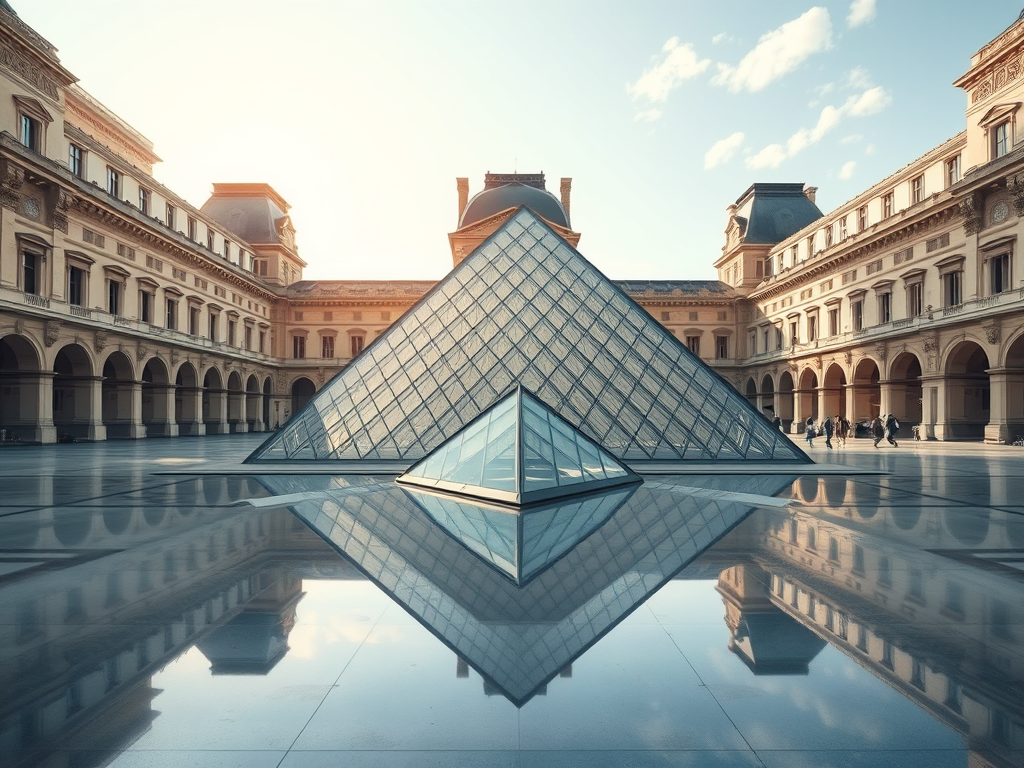
Nestled in the heart of Paris, the Louvre Museum is more than just the world’s largest and most visited art museum; it is a palace of human creativity, a labyrinth of history, and a testament to the enduring power of art. Home to timeless masterpieces like the Mona Lisa and the Venus de Milo, its sprawling galleries welcome millions of visitors each year, all eager to stand in the presence of genius. The iconic image of I. M. Pei’s glass pyramid rising from the centre of a grand, classical courtyard perfectly captures the museum’s identity: a place where history and modernity collide in a breathtaking display.
But before it was a museum, it was a fortress, a royal palace, and the stage for some of the most dramatic moments in French history. Its collections were shaped by kings, revolution, conquest, and a heroic effort to save them from the ravages of war. To truly appreciate the Louvre is to understand its many layers. Beyond the famous artworks and bewilderingly long corridors lie incredible stories of transformation, controversy, and hidden purpose. Let’s journey beyond the crowds and uncover ten fascinating facts that reveal the secret history of this unparalleled cultural institution.
1. It Began Life as a Fearsome Medieval Fortress
Before the Louvre was a home for art, it was a bastion of war. The original structure on this site had nothing to do with culture and everything to do with conflict. In 1190, King Philip II (Philippe Auguste) ordered the construction of a fortress on the banks of the Seine to protect Paris from Viking raids and the threat of English invasion from Normandy. This was the Louvre fortress, a formidable citadel with thick walls, a surrounding moat, and a massive central keep, or Grosse Tour.
Its primary purpose was to defend the city and house the royal treasury and archives. For centuries, it served this military function. Today, visitors can journey back in time by descending into the museum’s basement level. In the Sully Wing, you can walk among the original 12th-century foundations of the medieval moat and keep, which were rediscovered during excavations in the 1980s. Standing in this subterranean space, you can feel the building’s raw, powerful origins, a stark contrast to the elegant palace and world-class museum that would eventually rise above it. It’s a tangible reminder that the Louvre’s story begins with stone and steel, not canvas and marble.
2. The Iconic Glass Pyramid Was Hugely Controversial
Today, the Louvre Pyramid is a beloved symbol of Paris, as iconic as the Eiffel Tower. But when the design by Chinese-American architect I. M. Pei was unveiled in 1984, it was met with a firestorm of public outrage. The proposal to place a 70-foot-tall, modernist glass-and-steel pyramid in the centre of the Napoleon Courtyard—the historical heart of the palace—was seen by many as a sacrilegious act.
Critics lambasted the design as an “architectural joke” and a “gigantic, ruinous gadget.” They argued that its futuristic aesthetic clashed horribly with the French Renaissance style of the surrounding palace. Some opponents even spread bizarre rumours, including the false claim that the pyramid was designed with 666 panes of glass (it actually has 673), linking it to the devil. President François Mitterrand, who commissioned the project, and I. M. Pei stood firm. The pyramid was conceived as a new, grand entrance capable of accommodating the museum’s growing number of visitors and bringing light into the subterranean lobby. It took years, but public opinion eventually turned. The pyramid opened in 1989 and is now celebrated for its elegant geometry and for creating a brilliant dialogue between the past and the present.
3. The Mona Lisa Was Stolen, Which Catapulted Her to Fame
The Mona Lisa is undoubtedly the most famous painting in the world, but her global celebrity status was cemented by a dramatic crime. On August 21, 1911, the painting vanished from the walls of the Louvre. The museum was in chaos, the borders of France were sealed, and the theft became a massive international news story. For two years, her whereabouts were a complete mystery. Pablo Picasso was even questioned as a suspect at one point.
The culprit was an Italian handyman named Vincenzo Peruggia, a former Louvre employee. Believing that the painting had been looted from Italy by Napoleon (it had in fact been legally acquired by the French King Francis I), he saw himself as a national hero. He had hidden in a storeroom overnight, tucked the small painting under his coat, and simply walked out the next morning. The theft turned the Mona Lisa from an admired Renaissance portrait into a household name. When she was finally recovered in Florence in 1913 and triumphantly returned to the Louvre, massive crowds greeted her. The empty space on the wall where she had hung had drawn more visitors than the painting itself ever had before the theft.
4. It’s So Large You Couldn’t See It All in 200 Days
The sheer scale of the Louvre is almost impossible to comprehend until you are there. It is the world’s largest art museum, with over 782,000 square feet (72,735 square meters) of gallery space—the equivalent of nearly 15 acres. To put that in perspective, you could fit the entire British Museum inside it with room to spare. The museum’s permanent collection consists of over 615,000 works of art, though “only” around 35,000 are on display at any given time.
This immense collection has led to a famous calculation. If you were to spend just 30 seconds looking at every single piece of art currently on display, without stopping for breaks or sleep, it would take you nearly 200 full days to see everything. This staggering fact highlights why a visit to the Louvre requires a plan. It is not a museum you can “complete” in a single visit, or even in a lifetime. It is a world of art to be explored over time, a city of masterpieces where every corridor reveals another chapter in the story of human creativity.
5. It Became a Public Museum During the French Revolution
For most of its history, the Louvre was a royal palace, and its magnificent art collection was the private property of the monarch, accessible only to the king and a select few aristocrats and guests. The idea of creating a public gallery to display the royal collection had been discussed during the Enlightenment, but it took the radical upheaval of the French Revolution to make it a reality.
On August 10, 1793, one year after the monarchy was overthrown, the revolutionary government opened the doors of the Louvre to the public for the first time. It was a powerful symbolic act. The palace of kings was transformed into the museum of the people. The art that had once been a symbol of royal power and wealth was now declared the property of the nation, available for the education and inspiration of all citizens. This event was a landmark moment in the history of museums, helping to establish the modern ideal of the museum as a public, civic institution.
6. Napoleon Renamed It After Himself and Filled It with Plunder
During his reign as Emperor, Napoleon Bonaparte embarked on a systematic campaign of artistic looting across Europe. As his armies conquered Italy, Austria, Germany, and Egypt, he had his agents select the finest masterpieces—from paintings and sculptures to ancient artifacts—to be seized and transported to Paris. His goal was to turn the Louvre, which he renamed the Musée Napoléon in 1803, into the greatest museum the world had ever known, a symbol of France’s imperial glory.
Famous works like the ancient Roman sculpture Laocoön and His Sons from the Vatican and the four bronze Horses of Saint Mark from Venice were all brought to Paris and put on display. The museum became a repository of plundered treasures. However, after Napoleon’s final defeat at Waterloo in 1815, one of the key conditions of the peace treaty was the repatriation of this looted art. Over 5,000 works were returned to their countries of origin, though many pieces, particularly those from less powerful states or whose ownership was complex, remained in the Louvre.
7. Its Entire Collection Was Secretly Evacuated During WWII
As war clouds gathered over Europe in 1939, the director of the Louvre, Jacques Jaujard, knew the museum’s priceless collection was in grave danger. Anticipating a German invasion, he closed the museum for “repairs” and initiated one of the most audacious and heroic art evacuations in history. In absolute secrecy, a small army of curators and staff worked day and night to pack and transport thousands of artworks.
The Mona Lisa was sent on her own special journey in a custom case, moved from castle to castle throughout the war to keep her location hidden. The massive, nine-foot-tall Winged Victory of Samothrace was painstakingly trundled down its grand staircase on a wooden ramp. Over the course of three days, nearly 4,000 treasures were spirited away in a convoy of over 200 trucks, ambulances, and even taxi cabs to be hidden in châteaux and abbeys across the French countryside. This incredible foresight and bravery meant that when the Nazis marched into Paris, they found the Louvre’s galleries almost completely empty. Thanks to Jaujard and his team, not a single major artwork from the Louvre’s collection was lost during the war.
8. The Louvre Has a “Sister” in the Desert
The Louvre is not just a museum; it is a global brand. This was made official in 2017 with the opening of the Louvre Abu Dhabi in the United Arab Emirates. Housed in a breathtaking building designed by architect Jean Nouvel, with a massive, web-patterned dome that filters the sunlight, this museum is a separate institution that represents a unique cultural partnership.
Under a thirty-year agreement, the Louvre Abu Dhabi is able to use the prestigious “Louvre” name, receive expert guidance from French curators, and, most importantly, borrow hundreds of major artworks from the Paris museum and other top French institutions. The goal of the Louvre Abu Dhabi is to create a “universal museum,” telling the story of human creativity by juxtaposing artworks from different cultures and civilizations. It stands as a testament to the Louvre’s international prestige and its evolving role in the 21st century as a global leader in cultural exchange.
9. The Winged Victory of Samothrace Was Discovered in Pieces
Along with the Mona Lisa and the Venus de Milo, the Winged Victory of Samothrace is one of the three great ladies of the Louvre. This magnificent Hellenistic sculpture of the Greek goddess Nike (Victory) is celebrated for its incredible sense of movement and drama. But she was not discovered in her majestic state. In 1863, the French diplomat and amateur archaeologist Charles Champoiseau discovered the statue on the Greek island of Samothrace, shattered into more than 100 fragments.
The body was mostly intact, but the head and arms were missing and have never been found. The sculpture was painstakingly reassembled back in Paris, and the museum’s curators made a brilliant decision on how to display her. They placed her at the top of the Daru Staircase, one of the grandest architectural spaces in the museum. This placement recreates the drama of her original setting atop a sanctuary overlooking the sea. As you ascend the stairs, she appears before you as if she is alighting on the prow of a ship, her wings outstretched. It’s a masterful piece of museum curation that turned a fragmented archeological find into an unforgettable artistic experience.
10. It is the Starting Point of Paris’s “Historical Axis”
The Louvre is not just a destination; it is the anchor point for the entire city’s grand design. It marks the easternmost point of the Axe Historique, or Historical Axis, a nine-kilometre (5.6-mile) line of monuments and thoroughfares that creates a majestic, uninterrupted vista through the heart of Paris.
This perfectly straight line begins at the central courtyard of the Louvre. It runs west through the Arc de Triomphe du Carrousel, across the Tuileries Garden, through the obelisk at the Place de la Concorde, up the famous avenue of the Champs-Élysées, through the centre of the massive Arc de Triomphe, and continues all the way to the modern financial district, culminating at the Grande Arche de la Défense. This remarkable axis, created and added to by French leaders over centuries from Louis XIV to François Mitterrand, organizes the city visually and symbolically, with the historic palace of the Louvre as its origin point.
Further Reading
To continue your exploration of the Louvre’s art, architecture, and dramatic history, these books offer a rich and detailed perspective.
- The Louvre: The History, the Collections, the Architecture by Genevieve Bresc-Bautier – A comprehensive and beautifully illustrated guide that covers the museum’s transformation from fortress to palace to museum, with highlights from its vast collections.
- The Rape of Europa: The Fate of Europe’s Treasures in the Third Reich and the Second World War by Lynn H. Nicholas – This Pulitzer Prize-winning book details the heroic efforts to save Europe’s cultural heritage during WWII, with a significant focus on the evacuation of the Louvre.
The Greater Journey: Americans in Paris by David McCullough – While not exclusively about the Louvre, this book masterfully captures the artistic and cultural life of 19th-century Paris, providing rich context for the city the Louvre helped to define.




Leave a Reply