
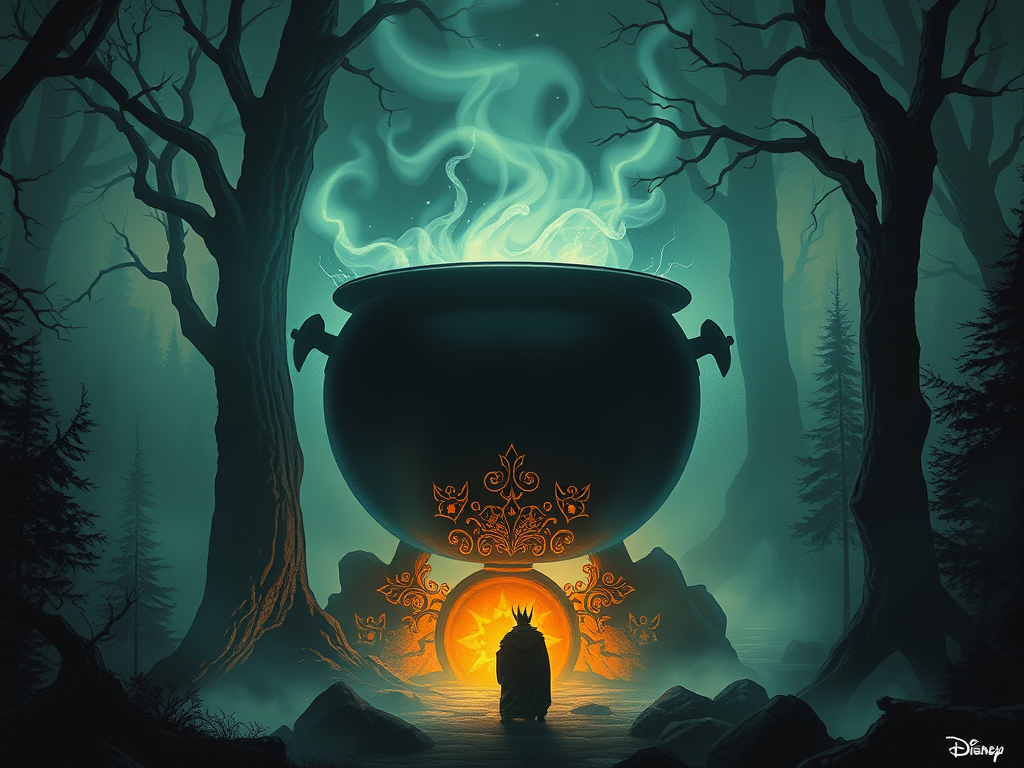
Welcome, fellow adventurers and fans of Disney magic, to a journey into the shadows of the studio’s history. Today, we’re prying open the lid of one of the most infamous and fascinating films ever to emerge from Walt Disney Animation: 1985’s The Black Cauldron. Based on Lloyd Alexander’s beloved “The Chronicles of Prydain” book series, this ambitious fantasy epic was meant to usher in a new, bold era for Disney animation. Instead, it became a legendary cautionary tale, a film so dark and troubled that it nearly brought the studio’s animation department to its knees. For years, Disney seemed almost ashamed of it, but time has been kind, and The Black Cauldron has since cultivated a loyal following who appreciate its daring tone and stunning artistry. You may have seen the film, but we guarantee you haven’t heard the whole story. We’re about to uncover 10 mind-blowing, little-known facts about its creation that will give you a profound new appreciation for this dark horse of the Disney canon. Prepare to face the Horned King; this is the story of the cauldron that almost cooked Disney’s goose.
1. The 12-Year Development Nightmare
Long before the film ever hit screens, The Black Cauldron was trapped in a seemingly endless cycle of development, a period so long and arduous it’s now legendary in animation circles. Disney first acquired the film rights to Lloyd Alexander’s “The Chronicles of Prydain” series all the way back in 1973. The studio saw the potential for a grand fantasy adventure that could rival the likes of The Lord of the Rings. However, what followed was over a decade of creative turmoil. The project passed through the hands of numerous writers, artists, and directors, each with a different vision for the story. Early concepts were even darker and more complex than the final film, aiming for a true sword-and-sorcery epic. This constant shifting of creative gears meant that work was often started, scrapped, and then started all over again. Storyboards were created and discarded, characters were designed and redesigned, and the script was rewritten countless times. This lengthy and chaotic process not only delayed the film’s release but also contributed significantly to its ballooning budget and the disjointed feel that some critics pointed out upon its release. It was a project born of ambition that became mired in indecision.
2. The Most Expensive Animated Film of Its Time
When The Black Cauldron was finally released in 1985, it held the startling distinction of being the most expensive animated feature film ever made. The final budget clocked in at a staggering $44 million. To put that into perspective, that’s more than double the cost of Disney’s previous animated film, The Fox and the Hound, and in today’s money, it would be well over $120 million. So, where did all that money go? A significant portion was consumed by the aforementioned 12-year development process, with years of salaries for artists and writers working on concepts that were ultimately abandoned. Furthermore, the film’s ambitious animation, which aimed for a level of detail and fluidity previously unseen, required immense man-hours. The quest to create a darker, more realistic fantasy world meant developing new techniques and pushing the boundaries of the craft. This financial gamble was a massive risk for Disney, one they hoped would pay off by launching a new franchise and re-establishing their dominance in animation. The pressure was immense; the film didn’t just need to be a hit, it needed to be a phenomenon to justify its colossal price tag.
3. The Katzenberg Scissors: A Film Drastically Cut
One of the most infamous stories surrounding The Black Cauldron involves the film’s then-studio chairman, Jeffrey Katzenberg. Upon viewing a nearly finished cut of the film in 1984, he was horrified by its intense darkness, particularly a sequence involving the “Cauldron Born”—the Horned King’s undead army. In a now-legendary incident, Katzenberg personally took a print of the film into an edit bay and, with his own hands, began physically cutting out frames with scissors, removing approximately 12 minutes of footage. The scene in question depicted the Cauldron Born warriors gruesomely killing human soldiers, with one zombie even slitting a man’s throat. Test audiences of children had been terrified, and Katzenberg feared the film would be a PR disaster. This last-minute, drastic edit created significant tension with the film’s directors and animators, who felt their work was being butchered. The cuts also resulted in some noticeable continuity errors and jarring jumps in Elmer Bernstein’s musical score. It was a brutal decision that fundamentally altered the film and signaled a major power shift at the studio, prioritizing commercial viability over artistic integrity.
4. Disney’s First PG-Rated Animated Feature
For decades, the Walt Disney Animation Studios brand was synonymous with family-friendly, “G”-rated entertainment. The Black Cauldron shattered that tradition. Its dark themes, terrifying villain, and intense sequences of fantasy violence were simply too much to squeak by with a G rating from the Motion Picture Association of America (MPAA). Even after Jeffrey Katzenberg’s significant cuts, the film was still deemed intense enough to warrant a “Parental Guidance Suggested” rating, making it the very first animated feature in the Disney canon to receive a PG. This was a huge deal at the time and a clear signal of the studio’s attempt to appeal to an older, teenage audience that had grown up with films like Star Wars and Raiders of the Lost Ark. The PG rating was both a marketing tool and a warning. While Disney hoped it would telegraph a more mature and exciting adventure, it also alienated many families who expected the traditional, gentle fare the studio was known for, contributing to its confusion in the marketplace.
5. The Terrifying Voice of the Horned King
A truly great villain needs a truly great voice, and The Black Cauldron found its in the legendary British actor, John Hurt. Known for his distinctive, gravelly voice and his incredible range, Hurt brought a chilling and unforgettable presence to the Horned King. His performance is a masterclass in voice acting; he imbues the skeletal lich with a palpable sense of ancient evil, rage, and bone-chilling authority. There is no hint of camp or theatricality, only pure, terrifying menace. The animators were so inspired by Hurt’s powerful vocal performance that they incorporated his mannerisms and intensity into the character’s design and movement. The Horned King is widely regarded as one of Disney’s most frightening villains, and a huge part of that legacy is owed to John Hurt’s terrifyingly brilliant work. He elevates the character from a simple monster to a truly iconic force of darkness.
6. Groundbreaking Animation and a Failed Experiment
The Black Cauldron was a film of immense technical ambition, pushing the boundaries of what was possible in traditional animation. It was the first Disney animated feature to be shot in 70mm widescreen since Sleeping Beauty, giving it a truly epic scope. More significantly, it was one of the first Disney films to incorporate computer-generated imagery (CGI). While the CGI is subtle by today’s standards, it was used for challenging objects like bubbles, floating orbs of light, and the cauldron itself. However, the film’s biggest technical gamble was the Animation Photo Transfer (APT) process. This was a new, cost-saving technique designed to transfer animators’ drawings directly onto the animation cels, replacing the expensive and time-consuming hand-inking process. While it worked in theory, the APT process proved to be unreliable and prone to creating a “scratchy” or “sketchy” look if not perfectly executed. The difficulties with this new technology caused numerous delays and frustrations for the animation department, and the process was ultimately abandoned after this one film, making The Black Cauldron a unique, if flawed, technical experiment.
7. The Box Office Bomb That Nearly Killed Disney Animation
After 12 years of development and a budget of $44 million, the fate of Disney Animation rested on the success of The Black Cauldron. The result was a catastrophe. Released in the summer of 1985, the film was a box office disaster, grossing only $21.3 million domestically. It was famously out-grossed that summer by The Care Bears Movie, a humiliating blow for the once-invincible studio. The film’s failure was attributed to many factors: its dark tone alienated families, its PG rating created confusion, and it received mixed-to-negative reviews from critics who found the story disjointed and the characters unengaging. The financial loss was so severe that it sent shockwaves through the company. The future of the entire animation division was called into question, and the animation department was moved off the main Disney lot in Burbank to a cheaper location in Glendale. For a time, it seemed that feature animation at Disney might be finished for good, a terrifying prospect that was, thankfully, averted by the studio’s later successes.
8. An Unsung Musical Score
The film’s score was composed by the legendary Elmer Bernstein, a giant in the industry known for his work on films like The Magnificent Seven and Ghostbusters. For The Black Cauldron, Bernstein crafted a powerful, dark, and sweeping orchestral score that perfectly captured the film’s epic fantasy tone. It was a far cry from the musical-style songs that had defined previous Disney films. However, due to the last-minute edits made by Jeffrey Katzenberg, portions of Bernstein’s score were chopped up, rearranged, or replaced entirely with new music to match the re-cut scenes. This resulted in a final soundtrack that was somewhat disjointed and, in Bernstein’s view, compromised. He was reportedly unhappy with the final result, and for years, a complete version of his original score was a holy grail for film music enthusiasts. Thankfully, a comprehensive release in 2012 finally allowed fans to hear his work as it was originally intended, revealing a masterpiece of fantasy scoring that stands as one of the film’s strongest and most underappreciated assets.
9. The Famous Animator You Didn’t Know Worked On It
In the world of animation, few names are as revered as Tim Burton. Known for his unique gothic sensibility and films like Beetlejuice, Edward Scissorhands, and The Nightmare Before Christmas, Burton actually started his career as a young animator at Disney in the early 1980s. During his tenure, he worked on The Black Cauldron as a conceptual artist. However, Burton’s quirky and macabre style was a poor fit for the more conventional (though still dark) aesthetic the studio was aiming for. He produced numerous character designs and concept drawings, but reportedly none of his work was used in the final film. His sensibilities were simply too different from the established Disney house style at the time. Frustrated by the creative constraints, Burton would soon leave Disney to pursue his own unique projects, but his brief, uncredited work on The Black Cauldron remains a fascinating footnote in the careers of both the legendary director and the film itself.
10. A Cult Following and a Slow Redemption
For many years after its disastrous release, The Black Cauldron was the black sheep of the Disney family. The company seemed almost to disown it; it was the last Disney animated feature to be released on home video, not appearing on VHS until 1998, a full 13 years after its theatrical run. For a generation, the film was practically invisible. However, as those who saw it as children grew up, and as new audiences discovered it on video and DVD, the film’s reputation began to change. A passionate cult following emerged, drawn to the very things that caused it to fail in the first place: its darkness, its genuinely frightening villain, its unique place in the Disney timeline, and its refusal to talk down to its audience. Today, The Black Cauldron is viewed not as a failure, but as a bold and beautiful experiment. It represents a fascinating “what if?” moment in Disney history—a glimpse of a darker, more daring path the studio might have taken.
Conclusion
From a development hell that lasted over a decade to a box office performance that threatened the very existence of Disney’s animation department, The Black Cauldron is so much more than just a movie. It is a survivor. It’s a testament to the hundreds of artists who poured their talent into its ambitious frames and a symbol of a pivotal, turbulent era at the House of Mouse. The story behind the film is one of risk, creative conflict, and ultimate redemption through a dedicated fanbase that saw the beauty in its darkness. While it may never be held in the same commercial esteem as The Lion King or Beauty and the Beast, its unique legacy as Disney’s daring, dark, and fascinating folly is finally secure. What do you think? Was The Black Cauldron a misunderstood masterpiece or a noble failure? Let us know your thoughts in the comments below!
Dive Deeper
- The Chronicles of Prydain by Lloyd Alexander: The award-winning five-book fantasy series that started it all. Discover the original, richer stories of Taran, Eilonwy, and their quest to defeat the forces of evil.
- Waking Sleeping Beauty (2009 documentary film): A must-see documentary directed by Don Hahn that chronicles the period of turmoil and eventual triumph at Disney Animation from 1984 to 1994, with The Black Cauldron‘s failure being a key starting point.
Disney’s Art of Animation: From Mickey Mouse to Herculesby Bob Thomas: This book offers a beautiful look at the artistry and process of Disney’s animated features, with insights into the ambitious techniques attempted in The Black Cauldron.




Leave a Reply