
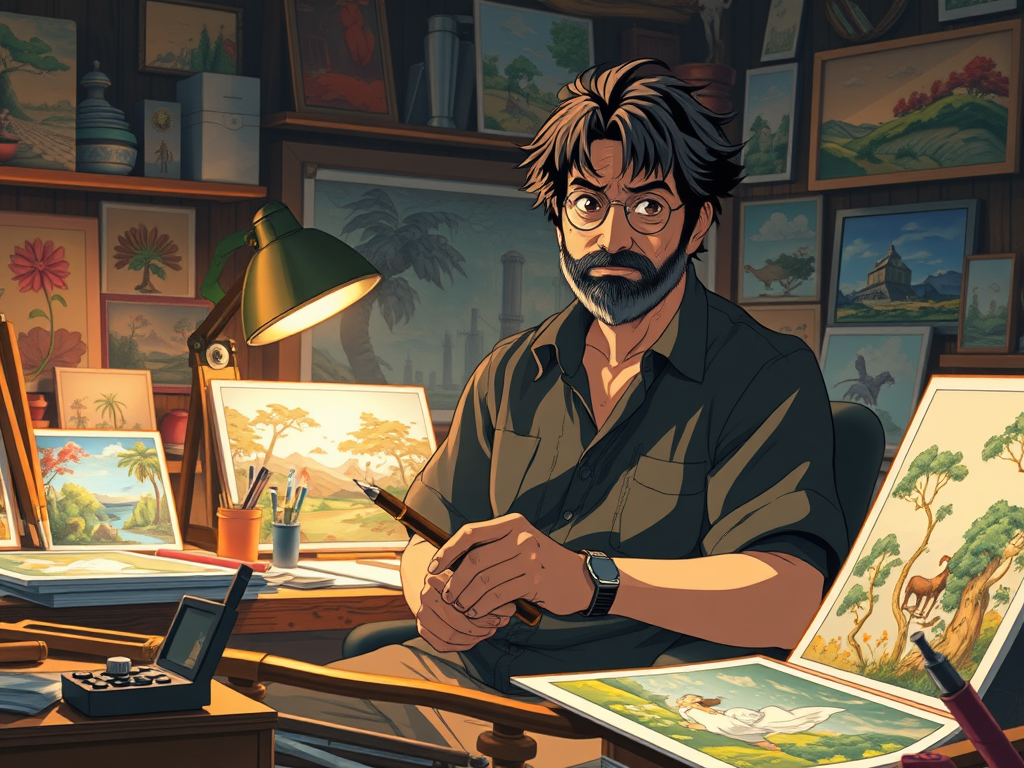
Over a quarter of a century since its release, Princess Mononoke remains a towering achievement in the world of animation. Hayao Miyazaki’s 1997 masterpiece was a watershed moment for Studio Ghibli, a film that traded the gentle whimsy of its predecessors for a dark, complex, and violent epic. It presented a world of brutal beauty, where gods and demons clashed with humanity, and no character was wholly good or evil. It was a raw, sophisticated, and unflinching look at the conflict between nature and industry, a theme that has only become more urgent with time.
The film’s power, however, is matched only by the Herculean effort that went into its creation. The story behind Princess Mononoke is one of obsessive dedication, artistic sacrifice, legendary defiance, and groundbreaking innovation. It was a project that pushed Hayao Miyazaki and his team at Studio Ghibli to their absolute limits and, in doing so, changed the landscape of global animation forever. To truly understand this cinematic landmark, we must explore the fascinating facts of its legendary production.
1. Its Record-Shattering Budget Was a Massive Gamble
In the mid-1990s, producing a 2D animated film was a costly endeavour, but Studio Ghibli pushed the boundaries to an unprecedented degree for Princess Mononoke. The film was made with a final budget of approximately 2.35 billion Yen (around 23.5 million USD at the time), making it the most expensive animated feature ever produced in Japan by a wide margin. This colossal figure was a monumental gamble for a studio known for its artistic integrity but not for producing blockbuster hits on this scale.
The investment was poured into the sheer quality of the animation, allowing for a longer production timeline and a larger team of animators. The gamble paid off spectacularly. Upon its release, Princess Mononoke shattered box office records in Japan, becoming the highest-grossing domestic film in the country’s history, surpassing the long-held record of E.T. the Extra-Terrestrial. Its success was a cultural phenomenon that proved adult-oriented, thematically complex animation could be a commercial powerhouse, legitimizing the medium in a way few films had before.
2. Miyazaki Personally Corrected Over 80,000 Animation Cels
The stunning fluidity and detail of Princess Mononoke were achieved through an almost inhuman level of dedication from its director. The film is composed of approximately 144,000 individual, hand-painted cels of animation—a staggering number for any production. What makes this figure truly legendary is Hayao Miyazaki’s personal involvement. As a notorious perfectionist, he insisted on reviewing every single one of these 144,000 cels himself.
According to studio producer Toshio Suzuki, Miyazaki personally made corrections or completely redrew portions of an estimated 80,000 of those cels. This is a level of hands-on control that is virtually unheard of for a director on a production of this scale. While other directors delegate, Miyazaki immersed himself in the frame-by-frame creation of his world, ensuring that every movement, every expression, and every background detail met his exacting standards. It’s a testament to his singular vision and the painstaking, manual labour that underpins the film’s artistic genius.
3. The Film’s Core Concept Was in Development for 16 Years
While Princess Mononoke premiered in 1997, its conceptual roots dig much deeper into Hayao Miyazaki’s past. The first seeds of the story were planted as far back as the late 1970s and early 1980s. His early sketchbooks from that period show concepts for a story titled Mononoke Hime, featuring a princess living in the wilderness with a large, monstrous cat-like beast. This “beauty and the beast” archetype was a recurring fascination for him.
However, the initial concept was more lighthearted and fantastical. It was ultimately shelved, and some of its ideas—particularly the relationship between a young girl and a gentle forest spirit—would evolve and find a new home in the 1988 classic My Neighbor Totoro. It wasn’t until the 1990s that Miyazaki revisited the idea, transforming it from a simple fairytale into the dark, historical epic we know today. This long, 16-year gestation period allowed the themes and characters to mature in his mind, resulting in a story with far greater depth and complexity than his original vision.
4. It Was Intended to Be Miyazaki’s Final Film
The production of Princess Mononoke was so physically and mentally demanding that Hayao Miyazaki fully intended for it to be his last film. The three-year production cycle was a relentless grind, and at nearly 60 years of age, he felt he had poured everything he had left into this one, final statement. He announced during its creation that this would be his swan song, the magnum opus that would cap his legendary career.
The film’s grand scale, its dark and morally ambiguous themes, and its unresolved, bittersweet ending were all characteristic of a final artistic statement. He wasn’t trying to create another crowd-pleaser; he was making a film that encapsulated his complex, often pessimistic, views on humanity, nature, and the cycles of hatred. Of course, his creative spirit would prove too restless to remain in retirement, and he would return four years later with the Oscar-winning Spirited Away. But at the time, Mononoke was crafted with the finality and weight of a farewell.
5. The Grueling Production Caused Miyazaki Physical Injury
The immense workload and pressure didn’t just take a mental toll on Miyazaki; it caused him physical harm. His insistence on personally redrawing tens of thousands of cels led to him developing a severe repetitive strain injury in his right hand and arm. The pain became so great that he was forced to animate through it, often with his hand heavily bandaged.
Studio documentaries from the time show him wincing in pain, flexing his aching hand, and admitting that the act of drawing was becoming physically agonizing. This injury forced him to change his drawing technique, relying on different muscles to compensate and continue his work. This physical sacrifice is a potent symbol of the price of traditional, hands-on animation at this level of perfectionism. He literally poured his own blood, sweat, and physical well-being into the cels of the film, a testament to his unwavering commitment.
6. Ghibli Cautiously Embraced CGI for the First Time
Princess Mononoke is rightly celebrated as a triumph of hand-drawn animation, but it also marks Studio Ghibli’s first significant use of computer-generated imagery. True to their artistic philosophy, however, CGI was not used as a cost-cutting measure or a replacement for traditional art. Instead, it was carefully and strategically employed as a tool to enhance the hand-drawn work in ways that would be impossible otherwise.
Approximately 10% of the film contains some form of digital animation. It was most notably used to create the complex, writhing demonic worms that erupt from the cursed gods. The CGI allowed these tendrils to move in a fluid, three-dimensional way that would be a nightmare to animate by hand. It was also used for digital painting and compositing, seamlessly blending multiple layers of animation to create a greater sense of depth and atmosphere. This thoughtful integration of new technology with traditional craftsmanship set a new standard for the industry.
7. Fantasy Author Neil Gaiman Penned the Superb English Script
When Princess Mononoke was prepared for its North American release by Miramax, the studio made an inspired choice for the English-language adaptation. They hired the acclaimed and beloved fantasy author Neil Gaiman, creator of The Sandman, to write the English dub script. Gaiman, a fan of Miyazaki’s work, took the responsibility seriously.
He championed a faithful translation, fighting to preserve the film’s moral ambiguity and complex themes. He resisted studio pressure to simplify the dialogue or insert black-and-white notions of good and evil. For example, he ensured that Lady Eboshi remained a complex character—a leader who empowers the marginalized (lepers and former prostitutes) while simultaneously destroying the environment—rather than being reduced to a one-dimensional villain. Gaiman’s intelligent and nuanced script is a major reason why the English version of Princess Mononoke is considered one of the finest dubs ever created.
8. A Katana Was Sent to Harvey Weinstein with the Message: “No Cuts”
This story has become a legendary piece of film industry lore. When Miramax, then run by Harvey Weinstein—a man infamous for his heavy-handed re-editing of foreign films (earning him the nickname “Harvey Scissorhands”)—acquired the US distribution rights, there was immense concern at Studio Ghibli that the film would be cut down for American audiences. Producer Toshio Suzuki, a fierce protector of Ghibli’s work, decided to send a clear message.
During a meeting with the Miramax executives, Suzuki presented them with an authentic Japanese katana sword. Attached to the sword was a simple, stark note that read: “No cuts.” The message, both a clever piece of showmanship and a deadly serious warning, was received loud and clear. Miramax agreed to release the film in its entirety, without a single frame removed. This act cemented Suzuki’s reputation as a formidable producer and ensured that international audiences saw Miyazaki’s vision exactly as he intended.
9. Its Setting is a Fantastical Vision of Japan’s Muromachi Period
To give his epic conflict a solid historical footing, Miyazaki set Princess Mononoke during Japan’s late Muromachi period (roughly the 14th to 16th centuries). This was a chaotic and transformative era in Japanese history, making it the perfect backdrop for his themes. It was a time of weakening central authority, constant warfare between feudal lords, and significant social upheaval.
Crucially, it was also a period of environmental change. The introduction of early firearms from Europe was revolutionizing warfare, and the demand for iron to create these weapons was leading to increased deforestation as trees were felled to fuel the smelters. This historical context grounds the film’s fantasy. The conflict between Lady Eboshi’s Irontown and the gods of the forest isn’t just a fairytale; it’s a powerful allegory for a very real turning point in Japanese history when new technology began to clash violently with the ancient, natural world.
10. The Film’s Forest Was Inspired by a Real-Life World Heritage Site
The ancient, sprawling forest in Princess Mononoke is a character in its own right—a place of breathtaking beauty, palpable danger, and deep spirituality. To create this magical setting, Hayao Miyazaki and his lead artists, including the brilliant art director Kazuo Oga, went on a research expedition to the remote island of Yakushima, located off the southern coast of Japan.
Yakushima is a designated UNESCO World Heritage site, famed for its ancient cedar trees (some thousands of years old) and its incredibly dense, moss-covered landscape. The visual identity of the film’s forest—the gnarled roots, the emerald-green moss that carpets every surface, the misty atmosphere, and the pristine rivers—is drawn directly from the real-life landscapes of Yakushima. This grounding in a real, sacred place is what gives the forest its tangible, almost spiritual presence on screen. The artists didn’t just imagine a forest; they translated the soul of a real one into animation.
Further Reading
For those who wish to explore the world and creation of this masterpiece even further, these books offer invaluable insights.
- Princess Mononoke: The First Story by Hayao Miyazaki. A fascinating look at Miyazaki’s original 1980 watercolour story proposal. It allows readers to see the initial, more fairytale-like concepts and how they evolved over 16 years into the final film.
- The Art of Princess Mononoke. An essential visual companion, this book is filled with stunning concept sketches, character designs, background paintings, and cel art from the film, showcasing the incredible artistry and labour involved.
Turning Point: 1997-2008 by Hayao Miyazaki. This collection of essays, interviews, and reflections from Miyazaki himself covers the exact period of Princess Mononoke‘s release and its aftermath. It offers a direct look into his mindset, his struggles, and his philosophies on filmmaking and the world.

Leave a Reply