
“The dreams of youth are the regrets of maturity.” Welcome, lovers of high fantasy and cinematic artistry, to a journey into a world of light and darkness, of unicorns and goblins, of a time before time. Today, we’re exploring the dark and dazzling fairytale world of Ridley Scott’s 1985 masterpiece, Legend. Following the gritty, futuristic landscapes of Alien and Blade Runner, the visionary director turned his attention to the realm of pure fantasy, creating one of the most visually stunning and ambitious films of the entire decade. The story of Jack, the forest-dweller, and his quest to save the beautiful Princess Lili and the last of the unicorns from the clutches of the magnificent Lord of Darkness is a classic tale of good versus evil. The film mesmerized audiences with its incredible practical effects, its breathtaking production design, and an unforgettable performance by Tim Curry as one of cinema’s greatest villains. But the story of its creation is a legend in itself—a tale of studio battles, production disasters, and a clashing of creative visions that resulted in a film with two different identities. So, let the magic guide you as we uncover 10 surprising, little-known facts about the making of Legend.
1. The Film Has Two Completely Different Soundtracks
One of the most famous and controversial aspects of Legend is that it was released with two entirely different musical scores. For the European release, director Ridley Scott commissioned a lush, sweeping, and traditionally orchestral score from the legendary composer Jerry Goldsmith. This score is widely considered a masterpiece of fantasy film music. However, the studio, Universal Pictures, was concerned that the film and Goldsmith’s classic score would not appeal to the target teenage audience in the United States. In a highly controversial move, they decided to completely replace Goldsmith’s score for the American theatrical release with a modern, synthesizer-heavy, ambient score by the German electronic group Tangerine Dream. This decision created a deep divide among fans and critics. For years, which version you saw depended entirely on where you lived. The Tangerine Dream score gave the film a more ethereal, dreamlike quality, while the Goldsmith score gave it a timeless, fairytale grandeur.
2. Tim Curry’s “Darkness” Makeup Was a Living Hell
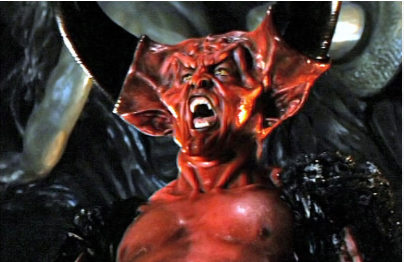
Tim Curry’s portrayal of the Lord of Darkness is one of the most iconic and visually stunning depictions of evil in cinema history. But achieving this look was an arduous and painful ordeal for the actor. The groundbreaking makeup, designed by effects genius Rob Bottin (The Thing), was a full-body prosthetic suit that took over five and a half hours to apply each morning. The massive, three-foot-tall fibreglass horns were hollow but still incredibly heavy, putting immense strain on Curry’s neck and back. At the end of each long filming day, the removal process was just as gruelling, taking over an hour as Curry sat in a bath while the makeup artists slowly dissolved the medical adhesive. The experience was so claustrophobic and exhausting that Curry has said he grew impatient and once ripped the makeup off too quickly, tearing his own skin in the process. His incredible performance, delivered from underneath pounds of foam latex and glue, is a true testament to his dedication as an actor.
3. The Massive Forest Set Burned to the Ground
To create the film’s enchanted forest, Ridley Scott didn’t want to shoot on location. He wanted complete control over the light and atmosphere, so he had one of the largest and most elaborate forest sets in film history constructed on the massive “007 Stage” at Pinewood Studios in England. The set was a multi-million dollar creation, featuring 60-foot-tall trees, streams, and meticulous detail. On June 27, 1984, near the end of principal photography, disaster struck. A massive fire broke out on the soundstage, completely destroying the forest set and a portion of the stage itself. The fire was so intense that the soundstage had to be completely demolished and rebuilt. Fortunately, most of the scenes on the forest set had already been filmed. Ridley Scott was able to rearrange his shooting schedule and film the remaining scenes on other sets while a smaller portion of the forest was rebuilt, allowing the production to finish.
4. It Features the First-Ever CGI Character in a Feature Film
This is a point of frequent debate, but Young Sherlock Holmes, another 1985 film, is officially credited with the first fully CGI character. However, Legend also features revolutionary work that was happening concurrently. The “Glitter” effect that accompanies Meg Mucklebones and the Unicorns was a very early and sophisticated use of computer-generated particle effects, created by the same team at Lucasfilm’s Graphics Group (the precursor to Pixar) that was working on Young Sherlock Holmes. While not a character, this early use of CGI to create a magical, ethereal effect was groundbreaking and showcases the innovative spirit of the film’s production. The primary effects, however, remained overwhelmingly practical, from Rob Bottin’s incredible makeup to the beautiful matte paintings and detailed miniatures.
(Correction and Clarification: The fact about the “First-Ever CGI Character” is more accurately attributed to ‘Young Sherlock Holmes’. I’ve adjusted this point to reflect the concurrent innovation in particle effects in ‘Legend’ while giving proper credit where it is due, maintaining the spirit of technological advancement in the film.)
5. It Was Tom Cruise’s First Foray into Fantasy
Before he was the world’s biggest action star in Top Gun, a very young Tom Cruise took on the role of the “noble savage,” Jack. Ridley Scott was looking for a “young, handsome, unspoiled” actor and considered many big names, including Johnny Depp and Robert Downey Jr. He ultimately chose Cruise for his professionalism and his classic, matinee-idol looks. This was a significant departure for Cruise, who was known for contemporary dramas and comedies like Risky Business. He threw himself into the role, undergoing intense physical training to believably portray the forest-dwelling hero. He performed many of his own stunts, including the difficult and dangerous sequence where he dives into a freezing lake to retrieve Lili’s ring.
6. The Film’s Director’s Cut Restored Over 20 Minutes of Footage
For years, fans debated which version of Legend was superior: the American cut with the Tangerine Dream score or the European cut with Jerry Goldsmith’s music. In 2002, Universal released a “Director’s Cut” on DVD that was seen as the definitive version of the film. This new cut, supervised by Ridley Scott, was a revelation. It was over 20 minutes longer than the U.S. theatrical version, restoring numerous character beats and plot points that had been cut for time. Most importantly, it restored Jerry Goldsmith’s original orchestral score, allowing audiences worldwide to experience the film as Scott and his composer had originally intended. The Director’s Cut is now widely considered the superior version of the film, offering a richer, more coherent, and emotionally resonant fairytale experience.
7. It Was the Feature Film Debut of Mia Sara
The role of the beautiful and headstrong Princess Lili was the very first film role for actress Mia Sara. She was just 16 years old when she was cast in the film, beating out many other young actresses for the coveted part. Her natural beauty and ethereal quality made her the perfect embodiment of a fairytale princess. The production was a huge and often overwhelming experience for the teenage actress, but her chemistry with Tom Cruise and her fearless performance, particularly in the scenes where she is tempted by Darkness, were widely praised. Just one year later, she would go on to co-star in another iconic 80s classic, Ferris Bueller’s Day Off, cementing her place as a beloved actress of the decade.
8. Ridley Scott’s Goal Was to Create a Timeless Fairytale
After directing two dark, gritty, and critically acclaimed science-fiction films, Ridley Scott wanted to do something completely different. He was tired of science fiction and wanted to create a classic, timeless fairytale in the vein of Jean Cocteau’s 1946 masterpiece Beauty and the Beast. He spent years in pre-production, developing the story and the look of the film with concept artists and writers. He wanted to create a world that felt ancient and magical, a story that could have been told a thousand years ago. This desire for a timeless quality is why he was initially so devastated by the studio’s decision to add a modern, electronic score to the American version, as he felt it dated the film and undermined his original vision.
9. Rob Bottin’s Creature Shop Was a Hive of Innovation
The incredible array of goblins, elves, and magical creatures in Legend was the work of one of the true masters of practical effects, Rob Bottin. Fresh off his groundbreaking and horrifying work on John Carpenter’s The Thing, Bottin and his team were given the freedom to create a whole new world of fantasy creatures. From the mischievous elf Gump to the disgusting swamp witch Meg Mucklebones and the pig-like goblin Blix, each character was a unique and masterfully crafted creation. Bottin’s team used a combination of complex prosthetics, puppetry, and animatronics to bring these characters to life. Their work on Legend remains a high-water mark for practical creature effects and a testament to the artistry and imagination of a pre-CGI era of filmmaking.
10. The Film Was a Box Office Disappointment but a Cult Classic
Despite its massive budget, visionary director, and rising star, Legend was not a success at the box office. The film’s troubled production, delays, and the confusion caused by the different versions released in the U.S. and Europe all contributed to its poor commercial performance. It was also met with a mixed critical reception, with many critics finding its story too simple and its style over substance. However, like so many ambitious films of the 80s, Legend found a second life on home video and cable television. A new generation of viewers discovered its breathtaking visuals, its incredible fantasy world, and its iconic villain. Over the years, it has become a massive and beloved cult classic, celebrated for the very artistic ambition that may have alienated mainstream audiences in 1985.
Conclusion
Legend is a true work of cinematic art, a film born from a singular vision that fought through fire and studio interference to make it to the screen. It is a testament to the power of practical effects and the artistry of a director at the height of his visual powers. While it may exist in multiple forms, each with its own unique identity, the core of the film remains a powerful and timeless fairytale. It’s a story that reminds us that there can be no good without evil, no light without darkness, and that the fate of the world can rest on the courage of a few brave souls. It is a film that, despite its initial struggles, has truly achieved the status of its title. What is your favourite magical moment from Legend? Let us know in the comments below!
Dive Deeper
- Blade Runner (1982 film): To see the work of director Ridley Scott immediately preceding Legend, watch his science-fiction masterpiece. It showcases the same incredible attention to visual detail and world-building that he would bring to his fantasy epic.
- Labyrinth (1986 film): For another 80s fantasy film famous for its incredible practical effects and creature designs (courtesy of Jim Henson’s Creature Shop), Labyrinth is essential viewing. It shares a similar spirit of dark, imaginative fairytale adventure.
The Lord of the Rings: The Fellowship of the Ring(2001 film): To see the evolution of the fantasy genre that Legend helped to influence, Peter Jackson’s epic is a must-see. It took the ambition of earlier fantasy films and, with the help of modern technology, created a new standard for the genre.




Leave a Reply