
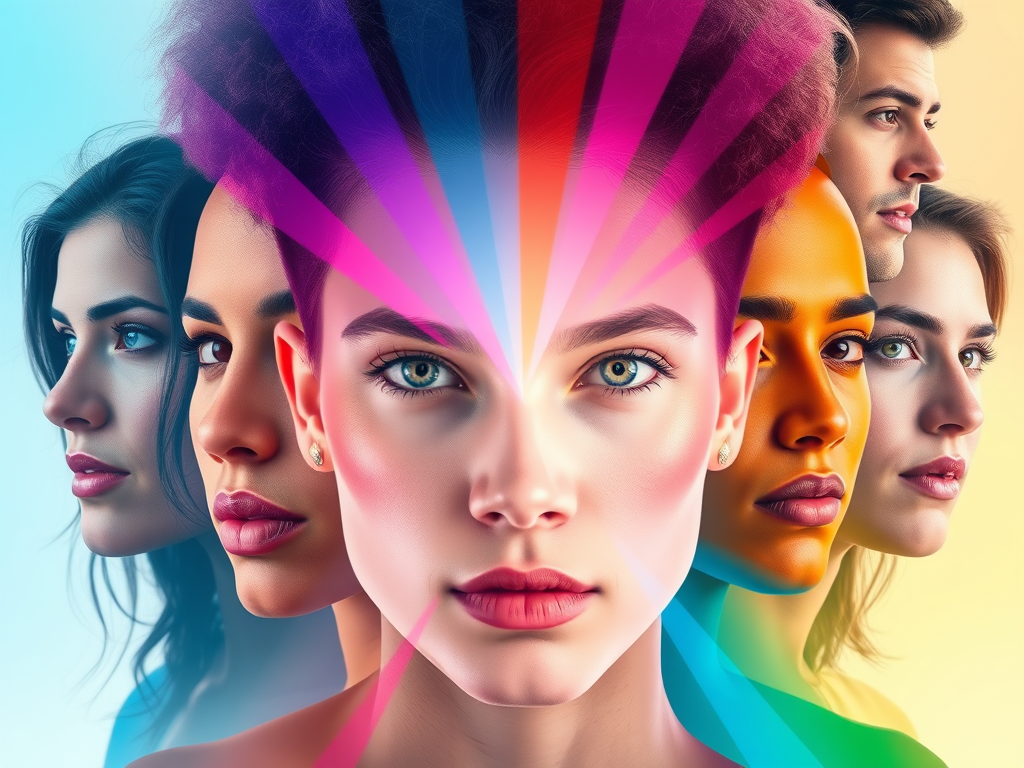
In our rapidly evolving world, conversations about identity are becoming more nuanced and visible than ever before. Among the most significant of these discussions is the topic of gender identity. For many, the concept can seem new or complex, leading to questions, confusion, and, unfortunately, a host of persistent misconceptions. These misunderstandings aren’t just academic; they have real-world consequences, impacting the safety, mental health, and social acceptance of transgender, non-binary, and gender-diverse individuals. Unravelling these myths is a crucial step towards fostering a more compassionate and informed society.
The dialogue around gender is not about erasing tradition or creating confusion; it’s about acknowledging the rich and diverse tapestry of human experience that has always existed. It’s about understanding that the internal sense of who we are is a profound and personal truth. By looking beyond simplistic boxes and embracing a more accurate understanding of gender, we can build communities where everyone is respected for who they are. This list aims to tackle ten of the most common misconceptions about gender identity head-on, using clear explanations and relatable analogies to replace fiction with fact, and prejudice with understanding.
1. Misconception: Gender Is the Same Thing as Biological Sex
This is perhaps the most fundamental misunderstanding in the entire conversation. For decades, many of us were taught that sex and gender are interchangeable terms. However, contemporary understanding, supported by science and sociology, draws a clear and crucial distinction between them. Biological sex refers to the physical characteristics you are born with—chromosomes (XX, XY, etc.), anatomy, and hormones. It’s the classification that a doctor typically assigns at birth as male or female based on external genitalia. Think of sex as the biological “hardware” of a person’s body.
Gender identity, on the other hand, is one’s internal, deeply held sense of self as a man, a woman, a blend of both, or neither. It’s not about what’s between your legs; it’s about what’s between your ears. It is the “software” of your identity—the innate understanding of who you are. For many people (cisgender individuals), their gender identity aligns with the sex they were assigned at birth. For others (transgender and non-binary individuals), it does not. Confusing the two is like assuming the cover of a book tells you the entire story inside. They are related, but they are absolutely not the same thing.
2. Misconception: There Are Only Two Genders
Many societies are built around a gender binary—the idea that there are only two distinct and opposite options: man and woman. This framework is presented as a simple fact of life, but it’s more of a social construct than a biological absolute. It fails to account for the vast diversity of human experience. A more accurate way to understand gender is as a spectrum. Think of the colour spectrum. While you have red on one end and violet on the other, there is a whole universe of colours in between—orange, yellow, green, indigo—and even shades that blend together.
Similarly, gender exists beyond a simple male/female dichotomy. People whose identity falls outside of this binary might identify as non-binary, meaning they don’t exclusively identify as a man or a woman. Within this umbrella, there are many other identities, such as genderfluid (having a gender identity that changes over time), agender (not identifying with any gender), or genderqueer. Acknowledging these identities doesn’t invalidate the experiences of men and women; it simply recognizes that the landscape of gender is far richer and more varied than two boxes can possibly contain.
3. Misconception: Being Transgender or Non-Binary Is a Choice
One of the most hurtful and persistent myths is that a person’s gender identity is a choice they make, like choosing a hairstyle or a favourite football team. This is fundamentally untrue. Gender identity is an innate, core part of a person’s being. You don’t choose your gender identity any more than you choose to be right-handed or left-handed; you simply are. It is a deep-seated sense of self that develops from a very young age.
What is a choice is how a person decides to live and express that identity. This is called gender expression, which includes the choices someone makes about their clothing, pronouns, name, and mannerisms. For a transgender person, the choice isn’t “to be trans,” but rather the courageous choice “to live authentically” as the person they have always known themselves to be. This process, known as transitioning, is an act of alignment, not of invention. To suggest it’s a choice is to invalidate their entire experience and ignore the overwhelming psychological and medical consensus that gender identity is an intrinsic part of who we are.
4. Misconception: Gender Diversity Is a New “Trend” or a “Phase”
With increased media visibility, it can be easy to assume that transgender and non-binary identities are a recent invention of the 21st century or a “social contagion” spreading among young people. History and anthropology tell a very different story. While the specific language we use today may be modern, the existence of people living outside the gender binary is ancient and cross-cultural. For centuries, various cultures around the world have recognized and respected more than two genders.
For example, the Hijras of South Asia have been a recognized third gender for centuries. Many Indigenous North American cultures have a concept of Two-Spirit people, individuals who embody both masculine and feminine spirits. In pre-colonial Filipino society, the babaylan were respected spiritual leaders who often defied Western gender categories. The reason we hear more about gender diversity today is not because it’s a new trend, but because of increased visibility and a growing social acceptance that allows people to speak their truth without fear. It’s not a phase; it’s the long-overdue public recognition of a timeless aspect of human diversity.
5. Misconception: Transgender People Are Mentally Ill
This misconception often stems from the medical term “gender dysphoria.” However, it’s crucial to understand what this term actually means. Being transgender is not a mental illness. Major medical and psychological organizations, including the World Health Organization and the American Psychiatric Association, have officially affirmed this. They have worked to de-pathologize transgender identity, recognizing it as a natural variation of human experience.
Gender dysphoria, on the other hand, is the clinically significant distress or impairment a person may experience when their gender identity does not align with their sex assigned at birth. The illness is not the identity itself, but the distress that can arise from that mismatch, often amplified by social stigma and discrimination. The established, evidence-based treatment for gender dysphoria is not to “cure” the person of their identity, but to help them align their life and, if they choose, their body with their true gender. This process of affirmation—using correct pronouns, social transition, and gender-affirming medical care—is proven to alleviate dysphoria and drastically improve mental health outcomes.
6. Misconception: Gender Expression Always Matches Gender Identity
Our society is filled with stereotypes about what men and women “should” look and act like. The misconception is that if you know someone’s gender identity, you can predict their gender expression. But these two things are distinct. As we’ve discussed, gender identity is who you are on the inside. Gender expression is how you show your gender to the world through clothing, hairstyles, mannerisms, and voice. One does not automatically dictate the other.
A man can love wearing makeup, skirts, and have stereotypically “feminine” hobbies; he is still a man. A woman can have short hair, wear “masculine” clothing, and be a bodybuilder; she is still a woman. Similarly, a non-binary person does not have to look “androgynous” to be valid; they can present in a way that is masculine, feminine, or a unique blend of both. This is also why it’s important not to confuse gender identity with performance, such as drag. A drag queen is typically a cisgender man who performs a highly stylized form of femininity, but his identity off-stage remains that of a man. How someone chooses to express themselves is personal and doesn’t invalidate their core identity.
7. Misconception: You Can Tell Someone’s Gender and Pronouns Just by Looking
This myth is a direct consequence of conflating gender identity with physical appearance and gender expression. You simply cannot know a person’s internal sense of self by observing their external features. Assuming you know someone’s gender based on their haircut, clothing, or body shape is like assuming you know their name without asking—you’re likely to get it wrong, and it can be awkward or even hurtful.
This is why pronouns (like he/him, she/her, they/them) have become such an important part of respectful communication. Using the correct pronouns is a fundamental way to show respect for someone’s identity. When you use the wrong pronoun for someone, it’s called misgendering, and it can make them feel invalidated, disrespected, or invisible. The best practice is simple: when you meet someone new, don’t assume. You can introduce yourself with your own pronouns (“Hi, I’m Alex, and I use he/him pronouns”) to create a safe opening for them to share theirs. It’s a small act of kindness that fosters an environment of mutual respect and acknowledges that only the individual can define their own identity.
8. Misconception: Children Are Too Young to Know Their Gender Identity
A common fear is that children who express a gender identity different from their assigned sex are simply confused, playing, or being influenced by adults. However, extensive research from developmental psychology shows that most children have a solid sense of their own gender identity between the ages of three and five. This is the same age they learn other core parts of their identity.
For transgender children, their understanding of their gender is not a whim. Professionals look for three key signs: their identity is consistent, insistent, and persistent over time. This is not about a young boy trying on his sister’s dress once; it’s about a child who consistently and insistently tells their parents, “I am a girl,” for months or even years. The supportive approach recommended by every major medical association is not to force the child into a different identity but to allow them to explore it. This “social transition”—letting them use a new name, pronouns, or dress in a way that aligns with their identity—is a reversible, non-medical step that has been shown to be incredibly beneficial for a child’s mental health and well-being.
9. Misconception: Being Non-Binary Is Just a Way to Get Attention
This dismissive and cynical claim ignores the social and personal challenges that non-binary people often face. Living outside of society’s most fundamental organizing principle—the gender binary—is not an easy path. It often involves constantly explaining one’s existence, facing skepticism from family and friends, navigating bureaucratic systems that don’t recognize your identity, and even risking harassment or violence. This is hardly a path someone would choose simply for “attention” or to feel “special.”
Instead of being a bid for attention, identifying as non-binary is an act of authenticity. It is the declaration that one’s internal experience of self does not fit into the pre-defined boxes of “man” or “woman.” For many, discovering the language of non-binary identity is a profound relief—a moment of finding a word for a feeling they have had their entire lives. It’s about finding a home for their identity, not about seeking a spotlight. Respecting this identity means trusting that people are the experts of their own experience.
10. Misconception: Accepting Transgender People Threatens Cisgender People
This fear is often framed as a “zero-sum game”—the idea that if rights and recognition are extended to one group, another group must lose something. The argument goes that acknowledging the validity of transgender women somehow erases or threatens cisgender women, or vice versa. This is a fallacy. Human rights and identities are not a finite resource.
Acknowledging and validating the existence and identity of transgender people does not, in any way, diminish the identity or value of cisgender people. Think of it like adding more tools to a toolbox. Just because you add a new wrench doesn’t mean your hammer disappears or becomes less effective. It simply means you have a more complete and capable set of tools. Similarly, expanding our understanding of gender to include transgender and non-binary people makes our society’s understanding more complete and accurate. It’s about creating more space for everyone to be their authentic selves. The goal is addition, not subtraction; inclusion, not replacement.
Further Reading
For those who wish to learn more from experts, advocates, and people with lived experience, these books are excellent resources:
- The Transgender Issue: An Argument for Justice by Shon Faye
- Gender: A Graphic Guide by Meg-John Barker and Jules Scheele
- Beyond the Gender Binary by Alok Vaid-Menon
- The Queer and Transgender Resilience Workbook by Anneliese A. Singh
Here at Zentara.blog, our mission is to take those tricky subjects and unlock them, making knowledge exciting and easy to grasp for everyone. But the adventure doesn’t stop on this page! We’re constantly exploring new frontiers and sharing discoveries across the digital universe. Want to dive deeper into more mind-bending Top 10s and keep expanding your world? Come join us on our other platforms – we’ve got unique experiences waiting for you on each one!
Get inspired by visual wonders and bite-sized facts: See the world through Zentara’s eyes on Pinterest!
Pin our fascinating facts and stunning visuals to your own boards. Explore Pins on Pinterest: https://uk.pinterest.com/zentarablog/
Discover quick insights and behind-the-scenes peeks: Hop over to Tumblr for snippets, quotes, and unique content you won’t find anywhere else. It’s a different flavour of discovery! Follow the Fun on Tumblr: https://www.tumblr.com/zentarablog
Ready for deep dives you can listen to or watch? We’re bringing our accessible approach to video and potentially audio! Subscribe to our YouTube channel and tune into future projects that make learning pop! Subscribe on YouTube: https://www.youtube.com/@ZentaraUK
Seeking even more knowledge in one place? We’ve compiled some of our most popular topic deep dives into fantastic ebooks! Find them on Amazon and keep the learning journey going anytime, anywhere. Find Our Ebooks on Amazon: https://www.amazon.co.uk/s?k=Zentara+UK&ref=nb_sb_noss
Connect with us and fellow knowledge seekers: Join the conversation on BlueSky! We’re sharing updates, thoughts, and maybe even asking you what wonders we should explore next. Chat with Us on BlueSky: https://bsky.app/profile/zentarablog.bsky.social
Perfect for learning on the move! We post multiple 10-minute podcasts per day on Spotify. Pop on your headphones and fill your day with fascinating facts while you’re out and about! Listen on Spotify: https://open.spotify.com/show/3dmHbKeDufRx95xPYIqKhJFollow us on Instagram for bytesize knowledge! We post multiple posts per day on our official Instagram account. https://www.instagram.com/zentarablog/ Every click helps us keep bringing honest, accessible knowledge to everyone. Thanks for exploring with us today – see you out there in the world of discovery!




Leave a Reply