
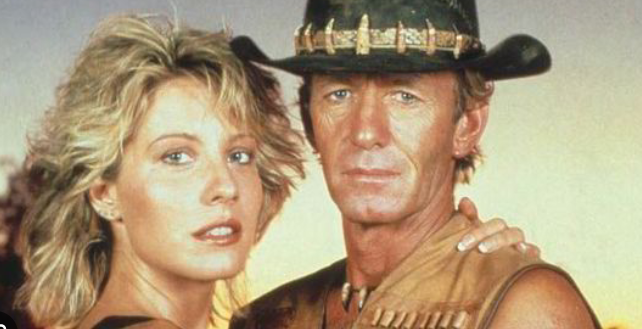
In 1986, a charismatic larrikin from the Australian outback swaggered onto the silver screen and charmed the entire world. With his weathered Akubra hat, a vest full of crocodile teeth, and a disarmingly cheerful attitude, Michael J. “Mick” Dundee became an instant global icon. The film, Crocodile Dundee, was a cinematic phenomenon. Part action-adventure, part romantic comedy, and part fish-out-of-water story, it smashed box office records and single-handedly put Australia on the map for a generation of moviegoers. Its star and co-writer, Paul Hogan, went from being a popular Aussie comedian to an international superstar overnight. But behind the famous “That’s not a knife” scene and the hilarious culture clashes is a story of incredible risk, clever marketing, and a real-life inspiration as rugged as the character himself. It’s a tale of how a low-budget comedy from Down Under conquered Hollywood and left an indelible mark on pop culture. So grab your Akubra, and let’s dive into ten fascinating facts about the legend of Crocodile Dundee.
1. The Film Was a “Crowdfunded” Passion Project
Today, we associate blockbuster films with massive studio budgets and corporate backing. Crocodile Dundee, however, was the ultimate underdog. Paul Hogan and his creative partner, John Cornell, were determined to make a film that would appeal to mainstream American audiences without sacrificing its distinctly Australian character. But no major Hollywood studio was interested in financing what they saw as a quirky, regional comedy. Undeterred, Hogan and Cornell embarked on one of the most ambitious independent fundraising efforts in film history. They raised the film’s modest $8.8 million budget by soliciting investments from over 1,400 private individuals, ranging from wealthy cricket stars and rock singers to everyday Aussies who believed in Hogan’s vision. These “Dundee Wives,” as the investors were nicknamed, were taking a huge gamble. It was a true passion project, funded by a nation’s belief in one of its own. This independent spirit is baked into the film’s DNA, contributing to its authentic, non-corporate feel that audiences found so refreshing.
2. The Character Was Inspired by a Real-Life Bushman
While Mick Dundee’s exploits were certainly exaggerated for comedic effect, the character’s core was inspired by a real person: Rodney Ansell. In 1977, Ansell, a cattle rancher and buffalo hunter, found himself stranded in the remote Northern Territory after his boat capsized. He survived for an astonishing 56 days with minimal supplies, sleeping in the fork of a tree to avoid crocodiles, hunting wild cattle, and even drinking their blood for hydration. His incredible survival story made him a national hero. When he was later interviewed in Sydney by a famous journalist, his fish-out-of-water experience was striking. He reportedly slept in his swag on the floor of his luxury hotel room instead of the bed and was bewildered by the bidet. Paul Hogan saw these interviews and was captivated by this clash of a rugged bushman with modern urban life. While Ansell’s life later took a tragic turn, his incredible story provided the essential spark for the character who would introduce the world to the myth of the Australian outback.
3. The Iconic “That’s Not a Knife” Scene Was Almost Cut
It’s arguably one of the most quoted movie lines of the 1980s. The scene where Mick Dundee and Sue Charlton are confronted by a mugger with a switchblade is a masterclass in comedic tension and character definition. Sue is terrified, but Mick is completely unfazed. As the mugger demands his wallet, Mick lets out a chuckle and says, “That’s not a knife,” before revealing his own formidable Bowie knife with the legendary follow-up, “That’s a knife.” The would-be assailant immediately flees. It’s the perfect encapsulation of Mick’s outback competence and fearlessness. Incredibly, this iconic moment was an afterthought. The original script didn’t include the scene, and it was added late in the writing process. Some involved in the production were even sceptical, worrying it might be too silly or that it disrupted the flow. Thankfully, Paul Hogan’s comedic instincts won out, and the scene not only stayed in but became the film’s most memorable and enduring moment, endlessly parodied and referenced for decades.
4. Paul Hogan Performed His Own Crocodile Stunt
In the film’s most thrilling action sequence, Mick Dundee saves Sue from a crocodile attack in the outback. As the lunging predator goes for her, Mick leaps onto its back and subdues it with his bare hands and trusty knife. While one might assume such a dangerous scene would be handled by a stunt double and a purely mechanical creature, the reality was a mix of both—with a daring contribution from Hogan himself. The crocodile used was a large, tranquillized, but very real, saltwater crocodile. For the shots where the croc lunges at Sue, a mechanical replica was used. However, for the crucial shot where Mick jumps towards the beast, Paul Hogan insisted on doing it himself. He actually leapt onto the back of the sedated, but still potentially dangerous, reptile. The animal had its snout roped shut for safety, but it was an incredibly risky move that added a layer of gritty realism to the scene and cemented Hogan’s image as being just as tough as the character he played.
5. The Film Had Two Different Versions for Different Audiences
Paul Hogan and the filmmakers were acutely aware that what makes an Australian laugh might not land the same way with an American audience. They were determined to make the film a global hit, so they made a clever and unusual decision: they created two different cuts of the film. The Australian version is slightly longer and includes more local slang and cultural in-jokes that would have been lost on international viewers. Words like “sheila” (woman) and “dunny” (toilet) were left in for the home crowd. For the international version, many of these slang terms were either cut or replaced with more universally understood language. The editing was also tightened to speed up the pacing for American tastes. This bespoke approach was a key part of the film’s marketing genius. It ensured that the movie felt authentically Australian to Aussies, while remaining accessible and hilarious to a worldwide audience, a strategy that undoubtedly contributed to its phenomenal international success.
6. The Film’s Success Triggered a Massive Tourism Boom for Australia
Before 1986, many people’s perception of Australia was vague, formed by dusty encyclopedia entries or nature documentaries. Crocodile Dundee changed everything. The film was a feature-length advertisement for Australia’s stunning landscapes, unique wildlife, and friendly, laid-back culture. Paul Hogan himself became the face of the Australian Tourism Commission, starring in a series of now-famous commercials. His simple invitation, “Come and say g’day. I’ll slip an extra shrimp on the barbie for ya,” became a global catchphrase (even though Australians call them prawns, not shrimp). The effect was immediate and dramatic. In the years following the film’s release, tourism to Australia from the United States skyrocketed, with some reports showing an increase of over 25%. Kakadu National Park, where much of the outback filming took place, became a must-see destination. The film didn’t just sell movie tickets; it sold a country.
7. The New York Locations Were a Huge Challenge
The second half of the film, which sees Mick navigating the concrete jungle of New York City, provided most of the fish-out-of-water comedy. However, filming in 1980s New York was no easy feat. The production team had to contend with chaotic streets, logistical nightmares, and a public that was largely indifferent to a film crew. For the scene where Mick rides a police horse through downtown traffic, the crew had to manage real-time city chaos. The most difficult location to secure was the Plaza Hotel, a symbol of New York luxury. The hotel management was initially very hesitant to allow a film crew inside. It took a personal charm offensive from Paul Hogan and the producers, who assured them the film would portray the hotel in a positive and glamorous light, to finally get permission. The resulting scenes, showing the rugged bushman comically out of place in opulent surroundings, are among the film’s most beloved.
8. The Movie Became the Highest-Grossing Australian Film of All Time
To say Crocodile Dundee was a financial success is a massive understatement. It was a global box office juggernaut. Made for just under $9 million, it went on to gross an astounding $328 million worldwide. In the United States, it became the second-highest-grossing film of 1986, second only to Top Gun. Back home, it shattered all previous records to become, and remain to this day, the highest-grossing Australian film in domestic box office history. The initial 1,400 investors who took a punt on Hogan’s vision received a spectacular return on their investment. The film’s incredible profitability proved that an independent, character-driven story from outside the Hollywood system could compete with and even beat the biggest studio blockbusters. It was a true David-and-Goliath story that changed the landscape of Australian cinema forever.
9. Paul Hogan and Linda Kozlowski’s On-Screen Romance Became Real
The chemistry between Mick Dundee and the sophisticated American journalist Sue Charlton was the heart and soul of the film. Their believable and charming romance, which blossoms as they bridge their two vastly different worlds, is what elevates the movie beyond a simple comedy. That on-screen chemistry was very real. Paul Hogan and American actress Linda Kozlowski fell in love during the making of the film. At the time, Hogan was married and had been for nearly 30 years. The romance became a major story in the international press. After the release of the sequel, Hogan divorced his wife and married Kozlowski in 1990. They remained married for over two decades and had a son together before eventually divorcing in 2014. Their real-life love story added a layer of romantic fairy tale to the film’s legacy, blurring the lines between fiction and reality for millions of fans.
10. The Film Earned an Oscar Nomination for its Screenplay
While Crocodile Dundee is best remembered for its comedy and charm, it also received serious critical acclaim. The screenplay, co-written by Paul Hogan, Ken Shadie, and John Cornell, was praised for its tight structure, witty dialogue, and clever character development. In a surprising but well-deserved nod from the film industry’s most prestigious body, the movie was nominated for an Academy Award for Best Original Screenplay at the 1987 Oscars. While it ultimately lost to Woody Allen’s Hannah and Her Sisters, the nomination itself was a monumental achievement. It validated the film as more than just a populist blockbuster and recognized the craft and intelligence behind its deceptively simple story. For a small, independently-funded Australian comedy to be competing for an Oscar in one of the main categories was the ultimate proof that Mick Dundee had truly conquered the world.
Further Reading
- “The A-Z of Oz Flicks” by Alistair R. R. Jones (A comprehensive guide to Australian cinema, providing context for Crocodile Dundee’s impact)
- “The Paul Hogan Story” by Douglas Thompson (A biography detailing the life and career of the man behind the icon)
- “Adventures in the Screen Trade” by William Goldman (While not about Dundee specifically, this is a classic, insightful look at how hit movies get made in Hollywood, offering a great contrast to Dundee’s independent path)
- “The Australian Film Book 1930-Today” by Andrew Pike and Ross Cooper (An academic but accessible history of the Australian film industry)
Here at Zentara.blog, our mission is to take those tricky subjects and unlock them, making knowledge exciting and easy to grasp for everyone. But the adventure doesn’t stop on this page! We’re constantly exploring new frontiers and sharing discoveries across the digital universe. Want to dive deeper into more mind-bending Top 10s and keep expanding your world? Come join us on our other platforms – we’ve got unique experiences waiting for you on each one!
Get inspired by visual wonders and bite-sized facts: See the world through Zentara’s eyes on Pinterest!
Pin our fascinating facts and stunning visuals to your own boards. Explore Pins on Pinterest: https://uk.pinterest.com/zentarablog/
Discover quick insights and behind-the-scenes peeks: Hop over to Tumblr for snippets, quotes, and unique content you won’t find anywhere else. It’s a different flavour of discovery! Follow the Fun on Tumblr: https://www.tumblr.com/zentarablog
Ready for deep dives you can listen to or watch? We’re bringing our accessible approach to video and potentially audio! Subscribe to our YouTube channel and tune into future projects that make learning pop! Subscribe on YouTube: https://www.youtube.com/@ZentaraUK
Seeking even more knowledge in one place? We’ve compiled some of our most popular topic deep dives into fantastic ebooks! Find them on Amazon and keep the learning journey going anytime, anywhere. Find Our Ebooks on Amazon: https://www.amazon.co.uk/s?k=Zentara+UK&ref=nb_sb_noss
Connect with us and fellow knowledge seekers: Join the conversation on BlueSky! We’re sharing updates, thoughts, and maybe even asking you what wonders we should explore next. Chat with Us on BlueSky: https://bsky.app/profile/zentarablog.bsky.social
Perfect for learning on the move! We post multiple 10-minute podcasts per day on Spotify. Pop on your headphones and fill your day with fascinating facts while you’re out and about! Listen on Spotify: https://open.spotify.com/show/3dmHbKeDufRx95xPYIqKhJFollow us on Instagram for bytesize knowledge! We post multiple posts per day on our official Instagram account. https://www.instagram.com/zentarablog/ Every click helps us keep bringing honest, accessible knowledge to everyone. Thanks for exploring with us today – see you out there in the world of discovery!




Leave a Reply