
Life Moves Pretty Fast: 10 Surprising Secrets and Hidden Details Behind Ferris Bueller’s Day Off
Ferris Bueller’s Day Off; John Hughes’ 80s masterpiece is more than just a movie about a teenager skipping school; it’s a philosophical manifesto on the importance of pausing to appreciate life. It transformed Chicago into a playground and turned Matthew Broderick into the world’s most charming rebel. To truly understand why this film remains the gold standard for teen comedies, one must look past the vest and the Ferrari to the meticulous craft and happy accidents that occurred behind the scenes. From improvised lectures to “fake” Italian sports cars, the making of this film was just as adventurous as Ferris’s trek through the Windy City.
1. The Script was Written in a Fever Dream of Six Days
Most iconic screenplays take months or even years of agonizing revisions to perfect, but John Hughes was not most writers. At the height of his creative powers, Hughes reportedly hammered out the entire script for Ferris Bueller’s Day Off in just under a week. He was fueled by a simple, high-concept premise: what if a kid just decided to have the best day of his life in the city?
This rapid-fire writing process gave the dialogue its electric, spontaneous energy. Hughes famously wrote with specific actors in mind, and his ability to capture the authentic voice of suburban youth was unparalleled. Because he wasn’t overthinking the structure, the film flows with a “slice-of-life” rhythm that feels less like a scripted movie and more like a curated adventure. This speed didn’t equate to sloppiness; instead, it allowed Hughes to tap into a pure stream of consciousness regarding the teenage experience—the desire for freedom, the fear of growing up, and the hilariously high stakes of avoid-ing a principal.
2. The “Ferrari” Was Actually a Fiberglass Illusion
The 1961 Ferrari 250 GT California Spyder is one of the most beautiful and expensive cars ever made, which presented a problem for the production. They needed a car that Cameron’s father would treasure above all else, but the budget simply couldn’t accommodate multiple real Ferraris—especially since one had to be crashed through a glass wall. The solution was a masterpiece of movie magic: the production used three replicas built by Modena Design and Development.
These “Faux-rraris” were fiberglass kit cars built on Mustang frames. While they looked stunning from a distance and during high-speed drives, they were notoriously temperamental. The actors often had to deal with the cars stalling or breaking down between takes. In fact, for the scene where the car is “running” in the garage, the crew had to manually push the car or use creative camera angles because the engines weren’t always cooperative. The decision to use replicas wasn’t just about cost; it was about the freedom to treat the vehicle as a prop rather than a museum piece, allowing for the high-octane joyride that defines the film’s second act.
3. The Improvised Genius of Ben Stein’s Economics Lecture
“Anyone? Anyone?” Those two words became a cultural shorthand for boredom, yet they were never in the original script. Ben Stein, a former speechwriter for Richard Nixon and Gerald Ford, was hired as an extra to play the teacher. He was initially supposed to read his lines off-camera, but the student actors found his natural monotone so authentic and hilarious that director John Hughes decided to film him in person.
Hughes told Stein to give a real lecture on a topic he knew well, and Stein chose the Hawley-Smoot Tariff Act. The blank, glazed-over stares of the students in the classroom were genuine reactions to a real economics lesson being delivered in the driest possible manner. Stein’s performance was so impactful that it launched a second career for him as a comedic actor and host. It stands as a perfect example of Hughes’ directorial style: recognizing a “happy accident” and giving it the space to become an iconic moment in cinema history.
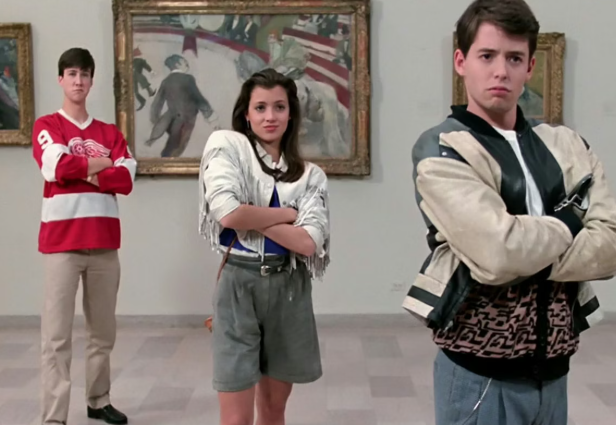
4. The Museum Scene Was a Deeply Personal Love Letter to Art
The sequence at the Art Institute of Chicago is widely considered the emotional heart of the film. Set to a dreamlike cover of “Please, Please, Please, Let Me Get What I Want,” it shows the trio absorbing world-class art. This wasn’t just a montage to fill time; it was John Hughes’ tribute to his favorite place in the world. As a teenager, Hughes would often visit the museum to find peace and inspiration, and he wanted to capture that sense of wonder on film.
The shot of Cameron staring intensely at Georges Seurat’s A Sunday on La Grande Jatte is particularly poignant. Hughes explained that the closer Cameron looks at the painting (specifically the little girl), the more the image breaks down into meaningless dots—a metaphor for Cameron’s own life and his fear that the more he is scrutinized, the less he exists. This scene elevated the movie from a standard teen romp to a sophisticated piece of visual storytelling, proving that even a comedy about skipping school could have profound artistic depth.
5. Charlie Sheen’s “Method” Approach to Staying Awake
In one of the film’s most memorable cameos, a young Charlie Sheen plays the “Boy in the Police Station” who counsels Ferris’s sister, Jeanie. To achieve the properly “strung-out” and disheveled look of a delinquent who had been in custody all night, Sheen reportedly stayed awake for over 48 hours before his scenes were filmed.
The result is a performance filled with authentic twitchiness and a glazed-over intensity that perfectly countered Jennifer Grey’s high-strung energy. Their chemistry in that brief scene is palpable, leading to the famous line, “Your problem is you.” Sheen’s dedication to such a small role added a layer of grit to the otherwise polished suburban world of the film. It also served as a pivot point for Jeanie’s character arc, allowing her to finally let go of her resentment toward her brother and join in on the spirit of the day.
6. The Parade Scene Captured a Real Chicago Moment
The “Twist and Shout” sequence at the Von Steuben Day Parade is one of the most exuberant scenes in movie history. While the parade itself was a real annual event in Chicago, the production had to integrate Ferris into the festivities seamlessly. Matthew Broderick’s performance on the float was so infectious that many of the people seen dancing in the crowd weren’t paid extras—they were real Chicagoans who were swept up in the music.
Interestingly, Matthew Broderick couldn’t actually dance during the parade because he had seriously injured his knee shortly before filming. Most of his “dancing” is limited to arm movements and clever editing. Despite the physical limitation, his charisma carries the scene. The construction workers dancing on the scaffolding and the people in the windows were all spontaneous additions that the camera crew caught in the moment, making the city itself feel like a living, breathing character that was fully “in” on Ferris’s secret.
7. The Casting “What-Ifs”: From Johnny Depp to Rob Lowe
It’s hard to imagine anyone but Matthew Broderick possessing the specific blend of arrogance and sweetness required to make Ferris Bueller likable. However, the casting process considered almost every young star of the era. Johnny Depp, Rob Lowe, John Cusack, and even Jim Carrey were all considered for the role of Ferris at various stages of pre-production.
John Hughes ultimately chose Broderick because he had a “sly” quality that didn’t feel malicious. Hughes noted that if someone else played the role, Ferris might come across as a “jerk” or a thief, but Broderick made him feel like a folk hero. Similarly, the role of Cameron Frye was almost played by Emilio Estevez, but Alan Ruck’s chemistry with Broderick (the two were real-life friends who had worked on Broadway together) made the friendship feel deeply lived-in and authentic. This chemistry is the “secret sauce” that makes the stakes of their friendship feel as important as the stakes of their truancy.
8. The Fictional “Shermer, Illinois” Connection
Like almost all of John Hughes’ films, Ferris Bueller’s Day Off takes place in the fictional suburb of Shermer, Illinois. For Hughes, Shermer was a composite of the various North Shore suburbs of Chicago where he grew up. By placing all his characters—from the Breakfast Club to the Weird Science duo—in the same town, Hughes created a proto-“cinematic universe” long before it became a Hollywood trend.
This shared setting allowed Hughes to explore the different social strata of suburban life. In Ferris’s world, Shermer is a place of manicured lawns and high expectations that need to be subverted. The town represents the “establishment” that Ferris is constantly outmaneuvering. By grounding the film in this familiar, recurring geography, Hughes made the escapades feel like they were happening in the audience’s own backyard, reinforcing the “everyman” appeal of Ferris’s rebellion against the mundane.
9. The Deleted Siblings and the Original Cut
In the version of the film that exists in our cultural memory, Ferris has one sister, Jeanie. However, the original script and early cuts of the film featured two younger siblings as well. These characters were eventually edited out to tighten the focus on the rivalry between Ferris and Jeanie. The removal of the younger children made the dynamic between the two remaining siblings much more intense and central to the plot.
Evidence of these deleted characters can still be seen in the background of certain scenes, such as family photos on the walls of the Bueller house. By trimming the family down, Hughes allowed the film to focus on the “trinity” of Ferris, Sloane, and Cameron, with Jeanie acting as the external force trying to bring them down. This streamlining was essential for the film’s pacing, ensuring that the momentum of the “day off” never faltered under the weight of too many supporting subplots.
10. Breaking the Fourth Wall as a Narrative Device
Ferris Bueller was one of the first mainstream comedic heroes to regularly “break the fourth wall,” speaking directly to the audience to explain his methods and philosophy. This wasn’t just a gimmick; it was a way to make the audience Ferris’s co-conspirators. By sharing his secrets with us, Ferris ensures that we aren’t judging his deceptions, but rather cheering them on.
This technique creates an intimate bond between the character and the viewer. When Ferris explains how to fake a stomach cramp or why “life moves pretty fast,” he is acting as a mentor to the audience. It removes the barrier between the screen and the theater seat, making us feel like we are right there in the passenger seat of the Ferrari. This narrative choice is arguably the biggest reason the film has such a lasting legacy; it doesn’t just tell a story, it invites the audience to participate in a lifestyle of joyful defiance.
Further Reading
- John Hughes: A Life in Film by Kirk Honeycutt
- You Couldn’t Ignore Me If You Tried: The Brat Pack, John Hughes, and the 1980s by Susannah Gora
- Ferris Bueller’s Day Off: Inside the Making of a 80s Classic by Brad Duke
- Podcast Episode: Classic Films And Horror Icons
- 10 The Exorcist III (1990) Movie Facts You Didn’t Know
- 10 Scream (1996) Movie Facts That Changed Horror
- 10 Twin Peaks TV SHOW Facts That Still Puzzle Fans
- 10 Poltergeist (1982) Movie Facts That Are Still Creepy
- 10 The Lion King (1994) Facts That Made It Iconic – Classic Movie
- 10 Forrest Gump (1994) Facts That Make It Timeless – Classic Movie
- 10 Fight Club (1999) Facts That Still Surprise Fans – Classic Movie
- 10 Hostel (2005) Movie Facts That Shocked Viewers
- 10 Avatar (2009) Facts That Changed Cinema – Classic Movie



