
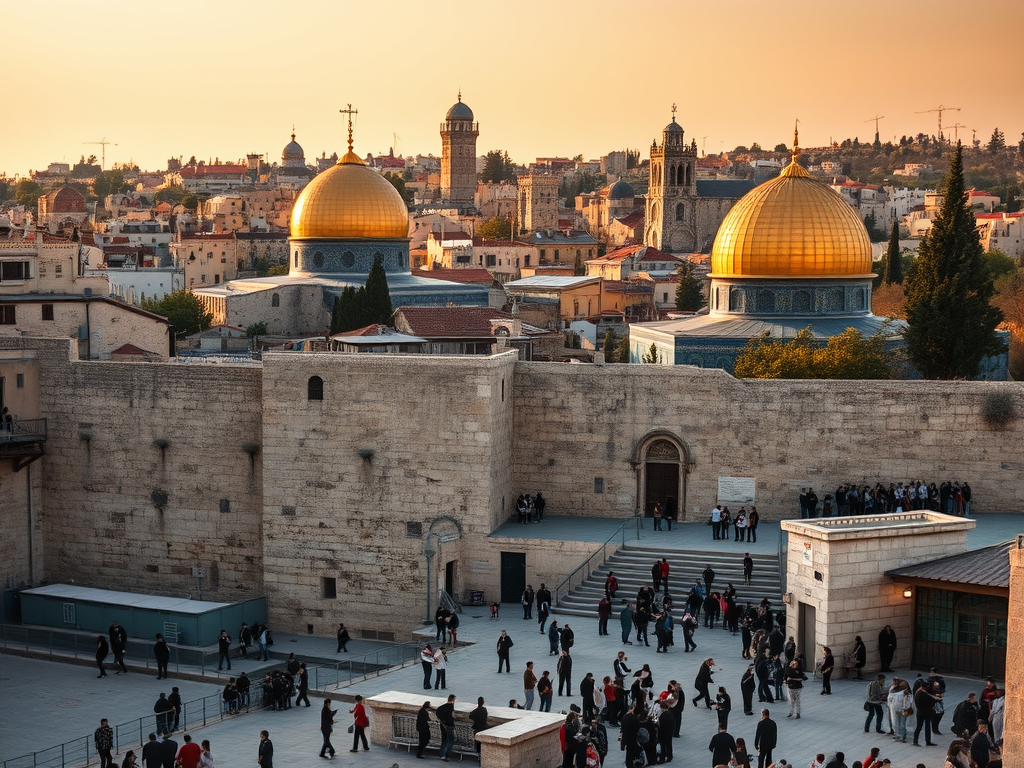
Across the globe, there are places that seem to hum with a different energy. They are more than just locations on a map; they are points of intersection between the earthly and the divine, the mortal and the eternal. A place becomes sacred when it is imbued with profound human belief. It might be the site of a miracle, a divine revelation, a connection to ancestral spirits, or a place where the veil between worlds feels exceptionally thin. These are the spiritual centres of gravity for humanity, drawing millions of pilgrims who seek solace, meaning, and connection.
These sacred sites are a testament to our enduring search for something greater than ourselves. They range from magnificent man-made temples to awe-inspiring natural wonders, but they all share one thing in common: they are the physical anchors for the world’s deepest faiths and spiritual traditions. Journeying to them, even just through words, is to explore the very heart of human devotion and the incredible diversity of our spiritual heritage.
1. The Crossroads of Faith: Jerusalem’s Old City (Israel/Palestine)
There is no other city on Earth that holds such immense spiritual significance for so many. Jerusalem’s walled Old City is the epicentre of the three great Abrahamic faiths, making it a place of unparalleled sanctity and heart-wrenching complexity.
- For Judaism, it is the site of the Temple Mount, where the First and Second Temples stood. Today, its holiest accessible site is the Western Wall, a retaining wall of the Temple Mount plaza, where Jews from around the world come to pray, mourning the temple’s destruction and celebrating their enduring covenant with God.
- For Christianity, Jerusalem is the stage for the final act of Jesus’s life. The Church of the Holy Sepulchre is built over what is believed to be the sites of his crucifixion, burial, and resurrection, making it the most venerated pilgrimage destination for Christians.
- For Islam, the Temple Mount is known as Haram al-Sharif. It holds the Dome of the Rock and the Al-Aqsa Mosque. From this spot, the Prophet Muhammad is believed to have ascended to heaven on his Night Journey, making it Islam’s third holiest site after Mecca and Medina.
The city’s importance lies in its role as a shared, sacred inheritance, a place where foundational stories of the world’s major religions overlap and intertwine, creating a landscape of intense devotion.
2. The Heart of Islam: The Kaaba in Mecca (Saudi Arabia)
Sacred to Islam, Mecca is the spiritual centre of a global faith of nearly two billion people. It is the birthplace of the Prophet Muhammad and the site of God’s revelations to him. At the heart of the city, inside the Grand Mosque, sits the Kaaba, a simple, cube-shaped building draped in black silk. Muslims believe the Kaaba was built by Abraham and his son Ishmael as the first house of worship dedicated to the one God.
Its importance is absolute in the daily life of a Muslim. Five times a day, Muslims across the world turn to face the Kaaba in prayer; this direction is known as the qibla. Furthermore, Mecca is the destination for the Hajj, the annual pilgrimage that is one of the Five Pillars of Islam. Every able-bodied Muslim is obliged to undertake the Hajj at least once in their lifetime. During this pilgrimage, millions of believers circle the Kaaba in a ritual of unity and devotion, shedding all signs of wealth and status to stand equal before God. Mecca is the ultimate symbol of Islamic unity and submission to God.
3. The City of Light and Death on the Ganges: Varanasi (India)
Varanasi, also known as Kashi, is the holiest of the seven sacred cities in Hinduism. Believed to be one of the oldest continuously inhabited cities in the world, Hindus consider it the earthly home of the god Shiva. The city is situated on the banks of the sacred Ganges River, which is personified as the goddess Ganga. For millennia, pilgrims have flocked here to bathe in the river’s holy waters, an act believed to wash away sins.
However, Varanasi’s most profound importance is its role as a place of death. Devout Hindus believe that to die in Varanasi and have one’s ashes scattered in the Ganges grants moksha—liberation from the endless cycle of birth, death, and rebirth (samsara). The city’s famous ghats (steps leading down to the river) are scenes of constant ritual, from celebratory baths to public cremations. Life and death are not hidden away but are on full display, making Varanasi a powerful place to confront the ultimate realities of human existence.
4. The Seat of the Papacy: Vatican City
Though it is the smallest independent state in the world, Vatican City is the spiritual and administrative headquarters of the Roman Catholic Church, which has over 1.3 billion members worldwide. Located within Rome, its importance stems from its status as the seat of the Pope, who Catholics believe is the spiritual successor to Saint Peter.
The centrepiece of Vatican City is St. Peter’s Basilica, a masterpiece of Renaissance architecture built over what is believed to be the tomb of St. Peter himself. Within its walls also lies the Sistine Chapel, featuring Michelangelo’s breathtaking frescoes depicting the biblical narrative from Creation to the Last Judgment. As the home of the Pope and the central government of the Catholic Church, the Vatican is a place of immense religious authority and a primary destination for pilgrims who come to see the Pope and feel connected to the heart of their faith.
5. The Navel of the Earth: The Bodhi Tree in Bodh Gaya (India)
For the world’s 500 million Buddhists, Bodh Gaya is the “navel of the earth,” the place where their faith was born. It is here that a young prince named Siddhartha Gautama, after years of searching for an end to suffering, sat in meditation beneath a fig tree and attained enlightenment (bodhi), becoming the Buddha.
The site is dominated by the magnificent Mahabodhi Temple and, more importantly, a sacred fig tree that is a direct descendant of the original Bodhi Tree under which the Buddha sat. Pilgrims from every Buddhist tradition travel here to meditate in the same spot where the Buddha achieved his profound insight into the nature of reality. It is the most important and revered of the four main pilgrimage sites in Buddhism, representing the ultimate potential for human awakening and liberation from suffering.
6. The Dreaming Heart of a Continent: Uluru (Australia)
Rising dramatically from the flat Australian Outback, Uluru is far more than a stunning geological formation. For the local Anangu Aboriginal people, it is a sacred, living landscape and the physical evidence of the Dreaming (Tjukurpa), their foundational creation stories. Its importance lies in its role as a spiritual and cultural anchor for one of the world’s oldest continuous cultures.
According to Anangu belief, the world was unformed until ancestral beings journeyed across the land, creating all living things and the features of the landscape, including Uluru. These ancestors’ spirits continue to reside in the land. The rock’s many caves, springs, and fissures are specific sites associated with these creation events and are still used for ceremonies and teaching. Uluru is not just a place to be looked at; it’s a place to be listened to, a storybook of creation that represents the unbreakable bond between the people, the land, and the spiritual realm.
7. The City of the Gods: The Pyramids of Teotihuacan (Mexico)
About 30 miles northeast of modern-day Mexico City lie the ruins of Teotihuacan, a vast and mysterious ancient city that was once the largest in the Americas. Though its original builders remain unknown, the later Aztecs revered the site, naming it “the place where the gods were created.” Its sacred importance comes from its design as a stone model of the cosmos.
The city is dominated by the colossal Pyramid of the Sun and the Pyramid of the Moon, which are aligned with celestial bodies and geological landmarks. The entire city was built as a sacred map, a place where human beings could live in harmony with the forces of the universe. The Aztecs believed that the current world—the world of the Fifth Sun—was created here by the gods. For them, and for modern visitors, Teotihuacan represents a place of immense power, a man-made mountain range built to mirror the heavens and connect humanity to the divine.
8. The Soul of Japan: The Ise Grand Shrine (Japan)
The Ise Grand Shrine, or Ise Jingu, is the most sacred site in Japan’s indigenous religion, Shinto. It is not a single building but a sprawling complex of over 125 shrines, centred on two main ones: the Naiku, dedicated to the sun goddess Amaterasu Omikami, and the Geku, dedicated to Toyouke, the goddess of food and bounty. The importance of the shrine is deeply tied to Japanese identity; Amaterasu is considered the mythical ancestor of the Japanese Imperial family.
What makes Ise uniquely sacred is the practice of Shikinen Sengu. Every 20 years for the past 1,300 years, the main shrine buildings are painstakingly dismantled and rebuilt on an adjacent site using traditional techniques. This ritual symbolises the Shinto beliefs in death, renewal, and the cyclical nature of existence. It ensures that the building techniques are passed down through generations and that the shrine remains eternally new yet ancient. Ise is therefore not just a place, but a process—the living heart of Japanese tradition and spirituality.
9. The Mountain of Revelation: Mount Sinai (Egypt)
Rising from the stark desert of the Sinai Peninsula, Mount Sinai is a site of profound holiness for Judaism, Christianity, and Islam. It is venerated as the place where the prophet Moses ascended to meet with God and receive the Ten Commandments. This event is a cornerstone of the Abrahamic faiths, representing the establishment of a formal covenant—a set of divine laws—between God and humanity.
The mountain’s rugged and remote character enhances its spiritual power, symbolising a place where one must journey away from the world to encounter the divine. At its foot lies St. Catherine’s Monastery, one of the oldest working Christian monasteries in the world, built on the site of the biblical burning bush. For millennia, pilgrims have climbed the mountain’s rocky paths to stand on the summit and connect with one of the most transformative moments in religious history.
10. The Lost City of the Inca: Machu Picchu (Peru)
Perched high in the Andes Mountains, the breathtaking ruins of Machu Picchu are a monument to the spiritual worldview of the Inca Empire. While its exact function remains debated, scholars agree it was a site of deep religious and astronomical importance. Its sacredness comes from its perfect integration with the surrounding landscape.
The city is nestled in a saddle between two sacred mountain peaks, known as apus, which were believed to be deities. The buildings, constructed with astonishing precision, are aligned with celestial events. The most sacred stone, the Intihuatana, is a pillar that precisely marks the position of the sun during the solstices, acting as a divine clock that connected the Inca rulers to the sun god, Inti. Machu Picchu is a testament to a belief system where there was no separation between the natural world, the cosmos, and the sacred.
Further Reading
To explore the rich tapestry of global faiths and the places they hold dear, these books offer insightful and accessible introductions:
- The World’s Religions by Huston Smith
- A History of God: The 4,000-Year Quest of Judaism, Christianity and Islam by Karen Armstrong
- Sacred Places: How the Living Earth Seeks Our Friendship by James A. Swan
- The Power of Myth by Joseph Campbell with Bill Moyers
Here at Zentara.blog, our mission is to take those tricky subjects and unlock them, making knowledge exciting and easy to grasp for everyone. But the adventure doesn’t stop on this page! We’re constantly exploring new frontiers and sharing discoveries across the digital universe. Want to dive deeper into more mind-bending Top 10s and keep expanding your world? Come join us on our other platforms – we’ve got unique experiences waiting for you on each one!
Get inspired by visual wonders and bite-sized facts: See the world through Zentara’s eyes on Pinterest!
Pin our fascinating facts and stunning visuals to your own boards. Explore Pins on Pinterest: https://uk.pinterest.com/zentarablog/
Discover quick insights and behind-the-scenes peeks: Hop over to Tumblr for snippets, quotes, and unique content you won’t find anywhere else. It’s a different flavour of discovery! Follow the Fun on Tumblr: https://www.tumblr.com/zentarablog
Ready for deep dives you can listen to or watch? We’re bringing our accessible approach to video and potentially audio! Subscribe to our YouTube channel and tune into future projects that make learning pop! Subscribe on YouTube: https://www.youtube.com/@ZentaraUK
Seeking even more knowledge in one place? We’ve compiled some of our most popular topic deep dives into fantastic ebooks! Find them on Amazon and keep the learning journey going anytime, anywhere. Find Our Ebooks on Amazon: https://www.amazon.co.uk/s?k=Zentara+UK&ref=nb_sb_noss
Connect with us and fellow knowledge seekers: Join the conversation on BlueSky! We’re sharing updates, thoughts, and maybe even asking you what wonders we should explore next. Chat with Us on BlueSky: https://bsky.app/profile/zentarablog.bsky.social
Perfect for learning on the move! We post multiple 10-minute podcasts per day on Spotify. Pop on your headphones and fill your day with fascinating facts while you’re out and about! Listen on Spotify: https://open.spotify.com/show/3dmHbKeDufRx95xPYIqKhJFollow us on Instagram for bytesize knowledge! We post multiple posts per day on our official Instagram account. https://www.instagram.com/zentarablog/ Every click helps us keep bringing honest, accessible knowledge to everyone. Thanks for exploring with us today – see you out there in the world of discovery!




Leave a Reply