
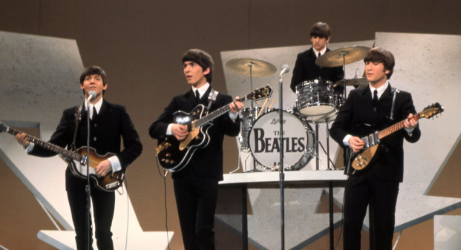
On the chilly evening of February 9, 1964, American culture pivoted on its axis. Seventy-seven days after the nation had been plunged into collective mourning by the assassination of President John F. Kennedy, four young men from Liverpool with electrifying charm and shockingly long hair stepped onto a television studio stage in New York City. For about fifteen minutes, The Beatles’ performance on The Ed Sullivan Show was watched by 73 million people—a staggering 40% of the entire US population. It was more than a television appearance; it was a cultural flashpoint, a sonic boom that heralded the end of one era and the explosive beginning of another.
This was not just the introduction of a new band; it was the televised birth of a new cultural landscape. The performance unleashed a tidal wave of change that reshaped the music industry, redefined youth culture, and drew a sharp, clear line between the generations. The world before that Sunday night and the world after were fundamentally different. To understand the trajectory of modern pop and rock music, one must return to this singular moment. Here are the top 10 ways The Beatles’ iconic appearance on The Ed Sullivan Show forever changed the world of music.
1. Launching the “British Invasion” and Opening the American Gates
Before February 1964, the American music charts were a fortress. While UK artists had occasional hits, the idea of a British band achieving sustained, dominant success in the US was almost unthinkable. The American market was seen as insular and self-sufficient. The Beatles’ performance was the battering ram that smashed the gates wide open. Their instant and overwhelming success proved to American record labels and radio stations that a massive, untapped appetite existed for British music.
This breakthrough created a slipstream for a wave of UK artists, forever known as the British Invasion. Within months, bands that had been toiling in relative obscurity in England were suddenly topping the US charts. The Rolling Stones, The Kinks, The Animals, The Dave Clark Five, and Dusty Springfield all owed their American success to the door The Beatles had kicked down. The Ed Sullivan appearance didn’t just introduce a band; it introduced a country’s entire music scene to the world’s most important market. It turned the one-way street of American cultural influence into a two-way superhighway, permanently internationalizing the sound of pop and rock music.
2. Cementing the “Self-Contained Band” as the New Ideal
In the pre-Beatles era, the dominant model for pop stardom was the solo singer. Artists like Elvis Presley, Frank Sinatra, and the teen idols of the day were the focal point, backed by anonymous, often interchangeable musicians. The Beatles presented a radical new paradigm: a four-headed, self-contained creative unit. John, Paul, George, and Ringo were not just a singer and his backing group; they were a gang, a team where each member had a distinct personality, played their own instrument, and contributed to the vocals.
This format, a group of equals who wrote their own material and performed it together, became the new template for what a rock band should be. They were a complete artistic package. The Ed Sullivan performance showcased this dynamic perfectly, with each member getting camera time and their names famously superimposed on the screen. For millions of kids watching in their living rooms, the message was clear: you didn’t have to be a solo crooner to be a star. You and your friends could form a band in your garage and, with the right chemistry and talent, conquer the world together. This democratic, gang-like structure became the very definition of a rock and roll band.
3. Redefining Masculinity, Style, and Rebellion
To a 1964 adult audience, The Beatles were a visual shock. Their “mop-top” hair, which cascaded over their ears and foreheads, was seen as wildly long and effeminate, a stark contrast to the military-style crew cuts sported by most American men. Their matching, collarless suits, designed by Pierre Cardin, were chic and European, a far cry from the buttoned-down Ivy League look. On that stage, they were cheeky, charming, and shook their heads with an energy that felt both joyous and defiant.
This look was an act of rebellion in itself. It challenged the rigid, clean-cut conventions of American masculinity and presented a new, more androgynous and expressive model of what it meant to be a young man. For the youth, this was liberating. The Beatles made it cool to be different. Style became inextricably linked with the music. Their appearance signaled that a band’s identity was about more than just their sound; it was about their attitude, their look, and their ability to stand apart from the establishment. They instantly made fashion a key weapon in the arsenal of rock and roll and the burgeoning youth culture.
4. Making Television the Ultimate Music Kingmaker
While artists like Elvis had created iconic television moments years earlier on the very same show, the sheer scale and impact of The Beatles’ appearance were unprecedented. The record-breaking audience of 73 million viewers demonstrated the immense power of network television to create an instant, nationwide cultural event. It was the 1960s equivalent of a viral video, but one that everyone watched at the exact same time.
The performance transformed The Ed Sullivan Show from a popular variety program into the single most important stage in the music world. A booking on Sullivan became the golden ticket, a guaranteed launchpad to stardom. The show became a crucial gatekeeper and taste-maker for the next several years, hosting debuts for other legendary acts like The Rolling Stones, The Doors, and The Supremes. This singular event established television as the most powerful promotional tool in the music industry, a role it would hold for decades until the rise of MTV. It proved that a few minutes on the right TV show could be more powerful than months of touring and radio play combined.
5. Legitimizing the Young Female Audience as a Market Force
One of the most enduring images from that night wasn’t just of the band, but of the audience: teenage girls, screaming, crying, and fainting with an ecstasy that bordered on religious fervor. This phenomenon, dubbed Beatlemania, was broadcast live into the homes of a bewildered older generation. While dismissively seen by many adults as mere hysteria, the industry saw something else: the emergence of a massively powerful and motivated consumer demographic.
The screaming girls of 1964 proved that the young female audience was a formidable economic force capable of driving record sales, concert tickets, and merchandise. Their passion could make or break an artist. Before this, the music industry was largely run by men who often underestimated the tastes and buying power of teenage girls. The Beatles’ appearance legitimized this audience, forcing record labels and marketers to take them seriously. This legacy endures today, as the passionate fan bases of modern pop superstars, largely driven by young women, continue to shape the charts and define mainstream musical trends.
6. Shifting the Spotlight to Original Songwriting
When The Beatles performed “I Want to Hold Your Hand” that night, they were performing a song they had written themselves. In the early 1960s, this was not the norm. The music industry was highly compartmentalized, with professional songwriters, often working out of hubs like New York’s Brill Building, crafting hits for performers to sing. Many artists were interpreters, not creators, of their material.
The Beatles, led by the prolific Lennon-McCartney partnership, changed that perception. Their success proved that a band could be both performers and brilliant composers. This inspired a seismic shift in the music industry. The idea of the “singer-songwriter” and the self-sufficient band that created its own art from scratch became the new benchmark of authenticity and artistic credibility. It empowered artists to take creative control and paved the way for the deeply personal and artist-driven music of Bob Dylan, Joni Mitchell, and the entire generation of songwriters that followed. Authenticity became the new currency, and that started with writing your own songs.
7. Drawing a Sharp “Generation Gap” in the Sand
For many families gathered around the television set, the reaction was split squarely down the middle. To the teenagers, the music was electrifying, the energy was infectious, and the band was impossibly cool. It was a sound that spoke directly to them. To many parents, however, the strange haircuts, the loud, repetitive music, and the hysterical reaction of the audience were baffling, alienating, and even threatening.
This shared moment created a stark cultural dividing line. Ed Sullivan himself tried to quell the parental backlash by famously saying, “they’re good, clean kids.” But for many, the line had been drawn. The Beatles became a symbol of a new youth culture that the older generation simply didn’t understand. This “generation gap” would widen dramatically over the course of the 1960s, fueled by debates over the Vietnam War, civil rights, and social mores. But for many, that Sunday night was the first tremor, the moment when music became a banner under which a new generation could unite in joyful rebellion against the tastes and values of their parents.
8. Ironically Revitalizing American Rock and Roll
By 1964, the raw, rebellious energy of 1950s rock and roll had faded. Elvis was in Hollywood, Little Richard had found religion, and Jerry Lee Lewis was in disgrace. The charts were dominated by a more polished, safer, and often manufactured sound of teen idols and vocal groups. In a great historical irony, it took four boys from England to remind America of its own greatest musical invention.
The Beatles were musical evangelists. Their sound was a potent cocktail of American influences: the driving rhythm of Chuck Berry, the harmonies of the Everly Brothers, the raw soul of Motown, and the grit of rockabilly. They repackaged these American sounds with a new, infectious energy and sold them back to a country that had started to forget them. Their performance inspired a generation of American kids to trade in their baseball gloves for electric guitars. Countless musicians, from Tom Petty to Bruce Springsteen to the members of The Byrds, have cited that performance as the pivotal moment they decided to form a band. The British Invasion, therefore, sparked an American renaissance, leading directly to the garage rock boom and the folk-rock movement.
9. Setting the Template for Global Media Superstardom
While stars like Elvis and Frank Sinatra were global figures, the speed and scale of The Beatles’ ascent to fame were entirely new. Their appearance on Ed Sullivan was a masterclass in using modern mass media to create an instant, continent-wide phenomenon. The build-up, the live broadcast, and the ensuing media frenzy created a template for modern celebrity launches.
This event marked the beginning of a new era of global, media-driven superstardom. It showed how television, combined with radio and print media, could create a shared cultural experience that transcended regional boundaries. The Beatles became a planetary phenomenon, recognized from Tokyo to Toronto. This model of achieving near-instantaneous, worldwide fame through a strategic media event became the blueprint for countless superstars to come, from Michael Jackson’s premiere of “Billie Jean” to Beyoncé’s Super Bowl performance. The Beatles on Sullivan was the dawn of the global music event.
10. Injecting a Shot of Optimism into a Grieving Nation
The cultural context of the performance cannot be overstated. America in early 1964 was a nation in shock, still cloaked in the somber gray of President Kennedy’s assassination just 11 weeks prior. There was a palpable sense of lost innocence and uncertainty. Into this void stepped The Beatles, with their boundless energy, cheeky grins, and songs about holding hands and wanting to be loved.
Their music was joyous, exuberant, and relentlessly optimistic. It was a complete tonal shift from the grief that had dominated the national conversation. For millions of young people, their performance was a cultural catharsis, a signal that it was okay to be happy and excited again. It was a burst of pure, uncomplicated fun that swept away the lingering shadows of the previous year. More than just a musical performance, The Beatles on Ed Sullivan was a symbolic turning point—the unofficial end of national mourning and the bright, loud, Technicolor kickoff of the Swinging Sixties.
Further Reading
For those who want to explore this pivotal moment and the incredible story of The Beatles in more detail, these books offer fantastic insights:
- Can’t Buy Me Love: The Beatles, Britain, and America by Jonathan Gould
- Tune In: The Beatles: All These Years, Vol. 1 by Mark Lewisohn (for the definitive deep dive)
- A Hard Day’s Write: The Stories Behind Every Beatles Song by Steve Turner
- The Beatles: The Biography by Bob Spitz
Here at Zentara.blog, our mission is to take those tricky subjects and unlock them, making knowledge exciting and easy to grasp for everyone. But the adventure doesn’t stop on this page! We’re constantly exploring new frontiers and sharing discoveries across the digital universe. Want to dive deeper into more mind-bending Top 10s and keep expanding your world? Come join us on our other platforms – we’ve got unique experiences waiting for you on each one!
Get inspired by visual wonders and bite-sized facts: See the world through Zentara’s eyes on Pinterest!
Pin our fascinating facts and stunning visuals to your own boards. Explore Pins on Pinterest: https://uk.pinterest.com/zentarablog/
Discover quick insights and behind-the-scenes peeks: Hop over to Tumblr for snippets, quotes, and unique content you won’t find anywhere else. It’s a different flavour of discovery! Follow the Fun on Tumblr: https://www.tumblr.com/zentarablog
Ready for deep dives you can listen to or watch? We’re bringing our accessible approach to video and potentially audio! Subscribe to our YouTube channel and tune into future projects that make learning pop! Subscribe on YouTube: https://www.youtube.com/@ZentaraUK
Seeking even more knowledge in one place? We’ve compiled some of our most popular topic deep dives into fantastic ebooks! Find them on Amazon and keep the learning journey going anytime, anywhere. Find Our Ebooks on Amazon: https://www.amazon.co.uk/s?k=Zentara+UK&ref=nb_sb_noss
Connect with us and fellow knowledge seekers: Join the conversation on BlueSky! We’re sharing updates, thoughts, and maybe even asking you what wonders we should explore next. Chat with Us on BlueSky: https://bsky.app/profile/zentarablog.bsky.social
Perfect for learning on the move! We post multiple 10-minute podcasts per day on Spotify. Pop on your headphones and fill your day with fascinating facts while you’re out and about! Listen on Spotify: https://open.spotify.com/show/3dmHbKeDufRx95xPYIqKhJFollow us on Instagram for bytesize knowledge! We post multiple posts per day on our official Instagram account. https://www.instagram.com/zentarablog/ Every click helps us keep bringing honest, accessible knowledge to everyone. Thanks for exploring with us today – see you out there in the world of discovery!




Leave a Reply