
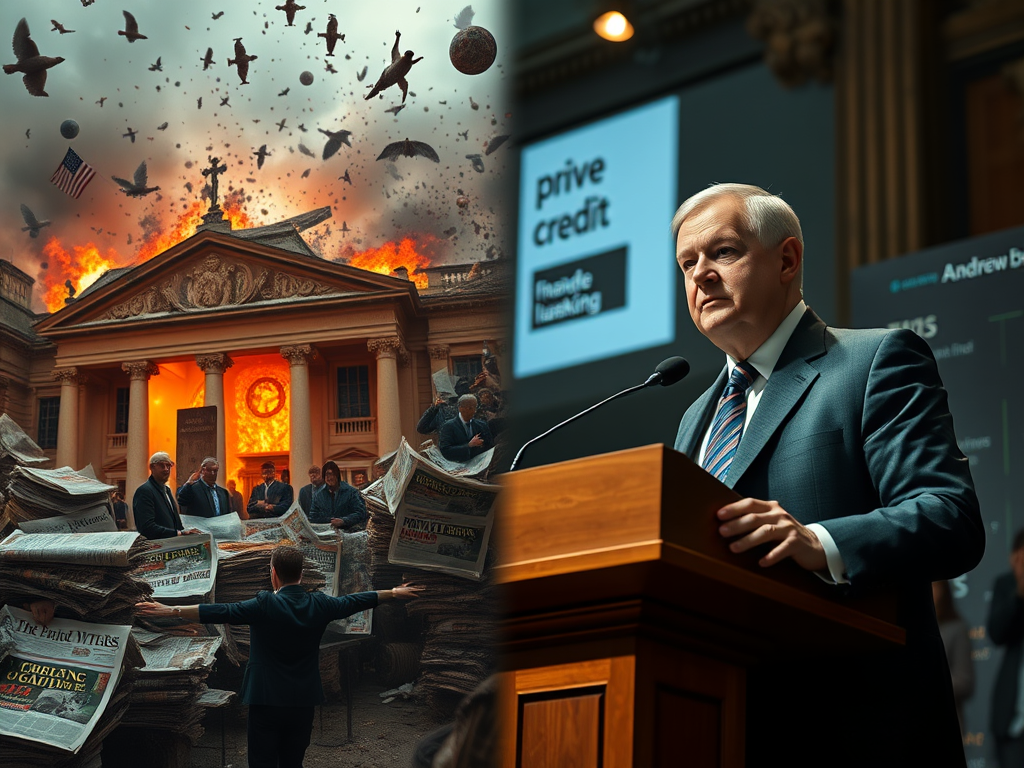
You might have seen some scary headlines recently. In late 2025, the Governor of the Bank of England, Andrew Bailey, gave a stark warning to lawmakers, saying he’s seeing “worrying echoes” of the 2008 financial crisis. He warned that recent events could be the “canary in the coalmine” for the global economy.
This news, reported in The Guardian and other outlets, is filled with confusing jargon like “private credit,” “shadow banking,” and “tranching.” But what does it actually mean, and should you be worried?
Let’s demystify the jargon. The core of the problem is surprisingly simple. Here are the top 10 simple facts you need to understand what’s happening.
1. The “Echo” Is a New, $3 Trillion Market You’ve Never Heard Of
The center of today’s concern is “private credit.”
- Simple Analogy: Imagine you need a loan. In 2007, you would go to a highly regulated, public bank (like Barclays or HSBC). Today, there’s a different option: a “private credit” fund. This is a giant, private pool of money from investors (like pension funds or billionaires) that acts like a bank, but without the same strict rules. This industry has exploded since 2008, growing into a nearly $3 trillion giant. It’s often called “shadow banking” because it’s so large, yet operates outside the view of many regulators.
2. Today’s “Private Credit” Is Being Compared to 2008’s “Subprime Mortgages”
The comparison that’s making regulators nervous is this:
- In 2008: The problem was subprime mortgages. These were risky home loans given to people who couldn’t really afford them.
- Today: The problem is private credit loans. These are often risky loans given to medium-sized, highly-indebted companies (many owned by private equity firms).
In both cases, you have a massive market built on debt that might not get paid back if the economy hits a rough patch.
3. The “Canary in the Coalmine” Has Already Collapsed
Andrew Bailey’s warning wasn’t just theoretical. It was triggered by the sudden collapse of two large US companies: an auto-parts supplier called First Brands and a car-finance firm named Tricolor. Both were heavily funded by private credit. Their failures sent a shockwave through the system, forcing major banks like JPMorgan and Barclays to admit they faced losses. This is what regulators fear is the “canary”—the first sign of a much bigger, hidden problem.
4. They’re Using the Same “Slicing and Dicing” Tricks from 2008
This is the most direct “echo.” Governor Bailey explicitly warned that he sees “alarm bells” because of “tranching” (or “slicing and dicing”).
- Simple Analogy: In 2008, bankers took thousands of risky subprime mortgages, bundled them into a “fruit salad” (a Collateralized Debt Obligation, or CDO), and then “sliced” that salad into different pieces, or “tranches.” They sold the “safest” slices (the A-grade fruit) to pension funds, claiming they were 100% safe. But in reality, it was all just a mix of rotten fruit. When the mortgages went bad, the “safe” slices were revealed to be worthless.
- Today: Regulators see the same thing happening with private credit loans. These risky corporate loans are being bundled, “sliced,” and sold off, with some slices being labeled as “safe” investments.
5. The Core Problem is “Opacity” (No One Knows Who Holds the Risk)
The biggest fear is what we can’t see.
- In 2008: When the subprime mortgages started to fail, nobody knew which bank was holding the “toxic” CDO slices. This created total panic. Banks stopped lending to each other because they couldn’t be sure who was secretly bankrupt. The system froze.
- Today: The private credit market is, by definition, private. It’s opaque. These loans are not traded on a public market. No one has a clear map of who really owns all this risky debt. If more companies like First Brands and Tricolor fail, we could have a 2008-style panic where no one knows which funds or even which banks are truly safe.
6. The “Watchdogs” Are Repeating 2008’s Mistakes
In 2008, credit rating agencies (like Moody’s and S&P) were a huge part of the problem. They were paid by the banks to rate those “fruit salad” CDOs and gave the riskiest junk a “AAA” (super-safe) rating.
Regulators are worried about a repeat. The collapsed Tricolor, for example, had bonds that were given a top-tier AAA rating just months before it went bankrupt. This suggests the “watchdogs” are again failing to see the real risk, just like in 2008.
7. The Problem Grew Because of the 2008 Rules
This is the great irony. After 2008, new rules made it much harder for traditional, regulated banks to make risky loans. This was meant to make the system safer. But it created a vacuum. All that risky-but-profitable lending business didn’t just disappear—it migrated out of the regulated banks and into the unregulated “shadow banking” world of private credit. In trying to fix the problem, regulators may have just moved it to a darker, less-controlled corner of the financial system.
8. “Weak Underwriting” Means Giving Loans That Shouldn’t Be Given
You’ll hear the phrase “weak underwriting standards.” This is just a fancy term for not doing your homework.
- In 2008: It meant giving “NINJA” loans (No Income, No Job, or Assets) to homebuyers. Lenders didn’t bother to check if the borrower could actually afford to pay the mortgage.
- Today: It means private credit funds, competing fiercely with each other to lend money, are giving loans to “zombie” companies that are already struggling with high debt. They are lending money based on optimistic projections rather than hard assets, just to get the deal done.
9. High Leverage Means Small Shocks Cause Big Waves
Both crises are built on “high leverage.” This just means using a lot of borrowed money to make a bet.
- Simple Analogy: You buy a $100,000 house with only $5,000 of your own money (you “leveraged” your $5k). If the house price drops by just 5% to $95,000, your entire $5,000 investment is wiped out. You’ve been “deleveraged.”
- Today: Private credit funds are highly leveraged. But so are the companies they lend to. This creates a fragile chain. If a company’s profits fall just a little bit, it can’t pay its loan; this wipes out the fund’s investment, which in turn could cause losses for a bank that lent money to the private credit fund. It’s a house of cards.
10. This Isn’t a “Fire Drill”—Regulators Are Genuinely Worried
When the Governor of the Bank of England and the head of the IMF both use language like this in public, it’s not just “banker-speak.” Andrew Bailey told lawmakers he didn’t want to sound “too foreboding,” but then immediately pointed out that in 2007, everyone said the subprime problem was “too small to be systemic” and “idiosyncratic.” He finished by saying, “That was the wrong call.”
His deputy, Sarah Breeden, was even more blunt, stating, “We can see the vulnerabilities here… We can see parallels with the global financial crisis.” As a result, the Bank of England is now planning a “stress test” of this entire market to see how bad the damage could be. This is a clear sign that the world’s top financial firefighters are smelling smoke.
Further Reading
If you want to understand the deep background of these issues, these books are essential, explaining the original 2008 crisis and the financial world we live in today.
- The Big Short: Inside the Doomsday Machineby Michael Lewis
- The single best book on the 2008 crisis. It brilliantly explains complex ideas like subprime mortgages and CDOs by telling the true story of the few outsiders who saw the crash coming.
- Too Big to Fail: The Inside Story of How Wall Street and Washington Fought to Save the Financial System—and Themselvesby Andrew Ross Sorkin
- A gripping, minute-by-minute account of the 2008 panic itself. It shows how interconnected and fragile the system was, which is exactly what regulators fear today.
- The Lords of Easy Money: How the Federal Reserve Broke the American Economyby Christopher Leonard
- A fantastic book for understanding the last decade. It explains how low interest rates (the “easy money” since 2008) fueled the rise of private equity and corporate debt, setting the stage for the exact problems we’re seeing now.
Here at Zentara.blog, our mission is to take those tricky subjects and unlock them, making knowledge exciting and easy to grasp for everyone. But the adventure doesn’t stop on this page! We’re constantly exploring new frontiers and sharing discoveries across the digital universe. Want to dive deeper into more mind-bending Top 10s and keep expanding your world? Come join us on our other platforms – we’ve got unique experiences waiting for you on each one!
Get inspired by visual wonders and bite-sized facts: See the world through Zentara’s eyes on Pinterest!
Pin our fascinating facts and stunning visuals to your own boards. Explore Pins on Pinterest: https://uk.pinterest.com/zentarablog/
Discover quick insights and behind-the-scenes peeks: Hop over to Tumblr for snippets, quotes, and unique content you won’t find anywhere else. It’s a different flavour of discovery! Follow the Fun on Tumblr: https://www.tumblr.com/zentarablog
Ready for deep dives you can listen to or watch? We’re bringing our accessible approach to video and potentially audio! Subscribe to our YouTube channel and tune into future projects that make learning pop! Subscribe on YouTube: https://www.youtube.com/@ZentaraUK
Seeking even more knowledge in one place? We’ve compiled some of our most popular topic deep dives into fantastic ebooks! Find them on Amazon and keep the learning journey going anytime, anywhere. Find Our Ebooks on Amazon: https://www.amazon.co.uk/s?k=Zentara+UK&ref=nb_sb_noss
Connect with us and fellow knowledge seekers: Join the conversation on BlueSky! We’re sharing updates, thoughts, and maybe even asking you what wonders we should explore next. Chat with Us on BlueSky: https://bsky.app/profile/zentarablog.bsky.social
Perfect for learning on the move! We post multiple 10-minute podcasts per day on Spotify. Pop on your headphones and fill your day with fascinating facts while you’re out and about! Listen on Spotify: https://open.spotify.com/show/3dmHbKeDufRx95xPYIqKhJFollow us on Instagram for bytesize knowledge! We post multiple posts per day on our official Instagram account. https://www.instagram.com/zentarablog/ Every click helps us keep bringing honest, accessible knowledge to everyone. Thanks for exploring with us today – see you out there in the world of discovery!




Leave a Reply