
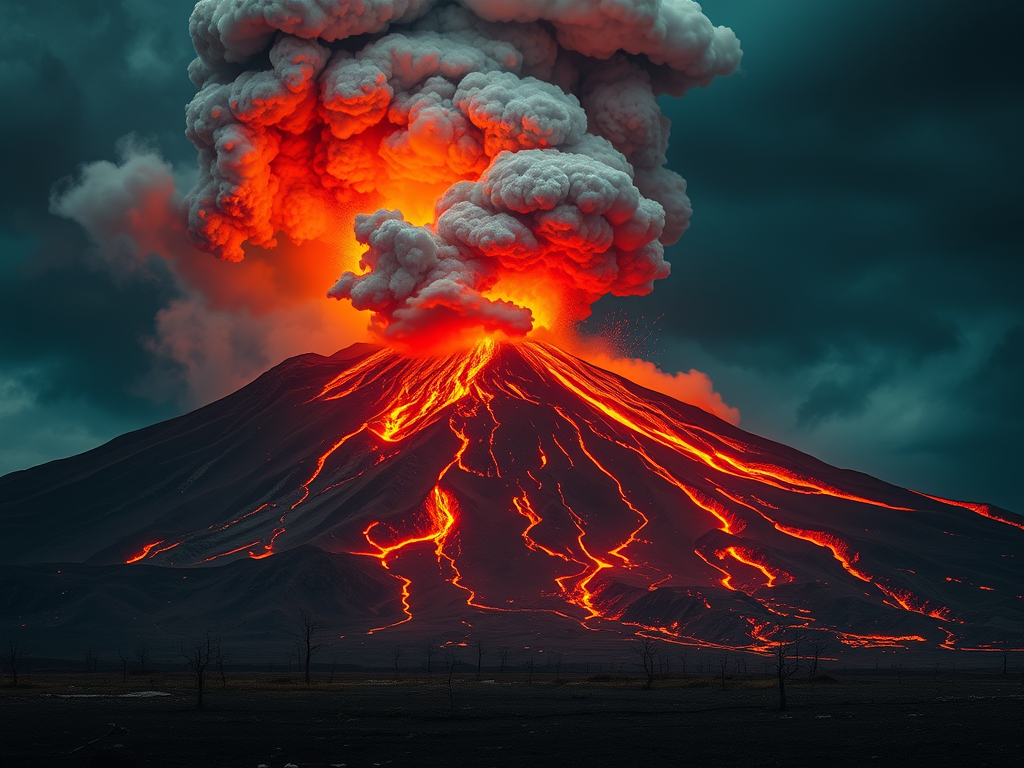
Our planet is a living, breathing entity. Deep beneath its placid crust, unimaginable pressures and temperatures churn, a constant reminder of the raw power that forged our world. We build our cities and live our lives on the thin shell of this restless giant, often forgetting what lies below. But every so often, the Earth reminds us. A volcano, that most dramatic and terrifying of geological features, erupts and reshapes our world in fire and ash.
Table of Contents
But what makes an eruption truly “destructive”? It’s not just the size of the explosion. The most destructive volcanic eruptions in history are defined by their lethal creativity. Some kill with speed, unleashing superheated avalanches of ash and gas. Others kill with tsunamis, drowning coastlines miles away. And some of the most devastating kill with slow, insidious silence, releasing gases that poison the air and block the sun, plunging the entire globe into years of darkness and famine.
To measure these events, scientists use the Volcanic Explosivity Index (VEI), a scale from 0 to 8 that, much like the Richter scale for earthquakes, measures the volume of ash, the height of the ash plume, and the eruption’s violence. As we’ll see, the eruptions that left the deepest scars on humanity weren’t always the ones with the highest VEI number, but were often a tragic combination of bad location and deadly phenomena.
This is a journey into the heart of the inferno, a look at the ten eruptions that not only leveled mountains but also toppled civilizations and permanently altered the course of human history.
1. Mount Tambora, Indonesia (1815): The Eruption That Stole a Summer
If there is one eruption that stands as the undisputed champion of destruction in recorded history, it is Mount Tambora. With a staggering VEI of 7, this was the largest and deadliest eruption of the last 10,000 years. When it blew, it ejected an estimated 38 cubic miles of rock, magma, and ash into the atmosphere—enough to bury the entire island of Manhattan half a mile deep.
The immediate blast and the resulting pyroclastic flows (superheated avalanches of gas and rock) obliterated the island of Sumbawa and killed at least 10,000 people instantly. But this was just the beginning. The towering tsunamis that followed washed away entire villages. The real killer, however, was the ash. It poisoned the water and crops across the region, leading to a “volcanic famine” that claimed another 80,000 to 90,000 lives.
But Tambora’s true destructive power was global. The sheer volume of sulfur dioxide it injected into the stratosphere—over 100 million tons—created a fine aerosol veil that circled the globe and reflected sunlight. The planet cooled. The following year, 1816, became known as the “Year Without a Summer.” Crops failed in Europe and North America. It snowed in New England in June. Famine gripped Ireland, Switzerland, and China. This global climate chaos, triggered by a single eruption, led to food riots, disease, and mass migration. It even inspired art: the gloomy, sunless summer led a young Mary Shelley, on holiday in Switzerland, to write Frankenstein.
2. Toba, Indonesia (~74,000 BCE): The “Near-Extinction” Supervolcano
To understand the Toba supervolcano eruption, you have to think on a scale that dwarfs human civilization. This was not an eruption; it was a planetary sterilization event. A true VEI 8 “super-eruption,” the Toba event was the largest volcanic eruption in the last 25 million years. It released energy equivalent to over a million tons of TNT every second for two weeks straight.
It didn’t just create a crater; it created Lake Toba, a 62-mile-long caldera that is visible from space. The eruption spewed nearly 700 cubic miles of material into the atmosphere, blanketing parts of India, Pakistan, and the Persian Gulf in over 30 feet of ash. This was an extinction-level event.
The resulting “volcanic winter” was cataclysmic. Global temperatures may have dropped by as much as 15°C (27°F) for several years, triggering a brief ice age. According to the Toba Catastrophe Theory, this event pushed the young human race to the brink of extinction. Genetic evidence suggests that the entire human population may have been reduced to just a few thousand individuals, a “population bottleneck” that almost ended our story before it began. Every human alive today is a descendant of the few, hardy survivors who made it through the long, dark winter of Toba.
3. Krakatoa, Indonesia (1883): The Sound Heard ‘Round the World
While Tambora was bigger, the Krakatoa eruption of 1883 was the first truly global media event. Its explosion was so violent that it was, quite literally, the loudest sound in recorded history. It was heard as a “distant cannonade” over 3,000 miles away in Perth, Australia, and on the island of Rodrigues near Africa. The atmospheric shockwave was so powerful it circled the globe seven times.
The eruption, a VEI 6, obliterated two-thirds of the island of Krakatoa in a single, cataclysmic blast. But the vast majority of the 36,000+ victims were not killed by the explosion itself. The island’s collapse triggered a series of colossal tsunamis, some over 130 feet high. These waves radiated outwards, annihilating 165 coastal villages in Java and Sumatra. A Dutch warship was carried nearly two miles inland and dumped in a forest.
The after-effects were as spectacular as they were deadly. A cloud of fine ash circled the globe, producing such vivid, fiery red sunsets in Europe and America that people called fire departments, believing their cities were on fire. It is widely believed that the blood-red skies in Edvard Munch’s famous painting The Scream were a direct inspiration from the eerie, beautiful, and terrifying sunsets Krakatoa painted across the world.
4. Laki, Iceland (1783-1784): The Haze That Poisoned a Kingdom
Not all destruction comes from a single, deafening explosion. The Laki eruption in Iceland was a nine-month-long “fissure eruption,” where a 17-mile-long crack in the Earth split open, spewing a relentless tide of lava and poisonous gas. This was not a mountain exploding, but the planet itself bleeding.
The lava flows were immense, covering over 230 square miles, but the lava wasn’t the main killer. The eruption released an estimated 120 million tons of sulfur dioxide and 8 million tons of hydrogen fluoride. This toxic fog, known as the “Laki Haze,” settled over Iceland. The fluoride poisoned the grass, killing over 75% of the island’s livestock. The sulfur dioxide created acid rain that destroyed crops. The resulting “Mist Hardships” led to a catastrophic famine that killed 10,000 people—a full 25% of Iceland’s entire population.
The haze didn’t stop at Iceland. It drifted over Europe, causing a “year of the fog” that choked the continent. It led to thousands of deaths from respiratory illness, severe acid rain, and a disruption of the monsoon in Africa and India. This slow-motion disaster is one of the best examples of how volcanic gas emissions can be even more destructive than a violent blast.
5. Mount Pelée, Martinique (1902): The Instant Annihilator
The Mount Pelée eruption of 1902 is the deadliest eruption of the 20th century, and it provides a chilling, textbook example of the most terrifying volcanic phenomenon: the pyroclastic flow.
The city of Saint-Pierre, Martinique, was a bustling, cultured city known as the “Paris of the Caribbean.” In the weeks leading up to May 8th, the volcano rumbled. It dusted the town in ash and filled the air with sulfur. But the local governor, eager to keep people from fleeing before an upcoming election, downplayed the danger.
On the morning of May 8th, the volcano’s crater wall collapsed. It didn’t erupt upwards; it unleashed a horizontal blast. A superheated cloud of ash, rock, and gas—a pyroclastic flow—shot down the mountainside at over 100 mph. It was a 1,900°F (1,000°C) inferno. In less than two minutes, the entire city of Saint-Pierre and its 30,000 inhabitants were incinerated. The flow was so hot it melted glass, vaporized water, and caused rum bottles to explode. There were only two known survivors: a man on the very edge of the city and, most famously, a prisoner named Ludger Sylbaris, who was saved by the thick, stone walls of his dungeon cell.
6. Mount Vesuvius, Italy (79 AD): The City Frozen in Time
No eruption is more famous than the one that destroyed Pompeii and Herculaneum. The Mount Vesuvius eruption of 79 AD is not on this list for its size (a “mere” VEI 5) or its death toll (an estimated 16,000), but for its unique, chilling form of destruction.
The eruption was immortalized in a detailed, eyewitness account by Pliny the Younger, whose letters to the historian Tacitus are considered the birth of volcanology. He described a towering column of ash and pumice shaped like an “umbrella pine,” which rained down on the city of Pompeii for hours. Many citizens suffocated on the toxic gas or were crushed by collapsing roofs.
But the neighboring town of Herculaneum met a different, even more terrifying fate. It was hit by a series of pyroclastic surges—a hotter, faster, gas-rich version of a flow. This surge instantly killed its inhabitants, boiling their brains and vaporizing their flesh before burying the town. The eruption’s legacy is the grim time capsule it created. The layers of ash perfectly preserved the cities, and in the 1800s, archaeologists made a haunting discovery. They found voids in the ash left by the decayed bodies, and by pouring plaster into them, they created perfect, agonizing casts of the victims at the very moment of their deaths.
7. Nevado del Ruiz, Colombia (1985): The Modern, Preventable Tragedy
The Armero tragedy in 1985 is a heartbreaking lesson that a volcano’s VEI number (in this case, a “small” VEI 3) has little to do with its destructive potential. The Nevado del Ruiz volcano was not a secret killer; it had a long history of creating lahars. A lahar is a volcanic mudflow, a fast-moving, destructive slurry of melted glacier ice, mud, rocks, and trees.
When the volcano erupted, it did exactly what scientists had warned it would do. The hot pyroclastic flows melted the mountain’s summit glacier, sending a 150-foot-high river of thick, “wet concrete” racing down the valleys. It traveled at 30 mph, easily cresting the hills that were supposed to protect the town of Armero. In the middle of the night, the lahar struck the town and simply erased it from the map.
The mudflow killed 23,000 of the town’s 29,000 inhabitants. The world watched in horror for days as rescuers tried to save a 13-year-old girl named Omayra Sánchez, trapped in the mud and water. Her tragic death, filmed by journalists, became a global symbol of the disaster. The true tragedy was that this was an entirely preventable disaster. Hazard maps had been drawn up and the danger was known, but a combination of government inaction and false alarms led to a catastrophic failure to evacuate.
8. Thera (Santorini), Greece (~1600 BCE): The Eruption That Forged a Legend
Around 3,600 years ago, a massive VEI 6 or 7 eruption occurred in the Aegean Sea, on the island of Thera, now known as the beautiful tourist destination of Santorini. This event, known as the Minoan eruption, was a cataclysm for the Bronze Age world.
The eruption was four to five times more powerful than Krakatoa. It vaporized the center of the island and sent a plume of ash 24 miles high. The resulting tsunamis, possibly hundreds of feet high, radiated across the Mediterranean, devastating the northern coast of Crete, which was the heart of the sophisticated Minoan civilization.
The eruption’s fallout is a subject of intense historical debate. The ashfall and tsunamis crippled the Minoan fleet, destroyed coastal towns, and caused massive crop failures. Within a few generations, this once-dominant civilization collapsed, paving the way for the rise of mainland Mycenaean Greece. The eruption’s influence is so vast that it is the single most popular candidate for the historical event that inspired Plato’s legend of Atlantis—a story of a mighty, advanced island civilization that angered the gods and was swallowed by the sea in a single, terrible day and night.
9. Yellowstone, USA (~640,000 BCE): The Sleeping American Giant
The Yellowstone supervolcano hasn’t erupted in modern history, but it earns its place on this list for its sheer, terrifying potential and its history of unfathomable destruction. The geysers and hot springs that draw millions of tourists are just the “steam” from a colossal magma chamber a few miles beneath their feet.
The Yellowstone hotspot has had three “super-eruptions” in the last 2.1 million years, all of them VEI 8. The most recent, the Lava Creek eruption 640,000 years ago, was 1,000 times more powerful than the Mount St. Helens eruption. It ejected 240 cubic miles of rock and ash, enough to cover half of North America in a thick, toxic blanket.
A full-scale eruption of the Yellowstone caldera today is a nightmare scenario. It would create a true volcanic winter, causing a global “nuclear winter” effect. The United States would be devastated, with its agricultural heartland buried, and global temperatures would plummet, leading to a worldwide collapse of the food chain. While geologists assure us it is not “due” for an eruption anytime soon, its presence is a humbling reminder of the scale of geologic time and the dormant power beneath our feet.
10. Mount St. Helens, USA (1980): The Eruption That Blew Sideways
The 1980 eruption of Mount St. Helens was not the deadliest or the largest, but it is one of the most significant modern volcanic eruptions in history. It was a “perfectly” documented event that taught scientists more about volcanoes than any other eruption, specifically about a phenomenon now known as a “lateral blast.”
For weeks, the volcano had been bulging outwards on its north flank at a rate of five feet per day. On May 18, 1980, a 5.1-magnitude earthquake triggered the largest debris avalanche (landslide) in recorded history. This “uncorked” the magma chamber, but not from the top—from the side.
The volcano exploded sideways in a lateral blast that shot a 660°F cloud of ash, rock, and gas outwards at over 300 mph, flattening 230 square miles of pristine forest in minutes. Trees were snapped like twigs. The blast killed 57 people, including volcanologist David Johnston (who famously radioed “Vancouver! Vancouver! This is it!”) and photographer Robert Landsburg (who used his body to shield his film, preserving his photos for science). The eruption became a priceless natural laboratory, teaching us about the terrifying power of lateral blasts and the surprising resilience of life as the ecosystem began to recover.
Further Reading
For those who wish to explore the power of these geological giants and the human stories surrounding them, here are a few essential, accessible books:
- Krakatoa: The Day the World Exploded by Simon Winchester
- The Year Without Summer: 1816 and the Volcano That Darkened the World and Changed History by William K. Klingaman and Nicholas P. Klingaman
- Supervolcano: The Ticking Time Bomb Beneath Yellowstone by Greg Breining
Here at Zentara.blog, our mission is to take those tricky subjects and unlock them, making knowledge exciting and easy to grasp for everyone. But the adventure doesn’t stop on this page! We’re constantly exploring new frontiers and sharing discoveries across the digital universe. Want to dive deeper into more mind-bending Top 10s and keep expanding your world? Come join us on our other platforms – we’ve got unique experiences waiting for you on each one!
Get inspired by visual wonders and bite-sized facts: See the world through Zentara’s eyes on Pinterest!
Pin our fascinating facts and stunning visuals to your own boards. Explore Pins on Pinterest: https://uk.pinterest.com/zentarablog/
Discover quick insights and behind-the-scenes peeks: Hop over to Tumblr for snippets, quotes, and unique content you won’t find anywhere else. It’s a different flavour of discovery! Follow the Fun on Tumblr: https://www.tumblr.com/zentarablog
Ready for deep dives you can listen to or watch? We’re bringing our accessible approach to video and potentially audio! Subscribe to our YouTube channel and tune into future projects that make learning pop! Subscribe on YouTube: https://www.youtube.com/@ZentaraUK
Seeking even more knowledge in one place? We’ve compiled some of our most popular topic deep dives into fantastic ebooks! Find them on Amazon and keep the learning journey going anytime, anywhere. Find Our Ebooks on Amazon: https://www.amazon.co.uk/s?k=Zentara+UK&ref=nb_sb_noss
Connect with us and fellow knowledge seekers: Join the conversation on BlueSky! We’re sharing updates, thoughts, and maybe even asking you what wonders we should explore next. Chat with Us on BlueSky: https://bsky.app/profile/zentarablog.bsky.social
Perfect for learning on the move! We post multiple 10-minute podcasts per day on Spotify. Pop on your headphones and fill your day with fascinating facts while you’re out and about! Listen on Spotify: [invalid URL removed]Follow us on Instagram for bytesize knowledge! We post multiple posts per day on our official Instagram account. https://www.instagram.com/zentarablog/ Every click helps us keep bringing honest, accessible knowledge to everyone. Thanks for exploring with us today – see you out there in theworld of discovery!




Leave a Reply