
Table of Contents
Take a deep breath. In the last year, you or someone you love has likely taken an antibiotic, received a vaccine, or perhaps even had a routine blood test. We live in an age of medical miracles, where surviving infections, surgeries, and even complex genetic conditions is often taken for granted. But this reality is incredibly new.
Just a few generations ago, a simple cut could lead to a fatal infection, childbirth was a perilous gamble, and a diagnosis of “consumption” was a death sentence. The world we live in today—a world of antibiotics, sterile operating rooms, genetic screening, and public health—was not an accident. It was built, piece by piece, by brilliant, curious, and often rebellious individuals who dared to question the established “knowledge” of their time.
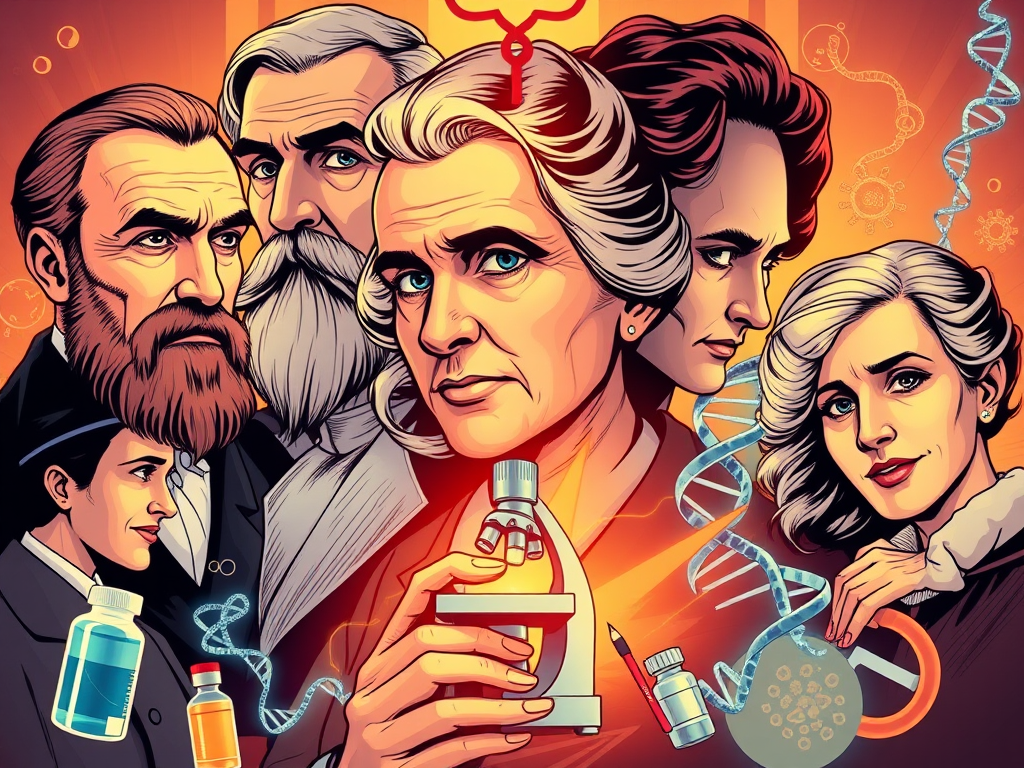
These are the pioneers of modern medicine. They fought against dogma, peered into the invisible, and decoded the very building blocks of life. Their discoveries are not just chapters in a history book; they are the reasons we are alive and healthy today. Let’s explore the top 10 individuals whose breakthroughs forever changed the human story.
1. Edward Jenner: The Country Doctor Who Conquered a Killer
Before the 1790s, smallpox was one of the most terrifying diseases on Earth, killing nearly 1 in 3 of its victims and leaving survivors deeply scarred. It was a global scourge. The “cure” at the time, variolation, was almost as dangerous, involving scratching material from a smallpox sore into a healthy person’s skin.
Edward Jenner, a country doctor in England, noticed a piece of local folklore: milkmaids who contracted cowpox—a mild disease from cows—seemed to be completely immune to smallpox. This observation, which others had dismissed, sparked a revolutionary idea. Was the folk wisdom true? And if so, could he intentionally give someone the harmless cowpox to protect them from the deadly smallpox?
In 1796, Jenner performed one of the most dangerous and, in hindsight, most important experiments in medical history. He took material from a cowpox sore on a milkmaid named Sarah Nelmes and inoculated an 8-year-old boy, James Phipps. The boy felt unwell for a few days and then recovered. Weeks later, Jenner exposed the boy directly to smallpox. Nothing happened. The boy was immune. Jenner had just performed the world’s first vaccination. He had given the body’s immune system a “mugshot” of a similar, weaker criminal (cowpox), allowing it to build an army of defenses that recognized and destroyed the real killer (smallpox) on sight. His work saved countless lives and created the entire field of immunology.
2. Louis Pasteur: The Man Who Proved the Invisible World
Why did milk spoil? Why did wine turn to vinegar? And most importantly, why did people get sick? For most of human history, the dominant theory was “spontaneous generation”—the idea that life, like maggots on meat or microbes in broth, simply appeared from nothing. Sickness was blamed on “bad air” (miasma) or imbalances in the body.
Louis Pasteur, a French chemist, shattered this entire worldview. Through a series of brilliant experiments, he proved that “invisible” microscopic organisms—germs, bacteria, yeasts—were all around us, in the air and on our hands, and that they were responsible for these changes. His most famous experiment involved a swan-neck flask: he boiled broth in a flask with a long, S-shaped neck. Air could get in, but dust and microbes from the air were trapped in the curve. The broth remained sterile forever. When he broke the neck, allowing microbes to fall in, the broth spoiled within days.
This was the “smoking gun” for the germ theory of disease. It wasn’t “bad air” that caused cholera; it was a specific germ. Pasteur proved that these microbes could be killed with heat (a process we still call “pasteurization”) and that they caused infectious diseases. This single idea is the bedrock of all modern medicine, leading directly to hygiene, antibiotics, and antiseptics.
3. Joseph Lister: The Surgeon Who Made Hospitals Safe
In the mid-19th century, hospitals were not places of healing; they were often gateways to death. Surgeries were brutal, but the real killer was what came after: infection. “Surgical sepsis,” or “ward fever,” was so common that operating theatres had a sickly, rotting smell. Surgeons would operate in their street clothes, with unwashed hands, moving from an autopsy directly to a live patient, proud of the blood and grime on their coats as a sign of experience.
Joseph Lister, a Scottish surgeon, read Louis Pasteur’s work on germ theory and had a profound realization: if germs in the air could spoil wine, perhaps germs in the air were “spoiling” the wounds of his patients.
He theorized that a chemical “shield” could kill these germs before they entered a wound. He chose carbolic acid, a substance used to treat foul-smelling sewage. In 1865, he began spraying a mist of carbolic acid over his patients during surgery, soaking his instruments in it, and applying it to wounds. The results were astonishing. His wards, once filled with the stench of gangrene, began to smell of carbolic acid—and his patients survived. He had introduced antiseptic surgery. Lister’s work transformed surgery from a desperate gamble into a life-saving practice. Every time a doctor scrubs in, sterilizes a tool, or wears a surgical mask, they are practicing the principles Joseph Lister established.
4. Alexander Fleming: The Happy Accident That Tamed Bacteria
Even with sterile surgery, if an infection took hold inside the body, doctors were helpless. The 20th century needed a “magic bullet”—a weapon that could kill invading bacteria without harming the patient’s own cells.
In 1928, a notoriously messy bacteriologist named Alexander Fleming returned to his lab after a holiday. He found a stack of petri dishes he had forgotten to clean. On one dish, growing colonies of Staphylococcus bacteria, a “contaminant” had landed—a speck of Penicillium mold. But something amazing had happened. Around the blotch of mold, there was a perfect, clear circle where all the bacteria had been killed.
Fleming’s genius was not in the accident, but in his recognition of its importance. He famously muttered, “That’s funny.” He realized the mold was producing a “juice”—a chemical weapon—to defend its territory from the bacteria. He isolated this substance and named it penicillin. It was the world’s first true antibiotic. While Fleming wasn’t able to purify it, his discovery lay the groundwork for Howard Florey and Ernst Chain, who, a decade later, turned penicillin into a mass-producible drug that saved millions of lives in World War II and launched the antibiotic age.
5. Wilhelm Röntgen: The Discovery That Let Us See Inside Ourselves
For all of human history, the inside of the living body was a complete mystery, accessible only by a surgeon’s knife. To diagnose a broken bone, a doctor had to guess. To find a bullet, a surgeon had to probe and cut.
On November 8, 1895, a German physicist named Wilhelm Röntgen was experimenting with a cathode-ray tube in his darkened laboratory. He noticed that a cardboard screen coated with a fluorescent chemical, which was lying on a nearby bench, had started to glow. This was impossible—the tube was covered in thick black cardboard, and the “rays” he was studying couldn’t pass through it. He had discovered a new, unknown, and invisible kind of ray. He called it the “X-ray,” with “X” standing for “unknown.”
He quickly found these rays could pass through paper, wood, and even his own flesh, but were stopped by denser materials like bone and metal. In a moment that changed medicine forever, he asked his wife, Anna, to place her hand in the path of the rays, holding a photographic plate behind it. The resulting image was astounding: a ghostly picture of the bones inside her living hand, her wedding ring floating around the bone. The news spread like wildfire. Within weeks, doctors around the world were using X-rays to find broken bones and locate shrapnel, birthing the entire field of diagnostic radiology.
6. Karl Landsteiner: The Scientist Who Made Blood Transfusions Possible
The idea of a blood transfusion—transferring blood from a healthy person to a sick or injured one—had been around for centuries. But it was a terrifying game of Russian roulette. Sometimes it worked. More often, it resulted in a violent, fatal reaction: the patient would convulse, their blood would clot, and they would die. No one knew why.
Karl Landsteiner, an Austrian physician, solved the puzzle in 1901. He hypothesized that perhaps not all human blood was the same. He systematically mixed blood serum and red blood cells from different colleagues in his lab. He observed that some combinations mixed perfectly, while others caused the red blood cells to “agglutinate,” or clump together.
From this, he identified the three main blood groups: A, B, and O. (AB would be discovered shortly after). He had discovered the “keys” to the human circulatory system. The “clumping” was an immune reaction: a person with Type A blood has “A” antigens on their cells and “anti-B” antibodies in their plasma. If they receive Type B blood, their body treats it as a foreign invader and attacks it. Landsteiner’s discovery of the ABO blood system turned transfusions from a deadly gamble into a routine, life-saving procedure, making major surgery, trauma care, and modern obstetrics possible.
7. The Trio Who Unlocked the “Secret of Life”: Franklin, Watson, and Crick
By the 1950s, scientists knew that a molecule called Deoxyribonucleic Acid (DNA) carried life’s hereditary information. But how? How did this simple molecule store the complex blueprint for an entire human being? What did it look like?
The race was on. In London, a brilliant and meticulous X-ray crystallographer named Rosalind Franklin was doing painstaking work, firing X-rays at tiny, crystallized fibers of DNA. In 1952, she captured a “snapshot” that would change the world: Photo 51. It was a grainy, abstract “X” pattern, but to a trained eye, it clearly screamed “helix.”
Meanwhile, in Cambridge, a brash young biologist named James Watson and a brilliant physicist named Francis Crick were trying to solve the problem by building physical models. When they were shown Franklin’s data (without her full permission), it provided the final, critical clue. They realized the structure wasn’t just a helix; it was a double helix. It was a “twisted ladder.” More than that, their model explained everything: the “rungs” of the ladder (the base pairs A-T and C-G) were the “letters” of the genetic code, and the two strands could “unzip” to make perfect copies of themselves. It was the “secret of life.” This discovery opened the floodgates for all of modern genetics, from genetic engineering to personalized medicine.
8. Marie Curie: The Genius Who Harnessed Radioactivity for Healing
Marie Curie stands alone as a titan of science. She was the first woman to win a Nobel Prize, the first person to win it twice, and the only person to win it in two different scientific fields (Physics and Chemistry). Her work not only defined a new field of physics but also gave medicine one of its most powerful tools.
Working with her husband, Pierre, she investigated the mysterious “rays” given off by uranium (first observed by Henri Becquerel). She discovered that this “radioactivity,” as she named it, was a fundamental property of the atom itself. This search led her to discover two new elements: polonium and radium. She realized this new, powerful energy could be a double-edged sword. It was dangerous, but it could also be used to destroy living tissue. This insight was the birth of radiation therapy (or “Curietherapy”), which soon became a primary method for treating cancer, using radium’s focused energy to kill tumors.
But her contribution didn’t stop there. When World War I broke out, she didn’t stay in her lab. She developed mobile X-ray units, known as “petites Curies” (“little Curies”), and drove them to the front lines herself, teaching surgeons how to use X-rays to find bullets and shrapnel in wounded soldiers, saving thousands of lives and limbs.
9. John Snow: The “Disease Detective” Who Stopped Cholera
In 1854, the Soho district of London was gripped by a terrifying cholera outbreak. In just ten days, over 500 people died. The prevailing theory, as mentioned earlier, was “miasma”—the idea that the disease was carried in a “bad air” or foul-smelling fog.
A physician named John Snow was deeply skeptical. He noticed that the disease seemed to attack the gut, not the lungs, suggesting it was swallowed, not inhaled. He began to investigate, but not with a microscope. He used a map. Snow went door-to-door, meticulously plotting every single cholera death in the neighborhood. His map revealed a terrifying pattern: the deaths were overwhelmingly clustered around a single public water pump on Broad Street.
He found exceptions that proved the rule: workers at a nearby brewery who drank only beer (which was boiled) were spared. A woman who lived miles away but had her servant fetch water from the Broad Street pump every day also died. Snow presented his map to the local council and, with the force of his evidence, convinced them to take the handle off the pump. The outbreak stopped almost immediately. It was later discovered that a leaking cesspit containing a sick baby’s diapers was poisoning the well. Snow had just invented the entire field of epidemiology—the “disease detective” science of tracking how diseases spread in a population.
10. Jonas Salk: The Man Who Gave the World Hope Against Polio
In the first half of the 20th century, few words struck more fear into the hearts of parents than “polio.” This devastating virus caused paralysis and death, often affecting children. Summers were a time of terror, with public pools and theaters shut down. The “iron lung”—a massive metal tube that forced patients to breathe—became a symbol of the disease’s cruelty.
The world was desperate for a vaccine, and a massive public campaign, the “March of Dimes,” funded the research. The leading scientist in this race was Jonas Salk. Building on the work of Jenner, Salk took the polio virus and “killed” it with formaldehyde. His theory was that the “dead” virus was harmless, but its shape was still intact—enough to serve as the “mugshot” for the immune system.
After successful animal trials, Salk, in an act of incredible bravery, injected the vaccine into himself, his wife, and his three sons. It worked. In 1954, a massive field trial involving 1.8 million children—the “Polio Pioneers”—was launched. The results were announced on April 12, 1955: the vaccine was safe and effective. The world celebrated. Church bells rang, and people wept in the streets. When asked who owned the patent, Salk famously replied, “Well, the people, I would say. There is no patent. Could you patent the sun?” His work represented the triumph of public health and the power of vaccination to eradicate a disease.
Conclusion
From Jenner’s bold experiment with a milkmaid to Salk’s gift to the world, the story of modern medicine is a story of human ingenuity. It’s a chain of discovery, where one pioneer’s breakthrough provides the “shoulders” for the next to stand on. Pasteur’s germs led to Lister’s sterile surgery. Röntgen’s rays gave Curie a tool for healing. Franklin’s photo unlocked the code that is now transforming our world.
These ten individuals are not just figures from the past. Their work is a living, breathing part of our lives every time we swallow a pill, get a shot, or welcome a healthy baby into the world. They are a profound reminder that curiosity, observation, and the courage to challenge “what everyone knows” are the most powerful tools we have.
Further Reading
For those inspired to learn more about these incredible stories, here are a few accessible and captivating books:
- Microbe Hunters by Paul de Kruif
- The Ghost Map: The Story of London’s Most Terrifying Epidemic—and How It Changed Science, Cities, and the Modern World by Steven Johnson
- Rosalind Franklin: The Dark Lady of DNA by Brenda Maddox
- The Great Influenza: The Story of the Deadliest Pandemic in History by John M. Barry
Here at Zentara.blog, our mission is to take those tricky subjects and unlock them, making knowledge exciting and easy to grasp for everyone. But the adventure doesn’t stop on this page! We’re constantly exploring new frontiers and sharing discoveries across the digital universe. Want to dive deeper into more mind-bending Top 10s and keep expanding your world? Come join us on our other platforms – we’ve got unique experiences waiting for you on each one!
Get inspired by visual wonders and bite-sized facts: See the world through Zentara’s eyes on Pinterest!
Pin our fascinating facts and stunning visuals to your own boards. Explore Pins on Pinterest: https://uk.pinterest.com/zentarablog/
Discover quick insights and behind-the-scenes peeks: Hop over to Tumblr for snippets, quotes, and unique content you won’t find anywhere else. It’s a different flavour of discovery! Follow the Fun on Tumblr: https://www.tumblr.com/zentarablog
Ready for deep dives you can listen to or watch? We’re bringing our accessible approach to video and potentially audio! Subscribe to our YouTube channel and tune into future projects that make learning pop! Subscribe on YouTube: https://www.youtube.com/@ZentaraUK
Seeking even more knowledge in one place? We’ve compiled some of our most popular topic deep dives into fantastic ebooks! Find them on Amazon and keep the learning journey going anytime, anywhere. Find Our Ebooks on Amazon: https://www.amazon.co.uk/s?k=Zentara+UK&ref=nb_sb_noss
Connect with us and fellow knowledge seekers: Join the conversation on BlueSky! We’re sharing updates, thoughts, and maybe even asking you what wonders we should explore next. Chat with Us on BlueSky: https://bsky.app/profile/zentarablog.bsky.social
Perfect for learning on the move! We post multiple 10-minute podcasts per day on Spotify. Pop on your headphones and fill your day with fascinating facts while you’re out and about! Listen on Spotify: https://open.spotify.com/show/3dmHbKeDufRx95xPYIqKhJFollow us on Instagram for bytesize knowledge! We post multiple posts per day on our official Instagram account. https://www.instagram.com/zentarablog/ Every click helps us keep bringing honest, accessible knowledge to everyone. Thanks for exploring with us today – see you out there in the world of discovery!




Leave a Reply