
Table of Contents
The human body is an absolute marvel of engineering. It’s a self-repairing, highly adaptive biological machine that we inhabit every second of our lives. Yet, for all our familiarity with it, the body is still shrouded in a fog of misinformation. We’ve all heard them—the “facts” passed down from our parents, repeated by coaches, or seen in a movie, which we’ve accepted as simple truths.
These myths are like “junk DNA” in our collective knowledge; we carry them around without ever questioning their function. But here’s the problem: some of these myths don’t just make us sound silly at a dinner party; they can actually influence our daily decisions about health, diet, and safety.
It’s time to put on our myth-busting gloves and do some biological housekeeping. We’re going to dive into the science behind 10 of the most persistent, popular, and just plain wrong “facts” about the human body. Prepare to have your mind (and maybe a few knuckles) cracked.
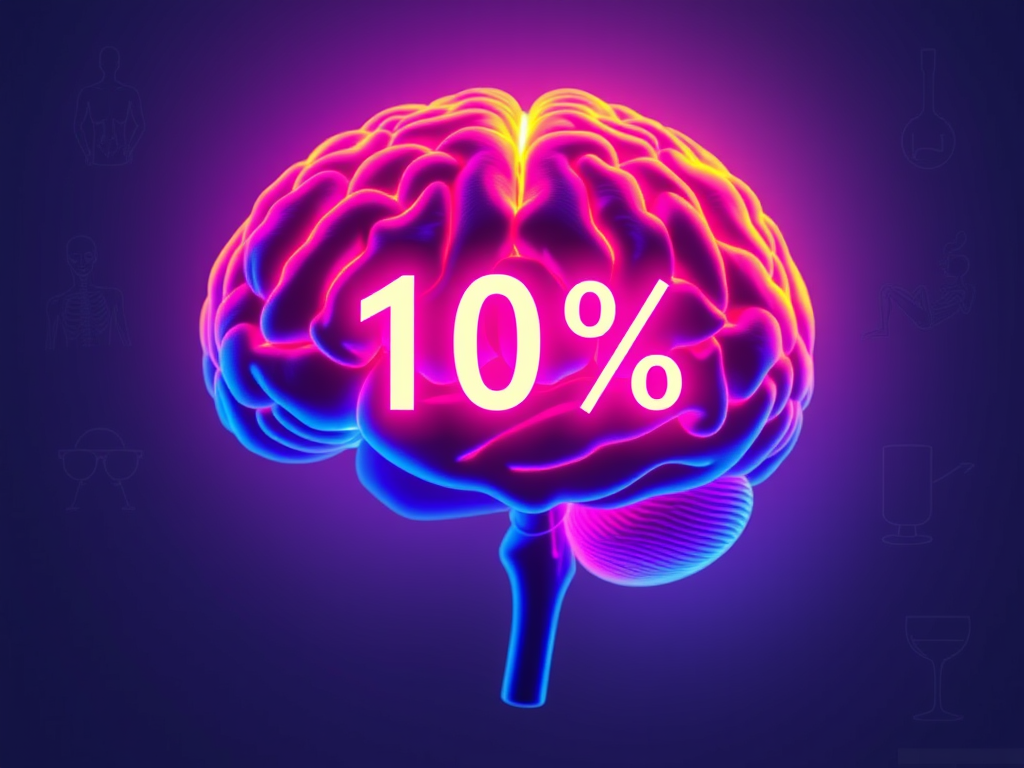
1. The 10% Brain Myth: Why You’re Not a “Wasted” Supercomputer
The “Fact”: Humans only use 10% of their brains. If we could just “unlock” the other 90%, we’d gain psychic powers, super-intelligence, or at least be able to remember where we left our keys.
The Reality: This is arguably the most famous and beloved of all human body myths, fueling countless sci-fi movies like Lucy and Limitless. It’s also 100% false. We use virtually all of our brain, every single day; we just don’t use it all at the exact same time.
Think of your brain less like a storage hard drive that’s 90% empty and more like a highly efficient corporate office. When you’re reading this, your visual cortex is firing, your language-processing centers are engaged, and your frontal lobe is handling comprehension. Meanwhile, your cerebellum is managing your posture, and your brainstem is keeping your heart beating. The “accounting department” might be quiet while the “creative department” is busy, but they all have a job, and they all get used.
Brain imaging scans, like fMRIs, show that even during simple tasks, activity is distributed across many regions. Even when you’re asleep, your brain is wildly active, consolidating memories and running system checks. The 10% myth is a comforting fantasy, but the truth is, your brain is already working at full capacity. The real way to “unlock” your brain is much less cinematic: practice, study, and a good night’s sleep.
2. The Five Senses: Why Aristotle’s Count Was a Little Short
The “Fact”: Humans have five senses: sight, smell, hearing, taste, and touch.
The Reality: This ancient classification, often attributed to Aristotle, is a massive oversimplification. While those five are definitely a great starting lineup, neuroscientists and biologists would argue you have many more. There isn’t a perfect consensus, but the number is easily closer to 20 or more.
“Touch” itself is a catch-all term for several distinct senses, including thermoception (sensing temperature), nociception (sensing pain), and sensing pressure. But it gets even cooler. Close your eyes and touch your finger to your nose. How did you know where your nose was in relation to your finger without seeing it? That’s proprioception, the sense of where your body parts are in space.
Then there’s equilibrioception, your sense of balance, which is managed by the vestibular system in your inner ear. You also have interoception, the sense of your body’s internal state. That feeling of being hungry, thirsty, or needing to use the restroom? That’s a sense. So, the next time someone mentions the five senses, you can confidently (and politely) inform them they’re selling themselves short.
3. The “Taste Map” Lie: Your Whole Tongue Can Taste That Pretzel
The “Fact”: We all saw the diagram in our elementary school science textbook: the tip of the tongue detects “sweet,” the sides are for “sour” and “salty,” and the back is for “bitter.”
The Reality: That ubiquitous tongue map is completely wrong. This myth originated from a mistranslation of a 1901 German paper, which was then misinterpreted by a Harvard psychologist. The original paper suggested that some areas were slightly more sensitive to certain tastes, but the “map” diagram took this to an extreme.
The truth is that you have taste buds, which contain receptors for all the tastes, distributed all over your tongue. You can taste sweetness on the back of your tongue and bitterness right on the tip. To prove it, try dabbing some salt on the very tip of your tongue—you’ll have no trouble tasting it.
Furthermore, the “four-taste” model is also outdated. We have at least five primary tastes: sweet, sour, salty, bitter, and the fifth, umami. This is the rich, savory, “meaty” taste you get from broth, mushrooms, and parmesan cheese. Some scientists are even arguing for a sixth taste linked to how we detect fats. Your tongue isn’t a divided map; it’s a unified, complex sensor.
4. The Shaving Myth: Why Your Hair Isn’t Growing Back Thicker
The “Fact”: Shaving your legs or face makes the hair grow back thicker, darker, and faster.
The Reality: This is a fantastic optical illusion, but it’s biologically impossible. Shaving does not, and cannot, change the nature of your hair follicle, which is a tiny “factory” under your skin. The follicle is what determines your hair’s thickness, color, and growth rate, and it is completely unaffected by what happens to the hair shaft on the surface.
So, why does it seem thicker? Your natural, uncut hair has a soft, tapered end. A razor cuts the hair shaft bluntly, straight across, at its thickest part. When this blunt-ended, coarse stubble starts to grow back, it feels and looks more prominent and “thicker” than the fine, tapered tip it replaced.
Think of it this way: if you cut a javelin in half, you’re left with the thick, heavy base. You haven’t made the javelin itself thicker; you’ve just changed the part you’re looking at. The hair doesn’t grow back faster (that’s set by genetics and hormones), and it isn’t darker (the new stubble just hasn’t been lightened by the sun yet).
5. That “Pop” Sound: Cracking Your Knuckles Won’t Give You Arthritis
The “Fact”: If you crack your knuckles, you’re “wearing out” your joints and are guaranteed to get painful arthritis when you’re older.
The Reality: This is a favorite scolding from parents and teachers, but it’s not supported by science. Decades of research have failed to find any credible link between the habit of knuckle-cracking and osteoarthritis.
That “pop” sound isn’t your bones grinding or your cartilage shattering. It’s the sound of gas bubbles bursting. Your joints are lubricated by a clear, thick liquid called synovial fluid. This fluid contains dissolved gases (like nitrogen). When you stretch or bend your joint (like by pulling on your finger), you increase the joint volume, which lowers the pressure. This causes the dissolved gases to pop out of the solution and form a tiny bubble. This bubble then rapidly collapses, and that’s the “pop” you hear. The process is called cavitation.
While it doesn’t cause arthritis, it’s not entirely harmless. Some studies have suggested that chronic, habitual crackers might experience slightly reduced grip strength or some soft-tissue swelling over many decades. But the big, scary disease of arthritis? You can’t “pop” your way into it.
6. The Cold Weather Sickness: Why You Can’t “Catch” a Cold from the Cold
The “Fact”: Your mother was right. Going outside with wet hair or without a coat in winter will make you catch a cold.
The Reality: This is a classic case of confusing correlation with causation. You cannot get sick just from being cold. Illnesses like the common cold and the flu are caused by viruses. You have to be exposed to the pathogen to get sick. You could stand on an Antarctic ice sheet for hours, and as long as no rhinoviruses were present, you wouldn’t “catch” a cold.
So, why do we get sick more in the winter? The cold weather is an accomplice, not the culprit.
- Behavior: When it’s cold, we huddle indoors in close quarters with recycled air, making it far easier to transmit viruses from one person to another.
- Dry Air: Cold winter air (and the dry indoor heating we use to combat it) dries out the mucous membranes in our nose. This membrane is a key part of our immune system, trapping viruses. A dry, cracked membrane is like a castle with a broken-down gate.
- Virus Stability: Some viruses, like influenza, are simply more stable and can survive in the air longer in cold, dry conditions.
So, being cold and wet doesn’t create the virus, but it can weaken your body’s defenses and create the perfect environment for the virus to spread.
7. The 8×8 Water Rule: Why You Don’t Need to Force-Feed Yourself Water
The “Fact”: To be healthy, you must drink eight 8-ounce glasses of water every day (the “8×8 rule”).
The Reality: This is a wonderfully specific guideline that has no solid scientific origin. It’s not bad advice—most people would benefit from more water—but it’s completely arbitrary. Our hydration needs vary enormously based on our body size, diet, activity level, and the climate we live in. An office worker in a cool climate simply doesn’t need the same amount of water as a marathon runner in a hot one.
This “rule” also ignores two crucial factors:
- You get water from food. Fruits, vegetables, soups, and yogurt are all packed with water that counts toward your total hydration.
- Other drinks count. Milk, juice, and even caffeinated beverages like coffee and tea contribute to your fluid intake. (While caffeine is a mild diuretic, the water in the beverage more than makes up for the effect).
The best advice is far simpler and has been programmed into your body for millennia: Drink when you are thirsty. Your body has a highly sophisticated thirst mechanism to tell you when you’re running low.
8. The 30-Minute Swim Rule: Why Waiting After Lunch Is Unnecessary
The “Fact”: You must wait at least 30 minutes after eating before you go swimming, or you’ll get debilitating muscle cramps and drown.
The Reality: This myth has terrified generations of children, but there is not a single documented case of anyone drowning because they swam on a full stomach. The theory is that digestion diverts blood from your arms and legs to your stomach, leaving your muscles without enough blood and oxygen, thus causing them to cramp.
While it’s true that blood flow to the stomach increases during digestion, your body isn’t an “either/or” system. It has more than enough blood to handle both digesting a sandwich and paddling around a pool. You might get a minor “stitch” (a side cramp), or feel a bit sluggish, but you are in no danger of your limbs suddenly becoming incapacitated. Vigorous, Olympic-level swimming right after a massive five-course meal might be uncomfortable, but a normal lunch before a casual swim is perfectly safe.
9. The “Sugar Rush” Lie: Candy Isn’t Making Your Kids Hyperactive
The “Fact”: Give a kid a slice of cake, a handful of candy, or a sugary drink, and they will transform into a hyperactive, unfocused tornado.
The Reality: This one feels undeniably true to any parent who has hosted a birthday party. But brace yourself: dozens of double-blind, placebo-controlled studies have comprehensively debunked this. Sugar does not cause hyperactivity in children.
In these studies, children were given either a sugary drink or a sugar-free (artificially sweetened) look-alike. Neither the children, their parents, nor the researchers knew who got what. The results were consistent: there was no difference in behavior. The kids on the sugar-free drink were just as likely to be rowdy and “hyper” as the kids on the real sugar.
So what’s really happening? It’s a combination of context and confirmation bias. When do kids eat the most sugar? At birthday parties, holidays, and celebrations—events that are already exciting and stimulating. The kids are hyper from the party, not the cake. Parents expect the sugar to make them wild, so they watch them more closely and interpret any energetic kid-like behavior as a “sugar rush.” It’s a classic self-fulfilling prophecy.
10. Reading in Dim Light: It Won’t Ruin Your Eyes (It Just Tires Them Out)
The “Fact”: Reading under the covers with a flashlight or trying to read in a dimly lit room will permanently damage your eyesight and make you need glasses.
The Reality: This is great news for book lovers: reading in dim light will not physically or permanently damage your eyes. It won’t cause nearsightedness (myopia) or any other long-term harm.
What it will do is cause eye strain. In low light, your eye muscles—specifically the ciliary muscles that control the shape of your lens—have to work much harder to focus. Your pupils also have to dilate to let in more light. This extra work can lead to temporary, uncomfortable symptoms: headaches, dry or watery eyes, blurred vision, and general fatigue.
Think of it like making your legs do squats for 20 minutes straight. Your muscles will be tired, sore, and shaky, but you haven’t “ruined” your legs or given yourself permanent damage. Once you rest your eyes (or, better yet, just turn on a lamp!), the strain will go away, and your eyes will be perfectly fine.
Further Reading
If you’re ready to bust more myths and explore the messy, fascinating truth about our bodies, here are a few books to get you started:
- The Body: A Guide for Occupants by Bill Bryson
- Gulp: Adventures on the Alimentary Canal by Mary Roach
- The Man Who Mistook His Wife for a Hat and Other Clinical Tales by Oliver Sacks
Here at Zentara.blog, our mission is to take those tricky subjects and unlock them, making knowledge exciting and easy to grasp for everyone. But the adventure doesn’t stop on this page! We’re constantly exploring new frontiers and sharing discoveries across the digital universe. Want to dive deeper into more mind-bending Top 10s and keep expanding your world? Come join us on our other platforms – we’ve got unique experiences waiting for you on each one!
Get inspired by visual wonders and bite-sized facts: See the world through Zentara’s eyes on Pinterest!
Pin our fascinating facts and stunning visuals to your own boards. Explore Pins on Pinterest: https://uk.pinterest.com/zentarablog/
Discover quick insights and behind-the-scenes peeks: Hop over to Tumblr for snippets, quotes, and unique content you won’t find anywhere else. It’s a different flavour of discovery! Follow the Fun on Tumblr: https://www.tumblr.com/zentarablog
Ready for deep dives you can listen to or watch? We’re bringing our accessible approach to video and potentially audio! Subscribe to our YouTube channel and tune into future projects that make learning pop! Subscribe on YouTube: https://www.youtube.com/@ZentaraUK
Seeking even more knowledge in one place? We’ve compiled some of our most popular topic deep dives into fantastic ebooks! Find them on Amazon and keep the learning journey going anytime, anywhere. Find Our Ebooks on Amazon: https://www.amazon.co.uk/s?k=Zentara+UK&ref=nb_sb_noss
Connect with us and fellow knowledge seekers: Join the conversation on BlueSky! We’re sharing updates, thoughts, and maybe even asking you what wonders we should explore next. Chat with Us on BlueSky: https://bsky.app/profile/zentarablog.bsky.social
Perfect for learning on the move! We post multiple 10-minute podcasts per day on Spotify. Pop on your headphones and fill your day with fascinating facts while you’re out and about! Listen on Spotify: https://open.spotify.com/show/3dmHbKeDufRx95xPYIqKhJFollow us on Instagram for bytesize knowledge! We post multiple posts per day on our official Instagram account. https://www.instagram.com/zentarablog/ Every click helps us keep bringing honest, accessible knowledge to everyone. Thanks for exploring with us today – see you out there in the world of discovery!




Leave a Reply