
Table of Contents
In the mid-1990s, at a time when episodic television was the ironclad rule, one show dared to be different. It emerged not as a series of disconnected adventures, but as a single, sprawling epic, conceived from the start with a five-year plan. This was Babylon 5, a “novel for television” set on a five-mile-long space station in neutral territory, a last, best hope for peace—and a last, best hope for a different kind of storytelling.
Created by J. Michael Straczynski (JMS), the show was a grand experiment. It was a place of dangerous diplomacy, ancient prophecies, clandestine wars, and characters who were allowed to grow, fail, and change in profound, permanent ways. While other ships were boldly going, Babylon 5 was a powder keg, a microcosm of galactic conflict where the wrong word from an ambassador could start a war, and the right person at the wrong time could change the fate of a billion souls.
The show’s influence is still felt today in every series that prizes a long-form arc over a “reset button” ending. But the story behind the station is just as dramatic as the one that played out on screen. From groundbreaking technology and real-life tragedy to a high-stakes gamble that changed TV, here are ten facts you need to know about Babylon 5.
1. The Grand Design: A “Novel for Television”
The single most important fact about Babylon 5 is its structure. Creator J. Michael Straczynski envisioned the show as a complete novel, with a five-season, 110-episode arc. He had a predefined beginning, middle, and end before the pilot ever aired. This was revolutionary in the 1990s, especially in American science fiction, where the dominant model (Star Trek) was almost entirely episodic. The studio and network were so baffled by the idea that JMS famously had to write the pilot script and the scripts for the last episodes of season one and season five, just to prove he knew where the story was going.
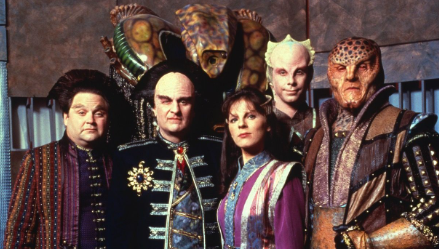
This “novel” approach meant everything mattered. A casual line in season one could become a major plot point in season three. Characters carried the baggage of their past, made decisions with lasting consequences, and evolved over time. Londo Mollari didn’t just wear a funny coat; he was a tragic figure of ambition and regret whose entire arc was a slow-motion catastrophe. G’Kar wasn’t just a growling alien; he was a revolutionary who became a spiritual leader. This commitment to long-form storytelling was a massive gamble, but it paid off, proving that TV audiences were more than ready for complex, character-driven sagas.
2. The Digital Pioneer: Forging the CGI Frontier
Today, we’re used to entire worlds being built inside a computer, but in the early 1990s, this was unheard of for a television budget. Sci-fi shows used “practical” effects—intricate, expensive, and time-consuming physical models. Babylon 5’s production team made a radical, and at the time, highly risky decision: they would create all exterior space shots, ship battles, and station fly-bys using entirely computer-generated imagery (CGI). This was a first for a major TV series.
Using off-the-shelf Amiga computers and, later, custom PC rigs running software like Lightwave 3D, the effects team at Foundation Imaging (and later, Netter Digital) created a visual language that was all its own. The physics were different; ships didn’t “bank” in space like airplanes. The scale was immense, allowing for massive fleet-on-fleet battles that would have been impossible with models. While some of the renders may look dated by today’s 4K standards, they were utterly groundbreaking in 1994. The show’s aesthetic, from the sleek Minbari cruisers to the terrifying, organic “living” ships of the Shadows, was only possible because of this pioneering leap into the digital realm.
3. The Writer in the “Virtual” Trenches: A Singular Vision
In a typical television series, a “showrunner” oversees a “writer’s room,” a team of a dozen or so writers who collectively break stories and write scripts. Babylon 5 was not a typical series. Of the show’s 110 episodes, J. Michael Straczynski personally wrote 92. This is a staggering, almost superhuman feat. He wrote the entire third and fourth seasons by himself. This wasn’t just for bragging rights; it was essential to maintaining the integrity of his intricate five-year arc. With so many plot threads, foreshadowed events, and character developments, a traditional writer’s room might have let important details slip.
Even more groundbreaking, JMS was one of the first creators to engage with his audience directly. Using online services like GEnie, Usenet, and CompuServe, he posted daily, answering fan questions, debunking rumours, and offering behind-the-scenes insights. He was, in effect, the world’s first internet-age showrunner, interacting with his “virtual” audience in a way that is now commonplace on social media. This direct line of communication built a fiercely loyal and invested fanbase that helped sustain the show through its most perilous production challenges.
4. The “Trap Door” Protocol: Planning for the Unplannable
JMS knew that in a five-year production, the one thing you can’t control is real life. Actors get sick, they want to leave, or they get into contract disputes. To protect his story, he built narrative “trap doors” for every major character. If an actor left, he had a pre-planned way to write their character out and transfer their essential plotlines to another character, new or existing, without derailing the entire saga.
The most famous example, of course, was the departure of the show’s lead, Michael O’Hare (Commander Sinclair), after season one. JMS executed the trap door, and Bruce Boxleitner was brought in as Captain Sheridan. This “twist” was then masterfully woven into the show’s mythology, with Sinclair’s destiny becoming one of the series’ most profound and mind-bending loops. It wasn’t just a replacement; it was a deepening of the lore. Years later, JMS revealed the heartbreaking, real-world reason: O’Hare was struggling with a severe mental illness, and they both mutually and secretly agreed he should step away to seek treatment. JMS kept the secret for decades until after O’Hare’s passing, at O’Hare’s own request, to protect his career and, one day, to destigmatize the issue.
5. The Accelerated Apocalypse: Cramming Two Years into One
The story of Babylon 5‘s fourth season is a legend in television production. The show aired on a shaky, ad-hoc network of stations (PTEN) that was collapsing. Near the end of season three, JMS was warned that the show was almost certainly not going to be renewed for its fifth and final year. Rather than let his epic story end on a cliffhanger, he made a drastic decision: he would collapse the two remaining seasons’ worth of major plotlines into one.
This is why Season 4 is a breathless, high-octane sprint. JMS races through the entire Shadow War and the Earth Civil War, resolving his main arcs by the season’s end, all while writing every single episode himself. The result is one of the most compelling, relentless, and satisfying seasons of television ever produced. In a last-minute miracle, the show was saved by the network TNT for its fifth season. This left JMS in the ironic position of having already finished his main story. He then had to pivot, using Season 5 to explore the fallout of those wars and tell a new, more contained story about telepaths and the birth of the new Interstellar Alliance.
6. A Universe of “Grown-Ups”: Tackling Real-World Issues
While competitors were often busy with alien-of-the-week stories, Babylon 5 was a political thriller, a war drama, and a philosophical treatise disguised as a space opera. It was, in short, a show for adults. It refused to shy away from the most difficult and mature themes, treating its audience as intelligent peers. The series was a dark mirror of our own world, tackling issues with a nuance that was, and still is, rare for the genre.
The show explored the rise of fascism, xenophobia, and government propaganda through the chilling “Nightwatch” organization and the slow corruption of Earth’s government. It dealt with the moral costs of war, religious fundamentalism, cultural colonialism (the Narn-Centauri conflict), and the trauma of PTSD. It even featured complex storylines about addiction (Dr. Franklin) and the ethics of organized labour (the dockers’ strike). Babylon 5 didn’t offer easy, utopian answers. It was a messy, complicated, and morally ambiguous universe where good people made terrible choices for the right reasons, and a victory on Monday could become a tragedy by Wednesday.
7. The Great Sci-Fi Rivalry: The Deep Space Nine Controversy
You cannot discuss Babylon 5 without mentioning Star Trek: Deep Space Nine. Both shows premiered within a year of each other (1993-1994). Both were set on a massive, politically important space station. Both featured a commander (a “chosen one” in some respects), a diverse crew, and complex, multi-species political conflicts. The similarities were so striking that they sparked one of the biggest fan controversies of the 1990s.
The history is complicated. J. Michael Straczynski had pitched his Babylon 5 concept to Paramount, the studio behind Star Trek. Paramount passed on the project. Shortly thereafter, they announced Deep Space Nine. JMS has always been clear that he doesn’t believe the DS9 creative team (Rick Berman and Michael Piller) plagiarized his work. However, he has maintained that he believes Paramount executives, having seen his detailed “bible” for Babylon 5, were inspired to create their own “space station show” to compete. Regardless of the truth, the “rivalry” pushed both shows to be better, and ultimately, sci-fi fans were the winners, getting two of the most complex and serialized genre shows of the decade.
8. The Shadow War: A Conflict That Was Always Coming
“There is a hole in your mind.” This chilling sentence, whispered to Commander Sinclair in the pilot episode by Ambassador G’Kar, wasn’t just a throwaway line. It was the first, tiny thread of a mystery that would define the entire series. The central conflict of Babylon 5 is the war against the “Shadows,” an ancient, malevolent species. What made the show brilliant was that this war wasn’t just introduced in season three. It was a cancer, growing in the background from the very first frame.
Every seemingly unrelated event was a prelude. The “Raiders” attacking cargo ships? They were being supplied by the Shadows. The strange political manoeuvres? They were agents of the Shadows, creating chaos. The show’s entire philosophy was built on this conflict: the Shadows (representing chaos and “What do you want?”) vs. their ancient rivals, the Vorlons (representing rigid order and “Who are you?”). The war was fought not just with ships, but with ideas, with whispers, and with the manipulation of the “younger races.” It was a war of philosophy, and Babylon 5 was the chessboard on which it would be decided.
9. A Carefully Curated Canon: The Expanded Universe
Like any popular sci-fi franchise, Babylon 5 spawned a massive expanded universe of TV movies (like the brilliant In the Beginning), a spin-off series (Crusade), novels, and comic books. But unlike many franchises, the Babylon 5 universe was kept on an incredibly tight leash by its creator. JMS maintained an unprecedented level of creative control, ensuring that this expanded material wasn’t just “filler” but was “canon”—meaning, it really happened in the show’s timeline.
The novels, in particular, were used to fill in crucial gaps and explore backstories the show’s budget or runtime couldn’t. The Psi Corps Trilogy gave a history of the telepath organization. The Centauri Trilogy explained the full, tragic arc of Londo and Refa. The Technomage books revealed the secrets of that mysterious order. This meant that for fans, the story didn’t just end when the credits rolled. There was a whole, consistent, and meticulously managed universe of lore to explore, all of it adding to and enriching the central “novel” that JMS had written.
10. The Legacy: Paving the Way for Modern TV
Babylon 5’s greatest legacy is, quite simply, the television you watch today. It was the crucial “proof of concept” that broke the episodic mold. It demonstrated to studios and networks that an audience would follow a complex, serialized story for years. It proved you could build a massive, interconnected world on a TV budget and that viewers were hungry for mature, morally grey stories.
Without Babylon 5’s five-year arc, the television landscape would look very different. The reimagined Battlestar Galactica, with its dark political themes and serialized story, is a direct spiritual successor. The Expanse, Game of Thrones, Breaking Bad, and The Wire all owe a debt to the “novel for television” structure that Babylon 5 championed. It was a bridge between the old world of episodic TV and the new “Golden Age” of long-form, character-driven streaming. Babylon 5 didn’t just tell a story; it changed how stories are told.
📚 Further Reading
If you’re ready to journey deeper into this universe, or learn about the mind that built it, these books are the perfect place to start.
- Becoming Superman: My Journey from Poverty to Hollywood… by J. Michael Straczynski
- This is not a Babylon 5 book; it’s the shocking, heartbreaking, and ultimately inspiring autobiography of its creator. It provides an incredible context for the themes of survival, trauma, and resilience that are at the heart of the series.
- Creating Babylon 5: Behind the Scenes of Warner Bros. Revolutionary Deep Space TV Drama by David Bassom
- A fantastic “making of” guide from the 1990s that dives into the production of the early seasons. It covers the groundbreaking special effects, the complex alien makeup, and the challenges of bringing the show to life.
- The Babylon 5 Encyclopedia by J. Michael Straczynski
- For the fan who wants to know everything. This definitive encyclopedia, written by the creator himself, is the ultimate source of canon lore, character histories, and technical details from the Babylon 5 universe.
Here at Zentara.blog, our mission is to take those tricky subjects and unlock them, making knowledge exciting and easy to grasp for everyone. But the adventure doesn’t stop on this page! We’re constantly exploring new frontiers and sharing discoveries across the digital universe. Want to dive deeper into more mind-bending Top 10s and keep expanding your world? Come join us on our other platforms – we’ve got unique experiences waiting for you on each one!
Get inspired by visual wonders and bite-sized facts: See the world through Zentara’s eyes on Pinterest!
Pin our fascinating facts and stunning visuals to your own boards. Explore Pins on Pinterest: https://uk.pinterest.com/zentarablog/
Discover quick insights and behind-the-scenes peeks: Hop over to Tumblr for snippets, quotes, and unique content you won’t find anywhere else. It’s a different flavour of discovery! Follow the Fun on Tumblr: https://www.tumblr.com/zentarablog
Ready for deep dives you can listen to or watch? We’re bringing our accessible approach to video and potentially audio! Subscribe to our YouTube channel and tune into future projects that make learning pop! Subscribe on YouTube: https://www.youtube.com/@ZentaraUK
Seeking even more knowledge in one place? We’ve compiled some of our most popular topic deep dives into fantastic ebooks! Find them on Amazon and keep the learning journey going anytime, anywhere. Find Our Ebooks on Amazon: https://www.amazon.co.uk/s?k=Zentara+UK&ref=nb_sb_noss
Connect with us and fellow knowledge seekers: Join the conversation on BlueSky! We’re sharing updates, thoughts, and maybe even asking you what wonders we should explore next! Chat with Us on BlueSky: https://bsky.app/profile/zentarablog.bsky.social
Perfect for learning on the move! We post multiple 10-minute podcasts per day on Spotify. Pop on your headphones and fill your day with fascinating facts while you’re out and about! Listen on Spotify: https://open.spotify.com/show/3dmHbKeDufRx95xPYIqKhJFollow us on Instagram for bytesize knowledge! We post multiple posts per day on our official Instagram account. https://www.instagram.com/zentarablog/ Every click helps us keep bringing honest, accessible knowledge to everyone. Thanks for exploring with us today – see you out there in the world of discovery!




Leave a Reply