
Table of Contents
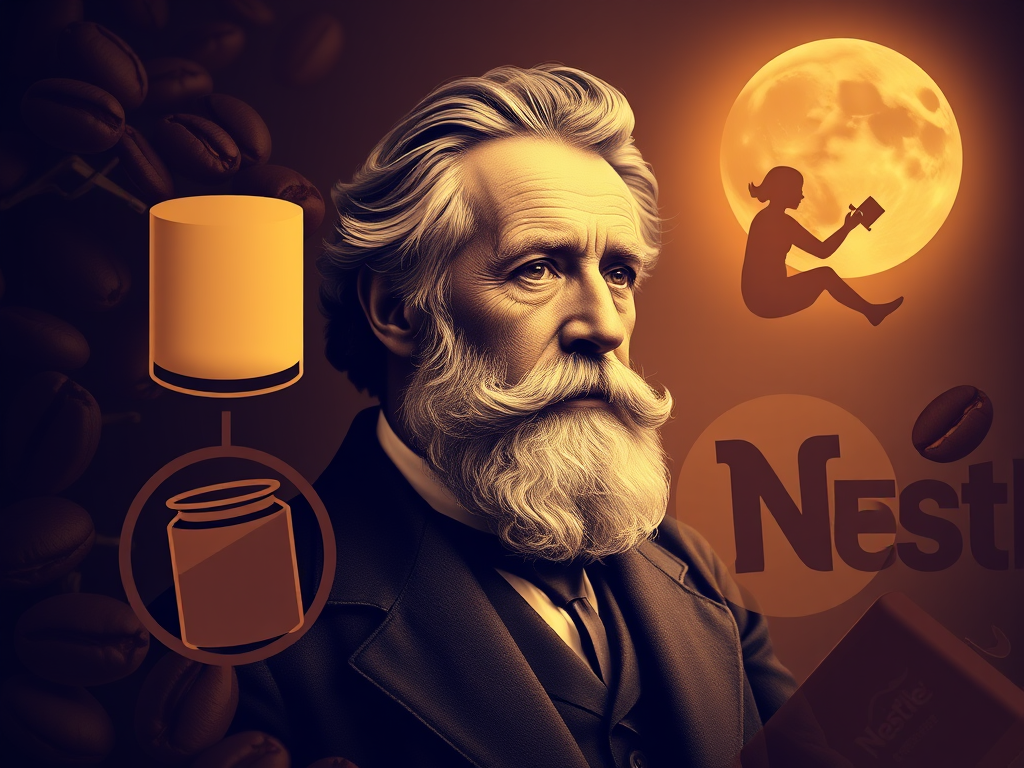
When you hear the name Nestlé, you likely picture a chocolate bar or a jar of instant coffee. As the world’s largest food and beverage company, its products are likely in your pantry right now, whether you realize it or not. But the story of this Swiss giant is far more complex than just sweets and caffeine. It involves life-saving 19th-century inventions, critical roles in global conflicts, and a brand portfolio that secretly dominates everything from your freezer aisle to your pet’s food bowl.
Founded in the 1860s by a German-born pharmacist, Nestlé began not as a confectionery empire, but as a scientific endeavor to solve a tragic problem: infant mortality. Over the next century and a half, the company would grow through a series of aggressive mergers, accidental discoveries, and shrewd business moves that placed it at the center of history—from the trenches of World War II to the surface of the Moon.
In this article, we will peel back the wrapper to reveal the fundamental and enduring facts about this corporate titan. We will explore how a surplus of Brazilian coffee beans changed how the world wakes up, why Japanese students buy chocolate for good luck, and the surprising meaning hidden in the company’s logo. Here are 10 facts you didn’t know about Nestlé, optimized to give you a richer understanding of the brand behind the bird’s nest.
1. The Company Started by Saving a Baby’s Life
The origins of Nestlé are rooted in a desperate attempt to solve a medical crisis, not a culinary one. In the mid-1860s, infant mortality was tragically high in Europe, often due to malnutrition among babies who could not be breastfed. Henri Nestlé, a trained pharmacist living in Vevey, Switzerland, saw this heartbreak firsthand and decided to use his scientific background to create a solution.
He spent years experimenting with combinations of cow’s milk, wheat flour, and sugar to create a digestible substitute for breast milk. His breakthrough came in 1867 when he successfully saved the life of a premature neighbor’s infant who had refused all other food and was expected to die. Henri fed the child his new concoction, which he called Farine Lactée (flour with milk).
The baby recovered, and news of the “miracle product” spread rapidly. This wasn’t just a business launch; it was a medical innovation that addressed a fundamental human need. By the time Henri retired in 1875, his formula was being sold in countries as far away as Indonesia and Egypt. This foundation of science-based nutrition remains a core part of the company’s identity today, proving that its empire was built on a life-saving powder, not a candy bar.
2. The Logo is Actually a Family Coat of Arms
You have likely seen the Nestlé logo thousands of times: a bird feeding her young in a nest. It feels like a generic symbol of nurturing, but it is actually a direct graphic translation of the founder’s family name. Henri Nestlé was born in Frankfurt, Germany, as Heinrich Nestle. In his local Swabian dialect, “Nestle” literally translates to “little nest.”
When Henri began branding his products in 1868, he adapted his family’s coat of arms, which featured a single bird on a nest. To make it more commercially appealing and relevant to his infant cereal, he changed the design to show a mother bird feeding three fledglings. This wasn’t just an artistic choice; it was a strategic move to communicate the product’s purpose (nutrition and care) to consumers who might be illiterate.
Interestingly, the logo has evolved to reflect modern families. In 1988, the number of baby birds was reduced from three to two. This was done to better represent the “average” modern family size, ensuring the Nestlé bird nest logo remained relatable to contemporary consumers. It is a rare example of a corporate logo that is both a literal translation of the founder’s name and a symbol that has adapted to changing social demographics.
3. Instant Coffee Was Invented to Save Brazil’s Economy
The creation of Nescafé is one of the great examples of problem-solving in industrial history. In the late 1920s, Brazil—the world’s largest coffee producer—faced a massive economic crisis. They had a colossal surplus of coffee beans with no one to buy them, and millions of pounds of coffee were at risk of rotting or being destroyed to stabilize prices.
The Brazilian Coffee Institute approached Nestlé in 1929 with a challenge: could they create a soluble coffee “cube” that would allow consumers to simply add water, similar to a bouillon cube? The goal was to preserve the surplus coffee in a shelf-stable format. Nestlé’s chemist, Max Morgenthaler, spent nearly a decade perfecting the process. The challenge was preserving the coffee’s aroma, which was often lost during the drying process.
Morgenthaler eventually discovered that adding carbohydrates helped stabilize the flavor, and in 1938, Nescafé was launched. It didn’t just solve Brazil’s waste problem; it revolutionized how the world drank coffee. Before this, making coffee was a time-consuming brewing process. Nescafé democratized caffeine, making it accessible, portable, and virtually instant, forever changing morning routines globally.
4. World War II Made Nescafé a Global Staple
While World War II devastated many industries, it acted as a rocket booster for Nestlé, particularly for its new instant coffee. When the United States entered the war in 1941, Nescafé was already gaining traction, but the military’s need for lightweight, easy-to-prepare rations made it an essential wartime commodity.
The U.S. government classified Nescafé as a vital military supply. Consequently, practically the entire output of Nestlé’s U.S. plant (more than one million cases) was reserved solely for the armed forces. For millions of American G.I.s fighting in Europe and the Pacific, Nescafé wasn’t just a drink; it was a warm, comforting taste of home that could be made in a foxhole with nothing but hot water.
This wartime ubiquity had a massive post-war payoff. When the soldiers returned home, they brought their taste for instant coffee with them, embedding the brand into American culture. The war transformed Nestlé’s role in history from a Swiss dairy company into a global food power, illustrating how geopolitical events can inadvertently build consumer empires.
5. Nestlé Coffee Went to the Moon
The Space Race of the 1960s was a contest of technology, engineering, and… coffee. When NASA was planning the historic Apollo 11 mission in 1969, they needed food and drink that was lightweight, compact, and safe to consume in zero gravity. Crumbs and liquids are dangerous in a spacecraft, as they can float into instruments and cause short circuits.
Nestlé’s freeze-drying technology, perfected for Nescafé, was the ideal solution. The company developed a special freeze-dried coffee for the astronauts that could be reconstituted with water injected into a sealed pouch. Neil Armstrong, Buzz Aldrin, and Michael Collins fueled their journey to the lunar surface with Nestlé coffee.
This wasn’t just a marketing gimmick; it was a testament to the science of food preservation. The same technology used to keep coffee fresh on a supermarket shelf was robust enough to survive the vacuum of space. It remains one of the few commercial food brands that can claim to have supported the first humans to walk on another world.
6. They Married the Inventor of Milk Chocolate
A common misconception is that Nestlé invented milk chocolate. They did not. That honor belongs to Daniel Peter, a Swiss confectioner and neighbor of Henri Nestlé. However, the invention would have been impossible without Nestlé. In the 1870s, Peter was trying to mix milk with chocolate to create a smoother, creamier bar, but the water content in the milk caused the chocolate to seize and spoil.
The solution was right next door. Henri Nestlé had perfected the process of making condensed milk—milk with the water removed. Peter realized that by using Nestlé’s condensed milk, he could bypass the water problem entirely. The two men collaborated, and in 1875, the world’s first milk chocolate was born.
While they started as friends and neighbors, the business relationship eventually solidified into a merger. In 1929, Nestlé acquired Peter’s company (along with other Swiss chocolate giants Cailler and Kohler). This cemented Nestlé’s dominance in the chocolate history books. It serves as a reminder that innovation is often about combining two existing technologies—in this case, cocoa processing and milk condensation—to create something entirely new.
7. Maggi Noodles Are a Cultural Religion in India
In the West, we might think of instant noodles as a cheap college snack, but in India, Nestlé’s Maggi noodles are a cultural phenomenon. Introduced to the Indian market in 1983, Maggi was the first brand to bring instant noodles to the country. Nestlé successfully marketed them not just as a snack, but as a solution for busy mothers and a treat for children, dubbing them the “2-minute noodles.”
The brand became so deeply ingrained in Indian consciousness that “Maggi” became a generic trademark for instant noodles, much like “Kleenex” for tissues. Street vendors across India sell their own spiced-up versions of Maggi, adding vegetables, cheese, and local spices, effectively turning a Swiss industrial product into a beloved Indian street food.
The depth of this loyalty was tested in 2015 during a food safety controversy where Maggi was temporarily banned due to allegations of high lead content (which were later cleared). The ban caused a national outcry, not just of anger at the company, but of genuine grief over the loss of a favorite comfort food. When Maggi returned to shelves, it reclaimed its market dominance almost instantly, showcasing the immense power of emotional branding.
8. Japan Has Over 300 Flavors of KitKat
If you visit a convenience store in the US or UK, you might see milk, dark, and maybe white chocolate KitKats. If you visit Japan, you will find a kaleidoscope of over 300 varieties, ranging from Green Tea and Sake to Wasabi, Purple Sweet Potato, and even Soy Sauce. The story of KitKat in Japan is a masterclass in linguistic marketing.
In Japanese, “KitKat” sounds very similar to the phrase “Kitto Katsu”, which translates to “You will surely win.” Because of this happy coincidence, KitKats became a popular good luck charm for students taking stressful university entrance exams. Nestlé leaned hard into this, marketing the bars as tokens of encouragement.
To keep the momentum going, Nestlé Japan adopted a strategy of constant, limited-edition innovation. They collaborate with local farmers to create “regional specialties” (omiyage) that can only be bought in specific prefectures. This turned a British-invented chocolate bar into a uniquely Japanese cultural souvenir, proving that global localization—adapting a global brand to local culture—is the key to international success.
9. They Secretly Own Your “American” Dinner
Many consumers make a conscious effort to buy from different brands to diversify where their money goes, only to find out it all flows back to Vevey, Switzerland. Nestlé’s brand portfolio is massive and includes names that feel distinctly American or unrelated to the parent company.
For instance, if you buy a frozen pizza, there is a high chance it is Nestlé (DiGiorno, Tombstone, Jack’s). If you grab a quick lunch pocket, that’s them too (Hot Pockets). Even the “premium” pet food you buy for your dog, like Purina Pro Plan or Fancy Feast, is wholly owned by Nestlé. They also own a significant stake (about 20%) in L’Oréal, the world’s largest cosmetics company, meaning your shampoo and lipstick are financially linked to your KitKat.
This strategy of acquisition allows Nestlé to dominate multiple aisles of the supermarket—frozen, pet care, water, health science—without slapping their logo prominently on every package. It highlights the reality of corporate consolidation, where a illusion of choice in the grocery store often masks the fact that a handful of giants own the vast majority of brands.
10. They Commercialized the First New Chocolate in 80 Years
For decades, the world only knew three types of chocolate: Dark, Milk, and White (the latter invented by Nestlé in the 1930s). In 2017, the chocolate world was shaken by the announcement of a fourth type: Ruby chocolate. Characterized by its stunning pink color and a berry-fruit tartness, it is not dyed; the color comes from a specific type of cocoa bean processed in a unique way.
While the cocoa processing method was invented by the chocolate manufacturer Barry Callebaut, Nestlé was the first company to race it to market. They launched the KitKat Ruby in 2018, securing exclusive rights to the new substance for the first six months. This allowed them to debut the first major innovation in chocolate in 80 years.
The launch was a strategic flex, showing that even a 150-year-old company could still move faster than its competitors. It capitalized on the “Instagrammable” food trend, as the naturally pink chocolate was visually striking without artificial additives. It reminds us that in the food industry, scientific innovation is just as important as taste.
Further Reading
To dive deeper into the history, business strategies, and global impact of Nestlé and the food industry, check out these books:
- “Nestlé: The Secrets of Food, Trust and Globalization” by Friedhelm Schwarz – An in-depth look at how Nestlé grew into a global powerhouse and its management philosophy.
- “Combat-Ready Kitchen: How the U.S. Military Shapes the Way You Eat” by Anastacia Marx de Salcedo – This book explores the fascinating link between military rations (like Nescafé) and the grocery store products we eat today.
- “Chocolate Wars: The 150-Year Rivalry Between the World’s Greatest Chocolate Makers” by Deborah Cadbury – A gripping history of the Quaker families and Swiss inventors (including Nestlé) who built the chocolate industry.
- “Noodle Narratives: The Global Rise of an Industrial Food into the Twenty-First Century” by Frederick Errington et al. – A sociological look at how instant noodles (like Maggi) became a global staple.
Keep the Discovery Going!
Here at Zentara, our mission is to take tricky subjects and unlock them, making knowledge exciting and easy to grasp. But the adventure doesn’t stop at the bottom of this page. We are constantly creating new ways for you to learn, watch, and listen every single day.
Watch & Learn on YouTube
Visual learner? We publish 4 new videos every day, plus breaking news shorts to keep you smarter than the headlines. From deep dives to quick facts, our channel is your daily visual dose of wonder. Click here to Subscribe to Zentara on YouTube
Listen on the Go on Spotify
Prefer to learn while you move? Tune into the Zentara Podcast! We drop a new episode daily, perfect for your commute, workout, or coffee break. Pop on your headphones and fill your day with fascinating facts. Click here to Listen on Spotify
Every click, view, and listen helps us keep bringing honest knowledge to everyone. Thanks for exploring with us today—see you out there in the world of discovery!




Leave a Reply