The Leap of Faith: 10 Revolutionary Facts About the First Assassin’s Creed That Changed Open Worlds Forever
In the mid-2000s, the gaming world was standing on the precipice of a new generation. Powerhouse consoles were promising experiences that weren’t just prettier, but fundamentally different in how we interacted with virtual spaces. Amidst this transition, a project emerged from the halls of Ubisoft Montreal that would do more than just launch a franchise—it would redefine the very concept of the “open world.” That project was Assassin’s Creed.
When it first appeared, the game was an enigma. It promised a sprawling, historically accurate recreation of the Third Crusade, blended with a bizarre, high-tech science-fiction framing device. It was a risk that shouldn’t have worked: a stealth game where you hid in broad daylight, a parkour simulator where the entire world was a playground, and a narrative that asked players to question the nature of reality itself. To understand the modern landscape of gaming, one must look back at the DNA of this original title. Here are ten essential facts about the 19th-century-born legend that started it all.
1. The Prince of Persia Spin-Off That Went Rogue
It is one of the most famous “sliding doors” moments in development history: the first Assassin’s Creed was originally intended to be a Prince of Persia title. Specifically, it was envisioned as Prince of Persia: Assassins. The initial concept centered on a young prince who needed to be protected by a group of elite bodyguards—the Assassins. However, as the creative team delved deeper into the history of the “Hashashin,” they realized the protectors were far more interesting than the person they were protecting.
The transition from a linear platformer to an open-world epic happened because the team wanted to give the player the agency of the Assassin. They shifted the focus from the Prince to Altaïr, a disgraced master seeking redemption. This change allowed Ubisoft to break away from the “magical” elements of the Prince of Persia series and lean into a more grounded, gritty, and pseudo-historical tone. By cutting the umbilical cord to an established franchise, they inadvertently created a juggernaut that would eventually overshadow its predecessor.
2. The Invention of “Social Stealth”
Before this title arrived, “stealth” in video games almost exclusively meant hiding in shadows, crawling through vents, or staying out of sightlines (think Metal Gear Solid or Splinter Cell). Assassin’s Creed introduced a radical new concept: “Social Stealth.” The idea was that an assassin shouldn’t necessarily be invisible; they should be hiding in plain sight by blending into the crowd.
This mechanic required players to act like a commoner. If you ran, pushed people, or climbed walls, you drew “social heat.” To stay hidden, you had to walk slowly, sit on benches, or blend in with groups of wandering scholars. This was a revolutionary shift in game design because it turned the NPC (non-player character) population from mere background dressing into a functional part of the gameplay. The crowd became your forest, and the city streets became your tall grass. It forced players to think about their “vibe” and public behavior, adding a layer of psychological tension that traditional stealth games lacked.
3. The Technical Sorcery of the “Puppet” Control Scheme
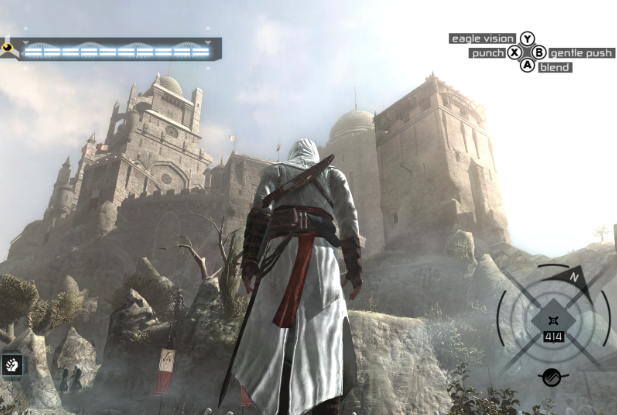
One of the most distinct aspects of the original game was its control scheme, which the developers described as “controlling a puppet.” Rather than mapping buttons to arbitrary actions like “jump” or “interact,” the layout was mapped to the character’s body parts. The top button controlled the head (Eagle Vision), the side buttons controlled the hands (attacking or shoving), and the bottom button controlled the feet (sprinting or blending).
This logic was tied to the game’s “High Profile” and “Low Profile” states. Holding a trigger shifted Altaïr into High Profile, making his actions faster and more aggressive but also more conspicuous. This intuitive mapping allowed for a seamless transition between calm exploration and frantic parkour. It felt less like you were pressing buttons and more like you were piloting a physical entity. This design philosophy was essential for making the parkour feel fluid; by holding the “feet” and “hands” buttons together, the game’s engine would automatically calculate how Altaïr should navigate the geometry of the world.
4. The “Inverse Kinematics” of Parkour
When players first saw Altaïr effortlessly scale the walls of Damascus, it looked like magic. In reality, it was a breakthrough in animation technology known as “Inverse Kinematics” (IK). In most games of that era, climbing was a canned animation; the character would play a “climbing” loop regardless of where their hands were placed. Assassin’s Creed changed this by making the character’s limbs react dynamically to the environment.
The system calculated exactly where a ledge, brick, or wooden beam was located and adjusted Altaïr’s hands and feet to meet that specific point. This meant that no two climbs were exactly the same. If there was a tiny protrusion on a wall, the game recognized it as a handhold. This level of environmental interactivity was unprecedented and is the primary reason why the “climb anything” promise of the game actually felt real. It turned the entire city into a 3D puzzle, where the path to the top of a cathedral was determined by the player’s eyes rather than a developer’s invisible ladder.
5. The Great “Sci-Fi” Bait and Switch
The marketing for the game primarily focused on the 12th-century Crusades. However, when players finally loaded the game, they were greeted with a glitchy, digital interface and a modern-day laboratory. The revelation of the “Animus”—a machine that allows a person to play through the genetic memories of their ancestors—was one of the biggest narrative shocks of the decade.
This framing device, featuring the protagonist Desmond Miles, served a brilliant functional purpose. It provided an “in-universe” explanation for traditional video game tropes. The “Health Bar” was actually a “Synchronization Bar” representing how closely Desmond was following the true history of his ancestor. The “invisible walls” at the edge of the map were simply parts of the memory that hadn’t been “loaded” yet. By grounding the game’s UI and mechanics in a sci-fi simulation, the developers made the experience feel more immersive. It allowed the game to be both a period piece and a high-concept thriller simultaneously.
6. Realizing the Cities of the Third Crusade
The level of historical research that went into the game’s three primary cities—Masyaf, Acre, Jerusalem, and Damascus—was staggering for its time. The development team consulted historians and used period-accurate maps to recreate the layout and “feel” of these ancient urban centers. Each city had a distinct color palette and atmosphere: Acre was a rain-soaked, blue-grey war zone; Damascus was a vibrant, orange-hued center of trade; and Jerusalem was a regal, golden city of stone.
Beyond the aesthetics, the cities were populated by thousands of NPCs, each with their own basic AI routines. You could hear town criers shouting about the progress of the war, see beggars asking for coins, and watch guards patrolling the ramparts. For many players, this was their first time experiencing a “living” historical world that felt like a place people actually inhabited, rather than just a stage for combat. It set a new bar for “environmental storytelling” that the industry is still chasing.
7. The Iconic “Leap of Faith”
If there is one image that defines the franchise, it is the Leap of Faith—the act of diving from a massive height into a conveniently placed bale of hay. While it has since become a bit of a gaming cliché, in the original game, it was a masterstroke of design. It solved the “descending problem”: in many open-world games, getting to the top of a building is fun, but getting back down is a tedious chore.
The Leap of Faith turned the descent into a reward. It was the “exclamation point” at the end of a successful climb. To make it work, the developers had to carefully place these haystacks throughout the cities, often near “Viewpoints” where the player would synchronize their map. This created a rhythmic loop of gameplay: climb, see the world, and dive back into the action. The sound of the eagle’s screech during the dive became the signature auditory cue of the series, symbolizing the freedom and predator-like nature of the Assassin.
8. The “Celebrity” Producer: Jade Raymond
During the development of the game, the industry saw the rise of one of its first “celebrity” producers: Jade Raymond. In an era when most game developers remained behind the scenes, Raymond became the face of the project. Her background in both programming and production, combined with her ability to articulate the complex “social stealth” and “Animus” concepts to the press, made her an essential part of the game’s identity.
Raymond’s involvement helped signal a shift in how games were marketed. She spoke about the game’s “organic” nature and the team’s desire to move away from scripted sequences toward “emergent” gameplay. While she often faced the brunt of the intense (and sometimes toxic) spotlight of the burgeoning internet culture, her leadership was instrumental in guiding a massive team of hundreds through the creation of a brand-new, unproven IP. Her influence paved the way for more diverse voices to take lead roles in high-budget “AAA” development.
9. Historical Accuracy vs. The “Rule of Cool”
While the game is famous for its historical setting, it played fast and loose with the facts to serve the gameplay—a philosophy the developers called the “Rule of Cool.” For example, the real-life Order of Assassins (the Nizari Ismailis) didn’t actually wear bright white robes with pointed hoods, as that would make them the most conspicuous people in any crowd. However, the white robes were chosen to make Altaïr look like a “bird of prey” and to help him blend in with the white-clad scholars.
Similarly, many of the targets Altaïr is sent to kill were real historical figures, such as Robert de Sablé and William of Montferrat. While they did die around the time of the Third Crusade, the game reimagines their deaths as being at the hands of a hidden blade. This “secret history” approach allowed the writers to weave a complex conspiracy theory involving the Templars and the Assassins that spanned centuries. It taught a generation of gamers that history wasn’t just a list of dates in a textbook, but a playground for imagination.
10. The Mystery of “Subject 16” and the Cliffhanger
The original game is notorious for its cryptic and haunting ending. After the credits roll (and even before), players are left with more questions than answers. The modern-day protagonist, Desmond, discovers that he is not the first person to be used in the Animus. His predecessor, “Subject 16,” had gone mad from the “Bleeding Effect”—a condition where the ancestor’s memories begin to bleed into the modern-day person’s mind.
The game ends with Desmond using “Eagle Vision” in the real world to see mysterious symbols painted in blood on his bedroom walls. These symbols included references to the end of the world, ancient religions, and mathematical formulas. This cliffhanger was a massive gamble; it essentially promised a multi-game epic before the first one was even a proven success. It ignited the internet with theories and “frame-by-frame” analyses, creating a hardcore fan base that was desperately hungry for a sequel. It transformed a simple “assassin game” into a deep, mythological puzzle that players are still deconstructing.
Further Reading
- Assassin’s Creed: Renaissance by Oliver Bowden (While it covers the second game, it establishes the literary tone of the series).
- The Art of Assassin’s Creed by Ubisoft (A deep dive into the visual design of the original cities).
- The Templars and the Assassins: The Magical Equilibrium by James Wasserman (For those interested in the real-world history that inspired the game).
- Assassin’s Creed: The Secret Crusade by Oliver Bowden (The novelization of Altaïr’s full life story).
- 10 Things You Should Know About The Making Of And History Of The Video Game – Diablo II
- 10 Things You Should Know About The Making Of And History Of The Video Game – God of War (2018)
- 10 Things You Should Know About The Making Of And History Of The Video Game – The Legend of Zelda: Ocarina of Time
- 10 Things You Should Know About The Making Of And History Of The Video Game – Portal 2
- 10 Essential Facts About Assassin’s Creed (2007) – Video Game Facts
- 10 Essential Facts About Mortal Kombat 2 – Video Game (1993)
- 10 Essential Facts About the Making and History of ARK: Survival Evolved – Video Game Lore
- 10 Essential Facts About the Making and History of Tomb Raider (1996) – Video Game Lore
- 10 Essential Facts About the Making and History of Mario Kart – Video Game Lore
- 10 Things You Should Know About Skyrim – Video Game