
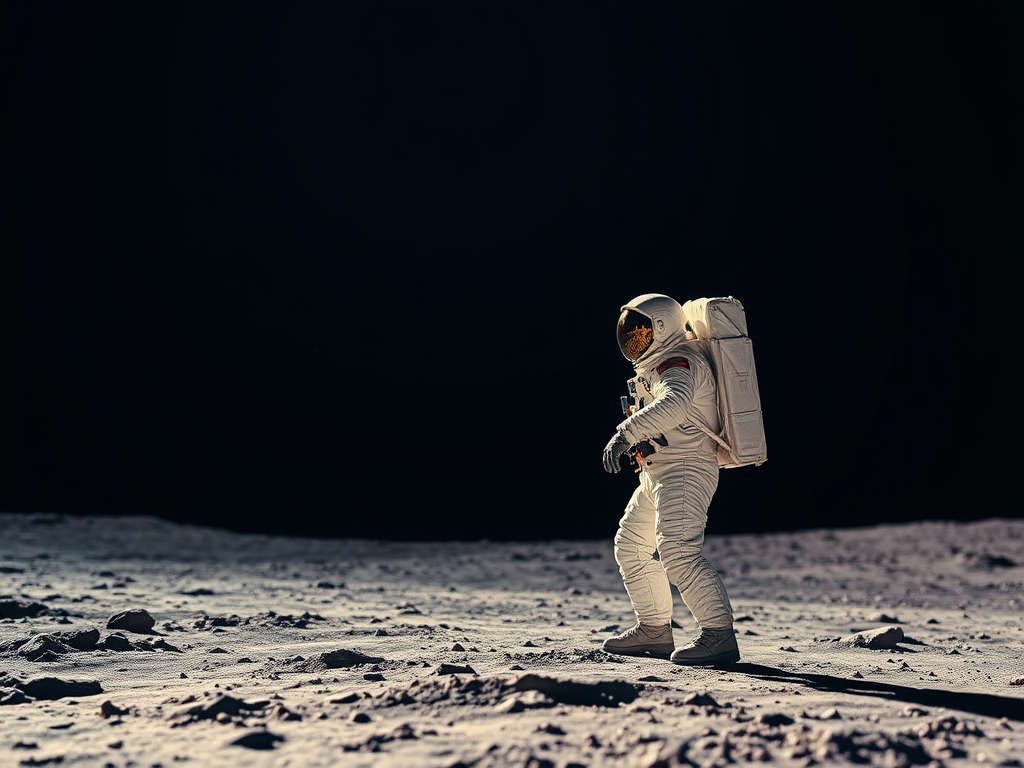
The Moon has always been a silent companion to humanity, a silvery disc that inspired myths, poetry, and calendars for millennia. However, between 1969 and 1972, that distant light became a physical landscape. The twelve men who walked on its dusty plains did not just bring back rocks and data; they brought back visions. These iconic lunar surface photos transformed our understanding of our place in the cosmos, turning a celestial body into a destination.
Capturing these images was a feat of engineering as much as it was an act of artistry. Using modified Hasselblad moon cameras, astronauts had to navigate the harsh vacuum of space, extreme temperature swings, and the absence of traditional viewfinders. The results are some of the most enduring artifacts of the 20th century. In this article, we explore the top 10 most significant images captured during the Apollo program, examining the historical space photos that continue to define the “Final Frontier.”
1. The Portrait of Buzz Aldrin: A Masterpiece of Astronaut Photography Techniques
Perhaps the most recognizable image in human history, this shot from Apollo 11 depicts Buzz Aldrin standing on the Sea of Tranquility. While Aldrin is the subject, the photo is famous for what is hidden in plain sight. In the gold-tinted reflection of his extravehicular visor, you can see the Lunar Module Eagle and the photographer himself, Neil Armstrong.
This image is a masterclass in astronaut photography techniques. Because the moon has no atmosphere to scatter light, the shadows are pitch black and the highlights are blindingly bright. To capture this, the Hasselblad 500EL used a specialized 70mm film magazine. Think of the visor as a curved mirror; it provides a 360-degree distorted “selfie” of the entire landing site. This photo isn’t just a portrait of a man; it is a technical map of a moment, proving that humans had finally arrived on a world where the sky is always black, even at high noon.
2. The “One Small Step” Footprint: Preserving Lunar Surface Exploration
If you were to walk along a beach, your footprints would be gone with the next tide. On the Moon, there is no wind to blow the dust and no rain to wash the ground. This close-up of a bootprint in the lunar regolith is a haunting symbol of lunar surface exploration. It was taken by Buzz Aldrin to help scientists understand the “load-bearing” capabilities of the moon’s soil, yet it became a cultural icon of permanence.
The analogy often used for this photo is that of a “fossilized moment.” Because the Moon is geologically quiet, that footprint is likely still there today, exactly as it was in 1969. The photo highlights the unique texture of lunar dust—which is more like crushed glass than Earthly sand. The sharp ridges of the tread show how the fine, jagged particles “lock” together under pressure. This historical space photo serves as a reminder that while the men left, their mark on the lunar landscape remains essentially eternal.
3. Earth over the Lunar Horizon: The Ultimate Perspective Shift
While “Earthrise” was taken from orbit, the images of the Earth hanging over the jagged mountains of the lunar surface provide a different kind of vertigo. Taken during later missions like Apollo 17, these Apollo mission images show our home planet as a fragile, glowing “marbles” suspended over an ancient, dead horizon.
The contrast is the core of the storytelling here. The lunar foreground is monochromatic—grays, tans, and blacks—while the Earth is a vibrant explosion of sapphire blue and cloud white. It’s like looking at a single wildflower growing in the middle of a vast, charred desert. This photo helped jumpstart the environmental movement on Earth, as it was the first time we saw our entire world not as a map with borders, but as a lonely island in a dark ocean. It remains one of the most powerful lunar landscape imagery examples ever captured.
4. Charlie Duke’s Family Photo: The Human Connection in the Void
On the surface of the Moon at the Descartes Highlands, Apollo 16 astronaut Charlie Duke left a small, shrink-wrapped family portrait. He took a photo of the photo sitting in the lunar dust. It shows Charlie, his wife Dorothy, and their two sons, Charles and Thomas. This is perhaps the most “human” of all the iconic lunar surface photos.
The technical challenge here was the intense solar radiation. Without an atmosphere to filter UV rays, a normal photograph would fade to white in a matter of days. By photographing the portrait in situ, Duke captured a bridge between the domestic and the cosmic. It’s a relatable analogy: we often leave a piece of ourselves behind when we travel—a carving on a tree or a name in wet cement. Duke’s gesture turned the vast, lonely expanse of the Moon into a family scrapbook for a fleeting moment.
5. The Flag and the Lunar Module: A Symbol of National Achievement
Every Apollo landing site featured the deployment of the American flag. The most famous images come from Apollo 11, where the flag appears to be “flying” despite the total lack of wind. This was achieved using a horizontal telescoping rod along the top edge of the fabric. In these historical space photos, the flag stands as a sentinel next to the spindly, gold-foil-wrapped legs of the Lunar Module.
This image represents the triumph of the Apollo mission images archive. The Lunar Module, looking like a giant metallic insect, contrasts with the familiar stripes of the flag. This photo was a message to the world: we came in peace, but we came with the full force of human ingenuity. The harsh, direct sunlight makes the colors of the flag pop against the stark black sky, creating a high-contrast tableau that looks almost like a theatrical stage set.
6. The Lunar Rover at Hadley Rille: Technology in the Dirt
During Apollo 15, 16, and 17, astronauts were no longer tethered to their landing craft by short walks. They had the Lunar Roving Vehicle (LRV), or “Moon Buggy.” Photos of the LRV parked near the edge of massive lunar canyons like Hadley Rille showcase a new era of lunar surface exploration. These images show a vehicle that looks like a stripped-down dune buggy, featuring “wire-mesh” tires designed to never go flat.
The rover photos are essential for understanding the scale of the Moon. Without trees or houses for reference, the human eye struggles to judge distance on the lunar surface. By placing the rover in the frame, we gain a sense of the immense size of the lunar mountains. This image is a testament to astronaut photography techniques, as the crew had to mount cameras to the rover and ensure they were protected from the abrasive “moondust” kicked up by the wheels, which acted like sandpaper on camera lenses.
7. Alan Shepard’s Golf Shot: Leisure in One-Sixth Gravity
Space exploration is a serious business, but during Apollo 14, Alan Shepard brought a bit of Earthly levity to the Fra Mauro highlands. He famously used a makeshift six-iron to hit two golf balls. While the video is grainy, the still photos of Shepard in his bulky pressurized suit, mid-swing, are legendary.
This photo uses the analogy of “play” to explain physics. Because the Moon has only one-sixth of Earth’s gravity, Shepard’s “miles and miles” claim (though an exaggeration) highlighted the incredible potential of the lunar environment. These iconic lunar surface photos show that humans don’t just survive in new environments; we adapt our culture to them. The technical difficulty of swinging a club in a suit that wants to stay inflated like a rigid balloon makes this a remarkable feat of physical coordination and photography.
8. Harrison Schmitt and the American Flag (Apollo 17)
As the final mission of the Apollo era, Apollo 17’s photography was the most polished. One specific shot shows geologist Harrison “Jack” Schmitt standing next to the flag with the Earth perfectly positioned above it. This is widely considered the “ultimate” Apollo mission image because it combines the three pillars of the program: the explorer, the flag, and the home planet.
Schmitt was a scientist, and his presence on the Moon represented the transition from “getting there” to “doing science.” The clarity of the Hasselblad moon camera in this shot is stunning. You can see the individual layers of the space suit and the fine “gray-tan” color of the soil. It serves as a poignant swan song for the era, a high-resolution farewell to a world we haven’t set foot on since December 1972.
9. The Reflection in the Visor (The “Meta” Photo)
One of the most artistically interesting photos from Apollo 12 shows Pete Conrad’s reflection in Al Bean’s visor. While similar to the Apollo 11 shot, this one is more deliberate. It captures the concept of “The Witness.” In space, you are never truly alone if your crewmate is there to document you.
This photo highlights astronaut photography techniques regarding lighting. Because the Sun is the only light source, the “fill light” has to come from the white space suits themselves. The astronauts acted as human reflectors for each other. This “meta” photography—a photo of a person taking a photo—reminds us that these images were part of a rigorous documentation process. Every frame of film was precious, as it had to be physically carried back to Earth through a fiery reentry.
10. The Ladder Descent: The Tension of the First Step
Before the flag was planted or the footprint made, there was the descent. The photos taken from the porch of the Lunar Module, looking down the ladder as an astronaut gingerly feels for the surface, capture the peak of human tension. Whether it’s Neil Armstrong or the later explorers, these historical space photos represent the threshold between two worlds.
The ladder shots are great analogies for “the unknown.” We see the curved “footpad” of the lander resting on the soil, and a human leg reaching out. It’s the moment of contact. These images were taken with a sequence camera mounted to the side of the lander, capturing the transition from a “flying machine” to a “lunar base.” They serve as the opening chapter of the visual story of lunar surface exploration, reminding us of the courage it took to step off the porch and onto a world where no life had ever existed.
Further Reading
- “Full Moon” by Michael Light
- “Apollo: The Epic Journey to the Moon” by David West Reynolds
- “A Man on the Moon: The Voyages of the Apollo Astronauts” by Andrew Chaikin
- “Picturing the Space Age” by Elizabeth A. Kessler
Keep the Discovery Going!
Here at Zentara, our mission is to take tricky subjects and unlock them, making knowledge exciting and easy to grasp. But the adventure doesn’t stop at the bottom of this page. We are constantly creating new ways for you to learn, watch, and listen every single day.
Watch & Learn on YouTube
Visual learner? We publish 4 new videos every day, plus breaking news shorts to keep you smarter than the headlines. From deep dives to quick facts, our channel is your daily visual dose of wonder.
Click here to Subscribe to Zentara on YouTube
Listen on the Go on Spotify
Prefer to learn while you move? Tune into the Zentara Podcast! We drop a new episode daily, perfect for your commute, workout, or coffee break. Pop on your headphones and fill your day with fascinating facts.
Click here to Listen on Spotify
Every click, view, and listen helps us keep bringing honest knowledge to everyone. Thanks for exploring with us today—see you out there in the world of discovery!




Leave a Reply