
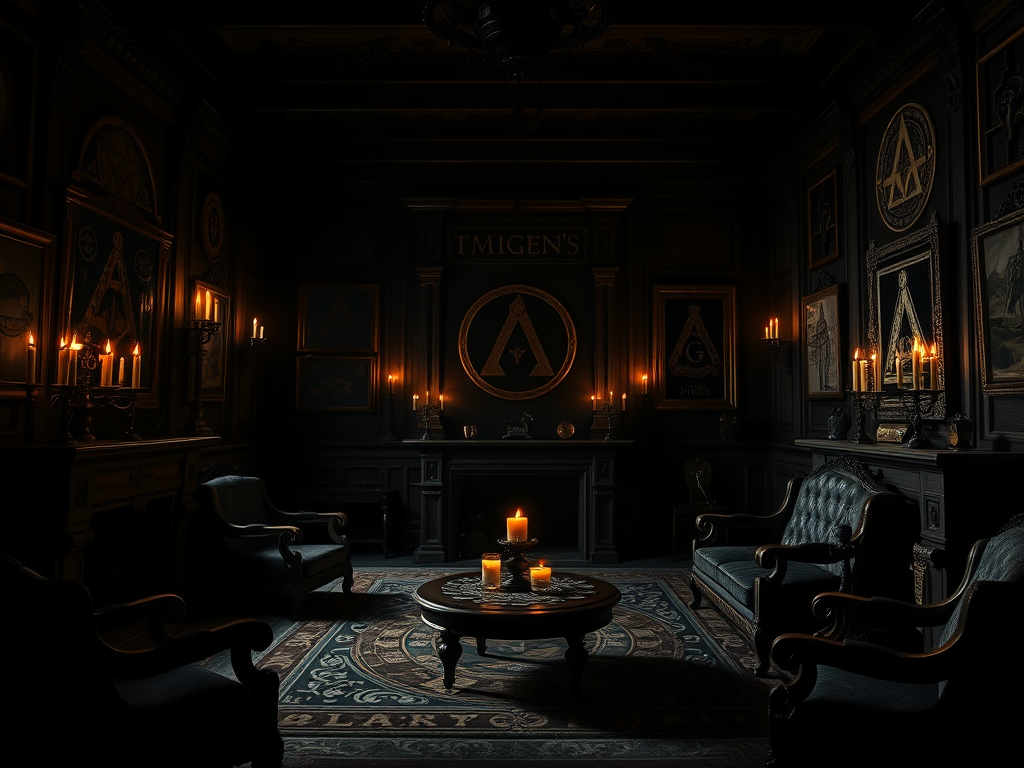
The allure of the “hidden hand” has fascinated humanity for centuries. From the smoke-filled backrooms of Enlightenment-era lodges to the stone-walled cloisters of medieval orders, secret societies have occupied a unique space in our collective imagination. They are often portrayed as the puppet masters of history, directing the rise and fall of empires from the shadows. However, the reality of these organizations is frequently more grounded—yet no less intriguing—than the conspiracy theories suggest.
By examining the historical secret societies that actually existed, we can uncover a fascinating subculture of ritual, mutual aid, and political subversion. These groups often emerged as a response to oppressive regimes, providing a safe haven for “forbidden” ideas or a way for ambitious individuals to climb the social ladder. Here are the top 10 facts that define the enigmatic world of historical secret societies.
1. The Real Illuminati Lasted Less Than a Decade
Perhaps no name invokes more modern conspiracy theories than the Bavarian Illuminati. However, historical records show that the actual group was remarkably short-lived. Founded in 1776 by Adam Weishaupt, a law professor, the society aimed to oppose religious influence over public life and the abuses of state power. Weishaupt wanted to create a space where Enlightenment ideals could flourish without fear of government reprisal.
Despite their fearsome reputation today, the original Illuminati were effectively dismantled by 1785. The Elector of Bavaria, Karl Theodor, issued an edict banning all secret societies, leading to the group’s collapse and Weishaupt’s exile. While many believe they simply “went underground” to orchestrate the French Revolution, most historians agree that the group ceased to exist as a functional organization before the century was out. Their lasting legacy is less about world domination and more about the power of underground political movements to spook the establishment.
2. Freemasonry Functioned as a “Moral University” for the Elite
The Freemasons are arguably the most successful and enduring secret society in history. While they are often viewed through a lens of mystery, their primary historical function was that of a fraternal organization dedicated to self-improvement and “brotherly love.” Emerging from the medieval stonemasons’ guilds, the society transitioned into “speculative masonry” in the 1700s, where the tools of the trade—the square and compass—became symbols for moral lessons.
During the Enlightenment, Masonic lodges became hotbeds for the exchange of radical ideas like democracy and religious tolerance. For many members, the lodge was a “moral university” where men of different social classes could meet as equals. This fraternal organization structure provided a rare meritocracy in a world still dominated by rigid aristocratic hierarchies. The “secrets” of the Masons weren’t world-ending plots, but rather complex passwords and grips used to recognize fellow members in an era before ID cards.
3. The Knights Templar Became Too Powerful for Their Own Good
The Knights Templar were the ultimate warrior-monks of the Crusades, but their “secrecy” was born out of their immense financial power. Beyond their military prowess, the Templars established one of the world’s first multinational banking systems. They grew so wealthy that they became the primary creditors to the monarchs of Europe.
This financial leverage eventually led to their downfall. King Philip IV of France, who was deeply in debt to the order, orchestrated a massive crackdown on Friday, October 13, 1307. To justify seizing their assets, the King accused them of heresy, devil worship, and secret rituals involving “spitting on the cross.” While the order was suppressed and its leaders burned at the stake, the myth of their hidden treasure and secret survival has fueled centuries of speculative history, from the Holy Grail to the founding of the United States.
4. Carbonari: The Secret Architects of Italian Unification
Not all secret societies were focused on philosophy; some were dedicated to revolution. The Carbonari (or “Charcoal Burners”) were a network of secret revolutionary cells active in Italy and France in the early 19th century. Their goal was clear: to overthrow absolute monarchies and establish a unified, constitutional Italy.
The Carbonari operated with extreme clandestine operations, using charcoal-burning terminology as a code to hide their true intentions. A “lodge” was called a “baracca” (hut), and members were “buoni cugini” (good cousins). Their influence was so pervasive that even a young Louis-Napoléon Bonaparte (the future Napoleon III) was reportedly a member. While they were eventually superseded by more public political movements, the Carbonari proved that a dedicated political secret society could lay the groundwork for the birth of a modern nation-state.
5. The Rosicrucians May Have Begun as a Giant Prank
In the early 1600s, three mysterious pamphlets appeared in Europe detailing the existence of the Rosicrucians, a secret brotherhood of “invisible” alchemists and healers. These documents claimed the group possessed ancient wisdom and could transform society through science and spirituality. Thousands of people, including famous scientists like René Descartes, spent years trying to find and join this “invisible college.”
However, many modern historians believe the “Rosicrucian Manifestos” were actually a work of hermetic philosophy satire or a “ludibrium” (a creative joke) written by a group of Lutheran theologians. There is no historical evidence that a formal Rosicrucian organization existed before the pamphlets were published. Yet, the idea was so powerful that it sparked a real movement, leading to the creation of various Rosicrucian-themed orders that still exist today. It is a prime example of how a “secret society” can be conjured into reality by the public’s desire to believe in hidden truth.
6. Yale’s Skull and Bones: A Pipeline for the American Elite
Secret societies aren’t just a European phenomenon. At Yale University, the Skull and Bones society (officially known as The Order of Death) has been a fixture of American elite culture since 1832. Unlike the global-reaching conspiracies often attributed to them, “Bones” is a hyper-exclusive collegiate secret society designed to create a lifelong bond among fifteen selected seniors each year.
The society is famous for its “Tomb”—a windowless brownstone building on campus—and its roster of members, which includes three U.S. Presidents (Taft, and both Bushes), numerous Supreme Court justices, and CIA directors. The “secret” of Skull and Bones isn’t a plan for a New World Order, but rather the power of elite networking. By fostering intense loyalty among its members, the society ensures that its “Bonesmen” occupy key positions in government and finance, creating an informal but powerful “old boys’ club.”
7. The Hashshashin: The Original “Assassins”
In the mountains of Persia and Syria during the 11th to 13th centuries, a breakaway sect of Ismaili Muslims known as the Hashshashin perfected the art of targeted political killing. Led by the “Old Man of the Mountain,” they utilized a strategy of asymmetric warfare to protect their small territory against much larger empires.
[Image representing an ancient mountain fortress like Alamut, the headquarters of the Assassins]
The Hashshashin were masters of covert infiltration. Their agents would spend months, or even years, living in a target’s inner circle before striking. Their reputation for lethality was so great that the word “assassin” entered the English language because of them. While legends suggest they used drugs (hashish) to motivate their killers, historical evidence suggests they were actually highly disciplined, sober, and motivated by intense religious and political conviction. Their “secret” was a combination of extreme psychological warfare and flawless execution.
8. The Molly Maguires and Secret Labor Resistance
In the coal mines of 19th-century Pennsylvania, a secret society known as the Molly Maguires emerged to fight for the rights of Irish immigrant workers. Faced with brutal working conditions and a legal system stacked against them, the “Mollies” used a system of secret signs and passwords (often based on Irish folklore) to coordinate strikes and acts of sabotage against mine owners.
This was a labor-based secret society born out of desperation. Because they operated in the shadows, they were eventually infiltrated by a private detective from the Pinkerton Agency. This led to a series of controversial trials and the execution of twenty men. The history of the Molly Maguires highlights the darker side of secret societies—how they often become the only recourse for the disenfranchised when all legal avenues for justice are closed.
9. The Thule Society and the Dark Roots of Extremism
Not all secret societies are benign or misunderstood; some have had devastating historical consequences. The Thule Society, formed in Munich after World War I, was a Völkisch (ethnic nationalist) group obsessed with the origins of the “Aryan race” and occult mysticism.
While it began as a literary and philosophical study group, the Thule Society became the ideological incubator for the early Nazi Party. They provided the funding, the newspaper (the Völkischer Beobachter), and many of the key early members who would go on to reshape the world in a horrifying way. This occult secret society shows how “secret” knowledge and exclusionary myths can be weaponized to fuel radicalization and violent political movements.
10. The Hermetic Order of the Golden Dawn and Modern Magic
At the end of the 19th century, a group of eccentric intellectuals in London founded the Hermetic Order of the Golden Dawn. This society was dedicated to the study and practice of “high magic,” alchemy, and the tarot. Unlike many other groups, the Golden Dawn was remarkably progressive for its time, allowing women to join on equal terms with men.
Members included famous figures like the poet W.B. Yeats and the infamous Aleister Crowley. The Golden Dawn is a classic example of an esoteric secret society—a group that exists to preserve and pass down a “hidden” spiritual tradition. Their complex system of rituals and grades influenced almost every modern Western occult movement, from Wicca to Thelema. Their “secret” was the belief that through ritual and study, a human could transcend their ordinary existence and achieve a higher state of consciousness.
Further Reading
- The Secret Societies of All Ages and Countries by Charles William Heckethorn
- Founding Fathers, Secret Societies by Robert Hieronimus
- The Invisible College: The Royal Society, Freemasonry and the Birth of Modern Science by Robert Lomas
- The Templars: The Rise and Spectacular Fall of God’s Holy Warriors by Dan Jones
Secret Societies: A History by David V. Barrett




Leave a Reply