
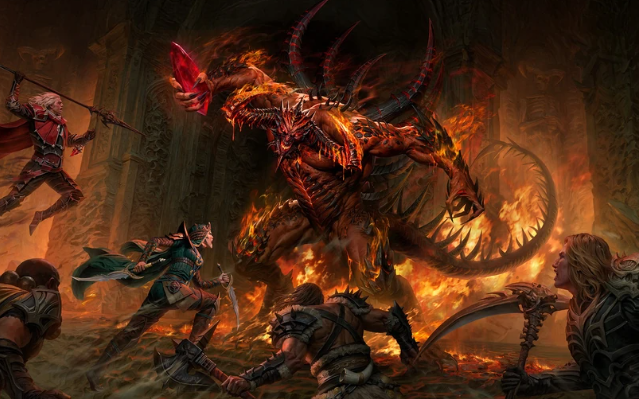
The Diablo franchise is widely regarded as the definitive architect of the modern action role-playing game (ARPG) genre. Known for its dark gothic atmosphere, addictive loot cycles, and the eternal struggle between the High Heavens and the Burning Hells, it has captivated millions of players for decades. However, the path from a small development studio’s ambitious pitch to a global entertainment titan was paved with radical design shifts, cancelled projects, and happy accidents that changed the course of gaming history forever.
To truly understand the “Lord of Terror,” one must look past the clicking and the carnage. The franchise is a masterclass in psychological design, utilizing complex “Skinner box” mechanics to keep players engaged, while simultaneously weaving a lore as deep as any classic fantasy epic. Whether you are a veteran who has spent thousands of hours in the Chaos Sanctuary or a newcomer curious about the “stay awhile and listen” meme, there is a wealth of hidden history buried within the catacombs of Tristram.
Below, we delve into the most intriguing secrets, development pivots, and cultural legacies of the series that turned dungeon crawling into a digital obsession.
1. The Turn-Based Roots: How a Single Vote Created the ARPG Genre
It is difficult to imagine a world where the fast-paced, click-heavy combat of this series doesn’t exist, but the original vision for the first game was remarkably different. Initially, the project was conceived as a traditional, turn-based role-playing game inspired by hardcore “roguelikes” such as Angband and Moria. The creators wanted a slow, methodical experience where every step and every action took place on a grid, allowing the player to weigh their tactical options carefully.
The shift to real-time combat only occurred because of intense pressure from the publishing side of the business. The development team was initially resistant to the idea, fearing that the transition would destroy the strategic depth they had worked so hard to build. After a fateful meeting, a vote was held among the staff, and the decision was made to experiment with real-time mechanics. The lead programmer spent a single afternoon rewriting the code, and as soon as the warrior character swung his sword and the monster died instantly, the team realized they had stumbled upon something revolutionary. This pivot didn’t just change the game; it effectively birthed the entire “Action RPG” genre, proving that the tension of a dungeon crawl could be heightened by the adrenaline of real-time combat.
2. The Secret Cow Level: Turning a Fan Hoax into a Gaming Legend
In the early days of the internet, a persistent urban legend began to circulate among the community: if a player clicked on the cows in the town of Tristram a specific number of times or in a certain sequence, a portal would open to a “Secret Cow Level.” This was entirely a hoax—the developers had included no such content in the original game. However, the rumor became so widespread that it turned into a defining piece of gaming folklore, with fans constantly trying to find the “trigger” for this mythical area.
Rather than ignoring the fan passion, the developers leaned into the joke. In subsequent games, they officially added the “Moo Moo Farm,” an absurd and hilarious hidden level populated by bipedal, spear-wielding bovines led by the “Cow King.” Accessing it required a specific recipe involving a wooden leg and a magical portal tome. This legendary Easter egg has since appeared in various forms across almost every title in the franchise, serving as a reminder of the unique relationship between the creators and their audience. It stands as a testament to the idea that in this universe, if enough people believe in a nightmare—or a farm full of hell-bovines—it eventually becomes reality.
3. A Mountain of Inspiration: The Real-World Origin of the Name “Diablo”
While many assume the name of the franchise was chosen simply because it is the Spanish word for “Devil,” its origin is actually far more personal to the game’s creators. The title was inspired by Mount Diablo, a prominent peak located in the San Francisco Bay Area of California. One of the lead developers lived near the mountain and grew up seeing it as a constant, imposing fixture on the horizon.
The name “Diablo” struck him as the perfect moniker for a lord of terror—not just because of its literal translation, but because of the natural majesty and intimidation the physical mountain represented. This local landmark provided the initial spark for what would become one of the most recognizable brands in gaming. It is a rare example of how a mundane piece of geography can evolve into a symbol for the ultimate personification of evil, grounding the franchise’s high-fantasy themes in a very real, tangible piece of the developers’ own history.
4. Diablo Junior: The Lost Handheld Legacy
Long before the franchise found its way onto modern mobile devices or hybrid consoles, there was a plan to bring the series to the handheld market in a very different way. Following the massive success of the first two installments, a project internally known as “Diablo Junior” entered development. This version was intended for the original Game Boy and Game Boy Color, and it aimed to capture the essence of the dungeon-crawling experience on a much smaller scale.
Intriguingly, the project took heavy inspiration from the Pokémon franchise. The plan was to release three separate versions of the game, each featuring a different hero class and unique items that would encourage players to trade with one another to complete their collections. While the concept was ambitious, it was eventually cancelled due to the high costs of production and the limitations of the handheld hardware at the time. Today, “Diablo Junior” exists only in design documents and early prototypes, representing a fascinating “what if” scenario where the dark world of Sanctuary nearly became a colorful, pocket-sized phenomenon.
5. The Slot Machine Logic: The Psychology of Loot
One of the most defining characteristics of the franchise is its “addictive” nature, often referred to by the community as the “just one more run” feeling. This is not an accident; the loot system was explicitly designed with the psychology of a slot machine in mind. The creators realized that “variable ratio reinforcement”—a psychological concept where rewards are given at unpredictable intervals—is significantly more engaging than a predictable reward system.
Every time a player clicks on a chest or slays a demon, they are essentially “pulling the lever” on a digital slot machine. Will it be a common piece of rusted iron, or a “Legendary” item with game-breaking stats? The bright colors, the distinct “clink” sound of a dropped ring, and the anticipation of seeing a gold-colored nameplate are all carefully calibrated to trigger dopamine responses. This “Skinner box” design philosophy has been analyzed by psychologists and game designers alike, as it represents one of the most successful applications of behavioral psychology in software history. It turns the act of monster-slaying into a loop of perpetual hope and reward.
6. The Butcher: A Masterclass in Unexpected Difficulty and Dread
In the original game, players encounter a boss that has become one of the most iconic figures in horror gaming: The Butcher. What many don’t realize is that The Butcher was designed to be a “teaching moment” for the player, albeit a brutal one. Located on one of the very first levels of the dungeon, he is far more powerful than any other enemy the player has faced up to that point. Most first-time players will open his door, hear his terrifying “Fresh Meat!” growl, and be slaughtered in seconds.
This was a deliberate design choice meant to break the expectations of the player. It taught the audience that they were not invincible and that exploration came with genuine risk. Instead of a linear progression of difficulty, The Butcher was a “wall” that forced players to retreat, level up, and return with a better strategy. This encounter defined the “survival horror” undertones of the early series, turning a simple boss fight into a lingering trauma that made every closed door in the game feel like a potential death sentence.
7. The Real-Money Auction House: A Bold Economic Experiment
During the development of the third major installment, the creators introduced a highly controversial feature known as the Real-Money Auction House (RMAH). The idea was to allow players to trade items with each other using actual currency, with the developer taking a small transaction fee. The goal was to provide a safe, legitimate way for players to engage in the “black market” trading that had plagued the previous game.
However, the experiment was a disaster for the game’s internal balance. Because players could simply buy the best gear in the game with a credit card, the motivation to actually play the game and find loot was severely diminished. Furthermore, the drop rates for items were intentionally lowered to sustain the economy, making the game feel unrewarding for those who didn’t want to spend extra money. The developers eventually made the unprecedented decision to shut down the Auction House entirely and overhaul the loot system. This move is now seen as one of the most successful “course corrections” in gaming history, proving that a healthy gameplay loop is more valuable than a monetized economy.
8. The Birth of Battle.net: Revolutionizing Online Multiplayer
The franchise played a pivotal role in the evolution of the internet through the creation of Battle.net. When the first game launched, it included this free online matchmaking service, which was revolutionary for the time. Previously, most online games required players to pay a monthly subscription or navigate complex third-party servers. Battle.net made multiplayer as simple as clicking a button from the main menu.
This infrastructure allowed players from all over the world to join forces or compete against one another, creating a massive global community. However, because the first game was “client-side,” meaning the data was stored on the player’s computer rather than a central server, it led to a “Wild West” era of hacking and cheating. Players would create “godly” items with impossible stats, leading to a permanent arms race between the developers and the hackers. Despite these early struggles, the lessons learned from the franchise’s online debut paved the way for the modern landscape of connected gaming and digital distribution.
9. The Voice of Tristram: The Surprising Inspiration for Deckard Cain
Deckard Cain, the sage-like scholar who advises the player throughout the series, is perhaps the most beloved NPC in the franchise. His iconic catchphrase, “Stay awhile and listen,” has become a staple of internet culture. Interestingly, the voice actor who portrayed Cain for the majority of the series was instructed to give the character a “Sean Connery-esque” quality—older, wiser, but with a slight rasp and an authoritative “kick” to his delivery.
Cain’s role was to provide the “lore” of the world, but the developers were worried that players would find long speeches boring. To combat this, they ensured that Cain’s dialogue felt personal and urgent. Furthermore, the character’s name itself was the result of a fan contest. A gamer named his son “Deckard Cain” (taking the name Deckard from the film Blade Runner), and the name won a promotional contest run by a gaming magazine. This lucky fan’s name became immortalized as the last of the Horadrim, proving that the identity of the series is deeply intertwined with its most dedicated followers.
10. The Forbidden Romance of Sanctuary: The Secret Lore of Sanctuary
Most players think of the setting, Sanctuary, as just a backdrop for killing monsters, but its origins are rooted in a tragic and forbidden love story. In the lore, Sanctuary was not created by a benevolent god, but by a rebel angel named Inarius and a demon princess named Lilith. Tired of the “Eternal Conflict”—the never-ending war between their two species—they stole a powerful artifact called the Worldstone and used it to create a hidden realm where they could live in peace.
The humans of the world, known as Nephalem, are the offspring of these angels and demons. This makes humanity a unique third power in the universe, possessing the potential to be even more powerful than their progenitors. This central conflict—that humans are essentially “half-demon, half-angel”—explains why the forces of Heaven and Hell are constantly trying to manipulate or destroy mankind. The world isn’t a prize to be won; it is a “sanctuary” that became a battleground, making every player character a pivotal figure in a cosmic family feud that has lasted for eons.
Further Reading
- Stay Awhile and Listen by David L. Craddock
- Diablo: The Sin War Trilogy by Richard A. Knaak
- Diablo: The Order by Nate Kenyon
- The Art of Diablo by Jake Gerli and Robert Brooks


Leave a Reply