
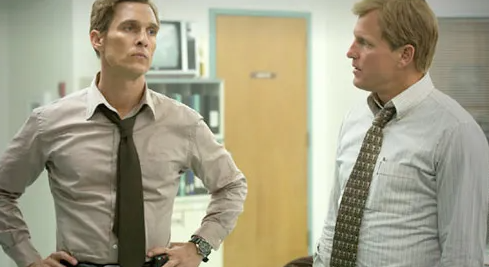
When the first season of True Detective premiered, it did more than just present a murder mystery; it mainlined a dose of cosmic horror and nihilistic philosophy directly into the veins of popular culture. The show, characterized by its brooding atmosphere, non-linear storytelling, and the electric chemistry between Rust Cohle and Marty Hart, transformed the police procedural into a high-art meditation on the nature of evil. Yet, even years after the initial case was closed, the show remains a “flat circle” for its audience—a series that fans return to over and over, finding new clues, deeper subtext, and unresolved questions.
The brilliance of the series lies in its ambiguity. It sits at the intersection of Southern Gothic tradition and weird fiction, leaving much of its lore to the shadows. From the identity of the elusive “Yellow King” to the reality of Rust’s psychedelic visions, the debates surrounding the show are as complex as the sprawling Louisiana bayous where the story unfolds. To truly understand the cult following of True Detective, one must look beyond the badge and into the philosophical and literary abyss that the show so fearlessly explores.
1. The Supernatural vs. Psychological Hallucination Debate
The single most debated aspect of the series is whether the events depicted are purely grounded in reality or if they touch upon the truly supernatural. Rust Cohle, suffering from the long-term effects of his years as an undercover narcotics officer, frequently experiences vivid hallucinations—trails of light, spiraling birds, and distorted perceptions of the sky. However, the climax in the labyrinth of Carcosa features a moment where Rust sees a swirling, cosmic vortex that feels far too detailed to be a mere brain glitch.
Fans are divided into two camps. One side argues that the “vortex” is the final manifestation of Rust’s damaged psyche under extreme stress and blood loss. The other side suggests that the show is a work of “weird fiction,” implying that the ritualistic murders actually thinned the veil between our world and a darker, cosmic dimension. This ambiguity is central to the show’s power; it forces the audience to decide if the world is merely “broken” or if it is haunted by something ancient and indifferent to human life.
2. The Identity of the “Yellow King”
Throughout the investigation, the “Yellow King” is spoken of with a mixture of reverence and terror. While the detectives eventually hunt down Errol Childress—the scarred man in the fields—debate continues as to whether Errol was the Yellow King or simply a high priest serving an idea. In the mythology of Robert W. Chambers, the “King in Yellow” is a fictional, god-like entity that drives men to madness.
Many fans argue that the “Yellow King” is not a person at all, but a representation of the systemic rot within the Tuttle family and the state of Louisiana. In this view, Errol Childress was merely the “spaghetti-faced man” doing the physical work, while the “King” was the dark spirit of the ritual itself. Others point to the elaborate “throne” found in the ruins of Carcosa as evidence that the King was a conceptual deity. The lack of a clear, singular answer keeps the mystery evergreen, as the “King” remains a shadow that can never be fully stepped upon.
3. The Literary DNA: Thomas Ligotti and Robert W. Chambers
The show is famously a patchwork of deep-cut literary references. The name “Carcosa” and the “Yellow King” are lifted directly from Robert W. Chambers’ 1895 short story collection, The King in Yellow. However, the “hard-hitting” debate among literary fans involves the influence of contemporary philosopher and horror writer Thomas Ligotti. Much of Rust Cohle’s bleak, antinatalist dialogue—specifically his view that human consciousness is a “tragic misstep in evolution”—mirrors the themes found in Ligotti’s non-fiction work, The Conspiracy Against the Human Race.
This has led to intense discussions regarding the line between “homage” and “plagiarism.” While the show’s creator has acknowledged the influence, fans enjoy tracing the exact philosophical roots of Rust’s worldview. The debate isn’t just about credits; it’s about how the show successfully integrated “weird fiction” and “pessimistic philosophy” into a mainstream television format. It elevated the series from a standard “whodunit” to a piece of art that requires a library card to fully decode.
4. The Mystery of the “Green-Eared Priest”
One of the most satisfying yet debated “clues” in the series is the mention of a “green-eared priest” seen near a murder site. For years, this detail baffled the detectives, leading them to look for religious figures or supernatural entities. The resolution—that it was actually a man with green paint on his ears from painting a house—is often cited by fans as a brilliant commentary on how “monsters” are often just ordinary men hiding in plain sight.
The debate here focuses on color theory and visual storytelling. The color green is used consistently throughout the series to represent the encroaching, untamed nature of the Louisiana landscape and the “growth” of evil. Some fans believe the “green-eared priest” was a meta-textual red herring designed to mock the audience’s desire for a supernatural explanation. By making the “priest” a literal house painter, the show grounds its horror in the mundane, suggesting that the most terrifying evils are those that are overlooked because they look like “work.”
5. Rust Cohle’s “Flat Circle” Philosophy
“Time is a flat circle. Everything we’ve ever done or will do, we’re gonna do over and over and over again.” This line, delivered by Reggie Ledoux and later echoed by Rust Cohle, has become the show’s most famous philosophical takeaway. Based on the Nietzschean concept of “eternal recurrence,” the debate among fans centers on whether Rust actually believes this or if he uses it as a coping mechanism for his grief.
Some interpret the “flat circle” as a literal cosmic truth within the show’s universe—that the characters are trapped in a loop of suffering. Others see it as a psychological trap: because Rust cannot move past the death of his daughter, his life becomes a flat circle of repetitive trauma. The debate intensified with the release of subsequent seasons, as fans looked for the “spiral” and the “circle” symbols to see if the show was building toward a unified theory of time and destiny.
6. The Sprawl of the Tuttle Conspiracy
While Errol Childress is the antagonist the detectives physically confront, the larger “Tuttle Conspiracy” is never fully dismantled. The Tuttle family, a powerful political and religious dynasty, is shown to be involved in the ritualistic abuse and disappearance of children for decades. At the end of the story, Marty and Rust have “got their man,” but the institutional evil remains largely untouched.
Fans frequently debate how far the conspiracy reached. Was it a local cult limited to the bayou, or did it extend to the highest levels of government? The news reports at the end of the series show the Tuttle family denying all claims, leaving the audience with a sense of “cosmic injustice.” This unresolved thread is a hallmark of the Southern Gothic genre—the idea that the “Old South” holds secrets that are too deep and too dark for any two men, no matter how determined, to ever truly bring to light.
7. The Significance of the Bird Masks and Ritualism
The visual iconography of the series—the bird-head masks, the “Devil’s Nests” (lattice-work structures), and the ritualistic posing of bodies—is a subject of endless fascination. Fans debate whether these elements are based on actual Louisiana folklore or if they are entirely fictional. In reality, the “Devil’s Nests” were inspired by Cajun bird traps, but the show imbues them with a sinister, occult meaning.
The debate often turns to the purpose of the masks. Some fans argue that the masks serve to strip away the “personhood” of the killers, allowing them to act as avatars for the Yellow King. Others see them as a way to mock the victims, turning a human death into a “nature scene.” The masks also connect to the theme of “masks” in general—how Marty Hart wears the mask of a “family man” while being a serial adulterer, and how the state wears the mask of “progress” while ignoring the rot in its rural communities.
8. Carcosa: A Place, a Myth, or a State of Mind?
“Carcosa” is the destination of the entire first season, yet what it is remains a point of contention. Physically, it is revealed to be a crumbling, vine-covered ruin of a pre-Civil War fort. But narratively, it is treated as something far more significant. Errol Childress speaks to it as if it were a sentient deity, and Rust Cohle experiences his most intense visions within its walls.
Is Carcosa just a “kill room” for a deranged man, or is it a “thin place” where reality is warped? Fans often debate the “architecture” of Carcosa—the way the tunnels seem to defy the logic of the building’s exterior. Many believe that Carcosa represents the “inner landscape” of the characters’ minds, a place where they must confront their deepest fears and sins. The debate keeps the location iconic because it never settles into being just a “creepy old building”; it remains a symbol of the abyss.
9. The Shift in the Final Monologue: Light vs. Dark
The ending of the first season is one of the most polarizing moments in television history. After eight episodes of relentless darkness and nihilism, Rust Cohle has a near-death experience and emerges with a changed perspective. He tells Marty, “Once there was only dark. If you ask me, the light’s winning.”
Hardcore fans of the “pessimist” Rust were initially shocked by this perceived “softening.” The debate rages over whether this was a hard-earned moment of character growth or a betrayal of the show’s gritty tone. Those who support the ending argue that it completes Rust’s journey: he moved from “knowing” the darkness to realizing that the mere existence of “the light” is the true miracle. Those who dislike it feel it was a “Hollywood ending” tacked onto a story that should have ended in silence. Regardless, it remains the defining “pivot” of the series.
10. The “Unreliable Narrator” and the 2012 Interviews
A significant portion of the story is told through Marty and Rust’s interviews with Papania and Gilbough in 2012. Throughout these scenes, it is clear that Marty and Rust are lying to the investigators about the events of 1995 (specifically the death of Reggie Ledoux). This has led fans to question: what else were they lying about?
The “Unreliable Narrator” theory suggests that the “heroic” version of the events we see in the flashbacks might be a stylized version of the truth. Fans debate if Marty and Rust’s version of the case was a way to protect their own legacies or if they were hiding an even darker truth about their involvement. This layering of the narrative—seeing the lie being told in the present while seeing the “truth” in the past—creates a friction that makes the show endlessly rewatchable. It forces the viewer to become a detective themselves, looking for the cracks in the story.
Further Reading
If you want to explore the darkness that inspired True Detective, these books are essential reading:
- The King in Yellow by Robert W. Chambers
- The Conspiracy Against the Human Race by Thomas Ligotti
- The Galveston by Nic Pizzolatto (The showrunner’s own gritty novel)
- In the Dust of This Planet by Eugene Thacker




Leave a Reply