
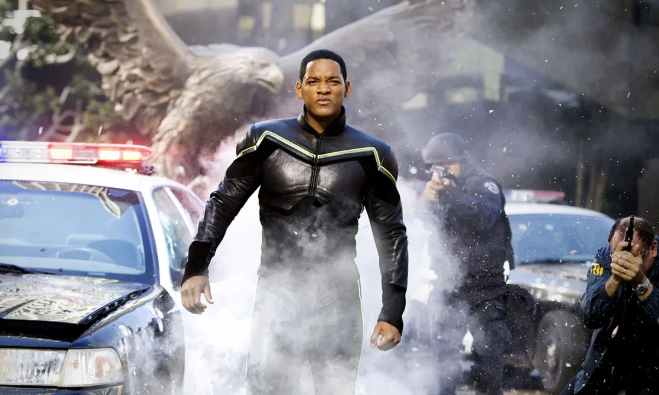
In the golden age of heroic icons, where capes are pressed and moral compasses always point north, one figure stands as a jarring, whiskey-scented contradiction. John Hancock—simply known as Hancock—is not your typical champion of justice. He is the ultimate deconstruction of the superhero archetype: a man with the power of a god but the temperament of a disgruntled neighbor. While he may not have originated in the pages of a 1940s monthly periodical, he has become a permanent fixture in the “comic book” cultural conversation, representing the gritty, realistic, and often destructive reality of what would happen if a man could actually fly through buildings.
Hancock is a cinematic myth, a modern-day legend that feels like it was ripped from an “Elseworlds” or “What If?” graphic novel. He is a “superhero” who hates the spotlight, despises the public, and is fueled by a profound sense of isolation. To understand Hancock is to understand the evolution of the superhero genre itself—from the bright, optimistic heights of the Silver Age to the cynical, grounded “anti-hero” era. This deep dive explores the complex lore, the ancient origins, and the shocking vulnerabilities of the man who proved that being “super” doesn’t always mean being a hero.
1. The “Tonight, He Comes” Origins
Before the world knew him as Hancock, the character lived in the “Development Hell” of Hollywood for over a decade. The original concept was far darker and more experimental than the final product we see today. Initially titled Tonight, He Comes, the story was penned by none other than Vince Gilligan—the mastermind behind iconic television dramas. In this early iteration, the character was less of a misguided grump and more of a deeply disturbed, borderline-suicidal figure who struggled with his own divinity.
This background is crucial for fans to understand because it explains the “DNA” of the character. Unlike most heroes who are born of a desire to do good, Hancock was born out of a script designed to subvert everything we love about superheroes. He was intended to be a critique of the “perfect” savior. Even as the tone shifted to become more accessible to a general audience, that core of existential dread and “anti-hero” energy remained. Hancock isn’t just a hero with a bad attitude; he is a character who was literally written to challenge the necessity of heroes in a modern, cynical world.
2. A 3,000-Year-Old Living God
One of the most profound revelations in the Hancock lore is that he is not a mutant, an alien, or a freak accident of science. He is an ancient being that has existed for millennia. According to the internal mythology, Hancock belongs to a race of immortal beings that humanity has labeled differently throughout history: “Gods,” “Angels,” and finally, “Superheroes.” While he currently resides in a modern urban environment, his peers once walked the earth as the inspirations for the greatest myths of antiquity.
This historical weight changes how we view his “powers.” He isn’t just strong; he is a foundational pillar of human culture. He has seen empires rise and fall, and he has outlived every friend, enemy, and civilization he has ever known. This extreme longevity is the primary source of his apathy. When you have lived for 3,000 years, the petty crimes of a single city start to feel like white noise. He is a man out of time, a relic of a mythological age trying to survive in a world of social media, PR agents, and legal liabilities.
3. The Tragedy of the “Pair” Bond
While Superman has his Kryptonite, Hancock’s greatest weakness is far more poetic and tragic: proximity to his soulmate. The lore reveals that his species was “built in pairs.” For every being like Hancock, there is a counterpart. In his case, that counterpart is Mary. When these two immortals are far apart, they possess god-like invulnerability and strength. However, the closer they stay to one another, the more “human” they become.
This biological imperative is a cruel cosmic joke. They are drawn to each other by an irresistible pull, yet their very union strips them of their divinity. As they spend time together, they begin to age, they can be wounded by ordinary bullets, and they eventually become mortal. This explains why Hancock is “the last of his kind”—all the other pairs throughout history chose to be together, lived human lives, and died. Hancock and Mary are the survivors because they were the ones who stayed apart, proving that for their kind, love is literally a death sentence.
4. The Amnesia of 1931
The name “John Hancock” is not his real name, nor is it a chosen moniker based on the US Founding Father. It is a byproduct of his profound amnesia. In 1931, Hancock woke up in a hospital in Miami with no memory of who he was, where he came from, or how he gained his abilities. When the nurse asked him for his “John Hancock”—a common American slang for a signature—he took the phrase literally and adopted it as his identity.
This amnesia is the “Origin Story” that defines his modern life. Most comic book characters have a clear motivation—a dead uncle, a destroyed planet, a sense of duty. Hancock has none of that. He is a man with a “blank slate” past, which contributes to his volatile personality. He doesn’t know why he should be good, so he simply exists. The year 1931 marks the “Day One” of his modern consciousness, and every action he has taken since has been a desperate, subconscious search for the identity he lost during a mysterious attack decades ago.
5. The PR Transformation and the “Asshole” Rule
Hancock is perhaps the first “superhero” to treat public relations as a superpower. Before meeting the idealistic PR specialist Ray Embrey, Hancock was the most hated man in Los Angeles. He was efficient at stopping crime, but the collateral damage he caused—destroying highways, tossing beached whales into sailboats, and shattering city landmarks—made him a massive financial liability. His transformation from a “drunken bum” to a “respected hero” wasn’t achieved through a change in powers, but through a change in branding.
A key part of this character study is his intense reaction to the word “asshole.” For Hancock, this word isn’t just an insult; it’s a trigger that represents the collective rejection he feels from the world. Ray’s strategy of having Hancock serve time in prison was a masterclass in psychological manipulation and public perception. By making the world “miss” him, Ray proved that even the most powerful being on Earth needs the approval of the people he protects. This storyline serves as a sharp commentary on modern celebrity culture and how heroes are “manufactured” rather than born.
6. The Leather Suit: More Than Just Fashion
Every iconic hero needs a costume, but for Hancock, the transition into a “uniform” was a significant character milestone. For years, he operated in a raggedy hoodie, sunglasses, and a beanie, representing his detachment from society. He dressed like a person who didn’t want to be seen. When he finally dons the sleek, black-and-gold leather suit, it symbolizes his “consent” to play the role of a hero.
However, unlike the colorful spandex of his contemporaries, Hancock’s suit is practical and grounded. It is designed to withstand high-velocity impact and extreme temperatures, but more importantly, it serves as a psychological armor. It signals to the public that he is finally “on the clock.” The suit is a bridge between his chaotic nature and the structured expectations of the city. It is the moment the “myth” finally accepts the “mask,” marking the end of his era as a rogue agent and the beginning of his life as a public servant.
7. The Lunar Legacy: A Heart on the Moon
One of the most enduring images of the Hancock lore is his “grand gesture” involving the moon. To show his gratitude to Ray Embrey and to mark his official return to heroism, Hancock flies to the lunar surface and carves a massive, visible “All Heart” logo into the dust. This feat is significant for two reasons: it demonstrates the sheer scale of his power (surviving in a vacuum and moving massive amounts of lunar soil), and it shows his newfound capacity for loyalty.
This act is often compared to the iconic feats of Silver Age comic heroes who could move planets. It serves as an “evergreen” testament to his existence—a permanent change to the night sky that everyone on Earth can see. While some view it as a massive act of vandalism, it represents Hancock’s unique way of saying “thank you.” It is the ultimate billboard for a man who spent decades wanting to be invisible, now literally making his mark on the cosmos.
8. The “Eagle” Symbolism and Zeus
Fans of mythological analysis have long noted the heavy “Zeus” symbolism surrounding Hancock. In ancient Greek lore, the eagle is the signature bird of the King of the Gods. Throughout the stories, Hancock is frequently associated with eagles—whether through visual cues, his perspective from the heights of the sky, or his “divine” lightning-like impact when he lands. Some theories suggest that Hancock is the actual historical figure that inspired the myths of Zeus, while Mary represents Hera.
This connection adds a layer of “High Fantasy” to an otherwise gritty story. When Hancock and Mary clash, they don’t just trade punches; they manipulate the weather, summon storms, and shatter the environment with the fury of ancient deities. This elevates Hancock from a simple “superman” clone to a character rooted in the very first “superhero” stories ever told by humanity. He isn’t just a guy who can fly; he is the “Thunderer” reborn in a world of concrete and glass.
9. Vulnerability through Connection
The most fascinating aspect of Hancock’s power set is that it is not static. His invulnerability is a variable, not a constant. This makes him one of the most unique “powerhouses” in all of fiction. Most heroes have a physical object (like a ring or a specific mineral) that weakens them. Hancock is weakened by emotional and physical proximity. The more he loves, and the more he is loved by his “pair,” the more he bleeds.
This creates a deep philosophical conflict. If a hero’s job is to protect people and form bonds, but those bonds literally kill him, can he ever truly be happy? This “Tragedy of the Pair” means that Hancock is destined for loneliness if he wants to remain a protector. It’s a subversion of the “Happy Ending” trope. To save the world, he must remain a solitary figure, forever watching from the moon or the top of a skyscraper, unable to ever truly “come home.”
10. The Pioneer of the “Anti-Hero” Wave
Hancock occupies a unique place in history as a pioneer of the “deconstructed” superhero movie. Released before the explosion of “shared universes,” it paved the way for modern hits that explore the dark side of heroism. Without the success of a character like Hancock—who was unlikable, flawed, and destructive—it is unlikely that audiences would have been as ready for the cynical worlds of later comic adaptations.
He proved that a “superhero” story could be a character study about trauma, addiction, and recovery. He showed that you could have a protagonist who is an “asshole” but still worth rooting for. Hancock’s legacy is found in every “fallen” hero we see today—the ones who drink too much, the ones who struggle with the burden of their powers, and the ones who don’t always save the day with a smile. He remains the definitive “modern myth” for a world that knows that even gods have scars.
Further Reading
- Hancock: The Lad Himself by Stephen Walsh & Keith Page – A surreal and poignant graphic novel that explores the life of a different “Hancock,” providing a fascinating parallel to the “lonely hero” theme.
- The Boys: Name of the Game by Garth Ennis – For those who enjoyed the “deconstruction” of heroes seen in Hancock, this is the essential comic book exploration of superhero corruption.
- Superman: Earth One by J. Michael Straczynski – A modern retelling of the Man of Steel that mirrors Hancock’s sense of isolation and the “burden” of having immense power in a realistic world.
- Irredeemable by Mark Waid – A chilling look at what happens when the world’s greatest “superman” finally snaps, exploring the darker psychological consequences of divinity.


Leave a Reply