
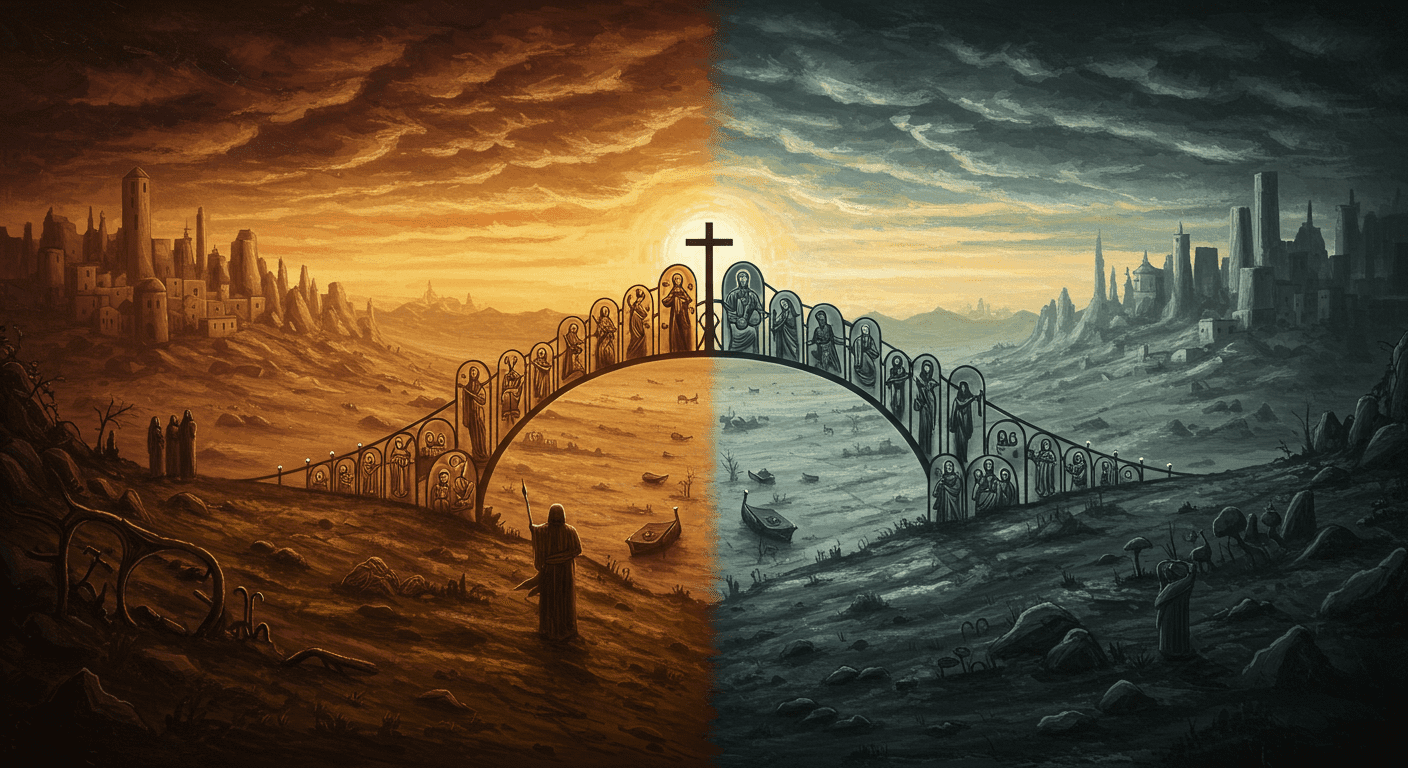
The Bible, a cornerstone of Western civilization, is divided into two primary sections: the Old Testament and the New Testament. While they share a common thread of divine revelation, they also exhibit profound differences in their themes, purposes, and perspectives. Understanding these distinctions is crucial for a nuanced appreciation of their respective roles in shaping religious thought and practice.
1. The Nature of Covenant: Law vs. Grace
Imagine you’re playing a game, and the rules are super strict, with lots of penalties if you mess up. That’s a bit like the Old Testament’s main agreement, called the Mosaic Covenant. This was a deal between God and the Israelites, where they had to follow a detailed set of rules and laws perfectly to stay connected to Him. It was all about what people did. But then, the New Testament introduces a whole new kind of agreement, or “covenant,” through Jesus. This new deal is all about grace. Think of grace as a wonderful gift you get even if you haven’t earned it. Instead of trying to follow every single rule perfectly, the New Testament says that believing in Jesus and accepting God’s love is how you connect with Him. As it says in Ephesians 2:8-9, “For by grace you have been saved through faith. And this is not your own doing; it is the gift of God, not a result of works, so that no one may boast.” This really changed how people understood their relationship with God.
2. The Role of Jesus: Prophecy vs. Fulfillment
Have you ever read a book where a big event is hinted at and talked about for many chapters before it finally happens? That’s a bit like how Jesus is presented in the Old Testament. It’s full of prophecies – special messages and predictions from God, often spoken by prophets like Isaiah or Jeremiah, that point towards a special leader, a Messiah, who would come and set things right. These prophecies describe what he would be like, what he would do, and how he would save people. Then, when you get to the New Testament, it’s like the moment that big event finally happens! Jesus steps onto the scene, and the New Testament shows how his life, his teachings, his miracles, and his death are the exact fulfillment of all those ancient prophecies. It connects the dots, proving that he is the Messiah the Old Testament had been talking about all along. For example, the Gospel of Matthew often points back to Old Testament verses to show how Jesus’s life matched what was predicted.
3. The Concept of Sin and Atonement: Ritual vs. Sacrifice
In the Old Testament, if someone did something wrong (sinned), there was a very specific way to make things right with God: through ritual sacrifices, usually involving offering animals. Imagine a detailed ceremony where an animal is brought to a priest and sacrificed as a way to say sorry for sins and to clean things up with God. The most important day for this was Yom Kippur, the Day of Atonement, where special sacrifices were made for the sins of the whole nation. However, the New Testament introduces a radical shift in this idea. It teaches that Jesus’s death on the cross was the ultimate and final sacrifice for all sins, for all time. It’s like Jesus became the one perfect offering, meaning that all those animal sacrifices were no longer needed. The book of Hebrews 10:12 explains this, saying, “But when Christ had offered for all time a single sacrifice for sins, he sat down at the right hand of God.” This changed everything, offering a permanent solution to the problem of sin.
4. The Scope of Salvation: National vs. Universal
Think about a team chosen for a special mission – in the Old Testament, God’s focus was primarily on the nation of Israel. They were considered His chosen people, and the stories and laws mostly revolve around their journey, their relationship with God, and their salvation as a group. It was about God’s plan for this specific nation. But then, in the New Testament, the focus broadens dramatically. It teaches that God’s plan of salvation isn’t just for one group of people; it’s universal, meaning it’s for everyone, everywhere! It doesn’t matter what country you’re from, what your family background is, or what language you speak. The famous verse in John 3:16 captures this perfectly: “For God so loved the world, that he gave his only Son, that whoever believes in him should not perish but have eternal life.” This shows a huge shift, making God’s offer of salvation available to all people, inviting everyone into a relationship with Him.
5. The Nature of God’s Revelation: Law vs. Gospel
In the Old Testament, God often showed His character through the Law. Imagine a very wise and just ruler who sets down clear rules for how things should be. The Old Testament highlights God’s justice, His holiness, and His expectations for how people should live. It shows what happens when people break His laws and emphasizes the consequences of disobedience. But when you move to the New Testament, while God’s justice is still there, His character is primarily revealed through the Gospel (which means “good news”). This good news is all about God’s incredible love, mercy, and grace shown through Jesus. It’s like seeing a different side of the same ruler – one who is not just strict but also incredibly compassionate and forgiving. The Gospel of John, for example, is filled with stories and teachings that emphasize God’s love and the forgiveness He offers through Jesus, showing a deeper and more personal side of God’s heart.
6. The Role of the Holy Spirit: Limited vs. Indwelling
Have you ever heard about special abilities or powers being given to certain people for important tasks? In the Old Testament, the Holy Spirit often came upon specific individuals – like prophets, kings, or craftsmen – to help them accomplish a particular task or deliver a message from God. It was usually for a special purpose and didn’t necessarily stay with them forever. Think of it as a temporary empowerment. However, in the New Testament, there’s a big change in the role of the Holy Spirit. After Jesus ascended to heaven, the Holy Spirit is described as indwelling all believers. This means the Spirit lives inside every person who trusts in Jesus, empowering them not just for special tasks, but for their everyday lives, for spiritual growth, and for sharing their faith. The book of Acts, especially the event of Pentecost, shows this amazing change, where the Holy Spirit came upon a large group of people, marking the beginning of this new, widespread presence.
7. The Emphasis on Temple vs. Community
For a long time, the central place for worshipping God and feeling His special presence was the Temple in Jerusalem. In the Old Testament, the Temple was incredibly important; it was where sacrifices were made, where people gathered for festivals, and where God was believed to dwell among His people. It was a physical building that represented God’s presence. But in the New Testament, there’s a profound shift. The focus moves away from a physical building and towards the community of believers, the Church. The New Testament teaches that believers themselves, collectively and individually, are now the “temple” of God, because the Holy Spirit lives within them. As 1 Corinthians 3:16 says, “Do you not know that you are God’s temple and that God’s Spirit dwells in you?” This means that God’s presence isn’t limited to one building but is found wherever His people gather, emphasizing the living, breathing community of faith.
8. The Understanding of the Law: External vs. Internal
Imagine having a list of rules written down that you have to follow very carefully – that’s often how the Old Testament Law is presented. It emphasizes external observance – making sure you do the right things and avoid the wrong things on the outside. For example, laws about not stealing or not lying were about outward actions. However, in the New Testament, Jesus teaches that simply following rules on the outside isn’t enough. He emphasizes the importance of internal transformation and a heart that is truly changed. In the Sermon on the Mount, Jesus often took Old Testament laws and showed that it’s not just the action, but the thought and intention behind it that matters. For instance, he said that being angry with someone without cause is like murder in your heart, or lusting after someone is like committing adultery in your mind. This highlights a shift from just “doing” the law to having a heart that genuinely desires to please God.
9. The Concept of Kingdom: Earthly vs. Spiritual
In the Old Testament, especially among the Israelites, there was a strong expectation of an earthly kingdom. People looked forward to a time when a powerful Messiah would come, free them from foreign rulers, and establish a glorious, physical kingdom on Earth where Israel would be the dominant nation. It was often understood in terms of political power and physical territory. However, the New Testament introduces a very different understanding of God’s kingdom. While it acknowledges an ultimate future earthly reign, its primary focus is on a spiritual kingdom. Jesus teaches that the “kingdom of God” is not about a physical place or political power in the way people expected, but rather about God’s rule in the hearts of individuals and the spread of His influence through spiritual transformation. This kingdom transcends earthly boundaries and focuses on eternal life and a spiritual relationship with God, emphasizing that God’s reign is not just about what you can see, but what is happening in the spirit.
10. Literary Genres and Styles: Law, History, Poetry, Prophecy vs. Gospels, Epistles, Apocalypse
If you think of books in a library, you know they come in all sorts of different categories. The Old Testament is like a whole library itself, containing many different literary genres. You’ll find books of Law (like Exodus and Deuteronomy), detailed History books (like Judges and Kings), beautiful Poetry and wisdom literature (like Psalms and Proverbs), and powerful books of Prophecy (like Isaiah and Jeremiah) where God’s messages are delivered. It’s a rich mix! The New Testament, while connected, introduces some distinct new genres. The Gospels (Matthew, Mark, Luke, John) are unique accounts of Jesus’s life, teachings, death, and resurrection. The Epistles are letters written by apostles like Paul and Peter to early Christian communities, offering guidance and teaching. And then there’s the Apocalypse, which is the book of Revelation, a highly symbolic and prophetic vision about the end times. These new genres reflect the new era and message presented in the New Testament.
Implications and Future Directions
These differences between the Old and New Testaments have profound implications for Christian theology and practice. They highlight the progressive nature of divine revelation and the transformative power of Jesus Christ. Understanding these distinctions is crucial for a balanced and informed approach to biblical interpretation. As the world continues to evolve, theological discourse surrounding the Old and New Testaments will undoubtedly continue to develop. Scholars will continue to delve into the historical context, literary nuances, and theological implications of these texts, seeking to deepen our understanding of their enduring relevance.
Conclusion
The Old and New Testaments, while interconnected, represent distinct phases in the unfolding narrative of divine revelation. The Old Testament lays the groundwork for the coming of the Messiah, while the New Testament proclaims his arrival and the inauguration of a new covenant. Recognizing the differences between these two sections of the Bible is essential for a comprehensive understanding of Christian faith and its enduring message.
Further Reading
- Wright, N.T. What Saint Paul Really Said. Eerdmans, 1997.
- Dunn, James D.G. The Theology of Paul the Apostle. Eerdmans, 1998.
- Goldingay, John. Old Testament Theology. InterVarsity Press, 2003.
- Bauckham, Richard. Jesus and the Eyewitnesses. Eerdmans, 2006.
- Fee, Gordon D. How to Read the Bible for All Its Worth. Zondervan, 2014.
- McKenzie, Steven L. How to Read the Bible: History, Scripture, and Interpretation. Oxford University Press, 2005.
- Longman III, Tremper, and Raymond B. Dillard. An Introduction to the Old Testament. Zondervan, 2006.
- Powell, Mark Allan. Introducing the New Testament. Baker Academic, 2018.




Leave a Reply