
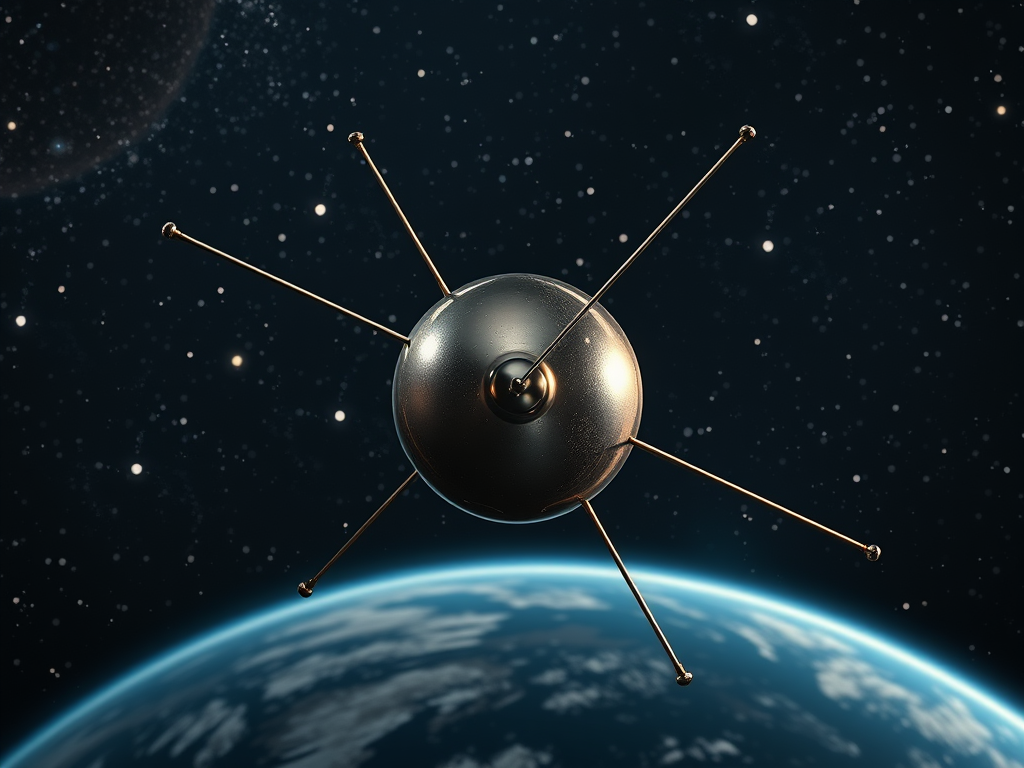
Imagine a time when no human-made object had ever orbited the Earth. Space was a vast, empty mystery above our atmosphere. Then, one amazing day, everything changed. A small, metallic ball with long antennas beeped its way into orbit, marking the dawn of the Space Age. This was the world’s first satellite in space. Its launch was a monumental achievement that captured the imagination of people everywhere and kicked off a race to explore the final frontier.
That pioneering spacecraft was called Sputnik 1. Launched by the Soviet Union in 1957, it was a simple machine compared to the complex satellites we have today, but its impact was enormous. It proved that humanity had the technology to reach space and stay there. Let’s dive into some fascinating facts about the first satellite and its incredible journey around our planet.
1. Its Name Means “Companion”: What Sputnik 1 Means
The name of the first satellite, Sputnik 1, comes from the Russian word “Sputnik,” which translates to “companion” or “fellow traveler.” This name was quite fitting, as the satellite became Earth’s first artificial companion, constantly traveling alongside our planet in orbit. It was a simple name for a revolutionary object that began the history of the first satellite orbiting Earth. The name itself became famous around the world overnight. Think of it like naming a new pet that joins your family – Sputnik became a new companion for Earth in the vastness of space, silently circling above us as it completed its mission. This simple name holds the story of humanity’s first step off-world.
2. It Was Small but Mighty: Sputnik 1 Space Facts
For being the first object ever put into orbit, Sputnik 1 was surprisingly small. It was essentially a polished metal sphere, only about 58 centimeters (about 23 inches) in diameter – roughly the size of a beach ball. It weighed about 83.6 kilograms (around 184 pounds). Attached to the sphere were four long antennas, designed to send signals back to Earth. Despite its modest size and weight compared to today’s massive satellites, this little sphere carried all the necessary equipment to survive the harsh environment of space and communicate with the ground. These Sputnik 1 space facts highlight how a relatively small object could achieve such a giant leap for mankind, proving that size isn’t everything when it comes to groundbreaking technology.
3. The Date That Changed Everything: When Sputnik Satellite Launched
Sputnik 1 was launched on October 4, 1957. This date is incredibly significant in history because it marks the very beginning of the Space Age. Before this day, spaceflight was just a dream or the stuff of science fiction stories. The successful launch by the Soviet Union proved it was possible. The launch took place from the Baikonur Cosmodrome, a launch site that is still used today in Kazakhstan. The moment the rocket lifted off carrying Sputnik 1 was the exact time when Sputnik satellite launched, changing the world forever. It was an event that caught many by surprise and immediately sparked intense interest and competition in space exploration between different countries.
4. Beep, Beep, Beep: What Sputnik 1 Did
Sputnik 1 didn’t have cameras or fancy scientific instruments like modern satellites. Its main purpose was much simpler but incredibly important: to prove that a satellite could be put into orbit and to transmit a radio signal back to Earth. It carried a simple radio transmitter that sent out a constant “beep, beep, beep” sound. People all over the world with the right radio equipment could tune in and hear these historic beeps as the satellite passed overhead. This confirmed its presence in orbit and its ability to function. So, what Sputnik 1 did was primarily to announce its existence from space, a simple task that had profound implications for the future of technology and exploration.
5. The Rocket Power: How the First Satellite Got to Orbit
Getting a satellite into space requires immense power to push it beyond Earth’s atmosphere and accelerate it to a speed fast enough to stay in orbit (around 17,000 miles per hour!). Sputnik 1 was launched using a modified intercontinental ballistic missile (ICBM) called the R-7 Semyorka. This powerful rocket, originally designed for military purposes, was the key to overcoming gravity and achieving orbit. Understanding how the first satellite worked involved not just the satellite itself, but the mighty rocket that carried it. The success of the R-7 in launching Sputnik demonstrated a significant technological capability, highlighting the power needed to break free from Earth’s pull and begin the era of space travel.
6. A Global Reaction: Why Sputnik Was Important
The launch of Sputnik 1 had a massive impact around the globe. In the United States, it caused significant concern because it showed the Soviet Union had advanced rocket technology that could potentially be used for other purposes. This event is often cited as the start of the “Space Race” between the US and the Soviet Union, where both countries competed fiercely to achieve milestones in space exploration. But beyond the competition, Sputnik’s beeps were heard worldwide, inspiring awe and wonder. It showed humanity’s potential to reach the stars. Why Sputnik was important is multifaceted: it spurred technological development, fueled a historic competition, and ignited global interest in science and space, demonstrating that space was now within humanity’s reach.
7. Not in Orbit Forever: Sputnik’s Time in Space
Sputnik 1 didn’t stay in orbit indefinitely. After about three weeks, its batteries ran out, and its radio transmitter went silent. Without power, it couldn’t send its “beep” signal anymore. The satellite continued to orbit Earth for a few more months, gradually losing altitude because of the tiny amount of drag from the uppermost layers of Earth’s atmosphere. Eventually, on January 4, 1958, Sputnik 1 re-entered Earth’s atmosphere and burned up, just like a shooting star. Its time in space was relatively short, but its impact lasted forever. These facts about the first satellite‘s lifespan show that even groundbreaking missions have a finite duration in orbit before gravity eventually brings them back down.
8. Beyond the Beep: Simple Science Experiments
Although Sputnik 1’s primary job was to send radio signals, it also carried out some basic scientific tasks. By measuring how long it took for the satellite to orbit and observing the path it took, scientists on Earth could learn more about the density of the upper atmosphere. The way radio signals traveled through the atmosphere also provided valuable data about the ionosphere, a layer of Earth’s upper atmosphere. These simple measurements were among the very first scientific observations made from orbit. These fun facts about Sputnik 1 remind us that even the earliest space missions were designed not just to reach space, but to start learning about it, laying the groundwork for future scientific satellites.
9. Inspiring the Future: The Legacy of Sputnik 1
Sputnik 1’s launch was a powerful inspiration. It spurred countries, particularly the United States, to invest heavily in science, technology, engineering, and mathematics (STEM) education. It led to the creation of NASA in the US and accelerated space programs around the world. The technologies developed to build and launch Sputnik, and those created in response to it, have benefited many other areas of life, from telecommunications to weather forecasting. The history of the first satellite is a story of how one small object can ignite a massive wave of innovation and progress. Its legacy is seen in every satellite orbiting Earth today, providing GPS, weather data, and communications.
10. More Than Just Metal: A Symbol of the Space Age
More than its technical specifications or scientific data, Sputnik 1 became a powerful symbol. It represented human ingenuity, the capability to reach beyond our planet, and the start of a new era – the Space Age. For some, it was a symbol of technological prowess; for others, it was a call to catch up. For everyone, it was a clear sign that space was the next frontier to be explored. The little beeping sphere proved that the impossible was now possible. These facts about the first satellite illustrate that sometimes, an object’s meaning and inspiration can be even more significant than its physical form or immediate function, serving as a lasting symbol of a turning point in human history.
Further Reading
- Sputnik and the Space Race by Daniel E. Harmon
- The Space Race: How the Cold War Put Men on the Moon by Sarah Cruddas
- Space Exploration for Kids: A Junior Scientist’s Guide to the History and Future of Space Travel by Bruce Betts PhD
- Mankind Beyond Earth: An Atlas of Space Exploration by Phil Grujic
Here at Zentara.blog, our mission is to take those tricky subjects and unlock them, making knowledge exciting and easy to grasp for everyone. But the adventure doesn’t stop on this page! We’re constantly exploring new frontiers and sharing discoveries across the digital universe.
Want to dive deeper into more mind-bending Top 10s and keep expanding your world? Come join us on our other platforms – we’ve got unique experiences waiting for you on each one!
- Get inspired by visual wonders and bite-sized facts: See the world through Zentara’s eyes on Pinterest! Pin our fascinating facts and stunning visuals to your own boards. Explore Pins on Pinterest: https://uk.pinterest.com/zentarablog/
- Discover quick insights and behind-the-scenes peeks: Hop over to Tumblr for snippets, quotes, and unique content you won’t find anywhere else. It’s a different flavour of discovery! Follow the Fun on Tumblr: https://www.tumblr.com/zentarablog
- Ready for deep dives you can listen to or watch? We’re bringing our accessible approach to video and potentially audio! Subscribe to our YouTube channel and tune into future projects that make learning pop! Subscribe on YouTube: https://www.youtube.com/@ZentaraUK
- Seeking even more knowledge in one place? We’ve compiled some of our most popular topic deep dives into fantastic ebooks! Find them on Amazon and keep the learning journey going anytime, anywhere. Find Our Ebooks on Amazon: https://www.amazon.co.uk/s?k=zentara+uk&crid=2273NA7RAJ1EU&sprefix=zentara+uk%2Caps%2C90&ref=nb_sb_noss
- Connect with us and fellow knowledge seekers: Join the conversation on BlueSky! We’re sharing updates, thoughts, and maybe even asking you what wonders we should explore next. Chat with Us on BlueSky: https://bsky.app/profile/zentarablog.bsky.social
- Perfect for learning on the move! We post multiple 10-minute podcasts per day on Spotify. Pop on your headphones and fill your day with fascinating facts while you’re out and about! Listen on Spotify: https://open.spotify.com/show/3dmHbKeDufRx95xPYIqKhJ
Every click helps us keep bringing honest, accessible knowledge to everyone. Thanks for exploring with us today – see you out there in the world of discovery!




Leave a Reply