
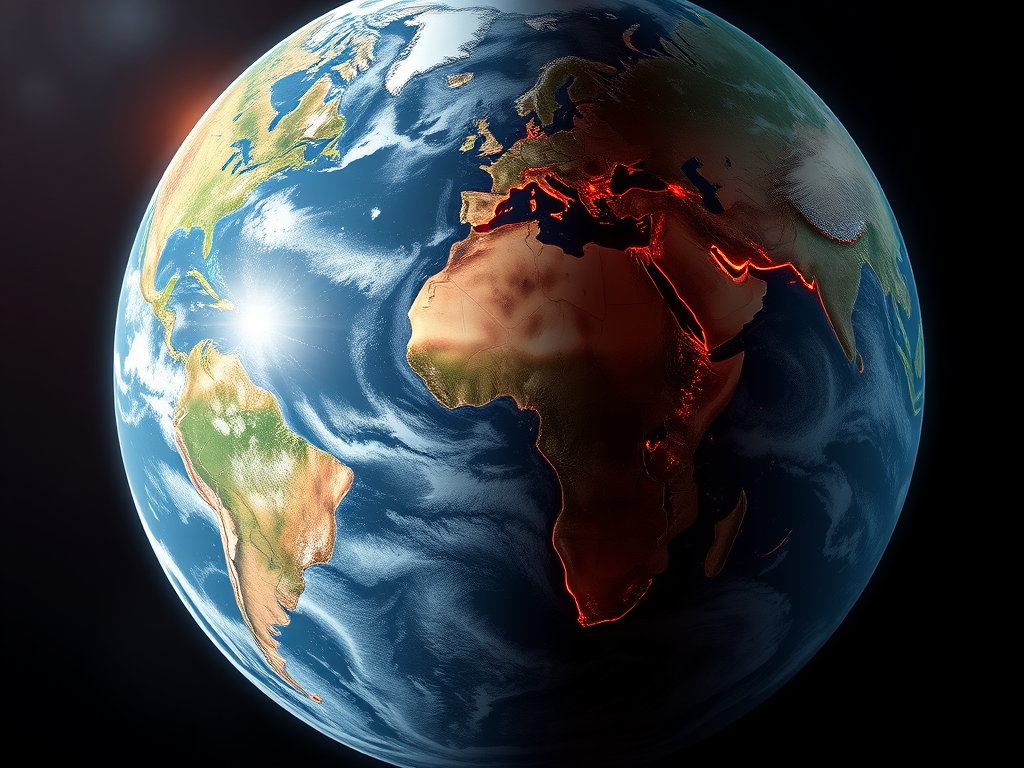
Imagine the ground beneath your feet isn’t solid, but rather a giant, slow-moving jigsaw puzzle! That’s exactly what our Earth is like, thanks to something incredible called plate tectonics. For billions of years, the Earth’s rigid outer shell, called the lithosphere, has been broken into huge pieces – tectonic plates – that are constantly, slowly, gliding over a hotter, softer layer beneath. This constant movement, known as continental drift, is the most powerful force shaping our planet, creating everything from towering mountains to vast oceans.
This isn’t just a science lesson; it’s the story of how our continents moved, how life evolved, and how the Earth became the vibrant, dynamic planet we know today. In this article, we’ll dive into ten mesmerizing instances where plate tectonics dramatically reshaped our world, explaining the science behind these colossal events. Then, we’ll take a peek into the future to see what amazing geological changes are yet to come! Get ready to travel through billions of years of Earth’s incredible transformation.
1. The Birth of Supercontinents: Assembling Pangea
Imagine all the continents mashed together into one gigantic landmass. This has happened several times in Earth’s deep past! The most famous and most recent supercontinent was Pangea, which formed about 335 million years ago during the Paleozoic era. Before Pangea, there were other supercontinents like Rodinia and Columbia, showing that this “supercontinent cycle” is a recurring theme in Earth’s history.
The formation of Pangea involved massive continents colliding and merging, driven by the slow but relentless movement of tectonic plates. As these huge landmasses crunched together, they caused immense geological upheaval, triggering widespread mountain building and influencing global climate patterns. For instance, the formation of the Appalachian Mountains in North America is a direct result of collisions that occurred during Pangea’s assembly. Pangea’s existence profoundly affected ocean currents, global temperatures, and the distribution of life, creating a single, enormous land environment for millions of years. This supercontinent cycle is a fundamental concept in understanding Earth’s deep history.
2. The Great Split: The Breakup of Pangea
Just as supercontinents assemble, they eventually break apart. The breakup of Pangea began about 175 million years ago, during the Jurassic period, and is one of the most significant events in Earth’s recent geological history because it created the continents we recognize today. This colossal split started with rifts forming in the vast landmass, driven by rising magma plumes from the Earth’s mantle.
First, Pangea split into two major landmasses: Laurasia (which would become North America, Europe, and Asia) in the north, and Gondwana (which would become South America, Africa, Antarctica, Australia, and India) in the south. As these giant pieces moved apart, new oceans began to form and widen, including the Atlantic Ocean. This process continues today as the Atlantic seafloor spreads. The continental rifting that tore Pangea apart reshaped global ocean currents, drastically changed climates, and opened up new pathways for the evolution and dispersal of life on Earth.
3. The Himalayas: The World’s Highest Collision
Look at a map and imagine India as an island speeding northward! That’s exactly what happened about 50 million years ago. India, once part of the supercontinent Gondwana, broke away and began a rapid journey across the ancient Tethys Ocean. When it finally slammed into the much larger Eurasian plate, neither plate could easily subduct (slide beneath the other).
Instead, the immense force of this continental-continental collision caused the Earth’s crust to crumple, fold, and thrust upwards, creating the mightiest mountain range on Earth: the Himalayan Mountains. This process is still ongoing, with the Himalayas continuing to rise by several millimetres each year, meaning that Mount Everest is still growing! This spectacular example of mountain building shows the incredible power of plate tectonics, where two landmasses relentlessly pushing against each other can create landscapes that literally touch the sky.
4. The Ring of Fire: Where Plates Collide and Explode
Imagine a giant horseshoe-shaped zone around the Pacific Ocean, where volcanoes erupt and earthquakes shake the ground almost constantly. This is the Ring of Fire, a direct consequence of intense plate tectonic activity. It’s not a literal ring of fire, but a metaphor for the high concentration of earthquakes and volcanoes found along the edges of the Pacific Plate, where it meets several other major and minor tectonic plates.
Along the Ring of Fire, oceanic plates are constantly subducting (diving) beneath continental plates or other oceanic plates. As the oceanic plate sinks into the Earth’s mantle, it melts, and this molten rock (magma) then rises to the surface, forming volcanoes. The friction and stress caused by these plates grinding past each other also generate powerful earthquakes. This region is a dramatic example of plate boundary activity, showcasing how the ongoing interactions of converging plates create some of the Earth’s most dynamic and often destructive geological phenomena.
5. The Atlantic Ocean: A Spreading Mid-Ocean Ridge
Have you ever wondered why the east coast of South America seems to fit perfectly with the west coast of Africa? That’s because they were once joined as part of Pangea, and the Atlantic Ocean formed as they drifted apart. This ocean is still growing wider today, thanks to a massive underwater mountain range called the Mid-Atlantic Ridge.
This is an example of a divergent plate boundary, where two tectonic plates are pulling away from each other. As they separate, magma from the Earth’s mantle rises to fill the gap, creating new oceanic crust. This process, called seafloor spreading, continuously adds new material to the ocean floor, pushing the continents further apart. It’s a slow but powerful process, like a giant conveyor belt, gradually widening the Atlantic Ocean by about 2-5 centimetres (1-2 inches) per year – roughly the speed your fingernails grow! This continuous oceanic crust formation reshapes the planet on a grand scale.
6. The San Andreas Fault: A Sliding Transform Boundary
Not all plate boundaries involve crashing or pulling apart; some involve plates sliding past each other horizontally. The most famous example of this is the San Andreas Fault in California, USA. Here, the Pacific Plate is grinding northwest past the North American Plate. This type of boundary is called a transform plate boundary.
Because the plates don’t slide smoothly, immense stress builds up along the fault line. When this stress is finally released, it causes sudden, often powerful earthquakes. Los Angeles and San Francisco, for example, are on opposite sides of this fault, and with each earthquake, they inch closer or further apart relative to each other. The San Andreas Fault is a prime example of how horizontal plate movement can dramatically reshape landforms and pose significant geological hazards, constantly reminding us of the Earth’s dynamic nature and the ongoing fault line activity.
7. The Great Rift Valley: Africa Splitting Apart
Imagine a continent slowly tearing itself in two! That’s what’s happening in East Africa, where the Great Rift Valley stretches for thousands of kilometres. This is another example of a divergent plate boundary, where the African Plate is slowly splitting into two new plates: the Nubian Plate and the Somalian Plate.
As the continental crust stretches and thins, it creates a series of deep valleys, volcanoes (like Mount Kilimanjaro), and lakes (like Lake Victoria). Scientists believe that if this process continues for tens of millions of years, the rift could eventually widen enough for a new ocean to form, effectively breaking East Africa away from the rest of the continent. The continental rifting in the East African Rift Valley is a live example of how new ocean basins begin to form, showcasing the very early stages of a continent-splitting event driven by underlying mantle plumes.
8. The Andes Mountains: A Subduction Zone Masterpiece
While the Himalayas formed from two continents colliding, the Andes Mountains in South America were created by a different type of plate interaction: the subduction of an oceanic plate beneath a continental plate. Here, the Nazca Plate (an oceanic plate) is diving beneath the South American Plate (a continental plate).
As the Nazca Plate sinks, it carries water into the Earth’s mantle, which lowers the melting point of the surrounding rock, generating magma. This magma rises to the surface, creating a long chain of explosive volcanoes along the western edge of South America. The intense pressure and friction from the subducting plate also cause the overlying continental crust to crumple, fold, and uplift, forming the mighty Andes mountain range, the longest continental mountain range in the world. This continuous oceanic-continental collision is a classic example of how subduction zones create both towering mountains and powerful volcanic activity.
9. The Formation of the Mediterranean Sea: A Closing Ocean Basin
The Mediterranean Sea, a beautiful and historically significant body of water, is actually a remnant of a much larger ancient ocean called the Tethys Ocean. Its formation is a complex story of continents moving and colliding, slowly squeezing this ocean basin. The African Plate is still slowly moving northward, pushing against the Eurasian Plate.
This continental convergence is causing the Mediterranean to slowly shrink. The collision has created mountain ranges like the Alps and the Apennines. The ongoing subduction in parts of the Mediterranean also leads to volcanic activity (like Mount Etna and Stromboli in Italy) and frequent earthquakes. The Mediterranean Sea is a dynamic example of an ocean basin closure, a geological process where ancient oceans are consumed by converging plates, eventually leading to continental collisions and mountain building, marking a significant reshaping of Earth’s geography.
10. Iceland: A Hotspot on a Mid-Ocean Ridge
Imagine a place where you can literally stand on two different continents at the same time, watching new land being created! That’s Iceland, a volcanic island nation that sits directly atop the Mid-Atlantic Ridge, a divergent plate boundary where the North American and Eurasian plates are pulling apart. But Iceland is unique because it’s also located over a “hotspot” – an area where magma from deep within the Earth’s mantle rises closer to the surface.
This combination of a divergent plate boundary and a hotspot creates incredibly intense volcanic activity and geothermal energy. New land is constantly being formed as lava erupts and cools, adding to the island’s size. You can see the rift valley where the plates are pulling apart, marked by dramatic landscapes, geysers, and hot springs. Iceland is a living laboratory for geologists, demonstrating in a dramatic and visible way how plate divergence and mantle plumes contribute to the constant reshaping and growth of our planet’s crust.
What’s Next for Plate Tectonics?
The Earth’s tectonic plates aren’t stopping anytime soon! While we might not see dramatic changes in our lifetime, geologists can predict how the continents might look tens or hundreds of millions of years into the future. Here’s a glimpse:
- The Atlantic will continue to widen: North America and Europe will continue to drift further apart from Africa and South America.
- Africa will split: The East African Rift Valley will likely continue to widen, eventually forming a new ocean basin and creating a new island continent.
- The Mediterranean will shrink and vanish: As Africa continues to push northward, the Mediterranean Sea is expected to close up entirely, leading to massive mountain ranges where the sea once was, perhaps forming a new “Afro-Eurasia” supercontinent.
- A new Supercontinent – Pangea Ultima or Amasia: Scientists theorize that in about 200-250 million years, the continents will once again converge, possibly forming a new supercontinent. One idea, “Pangea Ultima,” suggests the Atlantic will close, bringing the Americas back towards Africa and Eurasia. Another, “Amasia,” suggests that the Americas will collide with Asia as the Pacific Ocean shrinks.
These aren’t just fun predictions; they are based on the ongoing, measurable movements of our planet’s tectonic plates. Our world is a truly dynamic place, always changing, always moving, thanks to the incredible power of plate tectonics!
Here at Zentara.blog, our mission is to take those tricky subjects and unlock them, making knowledge exciting and easy to grasp for everyone. But the adventure doesn’t stop on this page! We’re constantly exploring new frontiers and sharing discoveries across the digital universe.
Want to dive deeper into more mind-bending Top 10s and keep expanding your world? Come join us on our other platforms – we’ve got unique experiences waiting for you on each one!
- Get inspired by visual wonders and bite-sized facts: See the world through Zentara’s eyes on Pinterest! Pin our fascinating facts and stunning visuals to your own boards. Explore Pins on Pinterest: https://uk.pinterest.com/zentarablog/
- Discover quick insights and behind-the-scenes peeks: Hop over to Tumblr for snippets, quotes, and unique content you won’t find anywhere else. It’s a different flavour of discovery! Follow the Fun on Tumblr: https://www.tumblr.com/zentarablog
- Ready for deep dives you can listen to or watch? We’re bringing our accessible approach to video and potentially audio! Subscribe to our YouTube channel and tune into future projects that make learning pop! Subscribe on YouTube: https://www.youtube.com/@ZentaraUK
- Seeking even more knowledge in one place? We’ve compiled some of our most popular topic deep dives into fantastic ebooks! Find them on Amazon and keep the learning journey going anytime, anywhere. Find Our Ebooks on Amazon: https://www.amazon.co.uk/s?k=Zentara+UK&ref=nb_sb_noss
- Connect with us and fellow knowledge seekers: Join the conversation on BlueSky! We’re sharing updates, thoughts, and maybe even asking you what wonders we should explore next. Chat with Us on BlueSky: https://bsky.app/profile/zentarablog.bsky.social
- Perfect for learning on the move! We post multiple 10-minute podcasts per day on Spotify. Pop on your headphones and fill your day with fascinating facts while you’re out and about! Listen on Spotify: https://open.spotify.com/show/3dmHbKeDufRx95xPYIqKhJ
- Follow us on Instagram for bytesize knowledge! We post multiple posts per day on our official Instagram account.
https://www.instagram.com/zentarablog/
Every click helps us keep bringing honest, accessible knowledge to everyone. Thanks for exploring with us today – see you out there in the world of discovery!




Leave a Reply